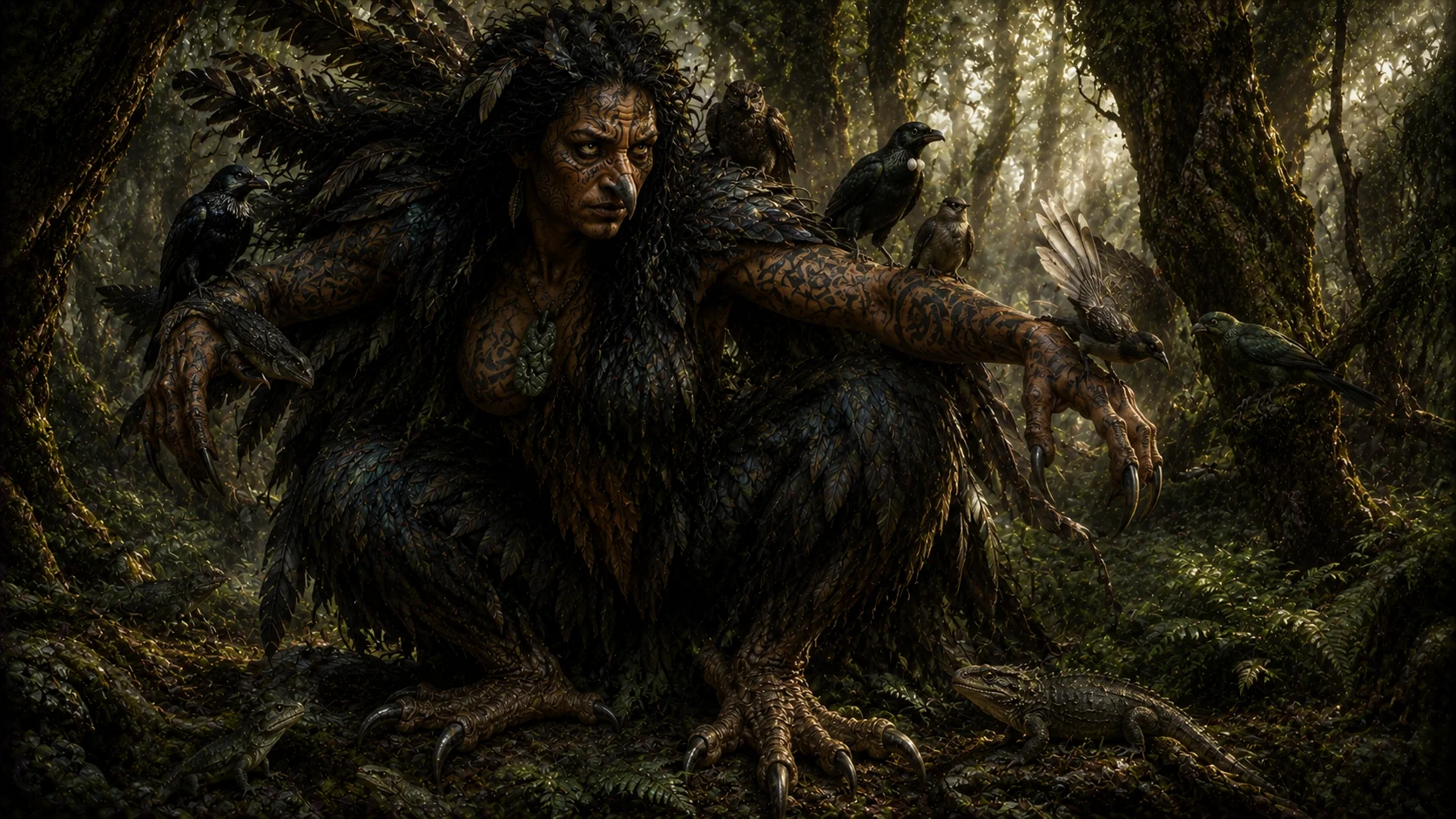
Kurangaituku is the bird-woman of Te Arawa tradition — a solitary, feathered being of forest and geothermal country whose most enduring story is bound to the hunter Hatupatu. She is remembered as taloned, long-beaked, and utterly at home among the birds and insects of the deep bush, and for generations her tale was told chiefly through his eyes: the captor, the monster, the thing escaped from. In recent retellings — Whiti Hereaka's award-winning novel among them — she has been given a voice of her own, and the old story reads differently once she is allowed to be more than the danger in it. Unlike the parallel accounts of Hine-Titama and Tāwhaki below, the Kurangaituku-Hatupatu tale as it appears here is not tied to a specific 19th- or 20th-century recorder such as Grey or Best; it is presented as Te Arawa tradition generally, and that is a looser evidentiary basis than the citations given elsewhere in this article.
A Woman Made of Feather and Forest
Where Hine-Titama is earth given breath and Tāwhaki is a grandson of thunder, Kurangaituku belongs to a different order of being within the Māori world: neither wholly human nor wholly bird, but something the forest itself seems to have produced. Tradition describes her as covered in feathers, with a nose drawn out long and hard like a beak, and hands ending in curved talons rather than fingers. She moves through the bush of the Rotorua district as though it were her own skin — because in every sense that matters, it is. The insects and birds of the forest are not simply nearby her; they are hers, gathered close, tame in her presence in a way they are with no one else.
The Guardians of Her Cave
At the heart of the story is her home: a cave ringed and filled with living guardians. Birds perch and insects cluster at her command, an attentive household that watches for her and warns her of intrusion. It is a striking picture of a being entirely integrated with the natural world — where a human chief might keep armed retainers, Kurangaituku keeps the forest itself, and it keeps faith with her. This detail is easy to read past on a first telling, but it is the story's clearest sign of what kind of figure she is: not an intruder in the bush who has learned to dominate it, but something closer to its living extension.
The Capture of Hatupatu
Into this world comes Hatupatu, and Kurangaituku takes him — not, in most tellings, to harm him outright, but to keep. He becomes a captive in her cave, tended and confined, kept apart from his own people while her feathered household watches over him. The relationship the story sets up is uneasy and asymmetric: a young man held by a being whose power over the forest he cannot match and does not understand. Older versions linger on this as the frightening core of the tale — the trapped hero, the monstrous captor.
The Escape
Hatupatu's escape is the hinge on which the whole legend turns. The tradition, in the form recorded here, gives few particulars of the escape itself beyond its outcome: with Kurangaituku away and her guardians unable to hold him, Hatupatu gets free of the cave and flees toward his own country. When she returns to find her captive gone, the pursuit that follows is framed, in the oldest tellings, simply as a monster's hunt for escaped prey — though it is worth noting that later, sympathetic retellings (discussed below) invite a reader to imagine the return rather differently, as a homecoming to a household suddenly and unexplainedly diminished.
The Chase Toward Rotorua
The pursuit carries both figures across a landscape that is not invented but real — the geothermal country around Rotorua and Whakarewarewa, ground that still steams and boils today. Hatupatu runs a country he knows; Kurangaituku follows at a speed her anger seems to lend her. The tale's power has always come partly from this — that a listener can walk the very hills the story names, that the danger in it is tied to ground you could stand on.
Hatupatu's Rock
Partway through the chase, tradition holds that a great boulder near Rotorua opened to shelter the fleeing Hatupatu, closing again around him and hiding him from Kurangaituku's pursuit before releasing him to run on. That rock is still pointed out and still named for him — Hatupatu's Rock — one of the clearest instances in Te Arawa tradition of a narrative event and a living, visitable place remaining fused together across generations. The story does not merely happen once, long ago; it happens at a location that is still there.
The Boiling Pool
The tale's ending turns on a piece of geothermal knowledge as much as it does on courage: Hatupatu, familiar with the ground, leads Kurangaituku toward one of the district's boiling pools, associated in local memory with the geothermal features of Whakarewarewa. He knows the pool well enough to leap it. She, pursuing at full speed and without his knowledge of the ground, cannot clear it, and falls, or is scalded, and is destroyed in the water that gives the whole region its danger. It is a hunter's ending — won by knowledge of terrain rather than by strength — and it has traditionally been told as Hatupatu's triumph and Kurangaituku's deserved end.
A Story Retold From Her Side
That has not been the last word on her. In 2021 the story was returned to publicly and deliberately from Kurangaituku's own vantage: Whiti Hereaka's novel bearing her name won multiple New Zealand literary honours for doing exactly this, and the same year saw a new opera, composed by Gareth Farr with libretto work including Anapuni Waititi, and a Rotorua Museum reinterpretation involving artist Ngahuia Harrison. None of these works change the events of the old tale — the cave, the captivity, the escape, the pool are still there — but together they invite a different question than the traditional telling usually asked: what the story might look like to the one who loses her home, her guardians, and finally her life in it. This is one interpretive lens among others that the tradition supports, not a settled revision of what happened; the older telling, centred on Hatupatu's escape and triumph, remains the version most widely recorded and still stands alongside it.
Kin to a Wider Company of Beings
Kurangaituku is not alone in Māori tradition as a being who stands apart from ordinary human society and belongs instead to wild, forested, or otherwise liminal ground. The patupaiarehe occupy a related place in the wider mythology: a race of fairy-like beings generally described as pale- or fair-skinned with reddish or fair hair, in contrast to the tribes who recorded the traditions about them. They are said to inhabit forested hill country, mountains, and misty places — ranges such as Pirongia, Pouakai, and parts of the Waikato and Te Urewera figure in various iwi accounts — and to avoid direct sunlight, being active mainly at night, at dusk, or in mist and fog. Their presence is strongly associated with haunting music played on the kōauau and pūtōrino, a recurring motif said to lure or warn away humans who stray into their territory, and they are credited in some traditions with teaching humans particular skills, including hīnaki (eel trap) weaving, through intermarriage or chance encounter. Tradition also holds that patupaiarehe dislike the smell of cooked food and the scent of red ochre (kōkōwai), and that these could be used to ward one off or to keep a patupaiarehe spouse from returning to the fairy realm. Several iwi whakapapa trace specific lines of descent to a union between a human ancestor and a patupaiarehe, a genealogy historically used to explain fair-skinned or red-haired individuals within some Māori communities. Like Kurangaituku, they mark a boundary between the human world and something older and stranger living alongside it, encountered rarely and remembered carefully.
Where This Story Sits in the Larger Tradition
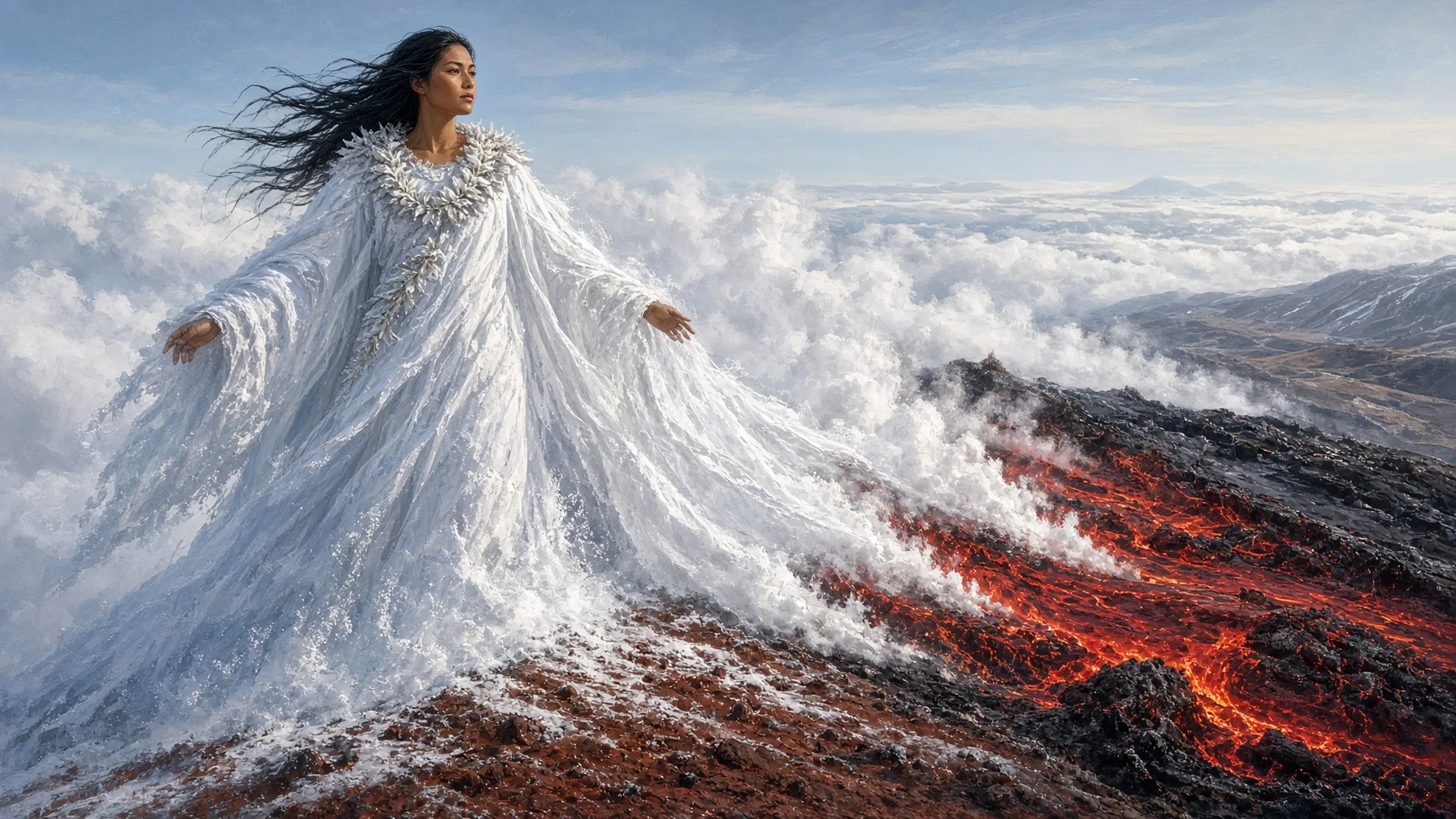
Māori cosmogony, as recorded by nineteenth- and twentieth-century collectors and later synthesised by scholars such as Margaret Orbell, moves in one continuous genealogical line from Te Kore through Te Pō into Te Ao Mārama — the realm of light and human affairs. Within that same broad tradition sit the more explicitly cosmogonic figures: Hine-Titama, the earth-formed daughter of Tāne who becomes, on discovering the truth of her parentage, Hine-nui-te-pō, guardian of the underworld and origin of human mortality — recorded by Grey in 1855 and again by Elsdon Best in 1924; and Tāwhaki, the thunder-descended demigod who climbs to the highest heaven for sacred knowledge, likewise recorded in Grey's and Best's collections and discussed by Orbell. Kurangaituku's story is told at a more local, more human scale than either of these — it does not explain the origin of death or carry knowledge down from the heavens, and it lacks the same named primary-source anchoring — but it belongs to the same world, the same forests and hot country, the same understanding that the land itself is inhabited by more than people.
A Landscape That Remembers
What distinguishes the Kurangaituku tradition most clearly is how thoroughly it is anchored to real, ongoing geography. Hatupatu's Rock still stands; the geothermal pools of the Rotorua and Whakarewarewa area still steam. A story that might elsewhere have drifted into pure allegory instead stays tied to ground that can be walked, named, and shown to a child as evidence that the old account is not simply invention. That fusion of place and story is itself a form of care — a way a people keeps its history close by keeping it underfoot.
What Endures
Told one way, Kurangaituku's story is a hunter's escape from a monster, ending in triumph at a boiling pool — the version most widely recorded and, on the evidence available, the older of the two. Told through the lens of recent retellings, it can also be read as the story of a being who lost her household and her life to a captive she had sheltered, and who is, in that reading, owed more sympathy than the traditional telling extends her. Both readings now circulate side by side; this article records the older telling as the tradition proper and the newer reading as a contemporary reinterpretation of it, rather than treating the two as equally established fact.
Sources & traditions
- EncyclopediaWikipedia — Kurangaituku
- TraditionMaori texts, oral tradition and village tellings (New Zealand)
Myths change from area to area and from time to time. This chronicle follows the most widely told versions; tellings in other villages, regions and eras may differ.