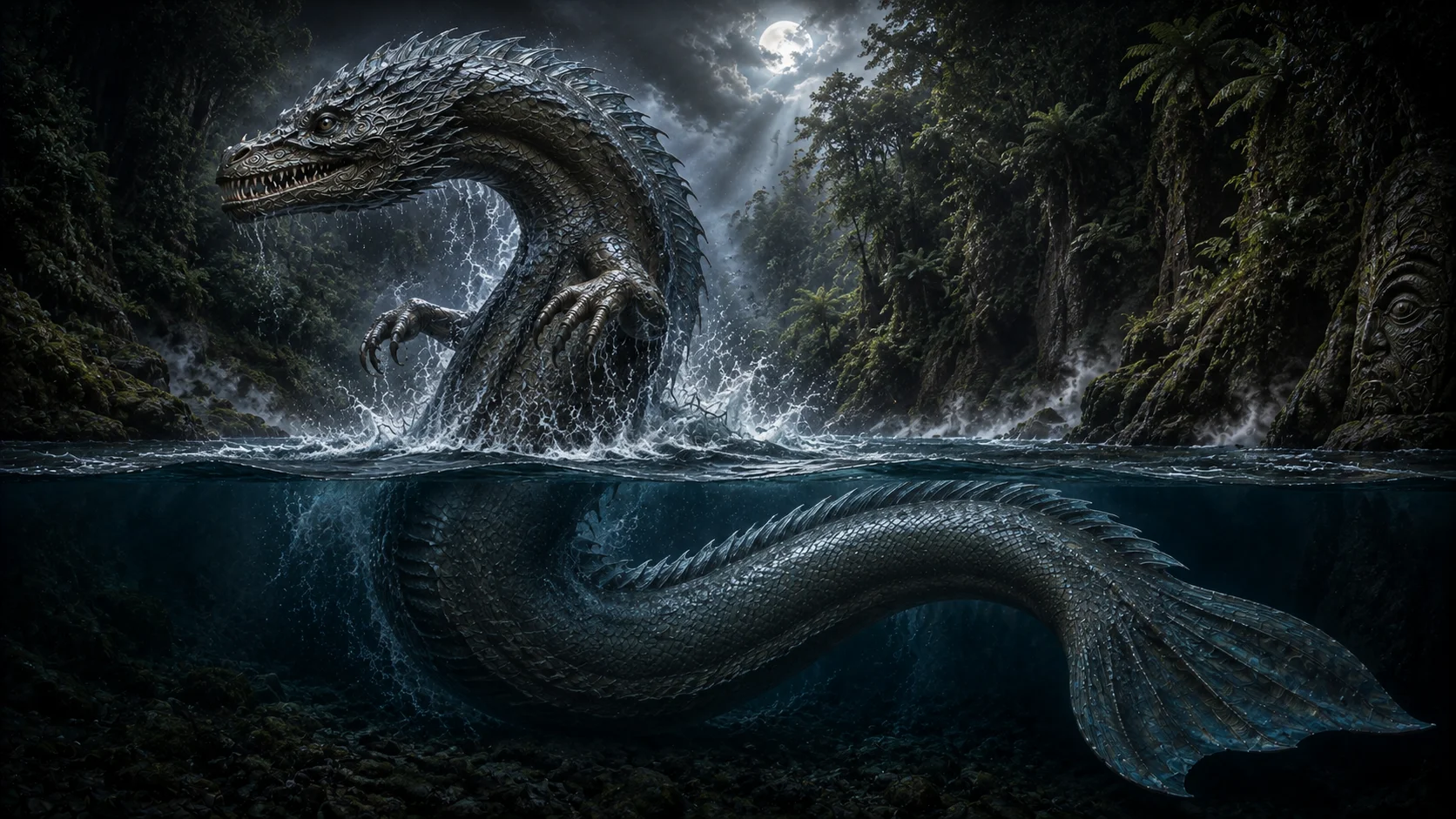
The Taniwha are among the most enduring supernatural beings of Māori tradition — guardians and terrors of the water world, whose presence has shaped how generations of Māori have understood, named, and moved through the rivers, lakes, harbours, and dark sea caves of Aotearoa. To speak of a taniwha is never to speak of a single kind of creature. Some are described as serpentine, coiling through river bends like living currents. Others are dragon-like, whale-like, or shark-like, their bodies suited to the particular water they inhabit. What unites them is not shape but relationship: a taniwha is bound to a place, and through that place, to the people who live beside it.
Creatures of the Rivers, Lakes, and Sea Caves
Taniwha are described across tribal traditions as dwelling wherever water runs deep and dark — the bend of a river where the current pools and slows, the black depths of a lake, the churn of a strait, or the mouth of a cave that never quite lets in daylight. This is not incidental scenery. The taniwha's home is usually a real, nameable place, one that can still be walked to or paddled past today. A taniwha's story is inseparable from its geography; remove the river or the lake and the being has nowhere left to be.
This grounding in real landscape is part of what makes taniwha distinct among the supernatural beings of Māori cosmology. Where other entities move through the heavens or the underworld, the taniwha's domain is the visible, physical water that a community draws from, fishes in, and crosses by waka. That intimacy is exactly what gives the taniwha its power — and its danger.
Guardian or Devourer: Two Faces of One Being
No single taniwha behaves the same way in every account. The same creature that protects one hapū may be remembered by a neighbouring iwi as a predator to be feared. Broadly, taniwha traditions describe two overlapping roles. As kaitiaki — guardians — a taniwha watches over a hapū or iwi, protecting a particular stretch of river, a fishing ground, or a travelling party, and is treated with the same respect owed to a powerful ancestor. As a threatening presence, a taniwha may be man-eating, capable of dragging travellers beneath the surface or capsizing canoes that cross its territory without proper acknowledgement.
These two faces are not necessarily contradictory within a single tradition. A taniwha that guards its own people may still be lethal to strangers, or may turn dangerous when disrespected — when offerings are withheld, when a karakia is not spoken before a crossing, or when the mana of the place is disregarded. In this sense the taniwha functions much like other powerful beings in Māori tradition: its temperament is relational, not fixed, and the correct response to it is respect rather than either total fear or total familiarity.
Escorts and Perils of the Great Migrations
Some of the most enduring taniwha narratives are woven into the oral histories of the great ancestral voyages that brought Māori to Aotearoa. Taniwha are described in tradition as having guided — and in some tellings endangered — the migrating waka, including traditions associating taniwha with the Tainui and Te Arawa canoes. In these accounts the taniwha is not a monster to be defeated so much as a powerful presence that had to be negotiated with: a being capable of steering a canoe safely through open water, or of threatening to overturn it, depending on how it was approached.
These migration traditions matter beyond their drama. They root the taniwha in the foundational story of how Māori came to the land at all, meaning the being is bound up not just with a local river or lake but with whakapapa reaching back to the voyaging ancestors themselves. A taniwha associated with a particular canoe's landing place carries, in effect, a fragment of that migration's memory.
Horomatangi in the Depths of Lake Taupō
Among the named taniwha tied to specific geographic features, Horomatangi is associated with Lake Taupō, one of the largest and most storied bodies of fresh water in the North Island. A taniwha linked to a lake of that scale and volcanic origin carries a different character to one bound to a narrow river bend — the lake is vast, deep, and, being set within a volcanic landscape, capable of sudden and unpredictable change. Traditions that place a taniwha at the heart of such a lake speak to the way Māori understood these waters as neither wholly safe nor wholly hostile, but as domains with their own will, deserving of caution and acknowledgement before they are crossed.
Tuhirangi and the Waters of Cook Strait
Further south, the taniwha Tuhirangi is associated with the waters of Cook Strait and the area around Kāpiti. A taniwha connected to a strait — a channel of open, often violent sea rather than an enclosed lake — reflects a different kind of relationship between people and water: one shaped by the risks of a sea crossing rather than the stillness of an inland lake. Traditions of this kind, tying a named being to a specific and still-navigated stretch of water, are part of why taniwha belief has never been simply antiquarian. The strait Tuhirangi is said to inhabit is still crossed by ferries and fishing boats today.
Karutahi and the Guardians of the Waikato
The Waikato River, the longest in Aotearoa, carries its own cluster of named taniwha traditions, among them Karutahi, associated with sites along its course. A river of the Waikato's length passes through many different communities, and it is characteristic of taniwha tradition that a single great waterway can hold multiple named guardians, each tied to a particular bend, rapid, or crossing rather than to the river as an undivided whole. This pattern — many taniwha along one river rather than a single being for the entire waterway — reflects how closely taniwha belief tracks the specific, local relationship between a hapū and the water immediately before them.
When Belief Meets the Resource Consent Process
Taniwha tradition is not confined to the past. In a notable case in 2002, concerns raised over the Ngāwhā prison development in Northland brought taniwha belief formally into a resource-management and planning consultation in New Zealand. The case demonstrated that, for the communities holding these traditions, a taniwha's presence in a particular place is not merely a story told about the land but a living consideration in how that land is used and developed. Whatever view is taken of such cases in wider public debate, they mark a genuine point where an ancient tradition of water-guardianship has continued to shape contemporary decisions about the whenua.
Reading the Serpent and the Dragon in the Same Being
Descriptions of taniwha vary strikingly from account to account — some emphasise a long, serpentine body suited to weaving through a river's course, others describe something closer to a dragon, and still others liken a taniwha to a shark or whale, particularly in traditions tied to coastal or open-sea locations. Rather than treating these as competing or contradictory descriptions, it is worth understanding them as reflecting the nature of the specific water each taniwha inhabits. A being said to guard a narrow, winding river is more likely to be remembered as serpent-like; one guarding open coastal water takes on the proportions of a shark or whale. The taniwha's form, in other words, is often a reflection of its watery home.
A Being Bound to Genealogy as Much as Geography
Like so much else in Māori cosmology, the significance of a taniwha cannot be fully separated from whakapapa. The great supernatural figures of tradition — from Hine-nui-te-pō, guardian of the underworld, to Mahuika, keeper of fire beneath her fingernails — descend from the primal union of Papatūānuku, the Earth Mother, and Ranginui, the Sky Father, and it is this same genealogical fabric that situates the taniwha within the wider Māori understanding of the world. A taniwha tied to a particular river is not simply an isolated monster story; it exists within a cosmology where land, water, and ancestry are continuous with one another, and where a hapū's connection to a taniwha can be as much a statement of identity and descent as it is a warning about a dangerous stretch of water.
Why Respect, Not Conquest, Governs the Taniwha
Unlike the hero-cycles built around figures such as Māui or Tāwhaki, taniwha traditions are rarely stories of a being being defeated or overcome for good. Where a taniwha is dangerous, the response called for in tradition is typically caution, acknowledgement, and correct protocol before entering its water — a karakia spoken, an offering made, respect shown for the mana of the place — rather than a contest to be won outright. Where a taniwha is a guardian, the relationship is sustained through ongoing recognition rather than a single act of appeasement. This distinguishes the taniwha from monsters in many other storytelling traditions, whose narrative arc typically ends in their destruction. The taniwha, by contrast, is understood as a permanent resident of its water — one a community must learn to live alongside, generation after generation.
A Tradition That Still Watches Over the Water
What makes the taniwha distinctive among the supernatural beings of Māori tradition is the sheer durability of its presence in the landscape. Long after many oral narratives have become the province of scholars and collectors, taniwha belief persists in the way particular rivers, lakes, and coastal waters are spoken of, approached, and in some cases formally considered in matters of land use. To travel the Waikato, cross Cook Strait near Kāpiti, or stand at the edge of Lake Taupō is, in this tradition, to pass through country that is not empty of will — country watched over, protected, or guarded by beings as old as the migrations that first brought people to these shores. The taniwha remains, in that sense, one of the clearest living threads connecting the Māori present to the ancestral past.
Sources & traditions
- EncyclopediaWikipedia — Taniwha
- TraditionMaori texts, oral tradition and village tellings (New Zealand)
Myths change from area to area and from time to time. This chronicle follows the most widely told versions; tellings in other villages, regions and eras may differ.