The Patupaiarehe are the fairy-folk of Māori tradition — a pale, fair-haired people said to move through the forested ranges and mist-bound hill country of Aotearoa just beyond the edge of human sight. They are neither gods nor ghosts but something stranger: a people, with their own villages, their own music, their own customs, living a half-step removed from the world of daylight. Ethnographers of the nineteenth and early twentieth centuries, most thoroughly Elsdon Best in his monograph The Fairy Folk of New Zealand and in Maori Religion and Mythology, recorded a body of tradition around them spanning the ranges near Pirongia and Pouakai, through parts of the Waikato, and into Te Urewera — traditions that place the patupaiarehe alongside such cosmological figures as Hine-nui-te-pō and heroic figures such as Tāwhaki in the great continuous genealogy that runs from Te Kore through Te Pō into Te Ao Mārama, the world of light.
A People of Mist and High Ground
Where humankind cleared the lowlands, built its pā, and lit its cooking fires, the patupaiarehe are said to have kept to the country humans left alone — the shoulders of forested mountains, the misty places, the deep bush interior. Ranges such as Pirongia and Pouakai carry patupaiarehe associations in the traditions of the iwi who live in their shadow, and stories from the Waikato and from Te Urewera describe the same pattern: a fair people who occupy the high, hidden places, and who are rarely seen by anyone who is not already looking for trouble, or already lost.
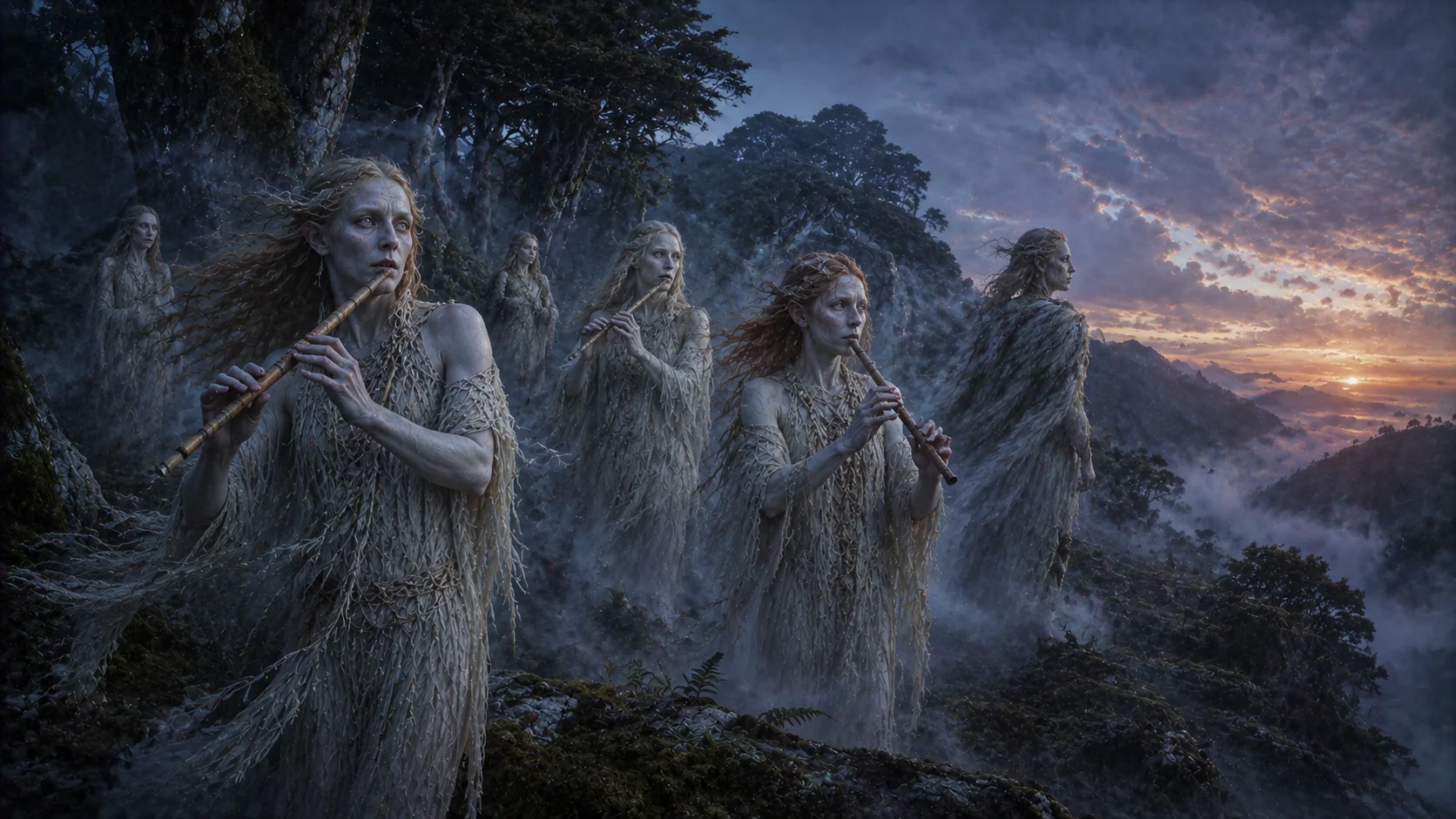
Their skin is described as pale, sometimes strikingly so, and their hair as reddish or fair — a description that stands in deliberate contrast to the appearance of the tribespeople who told these stories about them. This is not incidental. The patupaiarehe are defined, again and again, by difference: they are like people, but not people; they live where people do not; they do what people do — eat, sleep, marry, sing — but they do it turned away from the sun.
Children of the Dark Hours
Daylight is the one thing the patupaiarehe cannot bear. Tradition holds that they are creatures of night, dusk, and fog — active mainly under cover of darkness or mist, and avoiding direct sunlight. Correspondingly, the dangerous hours for a human abroad in patupaiarehe country are the blurred ones: the grey space before sunrise, the long dusk after sunset, and the mist that settles over ridge and valley.
The Flute on the Wind
If there is one sensation that marks a patupaiarehe encounter in the traditions, it is sound before sight. The patupaiarehe are remembered above all as musicians, associated particularly with the kōauau and the pūtōrino, and their haunting music is a recurring motif said to lure or warn away humans who approach their territory. Whether that music was a threat or an invitation seems to have depended entirely on who was listening and how far they had already strayed — to some a warning to turn back, to others the first thread of an encounter with consequences of its own.
This double nature of the music — protective and dangerous in the same breath — runs through nearly everything remembered about the patupaiarehe. They are not malicious in the way a taniwha might be malicious, nor predatory the way a bird-woman like Kurangaituku is predatory in the traditions of Te Arawa. They are simply other, governed by their own laws of hospitality and offence, and a human who blundered into their music was gambling on rules they did not know.
What Cannot Cross the Threshold
Two things, tradition insists, the patupaiarehe cannot tolerate: the smell of cooked food (kai), and the scent of red ochre, kōkōwai. Both became practical tools for the living, used to ward the patupaiarehe off. Kōkōwai in particular had a second, more specific use: in accounts of a human and patupaiarehe married to one another, ochre could be applied to the patupaiarehe partner to prevent them from returning to the fairy realm — a way of binding them to the human world rather than a substance credited with ending such a marriage.
The Gifts They Left Behind
For all the caution surrounding them, the patupaiarehe are not remembered only as a danger to be warded off. Several traditions credit them with teaching human ancestors real, useful skills — among them, in some accounts, the art of weaving hīnaki, the woven eel traps used in freshwater fishing. These skills are said to have passed to humans through intermarriage or chance encounters. A craft as practical as eel-trapping, remembered as a fairy gift, says something about how the patupaiarehe were actually held in the communal memory: not simply as a hazard of the high country, but as a people with knowledge worth having, however carefully that knowledge had to be obtained.
Marriages Across the Mist
The most persistent thread running through patupaiarehe tradition is the claim, made in the whakapapa of a number of iwi, that a human ancestor once married a patupaiarehe — a union between the world of daylight and the world of mist that left descendants walking among ordinary people. These genealogical claims served a real, recognisable purpose: they were the traditional explanation offered within some Māori communities for individuals born with notably fair skin or red hair, features otherwise unusual enough to call for an account of where they came from. Rather than treating such colouring as strange or foreign, the tradition folded it directly into whakapapa, giving those descendants a named ancestress or ancestor and a mountain or range as the point of origin. In this way the patupaiarehe are not simply characters in stories told about the past; they are, in living memory in some lines, kin.
In such marriages, kōkōwai plays a distinctive role: where a patupaiarehe spouse might otherwise slip back to the mist and the mountains, tradition holds that a human partner could use red ochre to keep them from returning to the fairy realm — the same substance that, used against a stranger, was a ward, becoming, within a marriage, a means of keeping the union together.
A Place in the Larger Genealogy
It is worth setting the patupaiarehe against the wider frame in which nineteenth- and twentieth-century collectors — George Grey, Elsdon Best, and later the synthesis offered by Margaret Orbell — placed Māori tradition as a whole: a single continuous genealogy running from Te Kore, the void, through Te Pō, the long night, into Te Ao Mārama, the world of light in which people now live. The great cosmogonic figures belong to that frame explicitly — Hine-nui-te-pō, who fled into the underworld as Hine-Titama and became the goddess who draws the dead down to her, and Tāwhaki, who climbed toward the highest of the heavens to bring back sacred knowledge for the living. The patupaiarehe occupy a quieter corner of that same continuous world: not underworld, not heaven, but the misted margin of the ordinary landscape, a reminder that Te Ao Mārama itself was never described as uniformly, safely lit. There were always places within it — a fogbound ridge, a mountain shoulder at dusk — where the light thinned, and something other than a human being might be listening to your footsteps.
Why the Fair Folk Endure
Traditions about a fair, hidden, musical people are rarely just about caution in the bush, and the patupaiarehe stories are no exception. They carry an explanation for unexpected family likeness, a set of practical rules about fire and ochre that doubled as real protective custom, a credited origin for a genuinely useful craft, and an account of what it meant, in some lines, for two very different kinds of people to be joined by marriage across a boundary neither fully crossed. That the same figures could be a genealogical claim of kinship in one valley and a warning whispered to children in another is not a contradiction in the tradition — it is the tradition working as it always has, carrying more than one kind of truth in the same story, for as long as people have walked the misted country beneath Pirongia and Pouakai and heard, or thought they heard, a flute on the wind where no one should have been standing.
Sources & traditions
- EncyclopediaWikipedia — Patupaiarehe
- TraditionMaori texts, oral tradition and village tellings (New Zealand)
Myths change from area to area and from time to time. This chronicle follows the most widely told versions; tellings in other villages, regions and eras may differ.