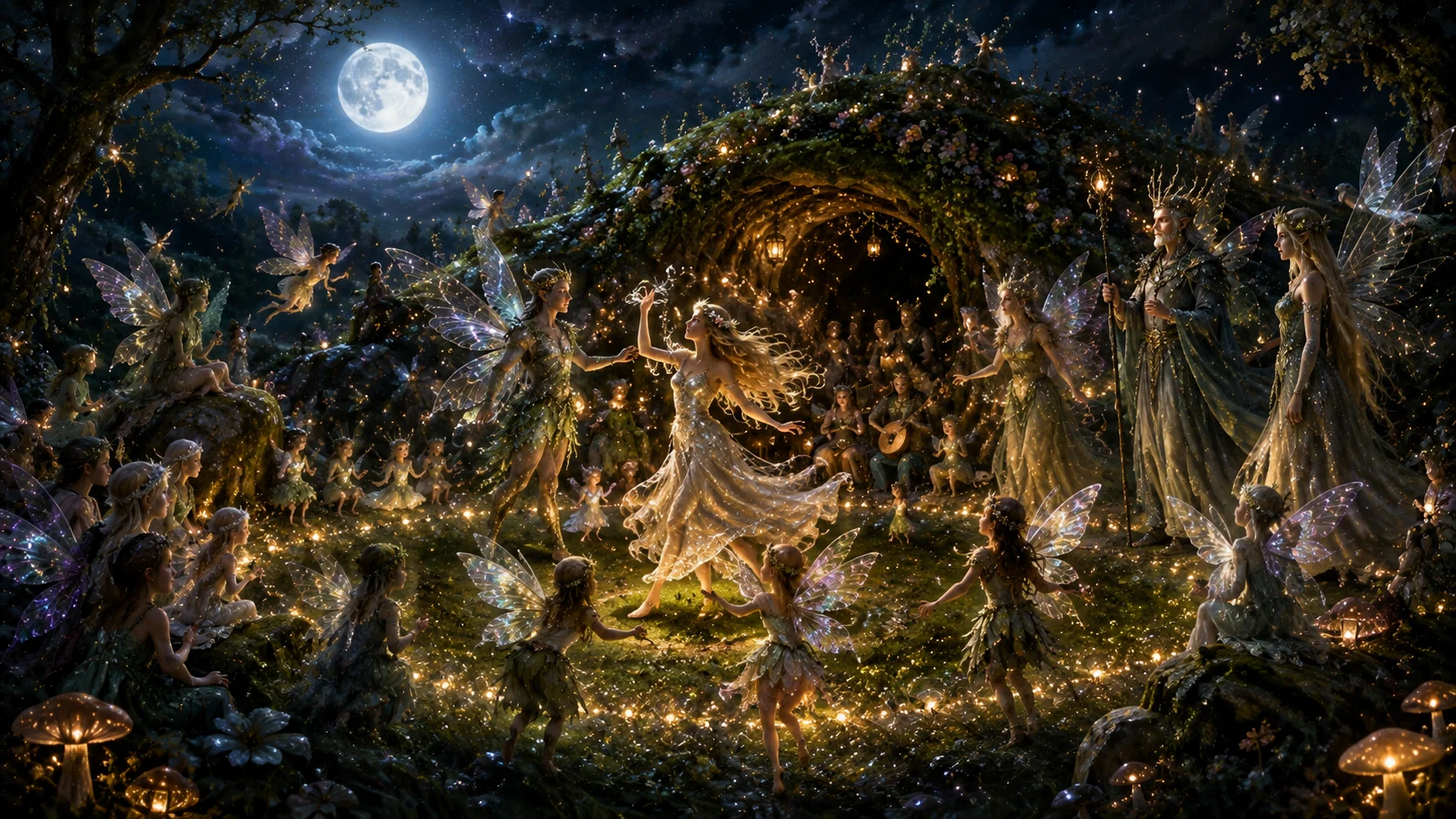
The Fairy (Fae, Faerie) is the supernatural folk of European legend: a race of magical, often beautiful and capricious beings — sometimes tiny and winged, sometimes human-sized and lordly — who dwell in an enchanted otherworld alongside the mortal world, who possess wondrous powers and treasures, who may bless or curse, help or harm, and who are bound by their own strange laws and tabus. They are the fair folk, the magical race of the European otherworld.
The Fair Folk
The Fairy (from Old French faerie, the realm of the fae, from Latin fata, the Fates) is a vast and varied tradition spanning the folklore of Europe — the Celtic Sidhe and Tylwyth Teg, the Germanic and Norse elves, the household and nature spirits, and the courtly fairies of medieval romance. Fairies are conceived in many ways: as a hidden race of the wild and the otherworld; as diminished gods or nature-spirits; as the spirits of the dead; or as fallen angels too good for Hell but not good enough for Heaven. They range from tiny, delicate, winged sprites to beings of human size and surpassing beauty, lords and ladies of a glittering fairy court.
The Powers and the Perils
Fairies possess great magical powers: they can fly, become invisible, shapeshift, enchant, see the future, and work wonders; they have fairy gold (which turns to leaves), fairy music (irresistibly beautiful), and fairy treasures. But they are capricious and dangerous, and dealing with them is perilous. They may reward the kind and punish the rude; they steal away mortals (especially babies, leaving a changeling, and beautiful youths and brides) into their world; they lead travellers astray; they blight or bless the crops and the cattle; and time runs strangely in their realm, so that one who spends a night dancing with the fairies may return to find a hundred years have passed. To eat fairy food, to accept fairy gifts, or to offend the fairies is to be ensnared.
The Tabus and the Otherworld
The fairy folk are bound by, and impose, strict rules and tabus: they cannot abide iron (cold iron repels and harms them), and they may be warded by iron, by salt, by running water, by holy things, by turning one’s coat inside out, and by rowan and other protective plants. They keep their bargains to the letter and demand the same. They dwell in the hollow hills, the fairy mounds (the raths and barrows), under the lakes, in the deep woods, and in their own otherworld of eternal youth and beauty, entered through fairy rings, on certain nights (May Eve, Midsummer, Samhain). From this immense tradition the fairy has become one of the most beloved and enduring figures of Western imagination, from the dread fair folk of old belief to the gossamer-winged fairy of the nursery. In the Fairy, Europe gave form to the supernatural folk — the magical, beautiful, capricious race of the otherworld who bless and curse, steal and reward, and dwell by their own strange laws beside the world of mortals, the fair folk of legend.
The Old Gods Underground
In Ireland the fairies were not always small. The medieval scholars who tried to explain where they came from told a stranger story: that the fair folk were once a nation of gods, and that they lost a war.
The Lebor Gabála Érenn — the medieval "Book of Invasions," which arranges Ireland's mythic conquests into a single pseudo-history — makes the Tuatha Dé Danann, traditionally glossed as the people of the goddess Danu, the fifth race to take Ireland, defeated in their turn by the Milesians, ancestors of the Gaels. Rather than vanish, the story goes, the Tuatha Dé Danann withdrew beneath the earth into the sídhe — the hollow hills and burial mounds that dot the Irish landscape — and became the Aos Sí, the people of the mounds. It is a demotion with dignity: not annihilation but retreat, a defeated pantheon still ruling its own country from underneath the one that replaced it. Scotland kept a parallel memory in the sìth, and in the conviction that certain paths belonged to the folk beneath and were not to be built across; Wales speaks of the Tylwyth Teg, the "fair family," whose court and customs differ from Ireland's in detail but share the same underlying grammar — a hidden, older people coexisting with mortals on terms the mortals do not fully understand.
Written Into Being
By the twelfth and thirteenth centuries, English and Welsh clerics who might have been expected to write about saints and relics were instead recording fairy encounters as though reporting news. Walter Map, a courtier-cleric in the household of Henry II, filled his De Nugis Curialium — "Courtiers' Trifles" — with them: King Herla, who rides into an underground realm for what feels like three days and returns to find centuries gone; a Breton knight who sees his dead wife dancing at night among a company of women and simply takes her back. Gervase of Tilbury, writing for the Emperor Otto IV in his Otia Imperialia, catalogued household and nature spirits alongside straight geography, treating the fair folk as part of the world's ordinary furniture. Gerald of Wales, in the Itinerarium Kambriae he completed in 1191, told of a boy named Elidyr who followed two small men through a riverbank tunnel into an underground country lit by no sun, moon or star, whose inhabitants ate no meat and — Gerald is emphatic on the point — detested lying above every other vice. Elidyr came and went freely until his mother asked him to bring home some of their gold. He stole a golden ball, was chased by its small owners to his own doorstep, dropped it, and never found the passage again.
Fairies entered romance in the same decades. Marie de France's twelfth-century lai Lanval gives its knight a fairy mistress whose wealth and love come with a single rule — never speak of her — broken, of course, exactly as such rules always are. The Middle English Sir Orfeo retells the Orpheus myth with the classical underworld replaced by a fairy kingdom: the queen is carried off not into death but into the otherworld, taken as she sleeps beneath a grafted tree, and her husband wins her back by harping at the fairy king's court. By Chaucer's day the fairy had become nostalgic furniture of its own. The Wife of Bath's Tale opens by mourning that in King Arthur's time "al was this land fulfild of fayerye" — the elf-queen and her company danced in every green meadow, Chaucer says, until the friars and their prayers crowded them out. Even in the fourteenth century, the fairy was already something people believed had only lately stopped being real.
The Fairy Queen and Her Court
The figure who recurs most insistently across English and Scottish tradition is the fairy queen. Morgan le Fay is first named in Geoffrey of Monmouth's Vita Merlini of about 1150, and not as a villain: she is the foremost and most skilled of nine sisters who rule the Isle of Apples, a healer who can change her shape and fly. The scheming Morgan of later Arthurian romance is a reinvention of a figure who began as royalty of the otherworld rather than its enemy. Scotland's queen goes unnamed and is the harder of the two. The ballad of Thomas the Rhymer has the Queen of Elfland carry a mortal poet into her country under a warning to speak to no one there whatever he sees; what feels to him like a short stay turns out to have been seven years, and she sends him home with a tongue that can never afterwards tell a lie — a gift he protests, reasonably, will ruin him at every market and court he enters. The same queen, under the name Elphame, surfaces in the Scottish witch trials of the sixteenth and seventeenth centuries: women such as Bessie Dunlop and Alison Pearson testified to having met and served her, and that testimony was taken seriously enough to help send them to the stake. Scottish folklore eventually sorted the fair folk into two companies, the Seelie Court and the Unseelie — the "blessed" ones who might help a mortal, however unpredictably, and those who meant harm as a matter of course.
Robert Kirk, minister of Aberfoyle, tried to set the whole system down systematically, finishing his treatise The Secret Commonwealth of Elves, Fauns and Fairies in 1691 — and is said by his own parish to have paid for the attempt. Found collapsed on a hill known for the folk and buried in his churchyard the following year, he was held by his neighbours not to have died at all, but to have been carried off by the very court he had been cataloguing. His manuscript kept a low profile afterwards too: it was not printed until 1815, more than a hundred and twenty years after he wrote it.
Fairy Brides and the Fairy of the South
France gave the tradition its most famous fairy bride. Jean d'Arras's Roman de Mélusine, written in the early 1390s to furnish the house of Lusignan with a supernatural ancestress, tells of a fairy who marries the nobleman Raymondin on one condition: he must never look upon her on a Saturday. He keeps the bargain for years, through the raising of castles and the birth of sons, until curiosity gets the better of him and he spies on her bath — and finds her transformed from the waist down into a serpent. The broken condition does not simply end the marriage; it exiles her from humanity. Melusine leaves the tower shrieking, in serpent form, and tradition holds she still returns — a wailing shape above the walls — whenever a lord of Lusignan is about to die or the lordship is about to change hands. It is the fairy-bride story in its starkest form: love and prosperity granted on a condition that human nature cannot help but violate.
Italy kept the same royal fairy under her Arthurian name in an unexpected place. Sailors in the Strait of Messina have for centuries described a rare mirage — distant ships and coastline apparently lifted into the sky, stacked and inverted where layers of air at different temperatures bend the light — and they named it the Fata Morgana, "Morgan the Fairy," from the belief that she raised illusory castles above the water to draw sailors to their deaths in the strait. The name then stuck to the physics: fata morgana is now the standard technical term for that class of superior mirage, wherever in the world it appears. A queen of the Arthurian otherworld ended her career as an entry in an optics glossary — one of the odder journeys any fairy has made.
How the Fairy Shrank
The shrinking is traceable, and it is more recent than it looks. Edmund Spenser's unfinished The Faerie Queene, the first three books of which appeared in 1590, took the otherworldly monarchy of medieval romance and turned it into flattering allegory, with Gloriana the fairy queen standing in for Elizabeth I. A few years later Shakespeare's A Midsummer Night's Dream gave the tradition its most quoted royal couple, Titania and Oberon, and its most famous attendant, Puck — identified in the play with Robin Goodfellow, an English household hobgoblin already familiar enough to be named in Reginald Scot's Discoverie of Witchcraft of 1584. These are still fairies with power over the people around them. It is across the eighteenth and nineteenth centuries, mostly in England, that they drift out of the category of things a farmer might genuinely fear meeting on a dark road and into the nursery, drawn smaller and prettier with every decade of illustration until they are closer to insects than to otherworld royalty.
The high-water mark of that sentimentality, and its most public embarrassment, came in 1917, when two cousins in the Yorkshire village of Cottingley, Elsie Wright and Frances Griffiths, produced photographs of themselves apparently among dancing fairies at the beck behind the house. The pictures convinced a startling number of adults who badly wanted to be convinced, most famously Arthur Conan Doyle, who argued for them in print as genuine evidence of the fair folk. Not until the early 1980s, both women by then elderly, did they admit that the fairies were paper cutouts propped up with hatpins. The older and more dangerous fairy never entirely vanished under the gauze wings, though. It survives, transformed again, in the elves and fair folk of modern fantasy fiction, which gave back much of the height, the menace and the moral ambiguity that the Victorian illustrators had drawn away.
The Belief That Would Not Retire
Fairy belief in Ireland did not stay safely in the past. In March 1895, at Ballyvadlea in County Tipperary, a young woman named Bridget Cleary died at the hands of her husband and several relatives, who had convinced themselves during her illness that the real Bridget had been taken and a changeling left in her bed. They forced herbs on her, demanded again and again that she say who she was, and finally burned her at her own hearth; her husband afterwards kept watch at a nearby rath for three nights, expecting the true Bridget to ride out of it. Michael Cleary was convicted of manslaughter and served fifteen years, the case made international news, and Irish children were still chanting the rhyme it left behind a generation later: "Are you a witch, or are you a fairy, or are you the wife of Michael Cleary?" Changeling belief was never merely quaint. It was an explanatory framework, reached for at the bedside of a spouse behaving strangely or a child failing to thrive, in a world with no other vocabulary for what was happening.
The same seriousness, without the tragedy, survives in the care still taken around Ireland's fairy forts — the raths and ring-forts that dot the countryside, most of them early medieval farmsteads long since reinterpreted as fairy dwellings. Farmers plough around them rather than through them. Builders and road planners have on occasion rerouted rather than disturb one, or a lone hawthorn known locally as a fairy tree: in 1999 a bypass in County Clare was famously realigned to spare a solitary whitethorn said to be a gathering place for the folk. Less of that is certainty than reluctance — an unwillingness to be the one who finds out whether the story is true, when the story is what has kept those particular acres untouched for a thousand years. It is a practical humility that outlasts whatever anyone privately believes: the fair folk asked for respect long before they asked for belief, and in scattered corners of the landscape that is the one thing they have never stopped getting.
Sources & traditions
- EncyclopediaWikipedia — Fairy
- TraditionMedieval European texts, inscriptions and later retellings
Myths change from area to area and from time to time. This chronicle follows the most widely told versions; tellings in other villages, regions and eras may differ.