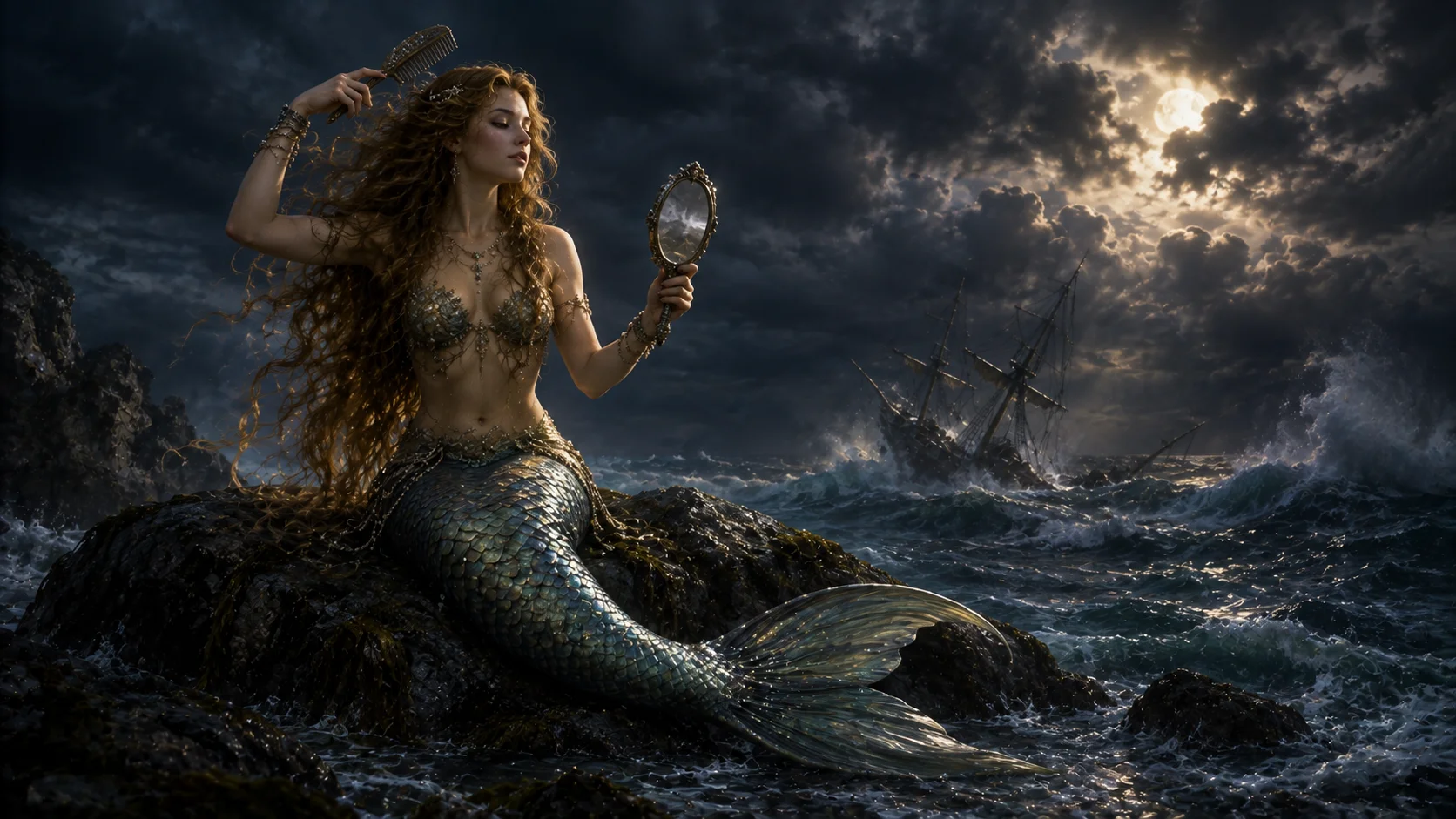
The Mermaid is the fish-tailed sea-maiden of European legend: a beautiful woman from the waist up and a fish below, who dwells in the sea, sings with bewitching voice, and is bound up with the perils and wonders of the ocean — an omen of storm and shipwreck, a luring seductress of sailors, and sometimes a being who longs for a human soul or loves a mortal. She is the sea-maiden, the fish-tailed enchantress of the waters.
The Maid of the Sea
The Mermaid (from “mere,” sea, and “maid”) is the classic European sea-being: a creature with the head and torso of a beautiful woman and the tail of a fish in place of legs, often pictured holding a comb and a mirror and combing her long flowing hair as she sits upon a rock above the waves. She is the female counterpart of the merman, one of the merfolk, and she descends from a long tradition reaching back to the Greek Sirens (originally bird-women, later conflated with fish-women), the sea-nymphs, and ancient fish-deities like Atargatis.
The Song and the Shipwreck
The mermaid is bound up, above all, with the sea’s beauty and its deadly peril. She sings with a voice of irresistible, bewitching sweetness, and her song (like the Siren’s, like the Lorelei’s) lures sailors to distraction, drawing them to leap into the waves or steer onto the rocks, so that mermaids were blamed for drownings and shipwrecks. To see a mermaid was a dire omen — a sign of coming storm, disaster, and the loss of the ship — and sailors dreaded the sight of one combing her hair, for it foretold the wreck. She might drag men down to her halls beneath the sea, to drown or to dwell with her.
The Longing for a Soul
Yet the mermaid is not only deadly; the lore is tender and tragic as well. Mermaids were said to fall in love with mortal men, to rescue the drowning as well as to drown, and above all to lack and to long for an immortal soul, which (in the Christian-influenced lore) they could gain only through the love of a human and marriage in a church — a theme that flowered in the literary water-maidens like Undine and, most famously, in Hans Christian Andersen’s “The Little Mermaid,” who gives up her voice and her tail and endures agony for the love of a prince and the hope of a soul. Mermaid-brides who wed mortals (with a fatal taboo), and the half-human children of such unions, fill the folklore. Kin to the nixie, the selkie, and the merrow, the mermaid is the most beloved of all sea-spirits. In the Mermaid, Europe gave form to the sea-maiden — the fish-tailed, hair-combing enchantress of the waters whose song lures sailors to their doom, who longs for a soul and loves mortals, the beautiful and perilous maid of the sea.
Older Than the Sirens
Long before a Greek poet sang of voices that could unmake a sailor, the ancient Near East already worshipped beings that were part woman and part fish. At Ashkelon, on the coast of what is now Israel, the Syrian goddess Atargatis — Derceto to the Greeks — was said to have thrown herself into a sacred lake in shame and to have come out of it transformed: her body that of a fish, her head still a woman's. Diodorus Siculus tells the story, and records that the Syrians who honoured her would not eat fish; Lucian, writing of the Syrian goddess some two centuries later, describes an image of her in Phoenicia that was woman above and fish below. Between them they leave the earliest clear ancestor of the figure later ages would call a mermaid.
Further east and further back, Babylonian tradition remembered Oannes, described by the priest Berossus as a being clothed in the skin of a fish who rose each day out of the Erythraean Sea to teach the first people letters, agriculture, law and the building of cities, and sank back into the deep each night. Oannes was no mermaid — he was male, and a teacher rather than a temptress — but he belongs to the same old habit of imagining the boundary between sea and land as a place where a fish might also be a person, and a person might also be a god.
The Sirens took longer to grow their tails than most readers expect. In early Greek art they are bird-women, feathered and taloned on their rocky island; by the early Middle Ages Latin writers were describing the siren as a woman down to the navel and a fish below, and the exchange proved permanent. The old name went with the new body, which is why much of Europe still calls a mermaid a siren: sirena in Italian and Spanish, sirène in French, syrena in Polish.
The Fish-Tailed Isles: Cornwall and the Highlands
Britain kept its mermaids close to home, carved into the very churches meant to supersede such beliefs. In the parish church of St Senara at Zennor, on the Cornish coast, a medieval bench-end still shows a mermaid holding her comb and her mirror — and the village will tell you why she is there. A beautiful, richly dressed stranger came to services now and then across many years and never seemed to age, drawn, so the story goes, by the singing of Matthew Trewhella, the finest voice in the parish. One evening she led him down to Pendour Cove and he was never seen on land again, though people passing above the cove afterwards claimed to hear the two of them singing together beneath the water.
Scotland's sea-maiden is stranger and more particular. The Highland ceasg is a woman above the waist and, below it, not a generic fish but specifically the tail of a grilse — a young salmon — and she haunts river-mouths and lochs as readily as open water. A ceasg who was caught could be made to grant her captor three wishes in exchange for her freedom, which places her nearer to a captured spirit driven into a bargain than to the doom-singer of the open Atlantic.
Where the belief has faded, the language has kept it. The leathery black egg-cases of skates and dogfish that wash up on British beaches are still called mermaid's purses: a small everyday fossil of a much larger folklore.
The Mermaid of Warsaw and Her Northern Kin
Not every mermaid was a private terror of fishermen. One of them became the property of an entire city. Warsaw has borne a mermaid on its arms since the Middle Ages, and in her modern form — raised sword in one hand, round shield in the other — she stands in bronze in the Old Town market square. The legend has her swimming up the Vistula from the Baltic, liking the look of the settlement on the bank, and staying; a merchant then trapped her to exhibit at fairs, a young fisherman set her loose, and she swore to defend the city ever after. The Cornish and Highland mermaids belong to lonely coves and lochs. The Syrenka belongs to a capital's idea of itself, and she is a protector rather than a predator.
Scandinavia kept to the older and more dangerous pattern. The Nordic havfrue, literally the sea-woman, was beautiful and unlucky in the same breath, and fishing communities along the Norwegian and Danish coasts read a sighting as weather and made for harbour. Her male counterpart, the havmand, comes down to us as the kindlier of the two: handsome, green- or black-bearded, and seldom blamed for anything.
Comb, Mirror, and the Sign of the Mermaid
The comb and mirror that turn up in nearly every regional mermaid — at Zennor, in Highland tales, in centuries of maritime painting — were never a neutral detail. To European eyes trained on religious art, a beautiful woman absorbed in her own reflection was the standing shorthand for vanitas: beauty tended and admired, and worth nothing in the end. Carvers and painters reached for it deliberately. The mermaid grooms herself while men drown for her, and the two halves of the image were meant to be read together.
The same figure travelled onto the sea itself, and then off it again. Ships carried mermaid figureheads at the bow. Inns hung a carved or painted mermaid as their sign, an alluring and otherworldly woman being as good an advertisement for hospitality as any innkeeper could ask for. London's Mermaid Tavern in Bread Street gave its name to a company of poets and wits in the early seventeenth century: Ben Jonson and Francis Beaumont are firmly among them, and a long-repeated tradition that has never quite been proved or killed puts Shakespeare there as well. A sea-monster's name hung over a room full of playwrights is a fair measure of how far the mermaid had drifted from dread towards decoration.
Columbus, Barnum, and the Manatee
Sailors did not only sing about her; they reported meeting her. On the ninth of January 1493, off the north coast of Hispaniola, Christopher Columbus set down in his log that he had seen three mermaids rise high out of the sea, and added, with a bluntness that has entertained readers ever since, that they were “not so beautiful as they are painted” — there was something of a man about their faces. What he saw were almost certainly manatees, whose rounded heads, oddly expressive faces and habit of lifting the upper body clear of the water have been misleading mariners for centuries. The taxonomic order that holds the manatees and the dugong is still named Sirenia, so the error has hardened into permanent zoology.
By the nineteenth century you could pay to look at one. In 1842 the American showman P. T. Barnum exhibited the “Feejee Mermaid,” a shrivelled object made in the manner of an older Japanese craft tradition from the torso of a juvenile monkey joined to the tail of a fish. The genius of it lay in the gap between the advertising and the exhibit: the handbills showed languid, lovely sea-women, and what the crowds filed past was a small brown horror with its mouth open in a permanent snarl. It toured for years on the strength of that discrepancy alone.
Why the Sea Keeps Her
Every culture that has looked out at deep water and not known what was under it has put something like her there. The mermaid holds because she sits exactly on the line a sailor cannot cross and cannot stop looking at: not fully human and not fully animal, not safely ashore and not simply lost, beautiful in a way that promises rescue while the story insists, in every telling, that the promise is the danger. She is what the sea would look like if it wanted something from you — your love, your soul, your body, or only your ship on its rocks — and every century that has gone on drowning sailors, in wooden hulls or steel ones, has found its reason to keep her.
Sources & traditions
- EncyclopediaWikipedia — Mermaid
- TraditionMedieval European texts, inscriptions and later retellings
Myths change from area to area and from time to time. This chronicle follows the most widely told versions; tellings in other villages, regions and eras may differ.