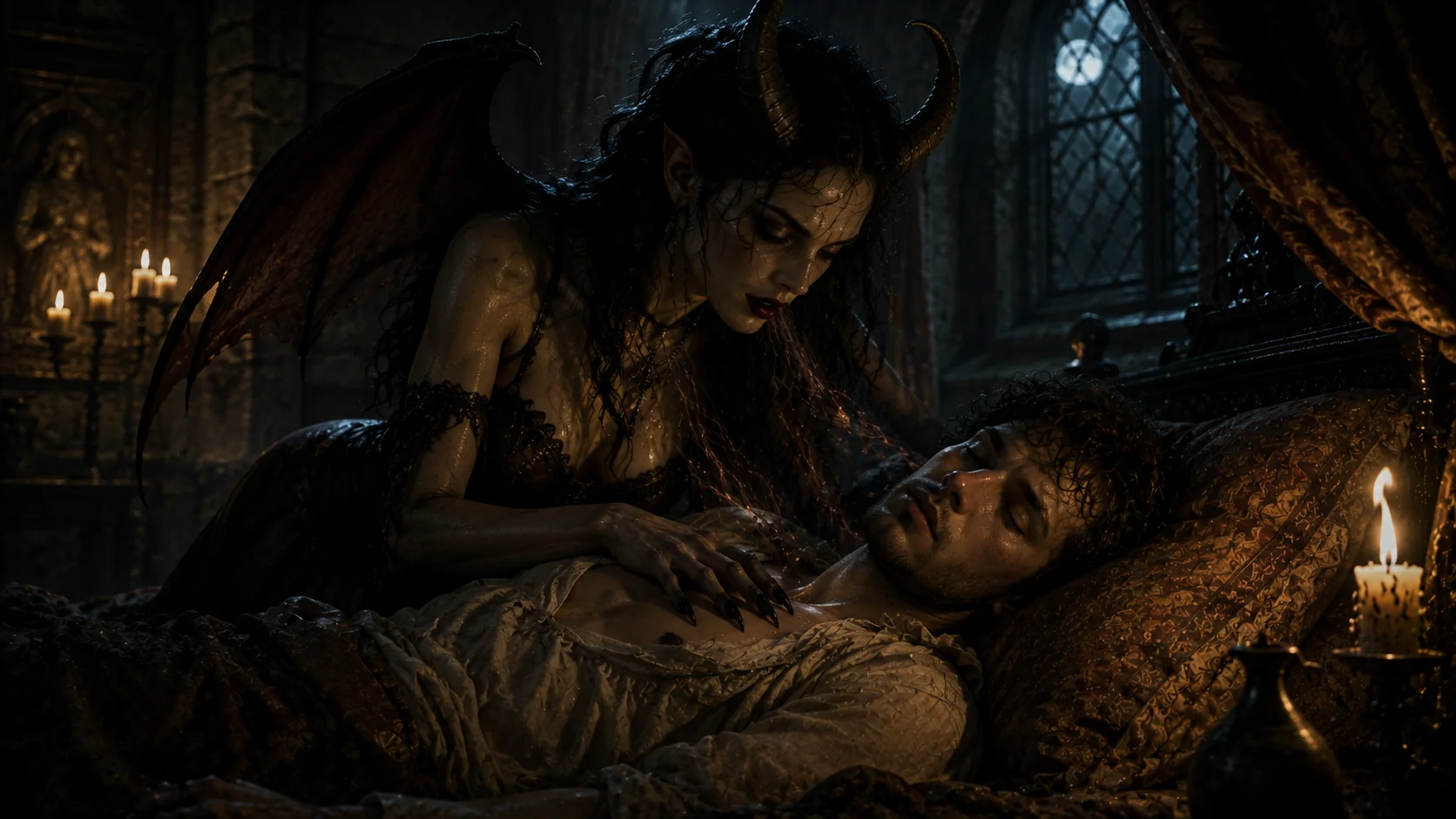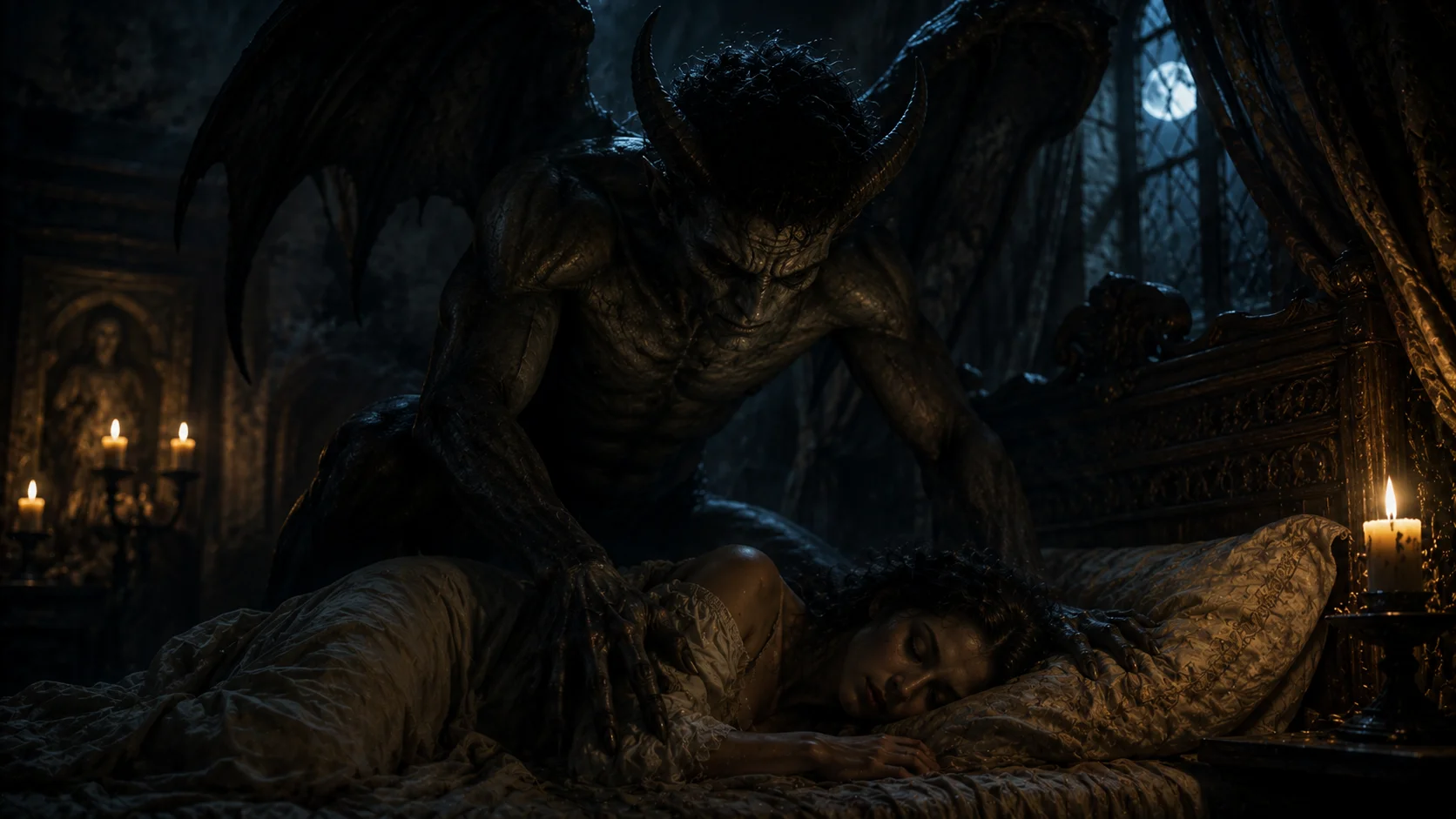
The Incubus is the male sex-demon of medieval European demonology: a fiend that comes to women in the night, lying upon and pressing the sleeper as it forces itself upon her in her sleep, draining her vitality and sometimes begetting monstrous or uncanny offspring — the male counterpart of the succubus, and a being bound up with the night-terror, the nightmare, and the dread of demonic assault. It is the night-lying demon, the male assaulter of sleepers.
The Demon That Lies Upon
The Incubus (from Latin incubo, “to lie upon”) is the male sexual demon of Christian and medieval European demonology — a fiend that visits sleeping women by night and lies upon them, pressing them down (the word is kin to the “nightmare” that presses the chest, and to the German alp) and forcing sexual congress upon them in their sleep. The experience it embodied — the sense of a heavy, suffocating presence in the night, paralysis, and erotic or terrifying dreams — is that of sleep paralysis and the nightmare, given the form of a lustful demon.
The Assault and the Offspring
The incubus was held to drain the strength, health, and even the life of its victims through its repeated nightly assaults, leaving them weakened, sickly, and tormented. More dreadful still, medieval theology held that an incubus could beget children upon the women it assaulted — producing offspring that were uncanny, deformed, or monstrous, or in some accounts simply human but demon-fathered (the wizard Merlin was said to be the son of an incubus). The elaborate demonology of the witch-hunting era (the Malleus Maleficarum and its kin) treated incubi and succubi at length, and explained that the same demon might act as a succubus to take seed from a man and then as an incubus to deliver it to a woman.
The Demon and the Nightmare
The incubus belongs to a vast, cross-cultural family of night-demons and nightmare-spirits that assault sleepers — the alp and drude of Germanic lore, the mare, and the sexual night-demons of many traditions — the supernatural explanation for sleep paralysis, erotic dreams, nocturnal terror, and unexplained illness or pregnancy. In the witch-trials it was a grave and literal danger, and accusations of congress with incubi were part of the machinery of persecution. From medieval demonology the incubus has passed into modern horror and fantasy as the archetypal lustful male demon. In the Incubus, medieval Europe gave form to the night-lying demon — the male fiend that presses upon and assaults sleeping women, draining their life and begetting monstrous offspring, the demonic face of the nightmare and counterpart of the succubus.
Before the Word: Silvans, Dusii, and a Roman Ghost of Gold
Long before medieval theologians settled on a single word for it, Augustine of Hippo was already fielding the question. In the City of God, written in the early fifth century, he reports — without much surprise — that “Silvans and Fauns, who are commonly called incubi, had often made wicked assaults upon women,” and that the Gauls knew demons of the same habits as the Dusii. Augustine’s Latin actually names Silvani and Panes, woodland spirits in the line of shaggy Faunus and goat-legged Pan, and that is the more telling detail: the creature the Church would spend a thousand years describing arrived already wearing the fur of a Roman field-god. The passage does a great deal of work in one sentence. By the early fifth century the Latin world had a settled, ordinary word for a specific being that lay upon sleeping women, and recognised the same figure under other names elsewhere in the empire. Augustine did not invent the incubus. He catalogued one that already had a folk pedigree.
The name is older than its demonic reputation. Latin incubare meant simply “to lie upon” or “to brood” — the same root behind incubatio, the rite of temple-sleep in which the sick lay down inside a god’s shrine and waited for a healing dream. Two futures branch out of one verb: a demon that pins the sleeper, and a cure sought lying down. And before the sexual sense hardened into doctrine, an incubo could be something else entirely — a spirit that squatted on buried treasure and guarded it. In Petronius’s Satyricon, one of the freedmen at Trimalchio’s table explains a neighbour’s sudden wealth with a shrug and a rumour: the man snatched the cap off an incubo, and so the creature had to give up its hoard. Rome’s incubus, at that stage, was less a rapist than a miser you could rob.
Could a Demon Really Father a Child? Aquinas and the Problem of Stolen Seed
The transfer theory named earlier in this article — the same demon acting first as succubus, then as incubus — was not idle speculation. It was theology defending two doctrines at once. Demons, the schoolmen held, are pure spirit: no flesh, no seed of their own, no power to make life out of nothing, because only God creates. Yet tradition was crowded with demon-fathered men: sorcerers, giants, the unnaturally strong and the unnaturally strange. How were both things supposed to be true at once?
Thomas Aquinas’s answer in the Summa Theologiae was that the demon created no new life at all. Nothing was begotten; something was moved. The demon collected human seed as a succubus and delivered it as an incubus, and the child that followed belonged to the man it had been taken from, not to the devil that carried it. The distinction mattered enormously. It allowed the Church to admit every lurid story in circulation without conceding that a devil could make a soul. The seed stayed human even when the hand carrying it did not, and demonic interference remained what the theology needed it to be: theft, never creation.
Merlin’s Making
The clearest medieval test of that theology belongs to the wizard this article has already named in passing. Geoffrey of Monmouth, writing his Historia Regum Britanniae around 1136, stages it as a scene at court. The tyrant Vortigern demands to know how a boy can have no father, and his counsellor Maugantius answers him with a citation: he has read in Apuleius, in the book on the god of Socrates, that between the moon and the earth live spirits called incubus demons, partly of the nature of men and partly of angels, who take mortal shape whenever they please and lie with women. One of them, it emerges, had come to a king’s daughter living among the nuns of a convent, in the shape of a beautiful young man — embracing her, and sometimes speaking to her without letting himself be seen at all — until she conceived. It is the earliest surviving text to name an incubus as Merlin’s father, and it is careful to make the naming respectable. The king’s wise man is not repeating a peasant rumour; he is quoting a Roman philosopher.
Robert de Boron, writing his Merlin in verse around the turn of the thirteenth century, turned the same premise into a conspiracy. Only a fragment of his poem survives; the story is known in full from the prose redactions made soon after. The devils of Hell, robbed of their claim on humanity when Christ harrowed hell, meet in council and resolve to answer the Incarnation with an inversion of it — a child got by a demon upon a mortal woman, an Antichrist to work their will wearing a human face. They select a prosperous family and take it apart piece by piece until only the youngest daughter is left, the most devout of them, and even she is caught off her guard asleep. But she goes to her confessor, Blaise, and tells him everything, and the child is baptised as soon as he is born. That is where the plot fails: the theft of the seed cannot steal the grace of the sacrament. Merlin is born carrying his father’s knowledge of everything that has already happened, and God answers the theft by granting him knowledge of what is still to come. The devils’ weapon becomes a prophet who sees backward like a devil and forward by gift. The romance dramatises, a lifetime before the schoolmen formalised it, exactly the same logic: the seed was stolen, the soul was not.
Other Names for the Weight in the Night
Neighbouring languages named the same ordeal without ever borrowing the Latin word, and their names are arguments in miniature. French cauchemar welds chauchier, “to tread or trample,” onto the same mare that sits inside English “nightmare” — a trampling night-spirit doing the incubus’s work under its own flag. German turns the creature into a verb: Alpdrücken, “elf-pressing,” names the sensation rather than the thing causing it, and the ordinary modern word for a bad dream, Alptraum, is still literally an “elf-dream.” Slavic folklore keeps the hag herself — Polish zmora, Czech můra, the mora of the wider tradition — who settles on the chest of a sleeper and takes the breath out of them. And Italian let the demon’s own name flatten into vocabulary: incubo today means nothing more sinister than a bad dream, an assault fossilised into a word spoken every morning by people who have never heard of the theology behind it.
Fuseli’s Vision
No single image fixed the incubus’s shape in the modern imagination like Henry Fuseli’s The Nightmare, painted in 1781, shown at the Royal Academy the following year, and now in the Detroit Institute of Arts. A woman lies flung backward across a bed in a collapse no sleeper could hold; a small, brutish, ape-like creature squats on her chest and looks out at the viewer; a horse’s head with blank pale eyes pushes through the curtain behind her. Fuseli never labelled the creature, and the title works the pun buried in “night-mare” — a word that has nothing to do with horses and everything to do with the demon the horse is standing in for. What makes the picture faithful to the older tradition is the posture. This is not a seducer waiting at the bedside. It is a weight, sitting on a body that cannot move, which is what the sources describe and what the word itself means. Fuseli returned to the subject more than once, and the composition was engraved, copied and parodied for a century afterwards — a large part of the reason the incubus is still pictured crouched on the sleeper rather than standing over her.
The Cambion
Geoffrey’s Merlin needed no special name for what he was. Modern fantasy fiction and tabletop role-playing supplied one anyway: a cambion, the half-human child of an incubus or a succubus, carrying some measure of inherited infernal power against a conscience that may or may not hold. It is Merlin’s plot with the theology stripped out and the dilemma left in. The medieval versions could resolve it with a sacrament — a priest, a font, a baptism performed quickly enough. The modern half-demon has no font. What survives of the incubus in fiction is not the assault at all, but the question the assault created: whether a person is what fathered them.
Sources & traditions
- EncyclopediaWikipedia — Incubus
- TraditionMedieval European texts, inscriptions and later retellings
Myths change from area to area and from time to time. This chronicle follows the most widely told versions; tellings in other villages, regions and eras may differ.