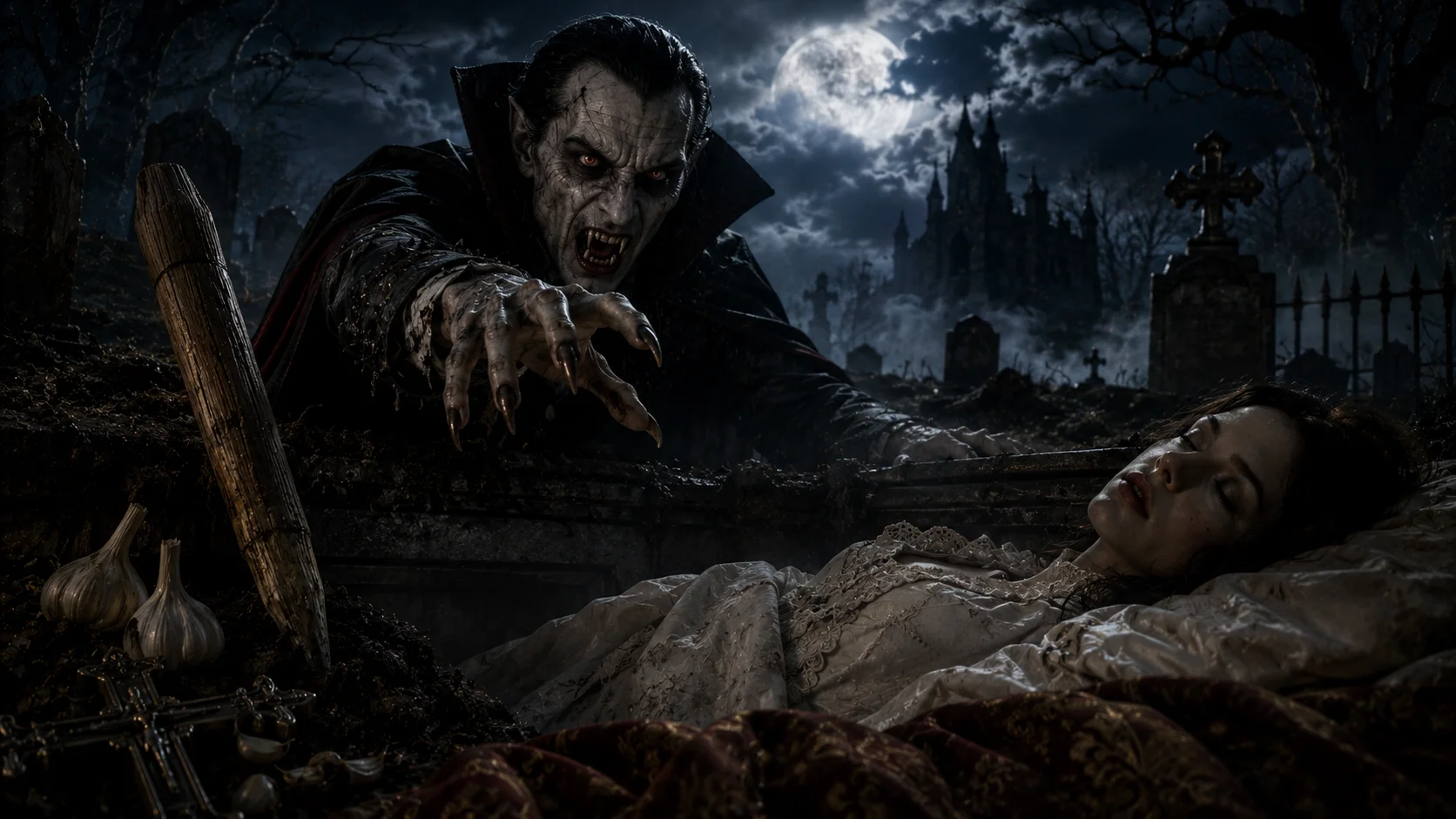
The Vampire is the blood-drinking undead of European, especially Eastern European, legend: a corpse that rises from the grave by night to feed upon the blood of the living — spreading death and plague, draining its victims until they too become vampires — an immortal, soulless predator destroyed only by stake, fire, decapitation, or the light of day, and the most famous and enduring of all the undead. It is the blood-drinker, the undead of the grave.
The Undead of the Grave
The Vampire (a word that entered Western Europe from the Slavic lands in the 18th century, amid a wave of vampire-panics in the Balkans and Eastern Europe) is the archetypal blood-drinking revenant — the dead who do not stay dead, but rise from the grave to prey upon the living. The belief is ancient and widespread (with kin in the Greek vrykolakas, the Slavic upir, the Romanian strigoi, the German nachzehrer, and demonic blood-drinkers like Lilith and the lamia), but it crystallised into the classic European vampire in the folklore of the Slavic and Balkan peoples, where the dread of the restless, blood-sucking dead was vivid and the rituals against them grimly real.
The Feeding and the Spread
The vampire’s nature is to feed on blood. It rises from its grave by night (lying as if dead, often fresh and ruddy and undecayed, by day) and seeks out the living — often first its own family and neighbours — to drink their blood, draining their life so that they sicken and waste and die. And the vampire’s curse spreads: those killed by a vampire, or otherwise tainted, may themselves rise as vampires, so that a single vampire could bring a chain of deaths and a plague of the undead upon a whole village — which is why vampire-belief so often flared in the wake of epidemics, the unexplained deaths blamed on the first-buried risen as a vampire. Vampires were thought to arise from many causes: the wicked, the excommunicate, suicides, the unbaptised, those improperly buried, or those over whose corpse an animal had leapt.
The Stake and the Modern Vampire
Against the vampire, the folk had grim and specific remedies: the suspected grave was opened, and a vampire found undecayed and bloated with blood was destroyed by driving a wooden stake (of ash, hawthorn, or aspen) through its heart, by cutting off its head, by burning the body to ashes, by filling the mouth with garlic or a stone, or by other means — rituals attested in real, gruesome historical accounts of grave-openings. The vampire was warded by garlic, by holy water and the cross, by running water it could not cross, and by the dawn (in much later lore, sunlight destroys it). From this folklore, the literary vampire was born — the seductive, aristocratic, immortal predator of Polidori’s “The Vampyre” and, supremely, Bram Stoker’s Dracula (1897), who gave the vampire its now-classic powers (shapeshifting into a bat or wolf or mist, hypnotic seduction, immortality, the need for native earth) and made it the most famous monster in the modern world. In the Vampire, Europe gave form to the blood-drinking undead — the corpse that rises to feed on the living and spread its curse, destroyed by stake and fire and sun, the immortal predator of the grave and the deathless king of the undead.
The Panic That Gave Europe the Word
In the summer of 1725, in the Serbian village of Kisiljevo — then a frontier district of the Habsburg empire, taken from the Ottomans only seven years earlier — nine people died within about eight days, and every one of them named the same culprit on their deathbed: their recently buried neighbour Petar Blagojević, who had been coming to them in the night. The villagers demanded the grave be opened. An Austrian provincial official named Frombald, obliged to attend so the thing would be done lawfully, watched them do it and then wrote up what he had seen for his superiors. The body was not decayed. There was fresh blood at the mouth. A stake was driven through the chest, more blood came, and the corpse was burned. Frombald's report is not a folk tale; it is a bureaucrat's memorandum, filed by a man plainly uneasy about having stood by while it happened.
Seven years later, in Medveđa, an army surgeon called Johann Flückinger was sent with a military commission to investigate a second outbreak, this one traced to a dead militiaman remembered as Arnold Paole. The commission exhumed more than a dozen graves, examined the bodies, recorded which were “in the vampiric condition” and which had honestly rotted, and published its findings in 1732 under the title Visum et Repertum — Seen and Discovered. It was, in form, a coroner's report. And because it was official, it travelled. Within a few months the London and Paris press were reprinting it, and the Slavic word vampir entered English and French. This is the strange truth beneath the whole tradition: Western Europe did not inherit the vampire from its own Middle Ages. It imported the word, in the 1730s, from a military paperwork scandal on the Ottoman border.
What followed was one of the odder episodes of the Enlightenment. Learned men who had no intention of believing in the undead nevertheless had to explain away sworn testimony from sober officers. The Benedictine scholar Augustin Calmet gathered the cases into a vast treatise in 1746, weighing them with a caution that his critics read as credulity. Voltaire took the opposite tack and made the vampire a joke with a blade in it — the real blood-drinkers, he observed, were not in graveyards but among the monks and the money-men, feeding in broad daylight. The matter was closed administratively rather than intellectually: the empress Maria Theresa sent her personal physician, Gerard van Swieten, into Moravia to look at the evidence, received his flatly sceptical report, and in 1755 simply forbade the exhumations, stakings and burnings by decree, removing the whole business from the hands of local clergy. The vampire was legislated out of the Habsburg legal system nearly a century and a half before Stoker put it into a novel.
What They Actually Found in the Grave
The most unsettling thing about the vampire panics is that the villagers were not hallucinating. They opened graves and saw exactly what they reported seeing — they simply did not have a science of decomposition to read it by.
A body a few weeks in the ground, particularly in cold earth or a shallow winter burial, does not look like the clean skeleton of the imagination. Bacterial gas swells the abdomen and chest, so the corpse appears plumper and better fed than in life — the bloated, ruddy vampire “gorged with blood” of the reports. That same gas pressure forces dark fluid from the lungs up through the mouth and nose, which reads unmistakably as fresh blood on the lips. Blood in a corpse can remain liquid rather than clotting. The outer layer of skin sloughs away, exposing the pinker layer beneath, so the villagers concluded the vampire had grown new skin; as the skin of the fingers and gums retracts, nails and teeth stand proud, and word goes round that the hair and nails have kept growing in the coffin. Stake the swollen torso and the trapped gas escapes past the vocal folds — and the corpse groans. Grave-openers heard that sound and understood, quite reasonably, that they had killed something still alive.
Later attempts to pin the vampire on a single disease — the porphyria theory that briefly delighted the press in the 1980s, or the rabies hypothesis that followed it — have never persuaded folklorists, and for a plain reason: they explain a monster, when what actually needed explaining was a corpse. The vampire was not diagnosed in the living. It was diagnosed in the dead, by people conducting what they believed was a careful forensic examination, during epidemics that killed families in sequence and made contagion look like a hunt.
The Archaeology of Fear
Because the remedies were physical, they left physical traces, and cemeteries across Europe have been quietly returning them for decades. Excavations of a plague burial ground on the Venetian island of Lazzaretto Nuovo produced the skull of a woman from the epidemic of 1576 with a brick lodged in her mouth — read by its excavator as an anti-revenant measure, meant to stop the dead from chewing through their shrouds and feeding, though other specialists argue the brick fell there by accident. At Drawsko in northern Poland, seventeenth- and eighteenth-century graves have been found with iron sickles laid across the throat or the hips, positioned so that a body attempting to rise would cut itself, and with heavy stones set under the chin. In Bulgaria, skeletons pinned through the chest with iron rods have been recovered from church graveyards, including a widely reported pair from Sozopol. Elsewhere the dead were buried face-down, decapitated with the skull placed between the legs, or weighted down with rocks.
Two things are worth holding on to here. First, these are frequently not the graves of outcasts flung into ditches: the Drawsko burials lie in an ordinary parish cemetery, given the full rites and then, in addition, secured. That community was not damning these people. It was protecting itself from them while still hoping to save them. Second, the practice is neither uniform nor ancient in the way the fiction implies — it clusters in particular regions and particular decades, most heavily where plague, famine or war had recently torn through, which suggests that the fear of the returning dead is not a constant background hum of European life but something that spikes when too many people die too quickly.
Millet, Knots, and the Compulsion to Count
Long before anyone thought of a stake, the household had softer defences, and the most revealing of them is the counting trap. Across the Slavic lands and beyond, mourners scattered millet or poppy seed in the coffin, on the grave, or along the path from the churchyard to the house, on the understanding that the vampire is compelled to count every grain before it can move on — and will still be counting when the cock crows. A knotted net served the same purpose: the dead must work loose one knot at a time, and in some tellings only one a year.
This is the tell. The folk vampire is not the suave predator of the drawing room; it is a mind that cannot stop itself, a dead thing running the same futile loop forever, obsessive rather than cunning. The same instinct produced its other homely weaknesses: thorny hawthorn strewn in the grave to snag the shroud, iron laid at the threshold. The elegant refinement that a vampire must be invited across a threshold belongs far more to fiction than to the grave-openings, but it grew from genuinely old ground — the doorway as the seam in a household's protection, the place where the outside must be formally admitted.
New England's Consumption Vampires
The tradition did not die out in the eighteenth century, and it did not stay in the Balkans. In rural Rhode Island, Connecticut and Vermont, through the eighteenth and nineteenth centuries, families destroyed by tuberculosis — then called consumption, and observed to move relentlessly from one household member to the next — exhumed their own dead looking for the one who was feeding on the rest. The best-known case is one of the last. In Exeter, Rhode Island, in 1892, George Brown had already lost his wife and his eldest daughter to consumption, and then watched his son Edwin sicken. Neighbours pressed him to open the graves. His daughter Mercy Brown, who had died in January and lain in an above-ground crypt because the ground was frozen too hard for burial, was barely decomposed, and blood was found still in her heart. The heart was burned on a nearby rock, and the ashes were mixed into medicine and given to Edwin to drink. He died within months.
Newspapers of the day used the word vampire; the families involved generally did not. It is worth reading the episode as what it was rather than as a curiosity — a community with no germ theory, no cure, and a disease that picked off relatives one after another in a pattern indistinguishable from predation, doing the only thing left when medicine has nothing to offer. The Griswold, Connecticut burial known as JB-55, whose bones were rearranged into a crossed-bone arrangement inside the coffin and whose ribs carry the lesions of tuberculosis, is the same grief in archaeological form.
The Vampire's Cousins
The blood-drinking dead are not a European monopoly, though the resemblances can be shallower than they look. In the Greek islands the vrykolakas is bound up with a specific theological dread: that the body of an excommunicate will not be received by the earth and so lies swollen and drum-tight, tympaniaios, until the curse is lifted. The French botanist Joseph Pitton de Tournefort, travelling in the Aegean at the turn of the eighteenth century, left an exasperated first-hand account of Mykonos convulsed by one such corpse — the islanders cutting out and burning its heart, and at last carrying the body off to a neighbouring islet to burn it entirely — and of his own complete inability to talk anyone out of it. In Romania, the strigoi covers a wider range than the Western vampire, including the living strigoi who leaves the body at night. In Chinese folklore the jiangshi is a corpse stiffened past bending that advances in hops, a figure entangled with the real practice of transporting the dead home for burial over long distances.
Elsewhere the tradition is living, and should be spoken of in the present tense. In the Philippines the manananggal is a woman who severs at the waist after dark, the upper half flying off with her entrails trailing, seeking the blood of the sleeping and especially of the unborn; her lower half, left standing, is her vulnerability. In Malaysia and Indonesia the penanggalan takes a comparable form, a detached head trailing its organs. In South Asian tradition the vetala is a spirit that occupies and animates a corpse, hanging inverted from trees like a bat — the frame of the celebrated cycle of riddle-tales in which a king must carry one on his shoulders and refuse to speak. These are distinct beings with their own logic, and flattening them into “local vampires” loses precisely what makes each of them frightening to the people who tell of them.
How the Corpse Became an Aristocrat
The transformation from bloated peasant revenant to seductive nobleman can be dated with unusual precision. It happens on the shore of Lake Geneva in the wet summer of 1816, in the ghost-story contest at the Villa Diodati that also produced Frankenstein. Byron's physician John Polidori took Byron's discarded fragment and turned it into a short tale whose vampire, Lord Ruthven, is a pale, magnetic, socially untouchable aristocrat who destroys those who trust him — a portrait so obviously modelled on Byron himself that the story was published under Byron's name. In one stroke the vampire moved from the graveyard to the salon, and acquired the quality that made it durable: it became attractive.
The rest arrived by instalments. The sprawling penny dreadful Varney the Vampire of the 1840s supplied the fangs and the twin puncture marks on the throat that everyone now assumes are ancient, and, more interestingly, the self-loathing vampire who hates what he is. Sheridan Le Fanu's Carmilla (1872) gave the figure its charged intimacy and a female predator who loves her victim. Stoker synthesised all of it. Then film rewrote him again: Murnau's unlicensed Nosferatu (1922) — which Stoker's widow pursued through the courts until a judge ordered every print destroyed, a sentence the film survived only because copies had already escaped — gave us the rule that daylight destroys the vampire. Stoker's Dracula walks about London by day, merely diminished. The single most famous vampire weakness in the world is a silent-film ending, not a folk belief.
Why It Will Not Stay Buried
Every age rebuilds the vampire out of whatever it is most afraid of, which is why it never dates. The eighteenth century, watching plague follow bloodlines through a village, made it a contagion. The nineteenth, uneasy about inherited wealth and foreign blood and the appetites beneath respectable manners, made it a nobleman. The twentieth fused it back into an epidemic, then handed it the narration and let it explain itself in the first person, and discovered that the monster's own boredom and guilt were more interesting than its hunger.
Underneath all the costume changes sits something simpler and harder. Blood is the one substance every tradition agrees is life itself — the old prohibition in Leviticus, that the life of the flesh is in the blood, states plainly what the vampire violates. And grief does genuinely feel like being fed upon: the dead take appetite, sleep, weight and interest from the living, and the bereaved really do waste. The vampire is what happens when a culture takes that sensation literally and goes out to the churchyard with a spade. It endures because the fear it encodes has never been cured — not the fear of dying, but the fear that the dead are not finished with us, and that love is one of the ways they hold on.
Sources & traditions
- EncyclopediaWikipedia — Vampire
- TraditionMedieval European texts, inscriptions and later retellings
Myths change from area to area and from time to time. This chronicle follows the most widely told versions; tellings in other villages, regions and eras may differ.