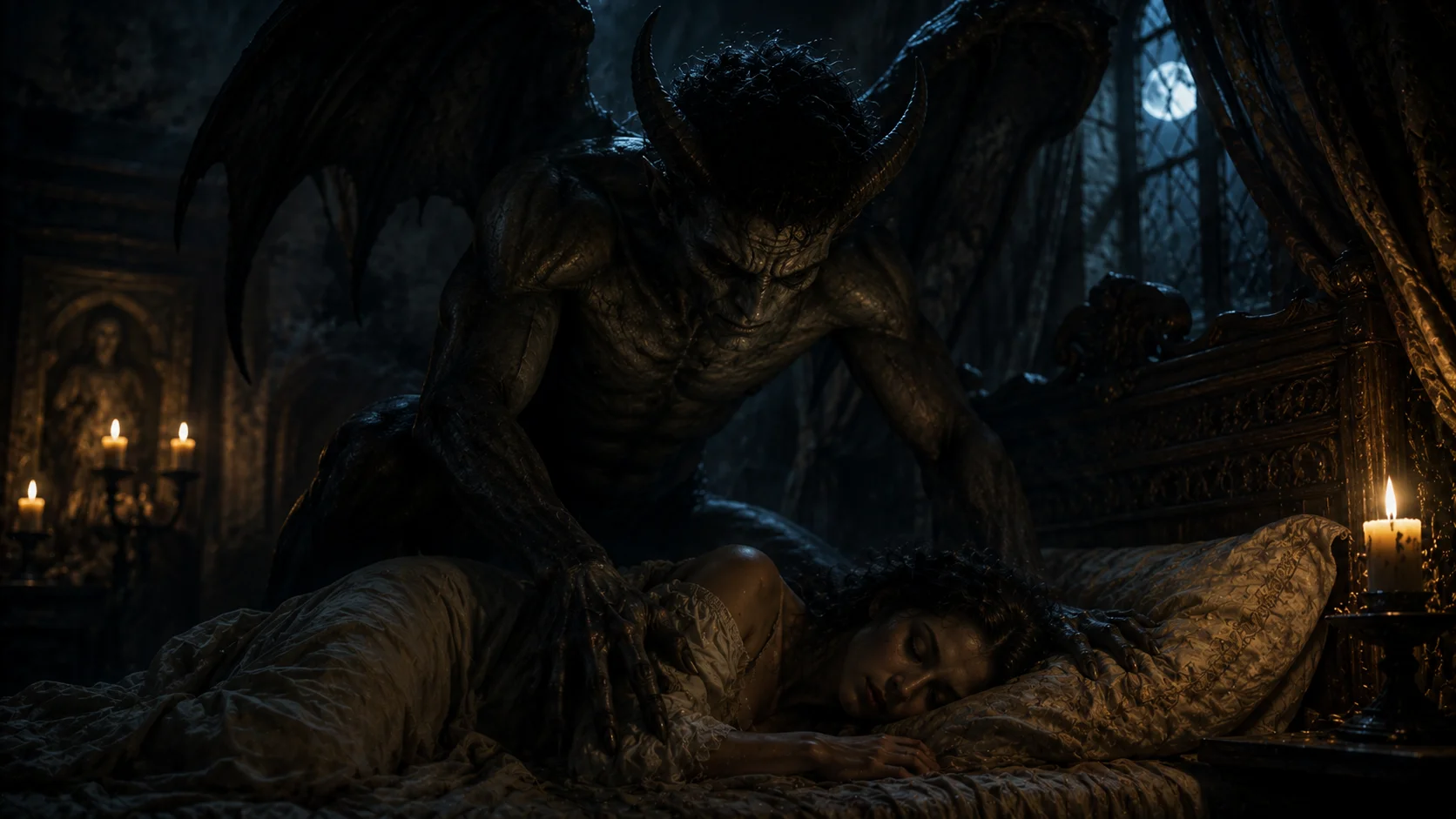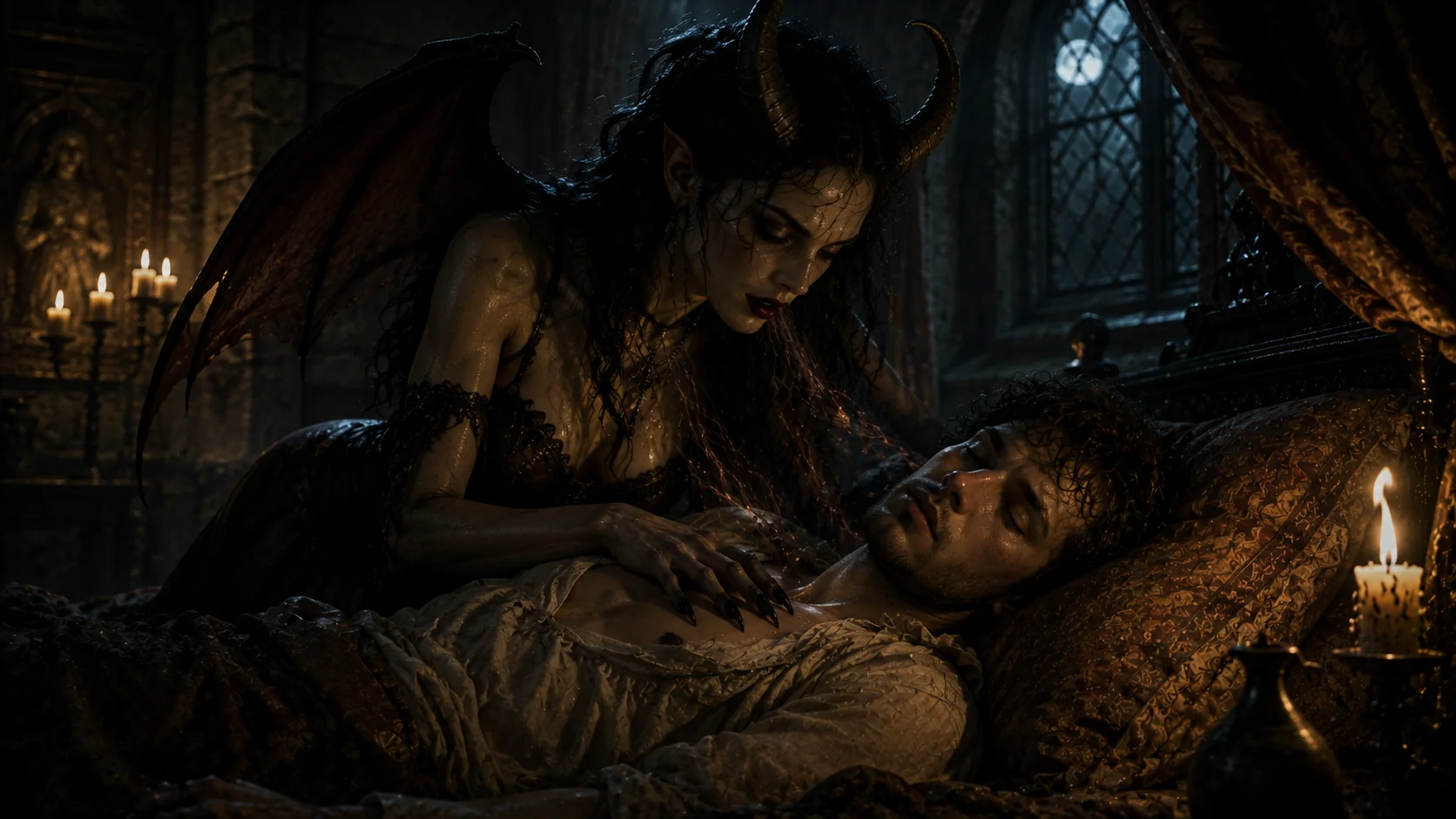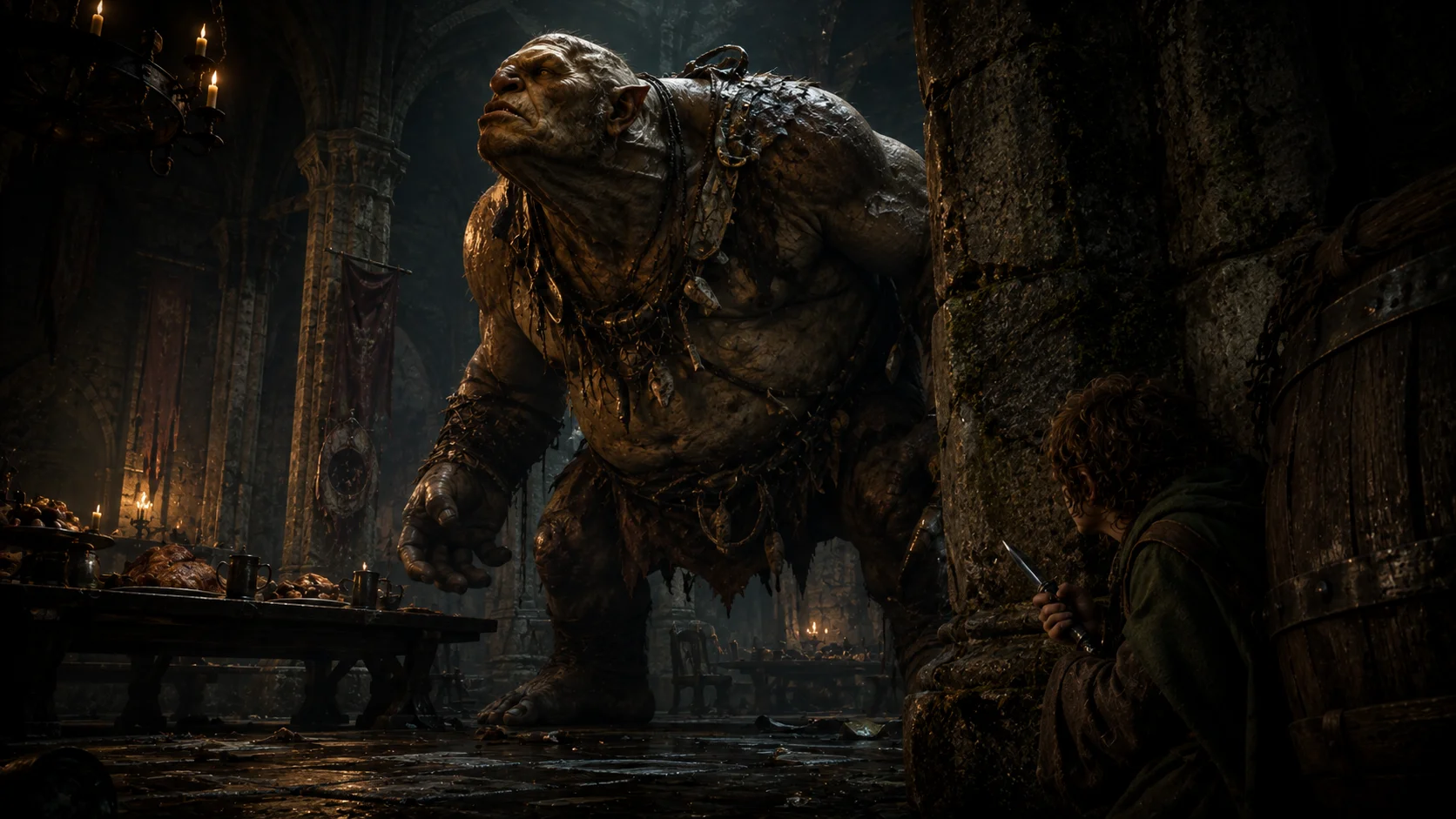
The Ogre is the man-eating giant of European fairy tale and folklore: a huge, brutish, monstrously strong and ugly humanoid creature that dwells in castles, caves, or the wild, preys upon human beings — above all relishing the flesh of children — and is overcome not by strength but by the cleverness of the hero. It is the man-eating giant, the brutish devourer of the fairy tale.
The Man-Eating Giant
The Ogre (a word popularised by the French fairy-tale tradition, perhaps from Orcus, the Roman god of the underworld and death, or from “Hungarian/Hun”) is the classic monstrous man-eater of European folklore and fairy tale — a large, hulking, hideous humanoid, often a kind of giant, with great strength, a brutish and stupid nature, a fearsome appearance (huge, ugly, sometimes with horns, tusks, or a grotesque face), and an insatiable appetite for human flesh. The female is the ogress. Ogres dwell in remote castles, dark forests, caves, and the borders of the wild, where they menace and devour the people who fall into their clutches.
The Taste for Children
The ogre’s defining trait is its cannibalism, and especially its relish for children — “Fee-fi-fo-fum, I smell the blood of an Englishman.” The fairy tales are full of ogres who capture, fatten, and devour children and travellers: the ogre of “Hop-o’-My-Thumb” (Le Petit Poucet) who means to eat the lost children but is tricked into killing his own ogre-daughters; the ogre of “Puss in Boots” who can shapeshift and is tricked by the clever cat into becoming a mouse and eaten; the giant of “Jack and the Beanstalk” (an ogre in all but name). The ogre embodies the primal childhood terror of being eaten by a monster.
The Triumph of Cleverness
And yet the ogre, for all its size and strength, is almost always undone — not by force, which no human could match, but by cleverness, trickery, and wit. The small, weak, clever hero (or heroine, or helpful animal) outsmarts the big, strong, stupid ogre: tricks it into transforming, into eating the wrong victim, into a fatal boast or bargain, or simply outwits and robs it. This is the great moral pattern of the ogre tale — intelligence triumphing over brute monstrous force — one of the most satisfying and enduring shapes of the fairy tale. From this tradition the ogre has become a stock figure of fantasy and a byword for a brutish, cruel, devouring tyrant. In the Ogre, Europe gave form to the man-eating giant — the huge, brutish, child-devouring monster of the fairy tale, overcome not by strength but by the cleverness of the hero, the brutish devourer of folklore.
An Older Ogre: Italy’s Orco Before Perrault
Two centuries before Perrault put the word into a nursery tale, an Italian poem had already given the man-eating giant both a name and a temperament. In Matteo Maria Boiardo’s chivalric romance Orlando Innamorato — written in the 1480s and printed complete in 1495, the year after his death — and in its continuation, Ludovico Ariosto’s Orlando Furioso (1516), knights stumble into the lair of the orco: a vast, cave-dwelling devourer of human flesh, unmistakably modelled on Homer’s Polyphemus and named for Orcus, the Roman god of death who was also the place of the dead. Italian had simply kept the Latin word alive in ordinary speech. Whether French took its ogre straight from that Latin root, by way of the Italian, or from somewhere else entirely is still argued — but the monster was on the page in Italian long before it became fashionable in French.
The orco found its fullest early form not in chivalric epic but in the fairy tale, six decades before Perrault. Giambattista Basile’s Neapolitan collection Lo cunto de li cunti — “The Tale of Tales, or Entertainment for Little Ones” — was published posthumously in Naples in 1634 and 1636 by his sister Adriana, under an anagram of his name, and became known later as the Pentamerone. Its fifty stories are thick with orchi and ogresses: the ogress who keeps Petrosinella shut in her tower, and, in the very first tale of the book, an uerco who is not a villain at all — he takes a simpleton named Antuono into service and sends him home with gifts that produce food out of nothing. That is worth noticing. Before the ogre hardened into the thing in the woods that eats you, it could still be a shaggy, dangerous, oddly generous power that a poor man might bargain with. Perrault did not invent the ogre. He inherited a monster already old, narrowed it to an appetite, and gave it the name that stuck.
The Ogress in the Family: Sleeping Beauty’s Second Act
Most modern retellings of Sleeping Beauty end at the wedding. Perrault’s does not. In the second half of “La Belle au bois dormant” (1697) — routinely dropped from the Grimm-descended and Disney versions — the prince marries the princess he has woken and then hides the marriage from his own mother for more than two years, through the birth of two children, because his mother is an ogress. The horror here is not exiled to a forest hut or a distant castle. It is seated at the family table, one generation up.
When the old king dies and the new one is called away to war, the queen mother sends her daughter-in-law and grandchildren to a house in the woods and instructs her steward to cook them, one at a time. Little Aurora first — and she is to be served, in one of the coldest lines in European fairy tale, with a sauce Robert: a real and thoroughly ordinary sauce of onions, butter, vinegar and mustard. The steward cannot do it. He kills a lamb instead, then a young kid for the boy, then a hind for the queen, dressing each in the same sauce and hiding the living family in his own lodgings while the ogress eats her contented way through the farmyard and the forest.
She discovers the trick by overhearing the voices of the people she believes she has already digested. Her answer is a great tub, filled with toads, vipers, snakes and every sort of serpent, into which the whole household is to be thrown together. She is interrupted only because the king rides home earlier than anyone expected. Caught in front of her own vat, the ogress throws herself in head first and is devoured by the creatures she had gathered for her grandchildren. Perrault’s ogre, then, is not always the stranger in the woods. Sometimes it is the mother-in-law, and the monstrous appetite is something a family can marry into and then spend years pretending not to see.
Orcus’s Other Children: How the Word Reached Middle-earth
The ogre has a linguistic cousin that most readers meet in an entirely different kind of book. Tolkien said he took the name of his orcs from Old English orc, a word that survives in Beowulf in a single line — eotenas ond ylfe ond orcneas, ettens and elves and orcneas — a roll-call of monstrous kinds that the poem traces back to Cain. Old English glossaries pair that orc with þyrs, the native word for a monstrous giant, and with heldeofol, hell-devil; philologists have long connected it in turn with the same Latin Orcus that stands behind the Italian orco. Tolkien himself was disarmingly unromantic about the borrowing: he said he chose the word chiefly because it sounded right.
The orcs of Mordor and the ogre at the top of the beanstalk are not the same creature, and neither owes the other its habits or its plots; there is no line of descent running from one to the other. They are distant cousins — two separate revivals of a single buried Roman word for death and the place of the dead. One was disinterred from a line of Anglo-Saxon verse by a philologist who liked the sound of it. The other was carried forward, retelling by retelling, through Italian romance and French nursery tale and onto the modern fantasy shelf.
Why the Ogre Still Haunts the Nursery
The pattern the tales keep returning to — the small and clever undoing the huge and hungry — is more than a satisfying plot shape. It is the shape of childhood itself, which is spent among giants who are, quite literally, bigger and stronger and more powerful than you are, and whose goodwill cannot simply be assumed. The ogre gives that ordinary vulnerability a face and an appetite, and then insists, tale after tale, that the small one wins anyway. It is a rehearsal for the adult world, conducted with nothing in hand but wit.
That is also why the figure has proved so easy to turn inside out. When Shrek (2001) made a green, swamp-dwelling ogre its reluctant hero rather than its monster, the joke worked only because the audience already knew the old shape by heart: brutish outside, feared on sight, judged entirely on size and teeth. Centuries of fairy tale had insisted the ogre was a thing to be outwitted; the retelling asked, just as pointedly, who decided that ugliness and appetite were the same as villainy. The nightmare has lasted because it turns out to be tellable from either side of the cooking pot.
Sources & traditions
- EncyclopediaWikipedia — Ogre
- TraditionMedieval European texts, inscriptions and later retellings
Myths change from area to area and from time to time. This chronicle follows the most widely told versions; tellings in other villages, regions and eras may differ.