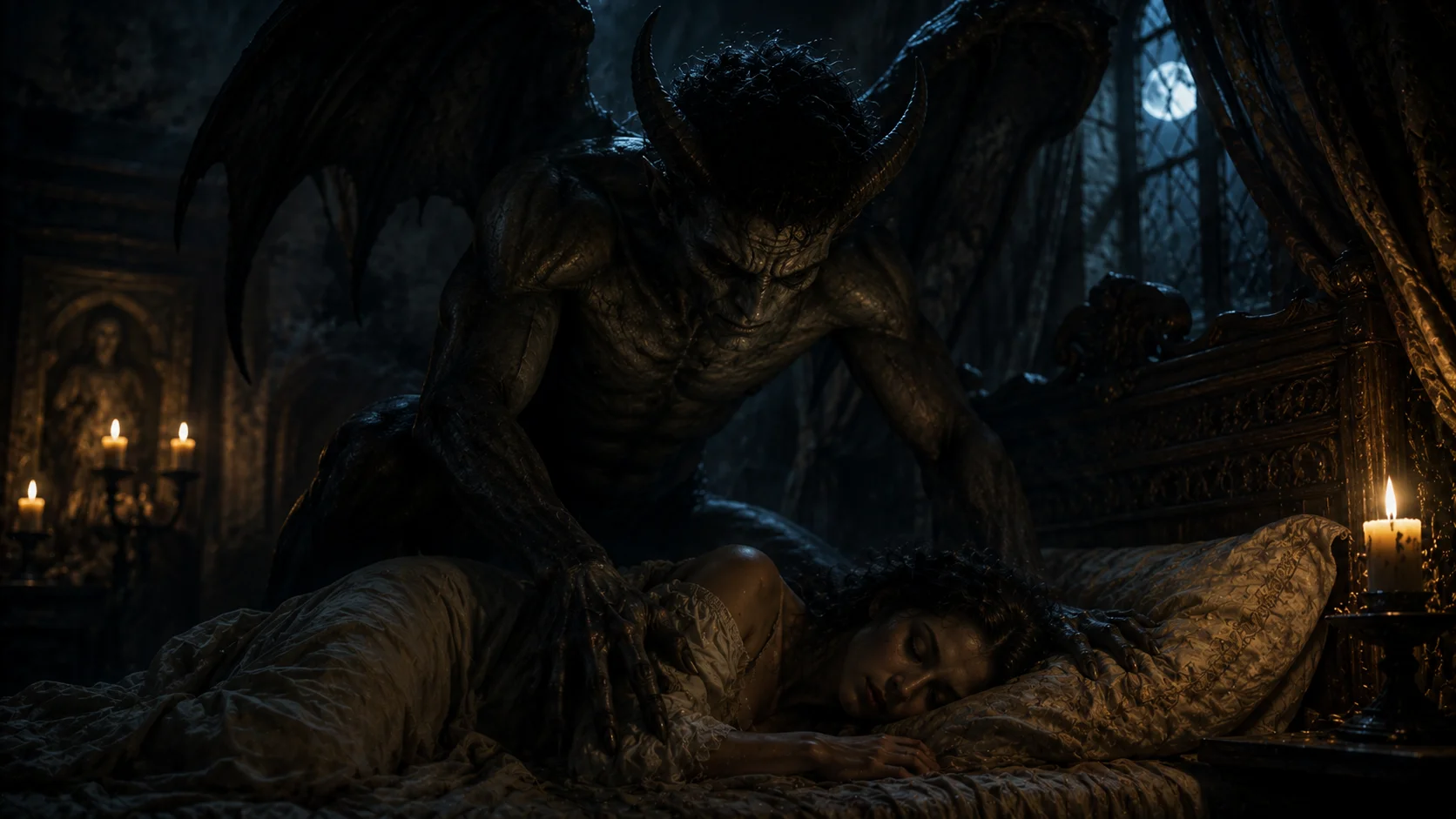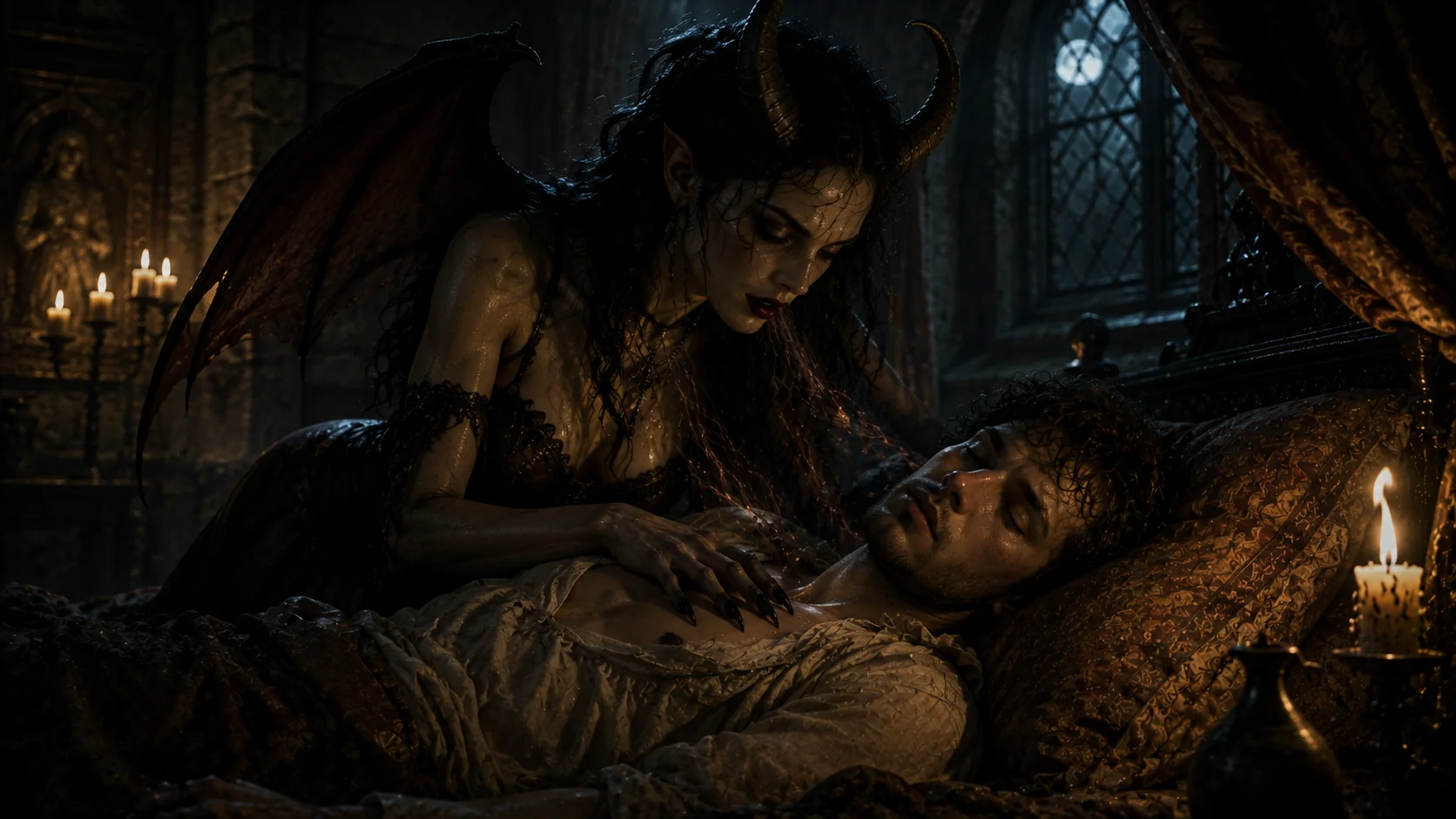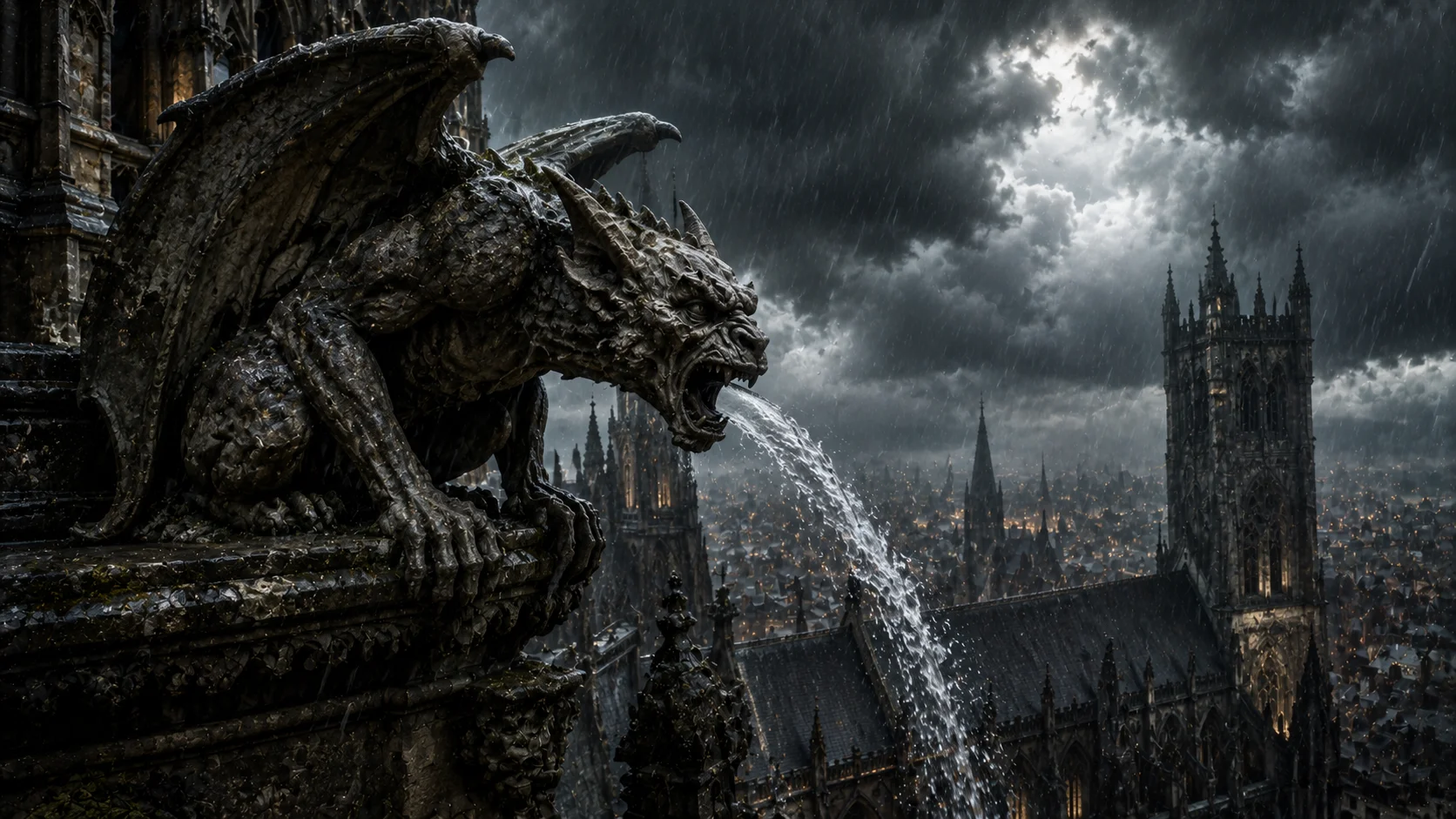
The Gargoyle is the carved stone monster of medieval European architecture: a grotesque, often demonic or beast-like figure set high upon the walls and towers of cathedrals and churches, at once a functional waterspout that throws rainwater clear of the masonry and a watchful guardian believed to ward off evil. In legend, it is also a creature in its own right — most famously a dragon subdued by a saint and rendered, in effigy, into the very stone of the church it once threatened. Grotesque, gutter, and guardian all at once, the gargoyle is one of the most recognizable figures to come out of the Gothic imagination.
The Throat That Gives It Its Name
The word gargoyle descends from the Old French gargouille, itself tied to the Latin gurgulio and gula, both clustering around the idea of the throat. This is not incidental color; it is the plainest possible description of what the carving does. Water gathered on a roof or parapet is directed through a channel hollowed into the figure's body and out through its open mouth, so that the stream falls clear of the wall below rather than running down the face of the building. The name gargoyle is, in its origin, an engineering term before it is a monster's name — the same root that gives modern English gargle, for the sound water makes passing through a throat. That the word settled so completely onto the grotesque carvings themselves, rather than staying a mason's technical term, says a great deal about how thoroughly the function and the imagery fused in the medieval and later imagination.
A True Gargoyle Versus a Silent Grotesque
Architectural historians draw a distinction that medieval builders themselves did not always observe with any consistency: a true gargoyle is, strictly, a spout — a carved figure with a hollow channel running through it, built to carry water. A carved monstrous figure that performs no such function, that simply crouches or leers from a ledge or buttress without ever channeling a drop of rain, is more properly called a grotesque or a chimera. The distinction matters to scholars cataloguing a building stone by stone, but it barely mattered to the medieval eye, and it barely matters to the popular imagination now. Both the functioning spouts and the silent decorative monsters share the same vocabulary of hybrid, threatening, and comic forms, and both are, in common usage, gargoyles.
Stone, Channel, and Lead
The material reality behind the myth is workmanlike. Gargoyles were typically carved from stone, limestone being especially common for its workability, with a channel bored or hollowed through the body of the figure to carry water from the roof to the open mouth. Over time, builders sometimes extended the spout's reach by fitting lead pipes to the stone mouth, throwing the water further from the wall and reducing the staining and erosion that a short fall would cause on the masonry below. It is a detail easy to overlook beside the monstrous carving itself, but it is the entire reason the figure exists at that height and in that posture in the first place: form built around a plumbing problem, dressed as a demon.
Notre-Dame and the Weight of Misremembering
No building is more associated with the gargoyle than Notre-Dame de Paris, whose roofline of monstrous watchers has become close to a visual shorthand for the Gothic cathedral itself. But much of what visitors and readers picture when they picture Notre-Dame's gargoyles and grotesques does not, in fact, date from the medieval builders at all — a great many of the figures now on the building were added during Eugène Viollet-le-Duc's nineteenth-century restoration. The confusion is persistent and understandable: the nineteenth-century carvers worked in a deliberately medieval idiom, and the figures sit on a genuinely medieval building. But the specific creatures most people picture when they picture a Notre-Dame gargoyle are very often a Gothic Revival invention layered onto a Gothic original, not a straight window into the twelfth or thirteenth century.
The Dragon of Rouen
The best-known origin story attached to the gargoyle is the legend of La Gargouille, a dragon-like monster said to have haunted the river Seine near Rouen. The creature was described as a serpentine terror with a long neck and a throat that could spew both water and fire, and it was blamed for ravaging the surrounding land and its people. According to the legend, the beast was confronted in the seventh century by Saint Romanus, Archbishop of Rouen, who subdued or tamed the monster rather than merely destroying it outright, and led it back into the city. There the dragon's body was burned, but its head and neck resisted the flames entirely, tempered, so the story goes, by the beast's own fire-breath over its long career of terror. That fireproof head was then mounted upon the newly built church as a spout and a warning — the very first gargoyle, in the legend's own telling, and the origin of the name for every monstrous waterspout that followed.
An Etiological Tale, Not a Historical Record
It is worth being precise about what the Rouen legend actually is. It is what scholars call an etiological legend — a story built specifically to explain why a thing exists and looks the way it does, rather than a report of an event. The tale of La Gargouille was first written down in later medieval and early modern hagiographic sources, well after the period it claims to describe, and the exact dating of when the story took the form we know remains debated among scholars rather than settled fact. This does not diminish its power as an origin story; if anything it sharpens what the legend was for. It gave an entire category of architectural ornament — objects that predate and postdate any single saint's life — a single, memorable birth story, and it did so in the same way many medieval communities explained the strange things standing in their midst: by wrapping them in the deeds of a local holy figure.
A Bestiary of Faces
Walk the length of any major Gothic building and the sheer range of gargoyle and grotesque forms becomes apparent. Medieval carvers drew on lions, apes, goats, dogs, and human faces, mixing and hybridizing them freely, alongside dragons, demons, and grotesque human figures bent into unlikely postures. This is not a separate visual tradition invented for church roofs; it draws directly on the same well of imagery found in the medieval bestiary and in the marginal drawings that fill the edges of illuminated manuscripts — hybrid beasts standing in for moral or ontological disorder, the same visual grammar used to depict griffins, manticores, and basilisks in bestiary pages. A cathedral's roofline and a monk's marginal doodle, in other words, were speaking the same visual language, one carved in stone at enormous scale and the other inked at the edge of a page.
Guardians at the Threshold
Beyond their plumbing, gargoyles carried a widely understood symbolic weight. Set at the exterior of the church, at the boundary between the sacred interior and the ordinary world outside, these grotesque and often demonic figures were read as apotropaic — objects that protect precisely by depicting the thing they guard against. Evil was given monstrous form and set fleeing, frozen, or straining outward from the building's edge, while sacred imagery of saints and holy figures was reserved for the interior. In this reading, the gargoyle does not merely decorate the church; it performs a kind of symbolic expulsion, pushing the demonic to the outer skin of the sacred space and holding it there in stone.
A Warning Carved in Stone
Alongside the protective reading sits a second, didactic one that does not so much contradict the first as sit beside it. Medieval church authorities and later scholars alike have also read the gargoyle as a moral reminder to those entering — a glimpse, carved directly onto the house of God, of the horrors of sin and of Hell that waited outside its walls and outside the state of grace. This mirrors the moralizing function bestiary monsters served on the page, where a creature like the salamander was described not merely as a curiosity but as a lesson bent toward the reader's soul. The gargoyle, on this reading, is less a guard dog than a sermon: a fixed, silent, monstrous illustration of what the church stood against, placed exactly where the faithful could not avoid seeing it on their way in and out.
Bernard of Clairvaux's Complaint
Direct medieval commentary on this proliferation of monstrous carving is rare, which makes Saint Bernard of Clairvaux's remarks unusually valuable. In his Apologia to Abbot William, written around 1125, Bernard criticized the sheer abundance of grotesque figures then decorating monastic cloisters, singling out monstrous centaurs, half-men, and fighting monkeys as unworthy distractions from the contemplative life the cloister was meant to support. It is important to place this complaint accurately: Bernard's target was Romanesque cloister carving in general, not gargoyles or waterspouts specifically, and his remarks predate the great flowering of Gothic gargoyle carving on cathedral exteriors by decades. Even so, his irritation is the clearest surviving voice from within the medieval church itself registering just how strange, excessive, and hard to justify this appetite for the grotesque could seem even to contemporaries — a reminder that the gargoyle's charm was not universally felt even in its own age.
Chimera, Grotesque, and Babewyn
The gargoyle sits within a small cluster of related terms that medieval and later writers used, not always consistently, for this family of carved monsters. Chimera is generally reserved for a grotesque figure that performs no drainage function, distinguishing it technically from a true water-spouting gargoyle. Grotesque serves as the broader umbrella term, covering fantastical carved figures of any kind, functional or not. And in Middle English and French usage, the word babewyn, sometimes rendered babouin, described grotesque figures appearing both in manuscript margins and in architectural carving — a term that, like the imagery itself, refused to respect the boundary between page and building.
Cousins in Stone and Ink
Because gargoyle iconography draws so heavily on bestiary hybrids and on the older Plinian tradition of monstrous races, the carved figure on a cathedral roof and the described monster in a bestiary manuscript are best understood as siblings rather than as separate inventions. Both traditions reach for the same combination of lion, goat, dog, ape, and human features; both use hybridity itself as a signal of moral or physical disorder, a body that will not resolve into a single coherent creature because what it represents will not resolve into a single coherent good. Seen this way, the gargoyle is not an isolated architectural curiosity but one physical expression, carved rather than illuminated, of a much wider medieval habit of thinking about monstrousness.
From Church Roof to Modern Imagination
Of all the figures that came out of Gothic architecture, the gargoyle has traveled furthest from its original purpose. Once thoroughly functional and thoroughly theological — a drainage solution doubling as a warning against sin and a ward against evil spirits — it has, over the centuries, become detached almost entirely from both roles in the popular mind. The nineteenth-century Gothic Revival helped fix its modern silhouette, and modern fantasy has gone further still, frequently reimagining gargoyles as living creatures of stone that wake and move at night, a leap the medieval legend of the tamed dragon perhaps made easy to take. What survives across all of it, from the Rouen legend to the cathedral roofline to the modern page and screen, is the same central image: a monstrous face fixed at the boundary of a sacred or significant place, mouth open, caught mid-warning, water or fire or nothing at all pouring from its throat.
Sources & traditions
- EncyclopediaWikipedia — Gargoyle
- TraditionMedieval European texts, inscriptions and later retellings
Myths change from area to area and from time to time. This chronicle follows the most widely told versions; tellings in other villages, regions and eras may differ.