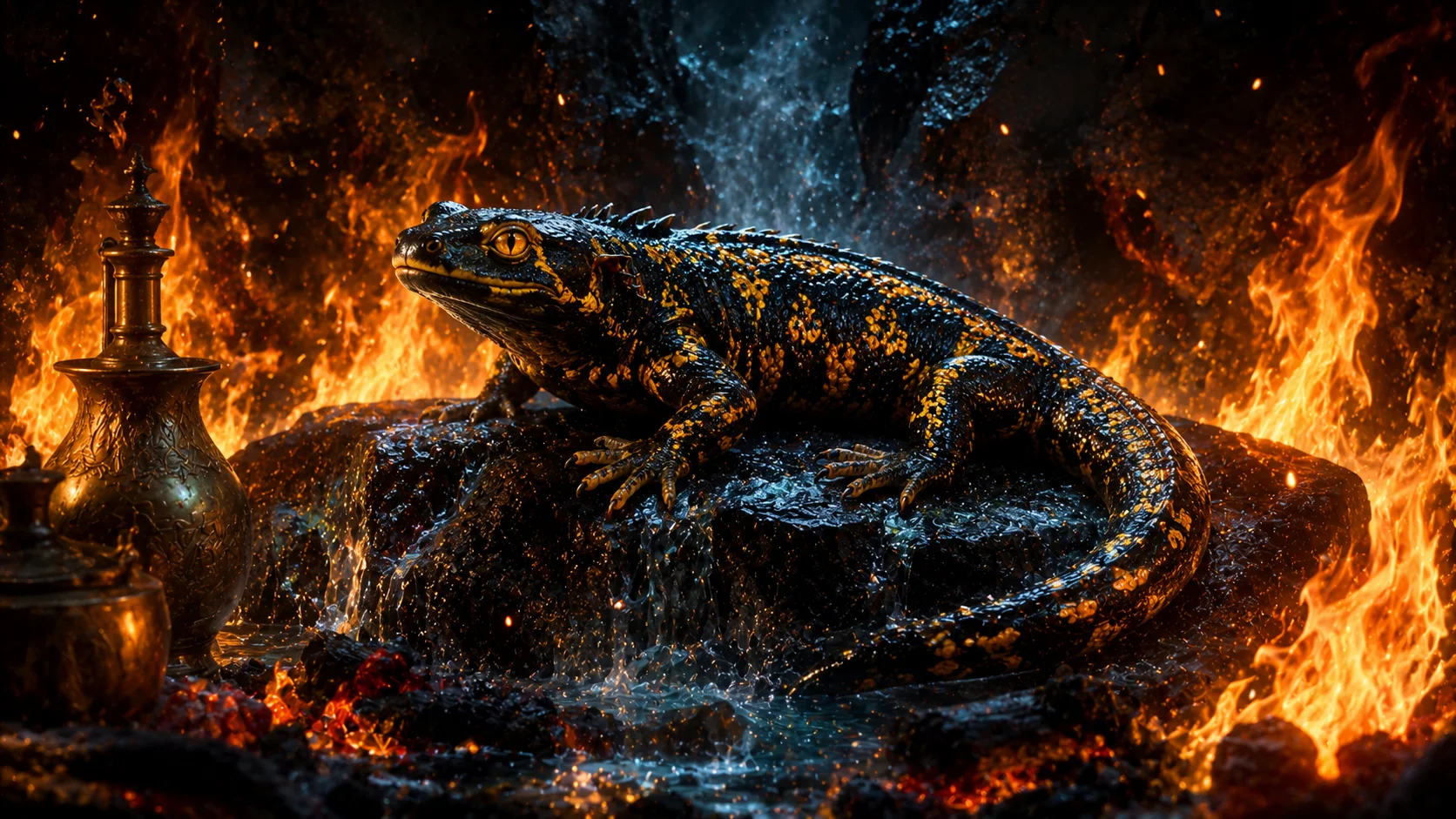
The Salamander is the fire-dwelling creature of classical and medieval European natural history: a lizard-like beast so contrary in nature to flame that it can live within fire, pass through it unharmed, and extinguish it by touch alone. Carried from Aristotle and Pliny the Elder into the Christian bestiary tradition through the Physiologus and Isidore of Seville, it became one of the most durable "facts" of the medieval natural world — cited by theologians, painted into manuscripts, and eventually stamped into royal heraldry.
A Beast Recorded Before It Was a Legend
Unlike many bestiary wonders that begin as folklore and are later dressed in classical authority, the salamander runs the other direction: it starts as a claim of natural history and calcifies into legend through centuries of unquestioned copying. Aristotle's Historia Animalium is among the earliest surviving mentions of a fire-resisting salamander, and Pliny the Elder's Natural History makes the claim explicit and emphatic, stating flatly that the creature is so cold that it puts out fire by contact, as ice would (Natural History X.86, and again at XXIX.4, where Pliny discusses its supposed medicinal properties). These two passages, endlessly excerpted and rarely challenged, are the taproot from which nearly every medieval salamander entry grows.
The Name as Argument
When Isidore of Seville compiled his Etymologiae in the seventh century, he did something bestiary writers loved to do with the salamander in particular: he made its name an argument for its nature. Isidore derives salamandra from its power contra incendia — against fires — treating the word itself as proof of the property (Etymologiae XII.4.36). This is a small move with a large effect. Once the name is read as etymological evidence, the fire-immunity claim stops being a reported observation and becomes something closer to a linguistic fact, harder to question because it is embedded in the very word used to discuss the animal. Isidore's Etymologiae became one of the two root texts nearly every medieval bestiary compiler copied from, alongside the Physiologus tradition, so this etymological framing traveled everywhere the creature did.
A Body Borrowed, a Legend Invented
Bestiary illustrators and writers describe the salamander as a lizard-like or newt-like creature, and some accounts note it as spotted like a leopard — a detail meant to distinguish it visually from the serpents and dragons it was grouped alongside, and one that survives today only in the name of the amphibian family. The physical description is modest and plausible; it is the behavior attributed to that body that is extraordinary. Medieval readers were not being asked to imagine a monster of unfamiliar shape, as with the dragon or the basilisk. They were being asked to believe that an animal they might recognize from damp logs and forest floors possessed a power that inverted the most basic relationship between flesh and flame.
Augustine and the Argument from the Salamander
The fire-immunity claim did not stay confined to natural history. St. Augustine, in Book XXI of The City of God, reaches for the salamander as a proof text in a much larger theological argument: if a living creature can be shown to endure fire without being consumed, then the idea that the bodies of the damned might burn eternally in Hell without being destroyed is not a logical absurdity but a demonstrated possibility of nature. The salamander here stops being a curiosity of zoology and becomes evidence in a debate about the mechanics of eternal punishment — a striking measure of how seriously the fire-immunity legend was taken, and how far its implications were pursued by the most rigorous minds of the age.
The Righteous Man Amid the Flames
The English bestiary tradition of the twelfth and thirteenth centuries, the Aberdeen Bestiary prominent among them, turned Augustine's proof into moral instruction. The salamander living untouched in fire becomes a figure for the righteous man who can dwell amid the "fires" of sin or worldly temptation without being burned by them — passing through corruption the way the creature passes through flame. Some bestiary moralizations invert the image slightly, reading the salamander instead as one who lives amid vice without being changed by it, a subtler and less flattering gloss on the same core picture: proximity to fire that does not equal consumption by fire.
A Second, Darker Power
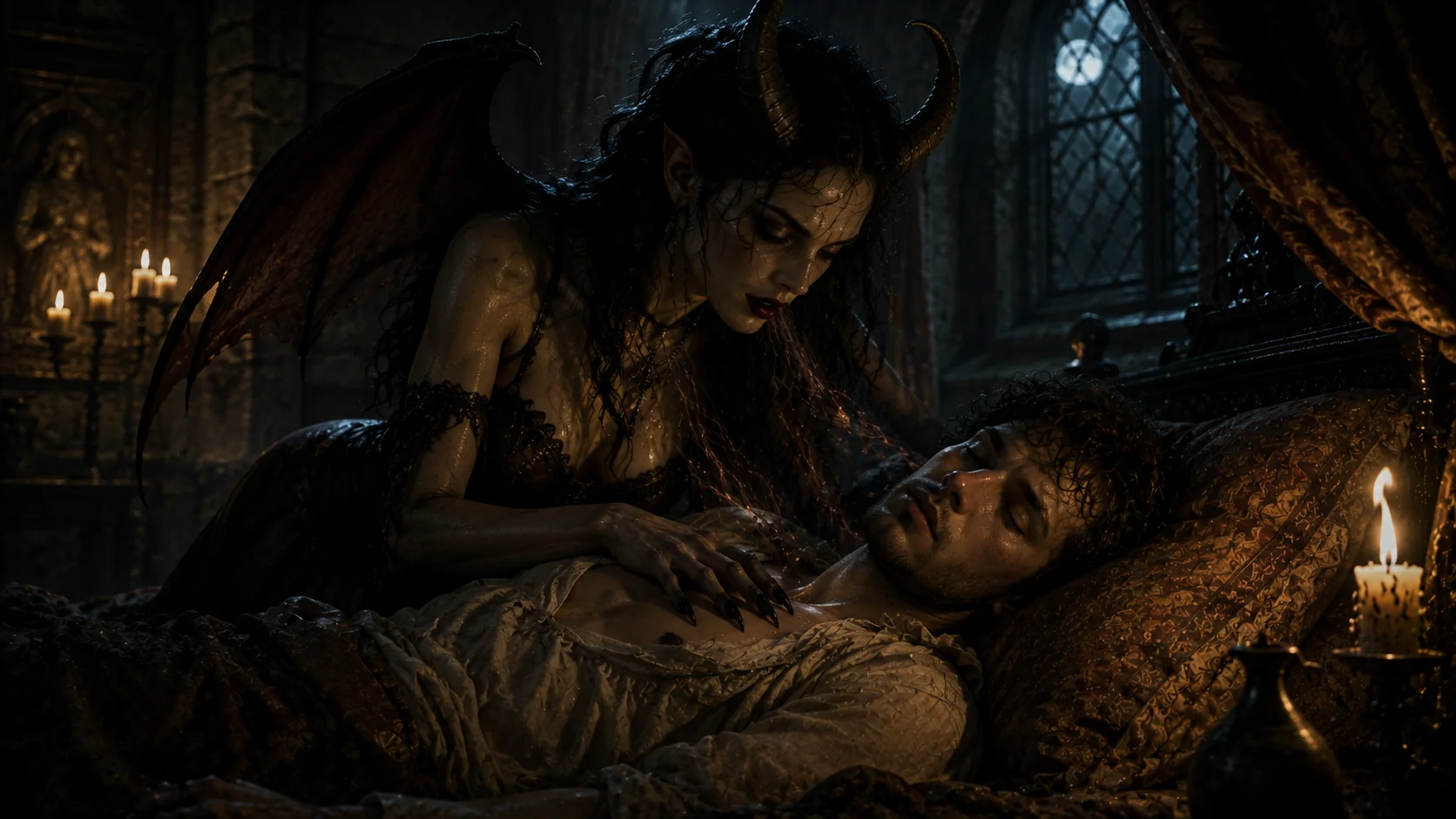
Several bestiaries, again following Pliny, attach a second and considerably less celebrated trait to the salamander: a poison so potent that its mere touch corrupts what it contacts. If the creature climbs a fruit tree, the bestiaries claim, every fruit on it becomes poisonous; if it falls into a well, the water turns deadly. This tradition sits uneasily beside the fire-immunity legend — one power protective and almost sanctified, the other silently lethal — and it is attested less consistently across manuscripts, a secondary strand rather than the creature's defining trait. But it is a reminder that the medieval salamander was not a simple emblem of purity: it carried an unpredictable, poisonous undercurrent that the moralizing tradition largely chose not to dwell on.
Cataloged Among the Serpents
Medieval bestiaries typically organize their contents by loose taxonomic grouping, and the salamander is filed among the serpentes — the section housing the dragon, the basilisk, and the viper. This placement tells its own story about how medieval naturalists sorted the world: not by leg count or habitat but by a shared aura of danger, venom, and the uncanny. Yet the compilers are careful, within that grouping, to mark the salamander apart from its most famous cousin.
Not the Dragon's Fire
The distinction is worth stating plainly because later folk tradition blurred it: the salamander does not breathe fire, produce fire, or command fire the way the legendary dragon does. Its relationship to flame runs the opposite direction — it resists fire, survives it, and quenches it. Medieval sources are explicit on this point, treating the dragon's fire-breathing and the salamander's fire-immunity as two separate and non-overlapping wonders, even though both creatures share a chapter and a general aura of the serpentine uncanny. That the two were later conflated in popular imagination — a fire-lizard blurring into a fire-breather — is a departure from, not a continuation of, the core bestiary texts, which keep the distinction clean.
Cloth That Would Not Burn
The fire-immunity legend did not stay in the manuscript margins; it reached into the medieval marketplace. A belief grew up around "salamander wool" or "salamander cloth" — fabric said to be fireproof because it was woven, in popular imagination, from the hair or hide of the creature itself. In reality, the material behind this belief was almost certainly asbestos, a genuinely fire-resistant mineral fiber that traders sometimes marketed under the salamander's name. Marco Polo records encountering "salamander cloth" on his travels and is notably careful to clarify, in his own account, that the material is mineral rather than animal in origin — a rare moment of a medieval traveler correcting the legend even while transmitting it, and a clear illustration of how a natural-history claim about an animal could reshape the marketing of a real, unrelated trade good.
The King's Flame
The salamander's afterlife in symbol reached its most famous expression well after the core bestiary period, in the personal emblem of King Francis I of France. Shown as a lizard-like creature sitting amid flames, it carried the motto Nutrisco et extinguo — "I nourish and I extinguish" — read as the king's claim to nourish the good fire (of faith, of virtue, of proper order) and extinguish the bad. This is an early sixteenth-century Renaissance usage, building on the medieval fire-immunity tradition rather than belonging to it directly; no medieval bestiary itself uses the salamander as a royal charge. But the image draws its entire force from centuries of prior natural history and moral reading — a king could not have claimed the emblem's meaning without the Physiologus, Isidore, Augustine, and the Aberdeen moralizers having already done the work of making the salamander mean something.
The Spirit Later Given to Fire
One further extension belongs to a later period still and should be held apart from the medieval bestiary proper: the salamander's adoption, in the sixteenth century, as the elemental spirit of Fire in the four-elements scheme popularized by Paracelsus, standing alongside spirits assigned to earth, air, and water. This alchemical and esoteric use draws directly on the medieval fire-immunity tradition — it would be unthinkable without it — but it is a post-medieval accretion, a new layer built atop thirteen centuries of natural history and moral allegory rather than a feature of the bestiaries themselves.
What the Legend Reveals
Read end to end, the salamander's medieval career shows how a single claimed property — cold enough to quench flame — could be extracted from a classical naturalist's page and pushed through nearly every register of medieval thought: etymology, theology, moral instruction, trade, and eventually royal symbol. It never needed the borrowed fire of the dragon or the invented wings of stranger beasts. Its whole legend rests on one inversion, endlessly repeated and endlessly interpreted: a creature that does not burn.
Sources & traditions
- EncyclopediaWikipedia — Salamanders in folklore
- TraditionMedieval European texts, inscriptions and later retellings
Myths change from area to area and from time to time. This chronicle follows the most widely told versions; tellings in other villages, regions and eras may differ.