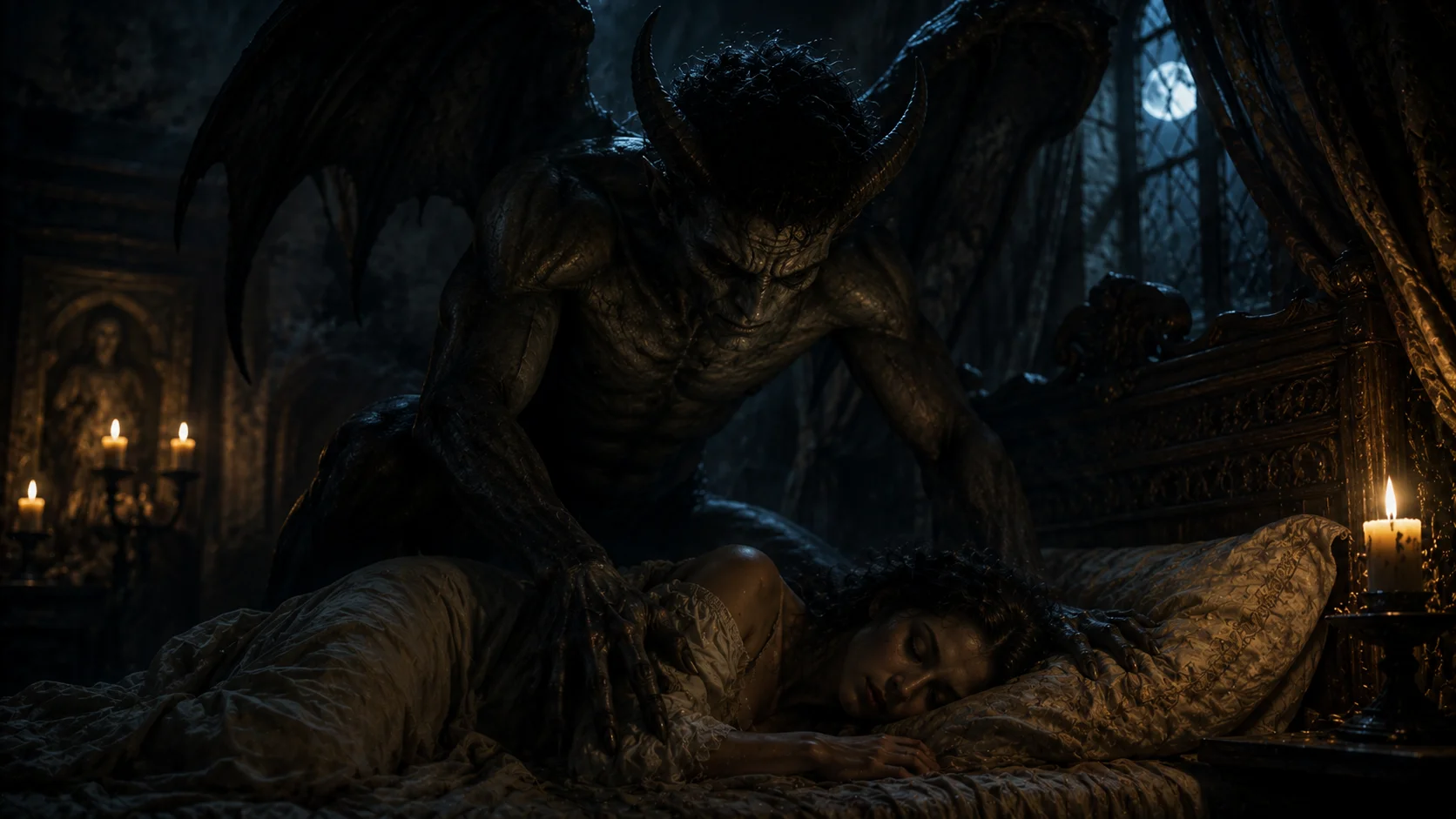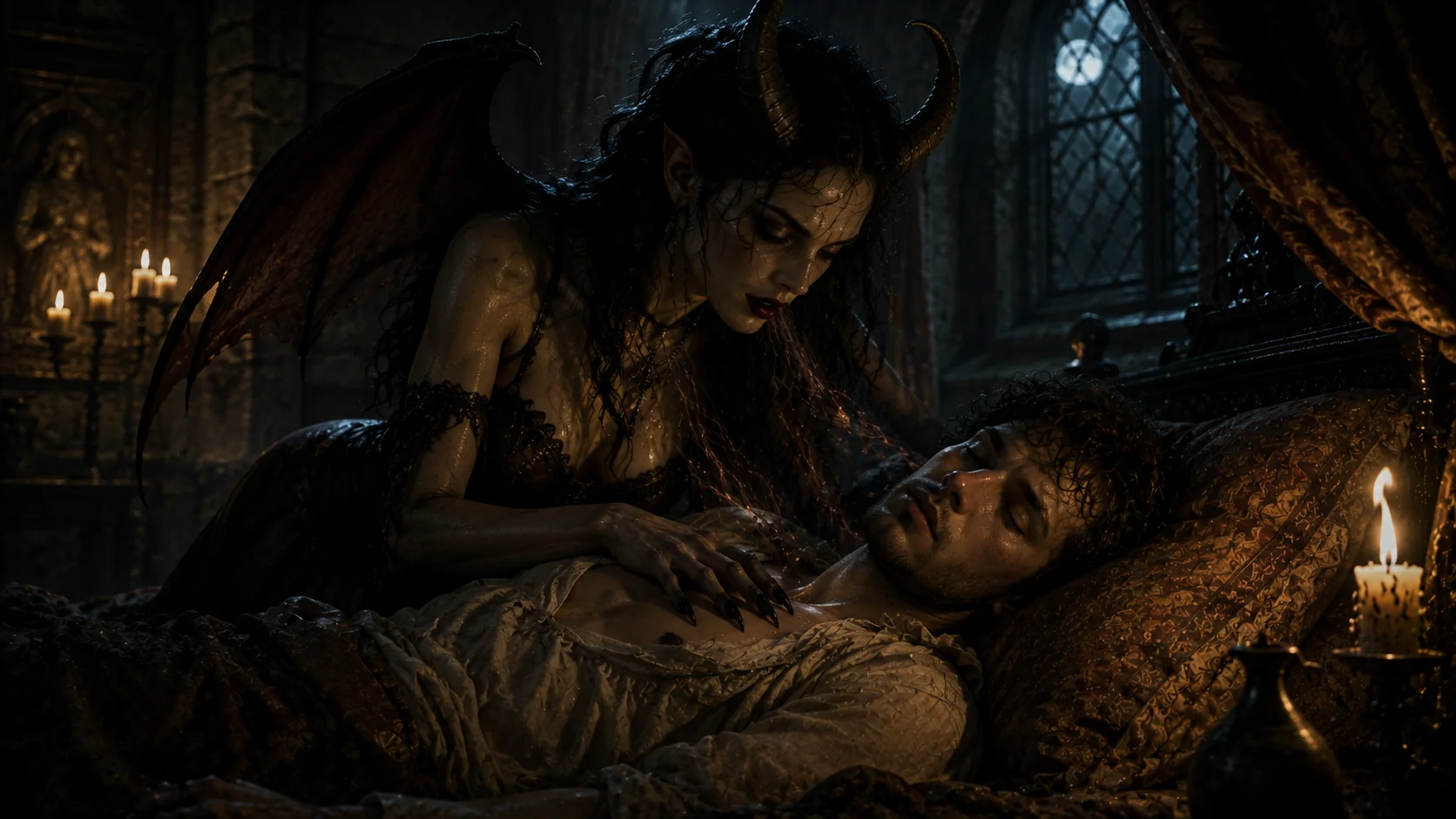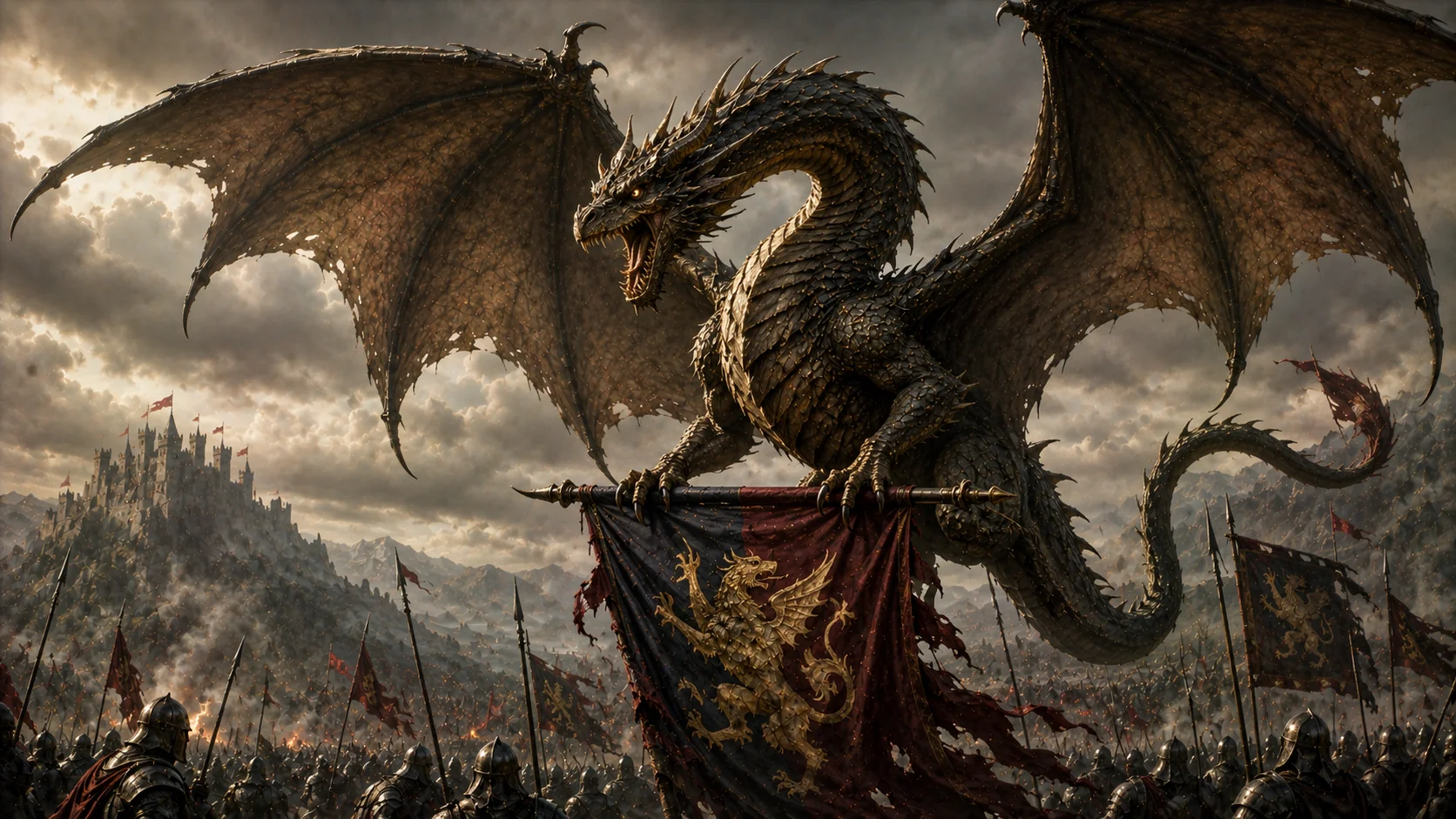
The Wyvern is the two-legged winged dragon of European heraldry and legend: a dragon-like creature with a pair of eagle’s legs, two great bat-wings, a serpentine body, and a barbed, often venomous tail — distinguished from the four-legged European dragon by its two legs — a fierce and martial beast of war, pestilence, and valour, especially beloved in British heraldry. It is the two-legged dragon, the winged serpent of the coat of arms.
The Two-Legged Dragon
The Wyvern (from Old French wivre, “viper,” from Latin vipera) is a kind of dragon distinguished above all by its anatomy: where the classic heraldic dragon has four legs and two wings, the wyvern has only two legs — the clawed legs of an eagle or a bird of prey — together with its two wings, and a long, coiling, serpentine body ending in a barbed or arrow-pointed tail, which is often venomous (echoing its “viper” name). It is generally smaller and more serpentine than the great four-footed dragon, swift and vicious.
The Beast of War and Pestilence
In the medieval imagination the wyvern was a creature of war, envy, pestilence, and aggression — a fierce and dangerous monster, associated with the spreading of disease and with martial ferocity. Tales of wyverns ravaging the countryside, poisoning wells and air with their venomous breath, and being slain by heroes are found across Europe; like the dragon, the wyvern was a monster to be overcome. Its venomous, stinging tail was its most characteristic weapon, and its association with the viper marked it as a poisonous and deadly foe.
The Heraldic Beast
The wyvern’s greatest fame is in heraldry, where it is one of the most important and frequently used of all dragon-forms — especially in British and Welsh heraldry, where the heraldic “dragon” is very often technically a wyvern (two-legged). It signified strength, valour, protection, and overthrow of the enemy, and it appears on the arms and badges of many families, cities, and military units, and famously in the dragon-standards and devices of England and Wessex. (The modern distinction between the four-legged “dragon” and the two-legged “wyvern” was largely fixed by later heraldic and fantasy convention.) In the Wyvern, the European imagination gave form to the two-legged dragon — the winged, serpent-tailed, venomous beast of war and pestilence, fierce monster and proud heraldic emblem, the winged serpent of the coat of arms.
The Guivre and the Vouivre: Serpents of Wells and Springs
Long before English heralds began arguing over how many legs a dragon ought to have, French-speaking Europe had serpent-dragons of its own, grown from the same Latin root that gave the wyvern its name. French heraldry knows the guivre, a coiling serpent charge; the folklore of the Jura and the Franche-Comté knows the vouivre, and she is no creature of parchment and paint but a resident of the actual landscape. She haunts springs, wells, caves, deep pools and ruined castles from Burgundy through Savoie, always as the guardian of a hoard, and in place of eyes she carries a single great jewel set in her head — a carbuncle, a ruby, a diamond, depending on who is telling it — which lights her way as she flies. The jewel comes out when she bathes. Without it she is blind, and that blindness is the hinge the whole story turns on: a thief quick enough to lift the stone from the bank while she is in the water carries off her fortune with her. The tales are rarely generous to him. In one Franche-Comté version a greedy man contrives to steal the carbuncle, then refuses to share what it brings him — and the jewel turns to dung in his hands. It is a legend far less interested in slaying a monster than in pricing a man’s greed, and it never quite died out; the vouivre is still a living regional figure rather than a museum specimen.
The Dragon Standard of Wessex
Centuries before any herald wrote “wyvern” on a roll of arms, a winged serpent was already flying over English battlefields — not as a fireside monster but as a war banner. The oldest of these standards were not flags at all but windsocks: a serpentine body mounted on a pole, mouth open to the wind, with small wings and half-formed limbs trailing behind. It is the form the Dacians and the late Roman cavalry used, and the form the Anglo-Saxons inherited. Chroniclers put a golden dragon over the West Saxons in their wars against Mercians, Vikings and Normans alike; Henry of Huntingdon describes one raised at the Battle of Burford in 752. The Bayeux Tapestry embroiders two of them into the scene of Harold’s death — one still held aloft beside the falling king, one already down with its bearer dead on the ground. The dragon of Wessex goes under, in the needlework, alongside the last English king to carry it.
It came back. A golden wyvern, gold on a blue square, served as the formation sign of the 43rd (Wessex) Infantry Division, worn from Normandy to Bremerhaven between June 1944 and May 1945; the German troops facing the division are said to have called them die gelben Teufel, the yellow devils, for it. A similar gold wyvern was the cap badge of the Wessex Brigade from 1958 to 1968. The flag most people now picture came later still, and it is worth being exact about the order, because it is usually told backwards: the gold wyvern on a red field was drawn up in 1974 by William Crampton, founder of the Flag Institute, for the Wessex Society — a good decade after the army badges, not their source — with the red borrowed from a seventeenth-century atlas rather than from anything Harold’s standard-bearers would have recognised. It was registered as the flag of the region in 2011. A device raised to frighten chroniclers now flies over the West Country as bunting.
Sorting the Menagerie: Cockatrice, Basilisk, Amphiptere
Heraldry rarely leaves a good monster alone, and the wyvern acquired a small family of near-relatives, each built by altering a single feature. Replace its dragon head with the comb, wattles and beak of a farmyard cock and the blazon calls the result a cockatrice — in every other respect, as the heraldic writer Arthur Charles Fox-Davies noted, it closely resembles a wyvern. Older natural history had it hatching from an egg laid by an aged rooster and brooded by a serpent or a toad, and killing by glance as readily as by bite. Give that cockatrice a second head, a dragon’s, at the tip of its tail in place of the sting, and heralds call it a basilisk, or an amphisien cockatrice. Here the reference books turn unexpectedly candid: Fox-Davies sets the distinction out carefully and then admits he knows of no coat of arms that actually bears one. It is a beast that exists chiefly in the definitions written to tell it apart from its cousin. Strip a wyvern of its legs altogether, leaving only a winged serpent, and the blazon is amphiptere. Even the cockatrice, Fox-Davies reckoned, is comparatively rare — which is the quiet joke of the whole menagerie: for all the space these creatures take up in the manuals, the wyvern is the one that actually got used.
Milan’s Biscione: The Serpent That Swallows a Man
The legless serpent has a stranger continental relation still. The biscione of Milan is a crowned serpent shown mid-swallow, a human figure’s legs kicking from between its jaws. Civic tradition credits the device to the Visconti and tells of an ancestor, Ottone, who killed a Saracen champion at the siege of Jerusalem and took the dead man’s emblem for his own. The story collapses on a date: the Ottone Visconti of record lived from about 1207 to 1295 and was never at Jerusalem, which leaves the legend roughly a century adrift of its own hero. Historians have looked elsewhere — one suggestion traces the emblem to a bronze serpent brought to Milan from Constantinople by an archbishop around the turn of the eleventh century. Whatever its origin, the biscione outlasted the family that made it famous. It passed to the Sforza dukes through Francesco Sforza, son-in-law of the last Visconti, then into the civic arms of Milan itself, and in 1910 onto the badge of a new Milanese motor company — so that a heraldic serpent devouring a man now sits, largely unrecognised for what it is, on the bonnets of sports cars all over the world.
How the Two-Legged Rule Was Actually Made
All this precision is a good deal later than it looks. In the medieval rolls of arms and the bestiaries, “dragon” and “wyvern” — or wivre, in the Anglo-Norman French the heralds themselves spoke — are used of the same beast, two-legged or four, more or less interchangeably. Medieval artists drew four-legged creatures and called them wyverns, and two-legged ones and called them dragons, and nobody appears to have minded very much. The tidy rule belongs to the systematising heraldic writers who came afterwards, cataloguing centuries of inconsistent blazon and needing the menagerie to hold still on the page; it was hardened into something like law by the Victorian and Edwardian handbooks through which almost all modern heraldry is read. The distinction is best understood, then, as a convention that won rather than a fact that was discovered — which is why a genuinely medieval blazon will cheerfully contradict it.
From Blazon to Bestiary
The wyvern’s most consequential redefinition happened not in a heraldic handbook but in a rulebook. When Dungeons & Dragons set about cataloguing its monsters in the 1970s — the first Monster Manual appeared in 1977 — it fixed the wyvern as a distant cousin of the true dragon rather than a dragon proper: hind legs only, used the way a hunting bird uses its talons; too dull-witted for the speech and cunning the game handed its dragons; no breath weapon at all; and, in place of one, a two-foot scorpion’s sting at the end of the tail, carrying a poison that killed outright. The barbed tail of the blazon had been promoted from a decorative detail to the creature’s entire identity. That single piece of game design, copied since into novels, films and video games without much examination, did more to lodge “wyvern” in the popular imagination as a specific and lesser sort of dragon than four centuries of heraldic writing ever managed. Ask someone today why a wyvern has only two legs and you are far likelier to get a bestiary entry than a coat of arms.
Sources & traditions
- EncyclopediaWikipedia — Wyvern
- TraditionMedieval European texts, inscriptions and later retellings
Myths change from area to area and from time to time. This chronicle follows the most widely told versions; tellings in other villages, regions and eras may differ.