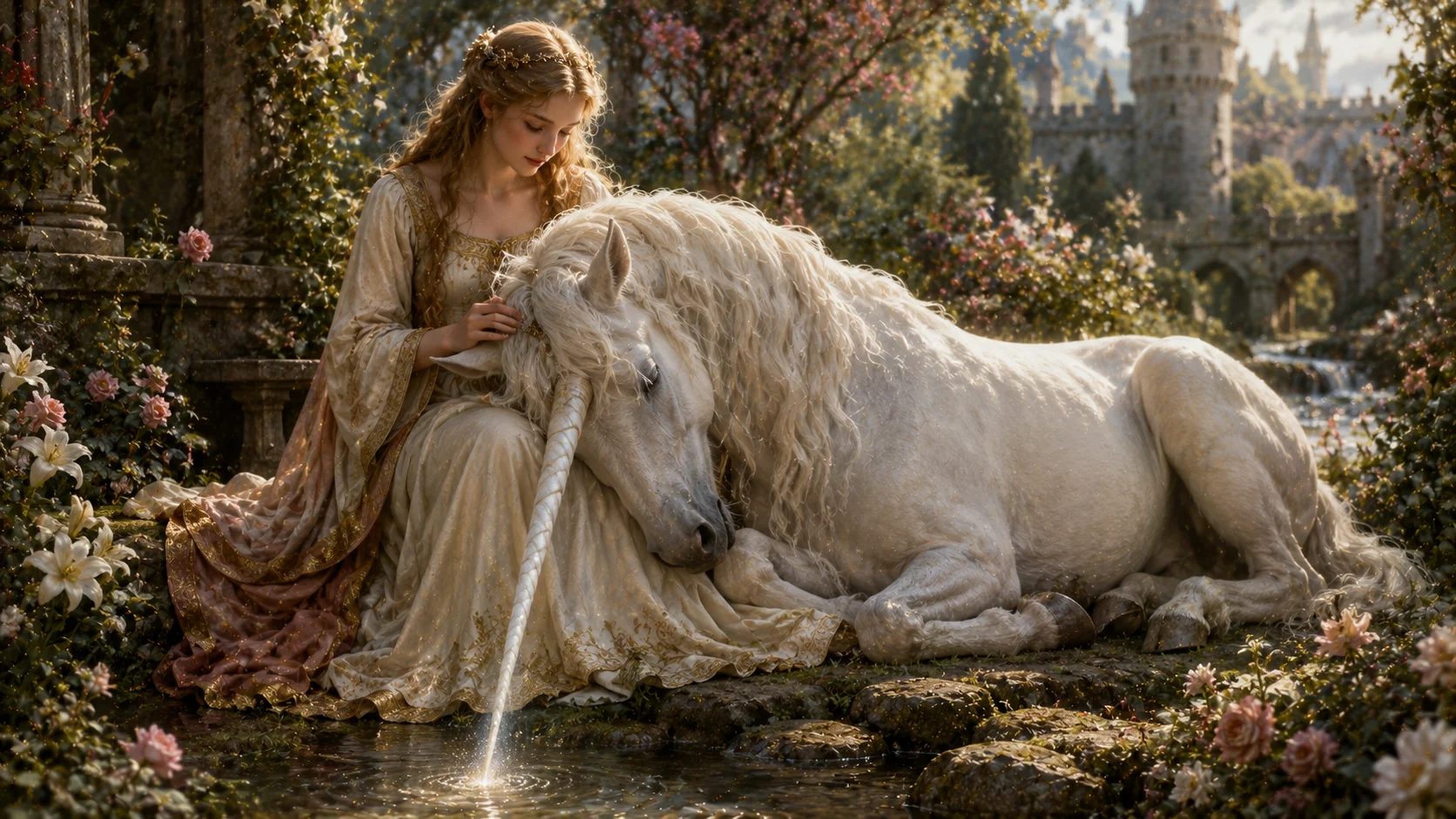
The Unicorn is the pure white horned horse of classical and medieval European legend: a beautiful, untamable beast like a horse (or goat) with a single spiralling horn upon its brow, a creature of surpassing wildness, purity, and power, whose horn could neutralise poison and whose only captor was a virgin maiden, in whose lap alone it would lay its head — the supreme symbol of purity, chastity, and Christ. It is the one-horned beast, the emblem of purity.
The One-Horned Beast
The Unicorn (Latin unicornis, “one-horned”; Greek monoceros) was reported by the classical authors — Ctesias, Aristotle, Pliny — as a real wild animal of India: a fierce beast with a single long horn on its forehead, swift and untamable, impossible to take alive. Through the bestiaries it became the beautiful creature of the medieval imagination: usually a graceful white horse-like animal (sometimes with a goat’s beard, cloven hooves, and a lion’s tail) bearing a single straight, spiralling horn (the “alicorn”) upon its brow, an animal of wildness, grace, strength, and above all purity.
The Horn and the Virgin
Two great traditions defined the medieval unicorn. The first was the marvellous power of its horn: the alicorn was held to be a sovereign remedy against poison — a cup made of it, or the horn dipped in a poisoned drink, would neutralise the venom — and so unicorn-horn (in reality usually narwhal tusk) was among the most precious and sought-after of all substances, worth many times its weight in gold, used to protect kings from poisoning. The unicorn was said to dip its horn into poisoned waters to purify them so the other animals could drink.
The Capture and the Symbol
The second great tradition was the unicorn’s capture. So fierce and swift was the unicorn that no hunter could take it by force — but it could be caught by a single, gentle stratagem: a pure virgin maiden was set in its haunt, and the unicorn, drawn irresistibly to her purity, would come and lay its head and its horn in her lap, growing tame and gentle, and so be captured (or, in the crueller versions, slain by the waiting hunters). This made the unicorn the supreme medieval symbol of purity and chastity, and in Christian allegory the maiden became the Virgin Mary and the unicorn Christ, drawn down to her womb and slain — the “hunt of the unicorn” an allegory of the Incarnation and Passion, beautifully depicted in the great medieval tapestries. The unicorn became a beloved heraldic beast (the supporter of the royal arms of Scotland and Britain) and an enduring emblem of purity, grace, and the unattainable ideal. In the Unicorn, the European imagination gave form to the one-horned beast — the pure white horned creature of wildness and grace, healer of poison, tamed only by a virgin, supreme symbol of purity and of Christ, the emblem of the bestiary.
An Ox Mistaken for a Marvel
Long before medieval illuminators painted a slender white horse kneeling in a maiden’s lap, readers of the King James Bible were told, again and again, that the faithful had “the strength of an unicorn.” Balaam declares that God, bringing Israel out of Egypt, “hath as it were the strength of an unicorn” (Numbers 23:22); Job is asked whether the unicorn will “be willing to serve thee, or abide by thy crib” (Job 39:9); the Psalmist prays, “my horn shalt thou exalt like the horn of an unicorn” (Psalm 92:10). None of this was poetic licence about a fairy-tale beast — the translators believed they were naming a real animal.
Modern scholarship generally identifies the underlying Hebrew word, re’em, with the aurochs, the immense wild ox from which domestic cattle descend, an animal whose raw, ungovernable strength made it an obvious figure for the power of God. But when the Hebrew scriptures were rendered into Greek for the Septuagint, the translators reached for monoceros, “one-horned” — a word Greek natural history already applied to the single-horned beasts of Indian report — and Jerome’s Latin carried the choice through as unicornis. By the time English translators worked from those texts, the aurochs was long gone from the lands of the Bible and the one-horned marvel of natural history was not. Scripture had, by an accident of translation, lent the unicorn an authority no bestiary could match: for centuries a sceptic could be answered simply by opening the Book of Job.
Ctesias’s Wild Ass and Aristotle’s Puzzle
The first unicorn in the written record is not a horse. Around 400 BC, working from travellers’ reports gathered at the Persian court rather than from anything he had seen, the Greek physician Ctesias described an Indian wild ass the size of a horse: white-bodied, purple-headed, blue-eyed, with a horn on its brow about a cubit long — white at the base, black in the middle, flame-red at the tip. The most eminent Indians, he claimed, drank from cups turned out of that horn and were proof thereafter against poison, convulsions and epilepsy. The idea that would still be commanding a king’s ransom two thousand years later begins here, as hearsay about a creature no Greek had ever laid eyes on.
Aristotle treated the report as a zoological datum rather than a fable. In the History of Animals he sorts the one-horned creatures he has heard of by their feet — the Indian ass solid-hooved and single-horned, the oryx cloven-hooved and single-horned — oddities either way in a world where horns come in pairs. In On the Parts of Animals he adds that when an animal carries only one horn it is set in the middle of the skull, the middle being the part that belongs equally to both sides. It was wrong zoology resting on a false report, but it was zoology: an attempt to file a rumoured animal under the same rules that governed goats and deer, not an invention out of nothing.
By the first century AD the beast had grown stranger still. Pliny the Elder’s Natural History gives the monoceros the body of a horse, the head of a stag, the feet of an elephant and the tail of a boar, a deep bellowing cry, and a single black horn two cubits long set in the middle of its forehead — adding flatly that it cannot be taken alive. This lumbering composite, closer to a chimera than to a horse, is the ungainly ancestor from which the graceful creature of the high Middle Ages had to be refined, one retelling at a time.
The Physiologus and the Birth of an Allegory
The story of the maiden who alone can catch the unicorn is not a folk tale that later acquired a Christian gloss — it was written as theology from the start. It first appears in the Physiologus, a Greek Christian text compiled somewhere between the second and fourth centuries, which took several dozen real and reported animals and assigned each a spiritual meaning drawn from its supposed nature. Its unicorn is not the horse of the tapestries at all but a small, goat-like beast, immensely fierce, which no hunter can take by force and which leaps into the lap of a virgin to be led away captive — glossed, in the text itself rather than by any later commentator, as the Christ whom worldly power could not seize.
Carried into Latin, the Physiologus fed Isidore of Seville’s seventh-century Etymologiae, and from there the illustrated bestiaries that multiplied across England and France from the twelfth century onward. Each retelling reshaped the animal: the goat-sized creature of the Greek original grew larger, whiter and more equine with every copy, until the beast in the margin was the horse-bodied figure that heraldry and tapestry would inherit. It is a rare case in which the meaning can be dated earlier than the creature. The allegory is late antique; the beautiful white horse is medieval; and the second was built, slowly and by many hands, to carry the first.
The Horn Trade: Narwhal Tusks and Kings’ Ransoms
The alicorn’s real origin was less unknown than commercially protected. The spiralled tusks reaching European courts came from far northern waters and were traded south by Norse seafarers who had every reason to keep the source to themselves — a substance arriving from nowhere, in small numbers, with a story already attached, prices itself. When Martin Frobisher’s men found a dead narwhal on an Arctic shore in 1577 and carried its horn home, it was received as a genuine unicorn’s horn and kept as a jewel in Elizabeth I’s wardrobe of robes.
Because the horn was believed to answer poison, it mattered enormously at courts where poisoning was a real and constant fear, and an industry of authentication grew up around it: a true specimen was said to make a poisoned drink sweat and bubble, or to hold a spider inside a circle traced in its powdered dust, and scrapings were prescribed against plague and venom alike. The belief cracked slowly, and against enormous vested interest, in 1638, when the Danish physician and antiquary Ole Worm demonstrated that the alicorn was the tooth of a whale. Even then the prestige of the material outlived the explanation: the Danish coronation throne at Rosenborg Castle, first used at the anointing of Christian V in 1671, is built largely of narwhal tusk that its makers still called unicorn horn.
Two Tapestries, One Obsession
Two surviving tapestry cycles show how completely the unicorn had captured the European imagination by 1500. The South Netherlandish hangings known as The Hunt of the Unicorn, woven around 1495–1505 and now at the Cloisters in New York, follow huntsmen and hounds through a forest dense with flowers and small creatures as they pursue, corner and kill their quarry — and then, in the celebrated final panel, show the unicorn alive again and loosely chained within a circular fence beneath a pomegranate tree. The scene has been read at once as the close of a hunt, as a resurrection allegory, and as a wedding image, the pomegranate carrying its old freight of fertility.
In France, the six tapestries of La Dame à la licorne (“The Lady and the Unicorn”), woven in the same decades and now in the Musée de Cluny in Paris, show a noblewoman attended by a lion and a unicorn through allegories of the five senses, before a sixth, more enigmatic panel inscribed “À mon seul désir” (“to my only desire”), whose exact meaning art historians still dispute. Between them the two cycles catch the animal doing double duty at the close of the Middle Ages: still Christ’s beast and a hunted prize, but increasingly a courtly emblem of love and the senses, as much at home in a lady’s garden as in a Passion allegory.
The Lion, the Unicorn, and the Modern Afterlife
The 1603 Union of the Crowns forced the English lion and the Scottish unicorn into a single coat of arms and an uneasy partnership, and the old nursery rhyme in which the lion and the unicorn fight for the crown is generally read as a comment on exactly that rivalry. Lewis Carroll borrowed the pair wholesale for Through the Looking-Glass, where the two are still brawling for the crown and break off to inspect Alice; the Unicorn pronounces her a “fabulous monster” and proposes a treaty — if she will believe in him, he will believe in her. The joke only lands because, by 1871, every reader already knew which of the two was imaginary.
The twentieth century kept finding new uses for the symbol without discarding the old meanings. Peter S. Beagle’s 1968 novel The Last Unicorn, and the 1982 animated film made from it, recast the creature as something rare and nearly extinguished by a world that has stopped believing in it — purity reimagined as an endangered species rather than a captured prize. Ridley Scott’s Blade Runner, released the same year, folded a single origami unicorn into its plot as a private token of a memory that may or may not be real. And Harry Potter and the Philosopher’s Stone revived the old pharmacology in a darker key: unicorn blood will keep a person alive even a step from death, but the life it buys is described as cursed and half-lived — the medieval logic of poison and cure turned into a moral warning rather than a remedy. From apothecary shelf to nursery rhyme to cartoon rainbow, the unicorn has never stopped being sold as something powerful, pure, and faintly dangerous to possess.
Why the Unicorn Never Stopped Being Wanted
Unlike the werewolf or the vampire, the unicorn was never a warning. It carries none of the domestic anxieties that power most enduring monsters — no fear of the neighbour, the wilderness, or the body’s own appetites given monstrous shape. What it offers instead is the opposite fantasy: a creature so wild that no force can take it, so pure that it can only be given, never seized. That is a shape the imagination has returned to for nearly two and a half thousand years precisely because it names something people want and rarely get — power that cannot be coerced, trust that cannot be bought, an innocence that survives contact with the world only on its own terms. The horn that cures poison and the maiden it will yield to for no one else are the same idea told twice: the things most worth having can only be approached gently, and only once.
Sources & traditions
- EncyclopediaWikipedia — Unicorn
- TraditionMedieval European texts, inscriptions and later retellings
Myths change from area to area and from time to time. This chronicle follows the most widely told versions; tellings in other villages, regions and eras may differ.