Origin lies in Late Latin succubare, "to lie under," a term that patristic and medieval Christian demonology built into a full doctrine over centuries — the concept began in older beliefs about night-demons harassing sleepers, and reached its mature form only through the successive labor of theologians who took the phenomenon seriously as a threat to the soul.
The Word Beneath the Doctrine
Augustine of Hippo, writing in City of God Book XV, addressed the male incubus as a demon troubling women in the night; the female form, the succubus, was elaborated more fully by the medieval scholastics who followed him, working out her mechanics in ever greater theological detail. Augustine's treatment did not yet give the succubus her later name or her fully separate identity — that labor belonged to the centuries after him — but it fixed the starting premise that such nocturnal demons were a fit subject for serious theological inquiry rather than idle folk fright.
The Scholastic Case for a Spirit Without Seed
Thomas Aquinas gave the doctrine its most influential shape in the Summa Theologica, composed in the thirteenth century. Aquinas taught that a single demon could take the form of a succubus to collect semen from a sleeping man, then transform into an incubus to deliver that same semen to a woman — a transfer that let a spirit, which by its nature could not generate life, still be blamed for begetting a child. This relay explained how demons might father offspring despite lacking any generative power of their own; it is a doctrine, not a myth, argued through careful scholastic reasoning about what a demon's nature does and does not permit. The logic mattered to Aquinas precisely because it preserved a strict theological boundary: no created spirit, however cunning, could originate life on its own. The succubus-to-incubus transfer was the mechanism that let the doctrine have its demon and its orthodoxy both.
From Theology into Accusation
Two centuries after Aquinas, the Malleus Maleficarum of 1486, written by Heinrich Kramer, took the succubus and her male counterpart out of pure theology and into accusation. The Malleus treated incubi and succubi at length as real and present dangers, binding them tightly to the emerging crime of witchcraft, and its influence on how the succubus was understood in the following two centuries can hardly be overstated. What had been, in Aquinas, an argument about the limits of demonic nature became, in Kramer's hands, a working assumption for interrogators: that a woman or man might genuinely have been visited, and that the visitation itself was evidence worth weighing in a courtroom.
The Visitor Who Takes While She Gives
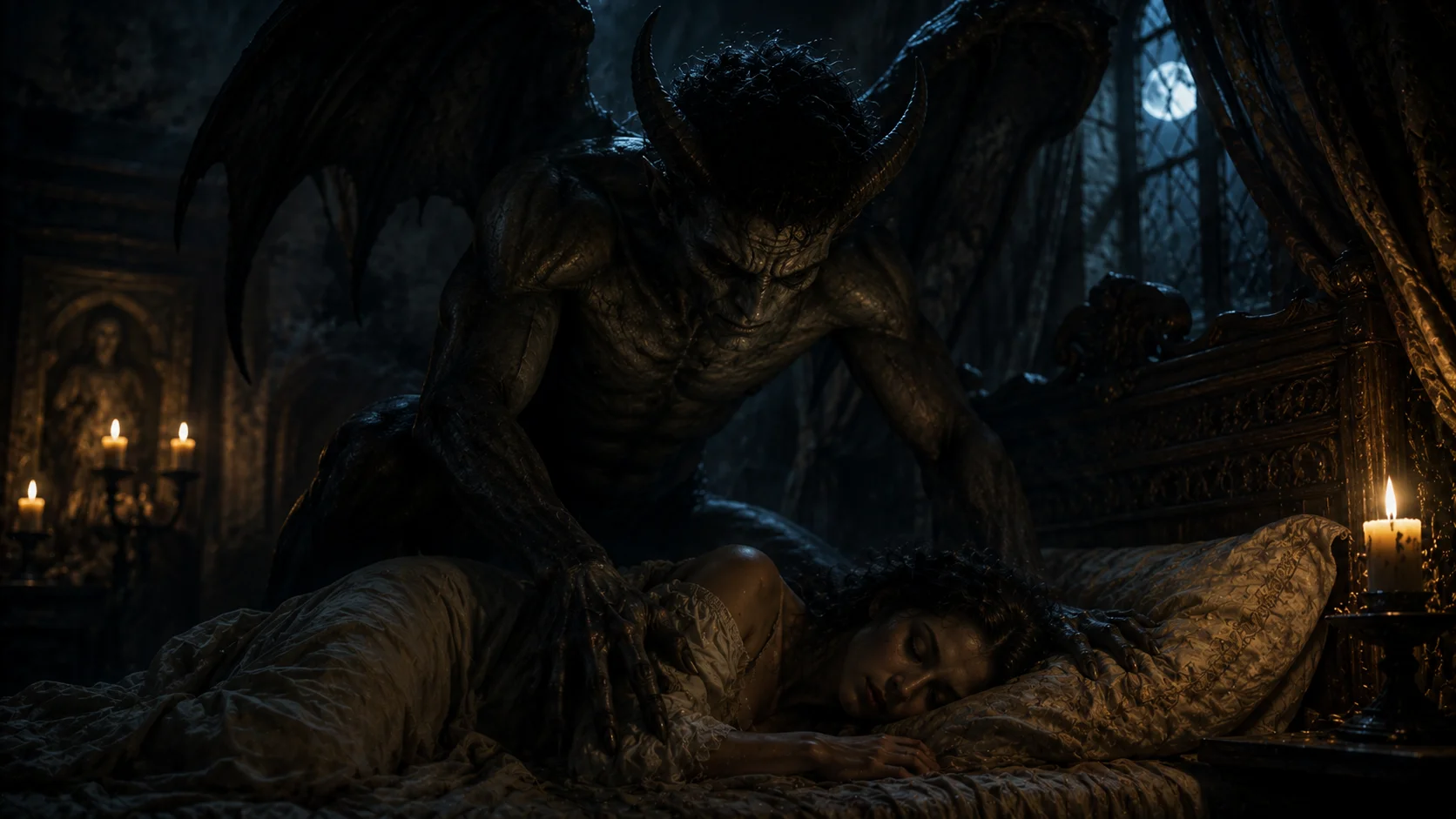
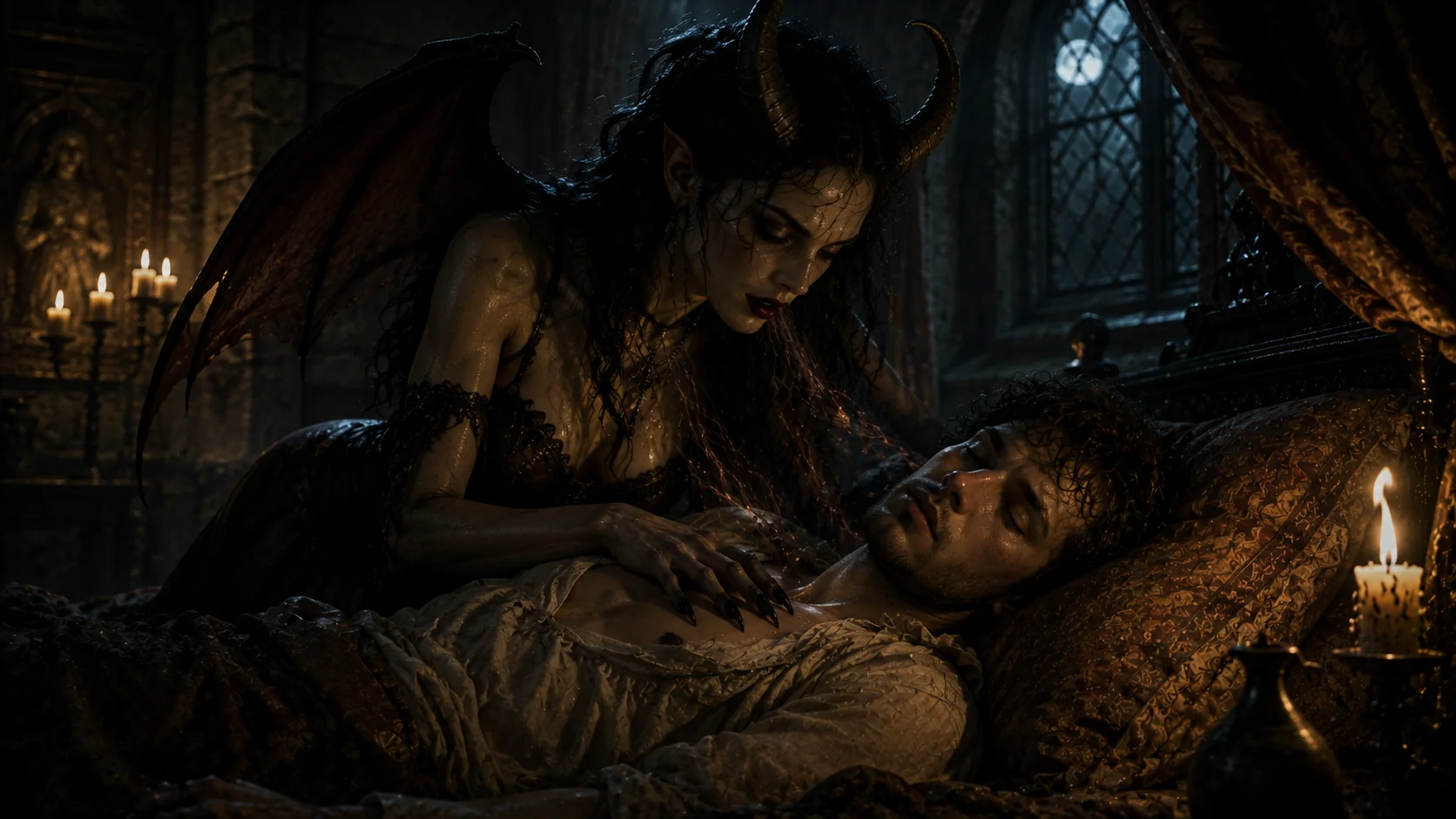
By established belief, the succubus came to a man in his sleep or in the depth of night to seduce him — never by force, but by allure — and in that seduction she drew from him his vital energy, his semen, sometimes his health itself, leaving illness or even death in the wake of her visits. This is a variant of the wider European "nightmare demon" motif: a being who visits sleepers and takes something from them by virtue of the visit alone. The theft was understood as gradual and repeated rather than singular; a man troubled by such visitations across many nights was believed to waste by degrees, his vigor drawn off a little at a time until the pattern became visible to those around him.
Two Halves of One Nocturnal Phenomenon
She was never spoken of as a lone or freestanding demon but as one half of a matched pair. The succubus who seduces a man and the incubus who imposes himself on a woman were understood as two aspects of one demonic phenomenon, per Aquinas's transfer doctrine — the same spirit, changing sex according to which theft it needed to commit. To speak of the succubus at all, in the tradition proper, is to speak of the incubus in the same breath; neither figure was ever fully separable from the other in the medieval theological imagination, since each existed to complete the mechanism the other began.
A Lexical Pair Built to Mirror the Doctrine
The very words are built as a matched set: incubus from incubare, "to lie upon," succubus from succubare, "to lie beneath," a deliberate lexical pairing that mirrors the gendered mechanics the doctrine assigned to each. The naming was not incidental ornament; it was itself a piece of the theology, encoding in grammar the physical posture each demon was believed to take toward its victim.
Named Demons in the Later Grimoires
Later grimoire traditions, including the demonological catalogues of Johann Weyer and works such as the Pseudomonarchia Daemonum of the sixteenth and seventeenth centuries, sometimes linked succubi to specific named demons of lust. These associations were never standardized; they vary from author to author, and the tradition as a whole should be understood as holding this linkage loosely rather than as settled doctrine. A reader moving from one grimoire to another in this period would find no single agreed roster of which named demon governed succubine temptation — only a family of overlapping, competing attempts to catalogue a phenomenon the theologians themselves had never fully pinned down.
A Warning Written into Moral Instruction
Within medieval Christian moral literature, the succubus served a plain didactic purpose. She was the explanation offered for nocturnal emission and for otherwise inexplicable lust experienced in sleep, and through that explanation she became a warning: a figure who reinforced clerical teaching on chastity by giving a face and a will to what might otherwise seem an involuntary bodily event. To succumb to her was to fail a test of virtue, not merely to suffer an accident of the body. This framing gave confessors and preachers a vocabulary for addressing a subject otherwise difficult to raise directly — sin could be named, resisted, and confessed where a bare bodily occurrence could not.
From Private Torment to Public Charge
In the era of the witch trials, this moral function darkened into forensic use. Accusations of consorting with incubi or succubi appear directly in trial records as evidence of a diabolical pact, and the framework the Malleus Maleficarum had built made such accusations legible to courts and inquisitors alike — a private nocturnal encounter transformed, in that context, into a public charge of consorting with the Devil. What had once been a matter between a troubled sleeper and his confessor became, under this later framework, a matter for a tribunal, with the succubus or incubus cited as proof of a pact rather than merely a temptation resisted or fallen to.
Horn, Wing, and the Weight on the Sleeper's Chest
Medieval and early modern art gave the succubus and incubus a consistent visual vocabulary: horned, winged, bat-like or goat-like female demons, at times shown pressing directly upon a sleeper's chest. This iconography overlaps visibly with imagery of the "nightmare" or mara, most famously in Henry Fuseli's 1781 painting The Nightmare — a later, more purely artistic reception of the same visual tradition rather than a strictly demonological source in its own right. The weight on the chest was not an incidental detail of these images; it gave visible, physical form to the draining the theologians described only in abstract terms, letting an illiterate viewer read the doctrine at a glance.
A Question the Theologians Never Closed
Whether the succubus was a literal being, a hallucination, or a symbolic and allegorical device for explaining nocturnal emissions and unaccountable pregnancies was a question medieval theologians debated at length and never fully resolved. That unresolved ambiguity was not a failure of the tradition but part of its attested character — a live theological question that stayed open across generations of scholastic argument rather than settling into a single accepted answer. Even writers who accepted the succubus as functionally real for the purposes of moral instruction or legal accusation did not always commit themselves to her literal, corporeal existence; the doctrine could do its work as explanation and warning whether or not the being behind it was granted full ontological reality.
The Temptress Who Outlasted the Treatises
From this long medieval Christian lineage, rather than from any unrelated mythology, the succubus passed into later Western literature, opera, and popular culture as a stock figure: the demonic temptress, the beautiful and dangerous night visitor. Her legacy traces directly back through Kramer and Aquinas and Augustine to the patristic concern with night-demons and sleepers — a lineage of theological reasoning about temptation, the body, and the will, given lasting form as one of medieval Europe's most enduring demonic figures. What survived into later centuries was not the fine scholastic argument about generative power but the image it had produced: a visitor who comes by night, offers what looks like desire, and leaves something taken rather than given.
Sources & traditions
- EncyclopediaWikipedia — Succubus
- TraditionMedieval European texts, inscriptions and later retellings
Myths change from area to area and from time to time. This chronicle follows the most widely told versions; tellings in other villages, regions and eras may differ.