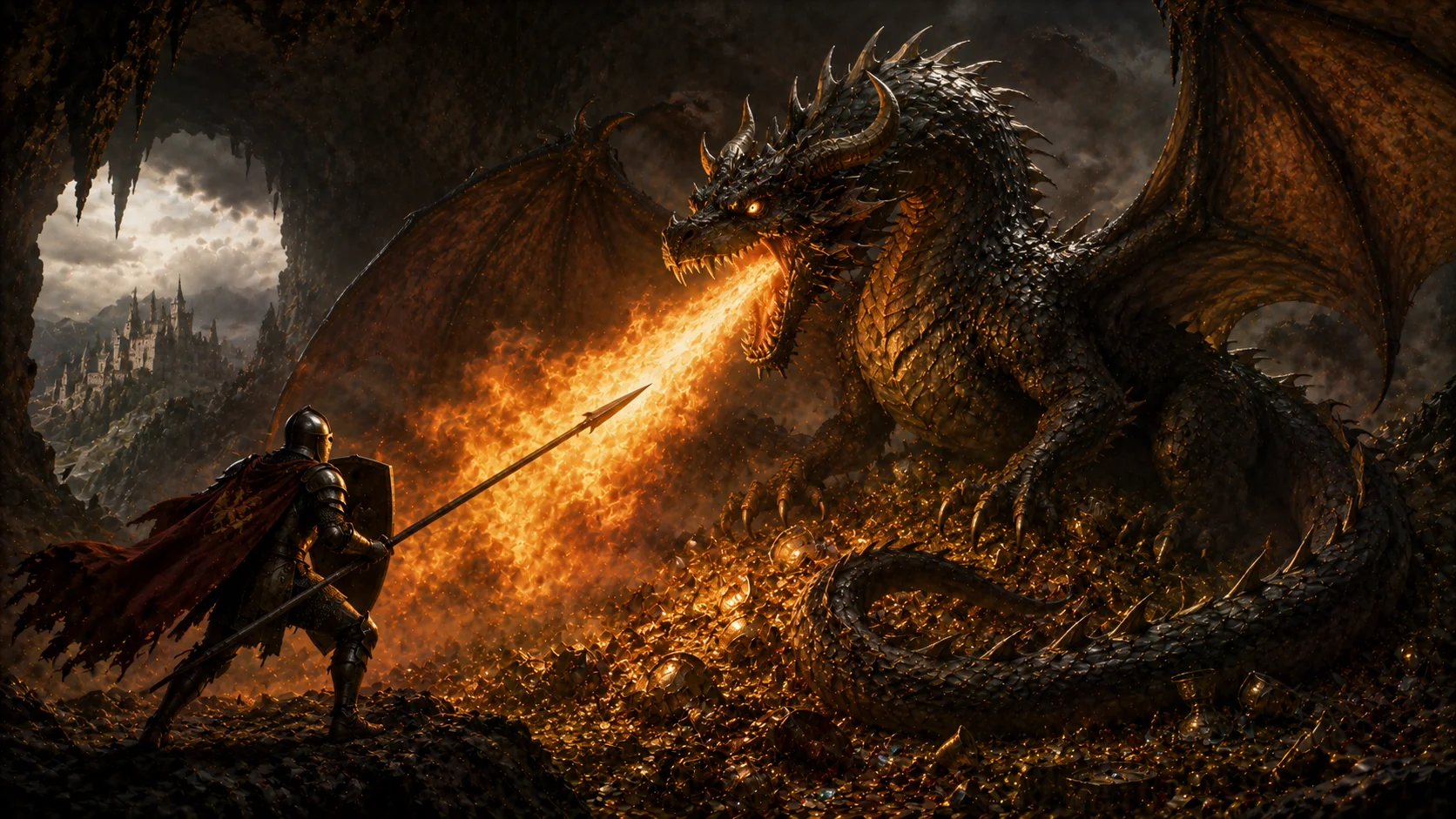
The European Dragon is the great fire-breathing, hoard-guarding monster of European myth and legend: a vast scaled reptile, winged and clawed, that breathes fire, hoards gold, ravages the land, devours maidens and cattle, and is slain by the hero or saint — the supreme adversary of European dragon-lore, from the worm Beowulf fought to the dragon of Saint George. It is the dragon, the archetypal monster of the West.
The Great Worm
The European Dragon (from the Greek drakōn, “serpent, the one who watches”) is the most iconic monster of Western myth — the culmination of a tradition reaching from the serpent-slaying myths of antiquity through the “worms” of Germanic and Norse legend to the great winged dragons of medieval romance and heraldry. The classic European dragon is imagined as a huge reptile, covered in impenetrable scales, with a long serpentine or crocodilian body, mighty clawed limbs, great bat-like wings, a barbed tail, fearsome teeth and horns, and above all the power to breathe fire (and sometimes venom or pestilential smoke).
The Hoard and the Devastation
The European dragon is, classically, a creature of greed and destruction. It hoards treasure — gold, jewels, and precious things — lying coiled upon its glittering hoard in a cave, a barrow, or a mountain lair, jealously guarding it (the dragon Fafnir of Norse legend, the dragon of Beowulf, are great hoard-guardians). And it ravages the surrounding land: laying waste the countryside with its fire, devouring the flocks and herds, and demanding tribute — often the dreadful tribute of maidens, sometimes the king’s own daughter, to be sacrificed to it (as in the legend of Saint George and the dragon). It is the embodiment of chaos, greed, and devastation, the monster that the ordered world of men and gods must overcome.
The Dragon-Slayer
And so the European dragon exists, above all, to be slain — for the dragon-slaying is one of the great archetypal deeds of Western heroism and sanctity. Heroes win their fame and saints prove their holiness by killing the dragon: Saint George skewers the dragon and saves the princess; Sigurd/Siegfried slays Fafnir and wins the hoard (and bathes in its blood); Beowulf falls slaying the dragon in his last battle; Tristan, Lancelot, and countless knights of romance overcome dragons. In Christian symbolism the dragon became the Devil and the serpent of Eden, evil itself, trodden underfoot by the saints and the archangel Michael. As a charge in heraldry, the dragon (and its kin the wyvern) signified valour and power. From this vast tradition the dragon has become the central monster of modern fantasy. In the European Dragon, the West gave form to its archetypal monster — the vast, scaled, fire-breathing, gold-hoarding worm that ravages the land and devours the maiden until the hero or saint lays it low, the great dragon of European legend.
Before the Fire-Breather: Serpents of the Old World
Long before any worm coiled on a barrow of Migration-Age gold, the pattern the dragon would inherit was already old. Greek myth is full of monstrous drakontes set to guard what must not be taken: Ladon, wound endlessly around the tree of golden apples in the garden of the Hesperides, to be killed or slipped past before Heracles can finish his labour; the serpent at Delphi that Apollo kills to claim the oracle for himself; the many-headed Lernaean Hydra, whose severed necks sprout new heads unless the stump is seared shut, forcing Heracles to improvise rather than simply out-fight it. None of these is yet the scaled, winged, fire-breathing beast of medieval romance — the classical drakōn is usually a colossal serpent, legless and wingless. But the shape of the story is fixed centuries before Beowulf or Saint George: something monstrous holds a boundary, a treasure, or a sacred place, and a hero’s worth is measured by whether he can get past it. The medieval dragon did not invent that contest. It inherited it, and then grew wings.
Fafnir: The Man Who Became His Own Treasure
That Sigurd killed Fafnir is the famous half of the story. What Fafnir had been before he was a dragon is the more unsettling half. In the Norse telling — preserved in the Poetic Edda’s Fáfnismál and retold in the Völsunga Saga — Fafnir was born a man, one of the three sons of Hreidmar, brother to Regin and to Otr, who liked to take the shape of an otter. When Loki killed Otr in his otter-skin, the gods were forced to pay a wergild of gold heavy enough to cover the pelt entirely, gold they wrung out of the dwarf Andvari — who cursed the treasure, and above all the ring hidden among it, to destroy whoever held it next. Hreidmar took the hoard as payment for his son’s death; Fafnir, unwilling to share it, killed his own father in his sleep to have all of it, and then, guarding what he had murdered for, took the shape of a monstrous serpent and lay down on Gnitaheath to brood over the gold alone — trusting no one, needing no one, become nothing but the hoard’s jailer. Regin, cheated of his share, took the young Sigurd as his foster-son and raised him for the sole purpose of sending him against his own transformed brother. After the killing blow the dying Fafnir speaks, warning Sigurd that the gold is cursed and will bring his death too — a warning the hero does not heed. Sigurd then roasts the dragon’s heart, burns his thumb on it and puts it in his mouth, and finds that the blood has given him the speech of birds, who promptly tell him that Regin means to murder him next. Fafnir is not a beast that happened to menace men. He is what unchecked greed does to a person, told as literally as a story can tell it.
The Barrow-Wyrm of Beowulf
The Old English poem gives its dragon a domestic, almost mundane provocation. For three hundred winters an unnamed hoard has lain sealed in a barrow, the last relic of a vanished people, watched over by a nameless wyrm that has made the mound its own. The peace is broken not by a hero but by a fugitive, fleeing his master’s anger, who stumbles into the barrow and steals a single gold cup to buy his way back into favour. The dragon wakes, finds the theft, and takes its fury out on the whole countryside — burning homesteads by night, and at last Beowulf’s own hall. Beowulf, now an old king who has ruled in peace for fifty winters, goes down to the barrow to fight it as he fought Grendel and Grendel’s mother in his youth. His chosen retainers run for the woods when the fire proves too much for them; only the young Wiglaf stays, rebuking the others and standing at his lord’s side. Together they kill the wyrm, but not before it drives its fangs into Beowulf’s neck, and the venom does what no sword could do a lifetime earlier. The treasure the dragon died guarding is dug out of the mound and, at the dying king’s own wish, buried again with him — as useless to the living, the poem says pointedly, as it ever was to the dragon.
Two Dragons Beneath Vortigern’s Tower
Britain’s other great dragon story has nothing to do with hoards at all. The ninth-century Historia Brittonum tells how the British king Vortigern tried to raise a fortress in the mountains of Gwynedd, only to have its walls collapse overnight, again and again, however often his masons rebuilt them. His advisers told him the foundation had to be sprinkled with the blood of a boy born without a father. Such a boy was found — and instead of submitting to the sacrifice, he told Vortigern that his masons were building over a hidden pool, and that beneath the pool, sealed in two vessels, slept two worms, one red and one white. When the pool was drained and the vessels opened, the two woke and fought — the white beast driving the red one back and back, until the red rallied at the last and chased the white one from the field. The boy read the omen for the king: the red dragon was the Britons and the white dragon the Saxon invaders, and the fight foretold a long, hard-won British victory. He gave his own name as Ambrosius; later retellings would hand the scene to Merlin. That red dragon — Y Ddraig Goch — is the beast Welsh princes carried as a battle standard, the one Henry Tudor is said to have flown at Bosworth Field, and it stands today at the centre of the Welsh flag: alone among the dragons gathered here, it guarded no treasure and devoured no maidens, and it ended as a nation’s emblem rather than a monster to be slain.
The Lambton Worm and the Wingless Worms of British Folklore
Not every English dragon has wings, or even legs. In County Durham folklore the young heir John Lambton skipped church one Sunday to fish in the River Wear and pulled out a small, eel-like thing ringed with teeth, which he flung down a well in disgust and thought no more about. While Lambton was away for years on campaign, the creature in the well grew — and grew — until it came out as a monstrous worm that coiled itself around a nearby hill, terrorised the villages, and could be quieted each day only with the milk of nine cows left out for it. When Lambton came home to find his family’s land laid waste, he sought out a wise woman, who told him how to kill it: armour studded with spearheads, so that the worm would cut itself to pieces trying to crush him, and the fight taken down into the river shallows, where the current would carry the severed coils away before they could knit together again. She also warned him that after the kill he must slay the first living thing he saw, or a curse would fall on his family for nine generations. He arranged for a hound to be loosed as his signal — but his father, overjoyed at the news, ran out to greet him first, and Lambton could not bring himself to strike him down. The nine generations are still counted off whenever the story is told. The Lambton Worm belongs to a whole category of British worms — the Laidly Worm, the Stoor Worm, the Linton Worm — wingless, often legless, far closer to the barrow-wyrm of Beowulf than to the winged dragon of heraldry, and rooted in one named stretch of ground rather than a distant kingdom.
The Many-Headed Zmey of the Slavic East
Slavic tradition keeps its own dragon, and it rarely has only one head. The zmey of Russian byliny and folk tale — most famously Zmey Gorynych — is usually given three heads, sometimes more, breathing fire from each, and is set at a boundary at least as often as at a hoard: guarding the Kalinov Bridge over the river Smorodina, the crossing between the world of the living and the world of the dead. Where the Western dragon is fought chiefly by knights and saints, the zmey is the business of the bogatyr, the epic warrior-hero of the Kievan cycle, and its most celebrated adversary is Dobrynya Nikitich, who meets it after disobeying his mother and bathing in the Puchai River. Caught without weapons, Dobrynya beats the creature using nothing but a cap of the Greek land, and lets it go on a promise of peace; the dragon breaks the promise immediately, flies to Kiev and carries off Zabava Putyatishna, the niece of Prince Vladimir, and Dobrynya has to go and finish what he started. In many tellings a severed head simply grows back unless the wound is dealt with correctly — the same problem Heracles met at Lerna, surfacing again half a continent and a thousand years away, which suggests that a monster too dangerous to beat by force alone is an idea Europe arrived at more than once.
Reading a Dragon: Wyvern, Lindworm, and Worm
Not every scaled monster called a dragon is built the same way, and heraldry and folklore both kept careful track of the differences. The full dragon — four legs, two wings, barbed tail — is only one variant. A wyvern has wings but only two legs, its forelimbs having become the wings entirely, and a tail usually knotted or barbed at the tip. A lindworm takes its name from the Old Norse linnormr, a compound of two different words for serpent, and it has legs — commonly two — but no wings at all; it runs through Central European and Scandinavian heraldry and legend alike. Klagenfurt in Austria still keeps a stone lindworm at the centre of its main square, carved in 1590, and its sculptor is said to have modelled the head on a great skull dug out of a nearby gravel pit in 1335, which the townspeople had taken ever since as proof that their local dragon had been real. The skull survives in the Carinthian state museum; in 1840 a palaeontologist identified it as a woolly rhinoceros of the last Ice Age, which makes the fountain something close to the first public reconstruction of a fossil animal in Europe — wrong in every particular except the bone it started from. A plain worm or wyrm, finally, has neither wings nor legs at all — a serpent in the oldest sense, and the form both Beowulf’s barrow-guardian and the Lambton Worm actually take, whatever later illustration gave them.
Why the Hoard Still Burns
The dragon outlives the age of saints and sagas because the anxiety underneath it never went away. It is, before anything else, a story about wealth taken out of circulation — gold that does no one any good, sat on by something that cannot spend it, use it, or want it for any reason a person would recognise, only guard it, absolutely, against a world it has decided is made entirely of thieves. That is Fafnir’s fate exactly. It is also why J.R.R. Tolkien, who held the Anglo-Saxon chair at Oxford for twenty years and lectured on Beowulf throughout them, could build Smaug in The Hobbit out of both dragons at once: a hoard-guardian woken by a single stolen cup, exactly as in Beowulf, and a proud, articulate, riddling creature who talks before he burns, exactly as Fafnir talks in the Edda. The fantasy dragon that came after — hoarding, speaking, ancient, and killed in the end by someone smaller and braver than itself — is still working from that template, because the fear it dramatises has not aged at all: that somewhere, something enormous and armoured has taken everything valuable out of the hands of the living, and dares anyone to come and take it back.
Sources & traditions
- EncyclopediaWikipedia — European dragon
- TraditionMedieval European texts, inscriptions and later retellings
Myths change from area to area and from time to time. This chronicle follows the most widely told versions; tellings in other villages, regions and eras may differ.