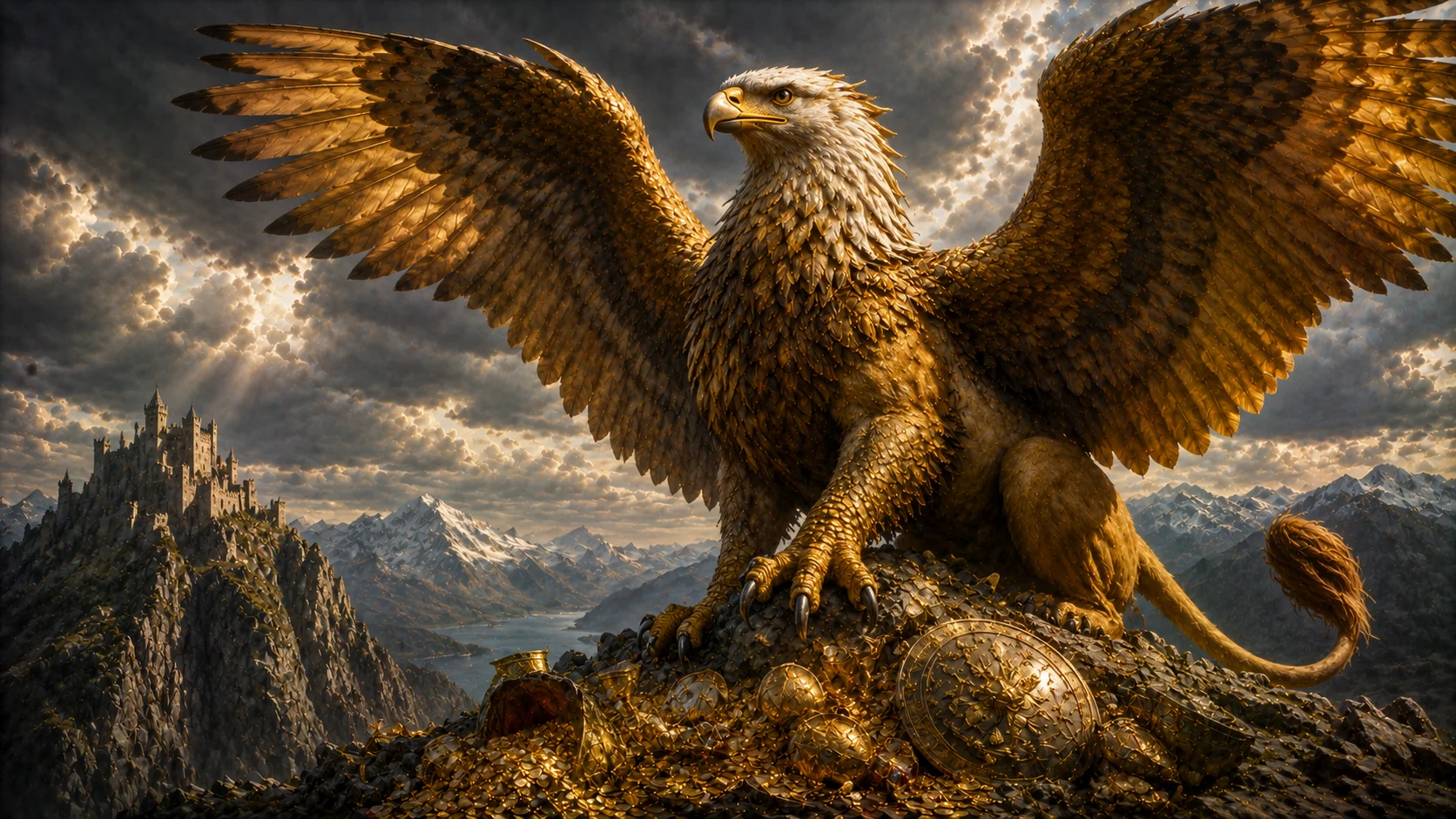
The Griffin (Gryphon) is the majestic eagle-lion of classical and medieval European legend: a noble beast with the head, wings, and talons of an eagle and the body, hind legs, and tail of a lion, guardian of gold and treasure, king of all creatures as the union of the king of birds and the king of beasts, and a great emblem of strength, vigilance, and divine guardianship. It is the eagle-lion, the noble guardian of the bestiary.
The Union of Eagle and Lion
The Griffin (Greek gryps) is one of the most ancient and noble of legendary beasts, known from the art of the ancient Near East, Egypt, Persia, and Greece long before the medieval bestiaries. Its form unites the two royal animals: the head, the great hooked beak, the feathered neck, the broad wings, and the fearsome front talons of the eagle (king of the birds), joined to the powerful body, the hindquarters, the legs, and the tufted tail of the lion (king of the beasts). As such a union, the griffin was held to be supremely majestic and powerful — the king of all creatures, combining the sovereignty of air and earth.
The Guardian of Gold
The classical authors — Herodotus, Pliny, and others — placed the griffins in the far north or east (in Scythia, near the Hyperboreans, or in India), where they guarded great hoards of gold, digging it from the mountains and fiercely defending it against the one-eyed Arimaspians who sought to steal it. This made the griffin a famous guardian of treasure, watchful and implacable, and a symbol of vigilance. Its strength was prodigious — it was said to be able to carry off a horse and rider, or a yoke of oxen, in its talons — and its nest held the marvellous “agate” or eagle-stones.
The Noble Emblem
In the Middle Ages the griffin became a beloved figure of the bestiaries and, above all, of heraldry, where it was one of the most popular and esteemed of all charges — a symbol of courage, strength, boldness, vigilance, and noble guardianship, fit for the arms of the powerful. In Christian symbolism the griffin’s dual nature was sometimes read as representing Christ (king of heaven and earth, divine and earthly), and Dante set a griffin to draw the chariot of the Church in the Purgatorio. The griffin was held to mate for life, a further mark of its nobility. Distinct from its kin the hippogriff (the offspring of griffin and mare), the griffin remained the pure and noble eagle-lion. In the Griffin, the European imagination gave form to the noble guardian — the majestic union of eagle and lion, king of all creatures, watchful guardian of gold, and great heraldic emblem of strength and vigilance, the eagle-lion of the bestiary.
The Griffin Before Greece
Long before Herodotus ever wrote the word gryps, a painter working in the throne room at Knossos set two griffins couchant on either side of a low gypsum seat, holding them in the same heraldic stillness that royal beasts would be given more than two thousand years before heraldry had a name. They are, in the restored fresco, wingless — a detail that unsettles anyone who arrives from the medieval version first. The griffin was already old news to the Bronze Age Aegean. Mycenaean palace frescoes repeat the flanking pose, and in 2015 archaeologists opening an undisturbed shaft grave beside the Palace of Nestor at Pylos found, among gold rings and a superbly carved agate sealstone, a plaque of ivory carved with a griffin — the find was striking enough that its occupant is now known simply as the “Griffin Warrior.” The Aegean griffin owed a debt eastward: winged, horned lion-eagles glazed onto brick friezes lined the palace of Darius I at Susa, and gold armlets terminating in griffin heads — part of the hoard called the Oxus Treasure — show the same creature standing guard on the wrists of Achaemenid Persian nobility centuries before it stood guard on a European coat of arms.
The Lost Poem Behind Herodotus
Herodotus did not invent the gold-guarding griffin; he was already repeating an old story when he wrote it down, and he says as much. The griffin-and-Arimaspian tale traces to a strange, half-legendary figure, Aristeas of Proconnesus, said to have been seized by the god and to have travelled north to the edge of the world, returning with an epic poem, the Arimaspea, about the one-eyed tribesmen who fought griffins for their gold. Herodotus adds a detail he plainly enjoys: Aristeas dropped dead in a fuller’s shop, the body vanished before it could be collected, and men insisted on meeting him alive on the road afterwards. The poem itself is lost, surviving only in quotation, but it was current enough that Aeschylus could fold it into Prometheus Bound, where the chained Titan warns the wandering Io to steer well clear of “the sharp-beaked hounds of Zeus that never bark” and the one-eyed riders beside the gold-bearing stream. A generation or two later the physician Ctesias, who had served at the Persian court, told it again in his Indica, moving the gold and its guardians to India and describing the beasts as four-footed birds roughly the size of wolves, with the legs and claws of a lion. What survives is less a single myth than a chain of retellings with the joints still visible: a lost poem, a tragedy, a history, and a court physician’s notebook, each borrowing from the last.
Steppe Gold and a Fossil in the Rock
The geography the Greeks kept pointing to — the gold-bearing mountains north and east of the Black Sea — was real, and so were its people. The Pazyryk kurgans of the Altai, sealed under ice since the Iron Age and opened by Soviet archaeologists across the twentieth century, gave up felt hangings, carved wooden ornaments sheathed in gold, and the tattooed skin of Scythian chieftains, all carrying the same fantastical animal-style menagerie: coiling, beaked, half-avian predators strikingly close to the Greek griffin. The Scythians who worked this gold country left no written account of their own, but they plainly shared the imagery. Intriguingly, the caravan country further east has yielded, weathering out of red sandstone, the skeletons of the beaked dinosaur Protoceratops — a four-legged, parrot-beaked animal roughly the size of a large dog or small lion, lying across ground that ancient prospectors crossed on their way to the gold. Some historians of science, most notably Adrienne Mayor, have proposed that these fossils, glimpsed half-exposed in the rock, gave travellers something like a skeleton for a monster already in circulation. Palaeontologists have pushed back hard on it, and it remains a disputed hypothesis rather than a settled one — but it is a rare case where the ground itself may hold a clue to how a monster was born.
Cups Carved From Claws
Medieval Europe did not merely tell griffin stories; for a while, it believed it owned griffin body parts. Cathedral and monastic treasuries catalogued “griffin’s eggs” and “griffin’s claws” among their relics and plate, mounting them in silver and bringing them out for feasts and high ceremony. The eggs were ostrich eggs, exotic enough in northern Europe to pass unquestioned; the claws were the horns of ibex and antelope, curved and ridged in a way that a viewer already primed to believe in griffins could read as talon rather than horn. Several of these griffin-claw cups survive in museum and cathedral collections, silver-footed and still gleaming — honest witnesses to how completely the bestiary tradition had convinced its readers that the griffin was not merely a symbol but a living, huntable animal somewhere at the edge of the map.
Alexander’s Flight to Heaven
No medieval griffin story travelled further than the tale of Alexander the Great harnessing a team of them to fly to heaven. It comes from the Alexander Romance, the sprawling and freely reinvented life of the conqueror that circulated in Greek from late antiquity onward and was translated into virtually every language of medieval Europe and the Near East. The legend has Alexander, unsatisfied with ruling the whole of the known earth, build himself a basket or cage, yoke griffins to its corners, and dangle meat on spears just out of their reach so that they beat their wings upward, carrying him toward the sky — until, looking down, he sees the world shrunk to the size of a threshing-floor ringed by a coiled serpent, and is humbled into turning back. The image proved irresistible to medieval artists: it is carved on church facades and laid into cathedral pavements across Romanesque Europe, most famously in the great mosaic floor of Otranto Cathedral, laid down in the 1160s, where Alexander rides his griffin-drawn basket among biblical and legendary scenes as a warning against the pride of earthly kings.
The Griffin’s Other Shapes in Heraldry
Heraldry, which adored the griffin, also complicated it. A griffin reared up on its hind legs is not blazoned “rampant” the way a lion is — heralds reserved a special term, segreant, for the griffin’s version of the pose, wings raised, as though the ordinary vocabulary of the beast-fable was not grand enough for it. Heraldic artists also split the griffin in two:
- the male griffin, wingless and studded along its body with short spikes or rays in place of feathers;
- the stranger opinicus, which swaps the eagle’s front legs for a second pair of lion’s legs and finishes with a short, camel-like tail — a beast borne, among others, in the arms of London’s Worshipful Company of Barbers.
The griffin had also long done duty as civic pride made animal. The Thracian city of Abdera struck it onto its silver coinage in the sixth century BCE, within a century or so of the invention of coined money itself, and centuries before any European nobleman quartered it onto a shield — proof that the eagle-lion was recruited as a badge of guardianship almost as soon as there were badges to be had.
Sources & traditions
- EncyclopediaWikipedia — Griffin
- TraditionMedieval European texts, inscriptions and later retellings
Myths change from area to area and from time to time. This chronicle follows the most widely told versions; tellings in other villages, regions and eras may differ.