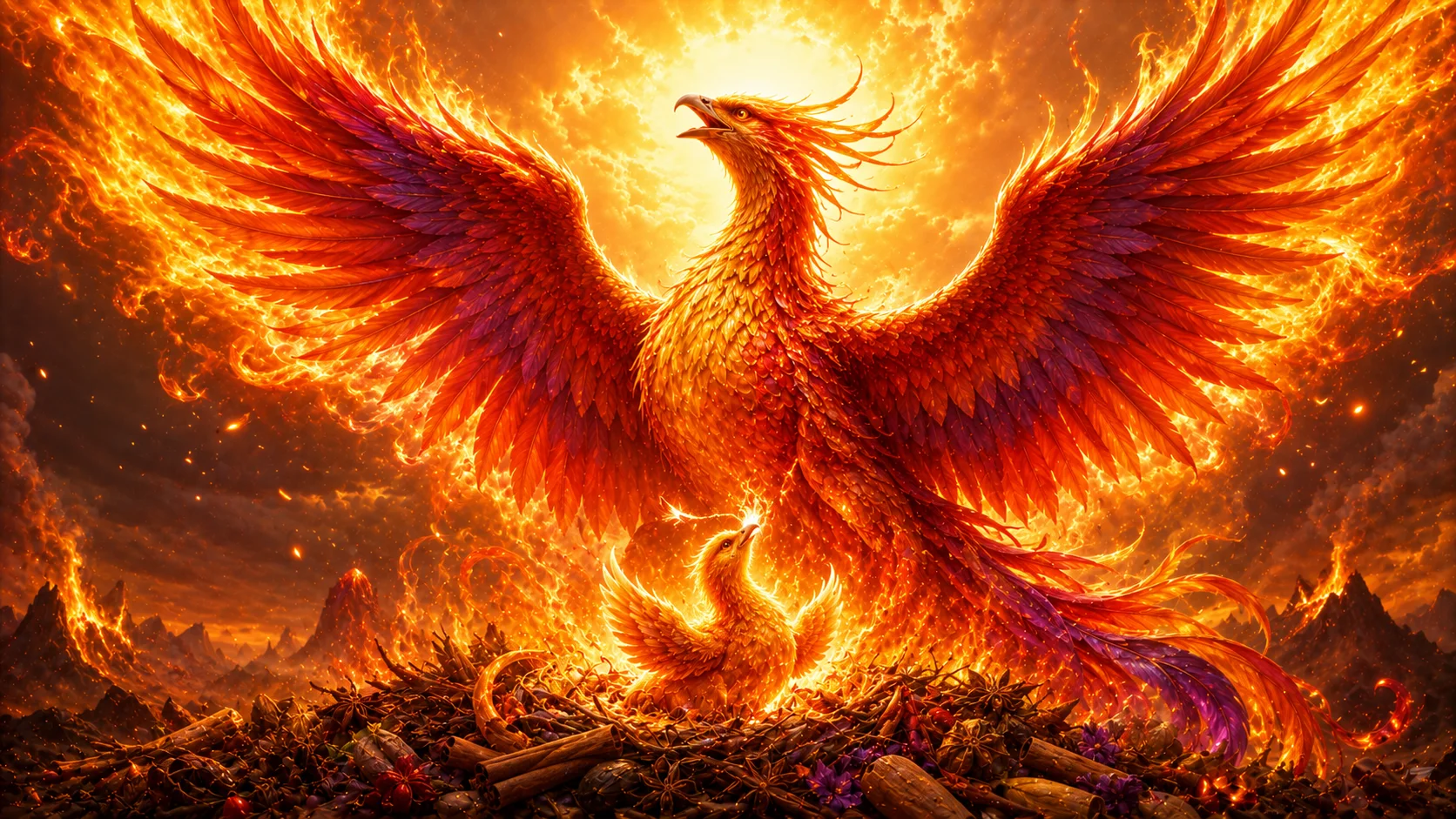
The Phoenix is the immortal fire-bird of classical and medieval European legend: a magnificent, gloriously plumaged bird that lives for centuries, then builds a nest of fragrant spices, is consumed in flames, and rises reborn from its own ashes — the supreme symbol of death and resurrection, renewal, and immortality, embraced by Christianity as an emblem of the risen Christ. It is the fire-bird, the eternal symbol of rebirth.
The Bird of the Sun
The Phoenix (Greek phoinix) is among the most beautiful and enduring of all legendary creatures, known to the ancient Egyptians (as the Bennu, the heron of the sun and rebirth) and described by the Greek and Roman authors — Herodotus, Ovid, Pliny, and others. It was imagined as a great and resplendent bird, often eagle-sized or larger, with magnificent plumage of red, gold, and purple, gleaming like fire and the sun, with a radiant crest and a melodious song. It was a bird of the sun, associated with Heliopolis (the “City of the Sun”) in Egypt, where it was said to return at the end of its long life.
The Death and Rebirth
The phoenix’s defining miracle is its cycle of fiery death and resurrection. There is only ever one phoenix at a time, and it lives an immense span — five hundred years, or a thousand, or more. When at last it feels its end approaching, it builds a nest (or pyre) of the most fragrant woods and spices — myrrh, frankincense, cinnamon, cassia — and there, fanning the flames (or kindled by the sun), it is consumed in fire and burned to ashes. And from the ashes — from a worm or an egg formed within them, in some tellings — a new phoenix arises, young and whole, reborn from its own destruction. The young phoenix then gathers the ashes of its parent into an egg of myrrh and carries it to Heliopolis, to the altar of the sun, completing the cycle.
The Symbol of Immortality
The phoenix is, above all, a symbol — the supreme emblem of resurrection, immortality, renewal, and the triumph of life over death, of the eternal rising again from destruction. The early Christians embraced it eagerly as a figure of the resurrection of Christ and the promise of eternal life, and it appears throughout Christian art and the bestiaries in this sense. Beyond Christianity it became a universal symbol of rebirth, recovery, and the indestructible — of cities and persons and hopes that rise again from their ruin and ashes (“rising like a phoenix”). Its imagery echoes across cultures (the Chinese Fenghuang, the Egyptian Bennu, the Slavic Firebird). In the Phoenix, the European imagination gave form to the fire-bird — the glorious immortal bird that burns to ashes and rises reborn, the eternal symbol of resurrection, renewal, and the victory of life over death.
Before the Fire: the Bennu of Heliopolis
The oldest ancestor of the phoenix does not burn. It stands very still in shallow water, on one leg, watching — a heron, the form Egyptian art settled on for it. The Egyptian bennu appears already in the Pyramid Texts, among the oldest religious writings to survive from anywhere on earth, and its name is usually connected to a root meaning to rise or to shine. That single word carries the whole theology. The bennu is the sun coming up. It is also the Nile coming back.
Egypt’s year was governed by an inundation that arrived, receded, and arrived again, and by a sun that died in the west every evening without fail and was never once lost. A heron standing on the first hillock of mud as the floodwaters drop is not a metaphor for renewal; to an Egyptian farmer it is renewal, arriving on schedule with a beak and grey feathers. Priestly theology gave the image its architecture: the bennu perched on the benben, the primordial mound that rose out of chaos at the beginning of the world and was represented at Heliopolis by a sacred stone. The bird was bound up with Atum and Ra, the creator and the sun, and with Osiris, who dies and is restored — and one of the transformation spells of the Book of the Dead lets the deceased become a bennu, which is to say lets them join the one thing in the cosmos that is guaranteed to come back.
What Egypt did not have was the pyre. There is no self-cremation in the bennu material. The fire is a Greek and Roman contribution, and it arrived late.
What Herodotus Actually Said
The first surviving description of the bird in Greek is also one of the most quietly sceptical passages in ancient literature. Herodotus, gathering priestly lore in Egypt in the fifth century BC, reports a sacred bird called the phoenix that comes to Heliopolis once every five hundred years, carrying the body of its father sealed inside an egg of myrrh, to bury him in the temple of the sun. Then he adds, in effect, that he has never seen one himself except in a painting, and that the story does not persuade him.
Read that carefully and notice what is missing. There is no burning. There is no nest of cinnamon, no worm rising from the ash, no bird kindled by the noon sun. Herodotus’ phoenix is a bird performing a funeral — an act of filial piety, a son carrying his father home. The fire that everyone now thinks of as the whole point of the phoenix is a later Roman-era refinement, and it changed the creature’s meaning entirely: a bird that buries its father is about lineage and continuity, while a bird that burns itself is about a single deathless self, destroyed and restored. The second version is far more useful to a theologian, which is presumably why it won.
Greek tradition also had a riddle, attributed to Hesiod, that stacked the lifespans of long-lived creatures into a tower: a crow outlives nine generations of men, a stag four crows, a raven three stags, the phoenix nine ravens, and the nymphs ten phoenixes. It repays a moment’s attention, because it shows the bird’s original role in Greek thought. The phoenix was not primarily a resurrection symbol. It was a unit of time — the largest span a living thing could be imagined to occupy before you had to start talking about gods.
One further accident of language shaped everything that followed. The Greek word phoinix already meant several things at once: the colour crimson-purple, the Phoenician, and the date palm. The palm was itself a byword for regeneration, since it appears to renew itself endlessly from its own crown. A word that simultaneously meant “the red bird” and “the tree that never dies” was a gift to later preachers, and they took it.
The Bird as a Clock — and a Roman Scandal
Rome inherited the phoenix and immediately did what Rome did with everything: dated it, argued about it, and put it on money.
The problem was that nobody could agree on the interval. Five hundred years was the traditional figure; Pliny the Elder records 540, on the authority of an earlier writer, and ties the bird’s life to the completion of the Great Year — the vast cycle after which the heavenly bodies return to their original positions and history itself is understood to reset. Others gave 1,461 years, which is not a mystical number at all but the Sothic cycle, the period after which the drifting 365-day Egyptian civil calendar realigns with the true solar year. The phoenix, in other words, had been quietly recruited as a calendrical marker: a bird whose death announced that the clock had run down and been rewound.
Tacitus records that a phoenix was reported in Egypt in AD 34, and treats the report exactly as a historian should — he lists earlier claimed appearances under older pharaohs and under a Ptolemy, notes that the intervals between them refuse to divide neatly by either five hundred or 1,461 years, and observes that this has led many to suspect the bird was a fraud. Pliny is blunter still. He reports that a phoenix was brought to Rome and displayed publicly during the censorship of Claudius, in the middle of the first century AD, and adds the deflating detail that nobody doubted it was a fake.
None of this scepticism stopped the state from using the image. The phoenix appears on Roman coinage as the companion of Aeternitas, the personified eternity of the empire, and returns in the fourth century on the great Fel Temp Reparatio issues — “the restoration of happy times” — struck in enormous quantities as the empire advertised its own renewal. A citizen handling small change was being told, coin by coin, that Rome burns and Rome returns. It is one of the earliest examples of the phoenix doing the job it has done ever since: reassuring people, on behalf of an institution, that a catastrophe was merely a phase.
The Christian Phoenix
The Church did not have to argue the phoenix into Christian symbolism. It was there almost immediately. In a letter written from Rome to the church at Corinth around the end of the first century, the phoenix is produced as straightforward evidence — if the Creator arranges for a bird to rise out of its own decay, the resurrection of the body is hardly beyond him. That argument reads oddly now, because it treats the phoenix as a fact of natural history rather than a poetic figure, but that is exactly how it was meant. The bird was a specimen, not a metaphor.
The pun helped too. Where the Greek Old Testament said the righteous would flourish like the phoinix, meaning the palm tree, Christian writers were free to hear the bird, and the ambiguity was too elegant to waste.
The finest ancient treatment is a Latin poem of the fourth century, transmitted under the name of Lactantius, which relocates the whole story into a paradise: a grove far in the east, beyond the sunrise, where there is no illness, no grief, no old age and no death, and where a single bird lives in the light. When its term ends it flies west into the mortal world, into Syria or Phoenicia, to build the pyre — deliberately entering death, and returning. The poem is a startlingly beautiful piece of work, and it fixed the phoenix’s landscape for a thousand years. An Old English poet later took it up and expanded it into the long allegorical poem preserved in the Exeter Book, where the bird’s grove becomes Eden, its fire becomes Judgement Day, and its ashes become the general resurrection — some of the most sensuous nature writing in early English attached to some of its sternest theology.
From there the phoenix entered the Physiologus and the medieval bestiaries, where it is read as a figure of Christ on a specific scriptural hook: the one who has power to lay down his life and to take it up again. The bestiary phoenix is not a mysterious creature. It is a sermon with feathers, and the manuscripts illustrate it doing the only two things that matter — sitting in flames, and stepping out of them.
The Bird That Refused the Fruit
Jewish tradition arrived at a deathless bird by an entirely different road: a single obscure word. In the book of Job, a passage about dying peacefully in one’s own nest uses a term, chol, that most translators render as “sand” — days as numberless as the sand. The rabbis read it instead as the name of a bird, and a story grew to explain it.
In the midrash, when Eve ate the forbidden fruit she offered it to every other creature, and all of them ate — all but one bird, which refused. For that refusal it was granted exemption from the death that came into the world with the rest, and it lives on in cycles of a thousand years, its body wasting and its wings falling away before it renews itself from what remains. The detail to notice is the moral logic. Classical antiquity gives its phoenix immortality as a property, like plumage or wingspan; the midrash gives it immortality as a consequence, earned by obedience at the one moment that mattered. It is the same bird only in outline, and a completely different argument about why anything should live forever.
The Cousins That Are Not the Phoenix
Almost every culture that has a splendid bird has had that bird called a phoenix by outsiders, and the habit has flattened a great deal of distinct tradition into mush. The distinctions are worth restoring.
- The Chinese fenghuang does not burn, does not die, and is not reborn. It is a composite auspicious creature that appears when the realm is well governed and a sage is on the throne, paired with the dragon in imperial symbolism and long associated with the empress. Calling it “the Chinese phoenix” is a European translator’s convenience that has since travelled back and stuck. The Japanese hō-ō and Korean bonghwang belong to this same family, not to the Mediterranean one.
- The Persian simurgh is enormous, ancient, and maternal — in the Shahnameh she raises the abandoned infant Zal and gives him a feather to summon her in need. In ‘Attar’s Sufi allegory the birds of the world set out to find the Simurgh and, at the end of a devastating journey, the thirty who survive discover the pun at the centre of the poem: si murgh is Persian for “thirty birds”, and what they have been seeking is what they have become. Nothing in this is a resurrection myth. It is a mystical one.
- The Slavic firebird (zhar-ptitsa) glows in the dark, and a single dropped feather is enough to light a room and to ruin the life of whoever picks it up. She is a quest-object and a bringer of trouble, not a symbol of eternal life — the engine of a folk tale rather than an emblem of one.
- Arabic tradition’s ‘anqā’ is a byword for something so rare it may not exist at all, and the humā of Persian lore confers kingship on whoever it shades with its wings.
These are living traditions with their own internal logic, and each is diminished by being filed under a Greek bird’s name. The genuine family resemblance — a great bird, solar, singular, associated with legitimate rule — is real and interesting. The fire is not shared.
Ashes, Alchemy and the Tudor Badge
Two later trades found the phoenix indispensable, for opposite reasons.
The alchemists needed an image for what their furnaces were supposed to accomplish. Their process required a substance to be reduced — blackened, burned, apparently destroyed — before it could arrive at its perfected red state, and the bird that must be ashes before it can be gold was the perfect emblem for the reddening. In the illustrated alchemical books of the sixteenth and seventeenth centuries the phoenix stands for the end of the work, the point at which destruction is revealed to have been the method rather than the failure.
Heraldry needed something else: an image of the unrepeatable. Since there is only ever one phoenix, the badge asserts singularity, and it was chosen with great care by the Tudors. Jane Seymour — the queen who gave Henry VIII his son and died of it — bore a phoenix rising in flames. Her stepdaughter Elizabeth I made the bird one of her defining personal devices, and its meaning in her hands is sharper than mere renewal: a creature with no mate, no peer, and no other of its kind alive in the world was an exquisitely precise badge for an unmarried queen who intended her uniqueness to be read as strength rather than lack. Shakespeare, writing after her death, has Cranmer prophesy over the infant Elizabeth in exactly these terms, calling her the maiden phoenix whose ashes will create another heir — a solution, in verse, to the constitutional problem she had refused to solve in life. Milton reached for the same bird for Samson, that self-begotten creature of the Arabian woods, rising from the ruin of its own body.
The Phoenix in the Modern Imagination
No ancient monster has adapted to modernity as comfortably. The reason is that the phoenix requires no belief. You do not have to think a bird exists to find the shape of its story true, and so it survived the Enlightenment intact while the basilisk and the manticore went into the footnotes.
It is stamped on civic identity wherever a city has burned. San Francisco flies a phoenix on its flag, commemorating a nineteenth-century sequence of fires that repeatedly took the city down. Atlanta’s seal shows the bird rising with the motto Resurgens and the dates 1847 and 1865 — the year the city was incorporated, and the year it began rebuilding after the burning. The city of Phoenix, Arizona took the name because it was founded on the ruined canal system of an earlier civilisation — a new settlement literally drawing water through the works of a vanished one.
In fiction the bird has become shorthand so efficient that writers rarely bother to explain it. Bradbury closes Fahrenheit 451 with the phoenix as the emblem of a species that keeps burning itself down and keeps rebuilding, with the faint hope that this time it might remember. Fawkes, in the Harry Potter novels, restores the classical package almost unaltered — combustion, rebirth from ash, healing tears, loyalty — and lends the bird’s name to an order of resistance. Marvel’s Phoenix Force takes the myth in its darkest available direction, making rebirth indistinguishable from annihilation and asking whether a power that can restore anything can be trusted not to consume everything. Stravinsky’s Firebird, meanwhile, made the Slavic cousin famous under a name that has caused a century of comfortable confusion.
Even commerce uses it, and not always kindly. Insolvency practitioners speak of a phoenix company: a business that collapses, sheds its debts, and reopens the next morning under a new name with the same directors and the same premises. It is a sardonic use of the myth, and an unusually honest one — a reminder that “rising from the ashes” can also describe someone walking away from a fire they set.
Why the Phoenix Will Not Die
Most legendary creatures encode a fear. The phoenix encodes a bargain, and it is a harsh one.
The bird does not evade death, negotiate with it, or defeat it. It walks into the fire on purpose. Every version of the story insists on this: the pyre is built by the bird, from materials the bird gathers, in the place the bird chooses. There is no shortcut in which renewal arrives without the burning first. That is a far more demanding promise than simple immortality, and it is the reason the image still works for people who believe in nothing supernatural at all — for the recovering, the bankrupt, the bereaved, the bombed-out city, the person starting over at fifty. The phoenix is the myth we hand to anyone who has had to lose a life in order to get one.
There is a sharper thought buried in it, too, and the ancients felt it. The new bird is not the old bird. It carries the ashes of its predecessor to the altar; it performs a funeral. Whatever rises is continuous with what burned, but it is not the same self walking out of the flames, and no amount of triumphant rhetoric quite dissolves that. Perhaps that is the truest part of the story. Renewal is real, and it is also a bereavement — and the bird of the sun, alone in its grove, has been trying to tell us so for four thousand years.
Sources & traditions
- EncyclopediaWikipedia — Phoenix (mythology)
- TraditionMedieval European texts, inscriptions and later retellings
Myths change from area to area and from time to time. This chronicle follows the most widely told versions; tellings in other villages, regions and eras may differ.