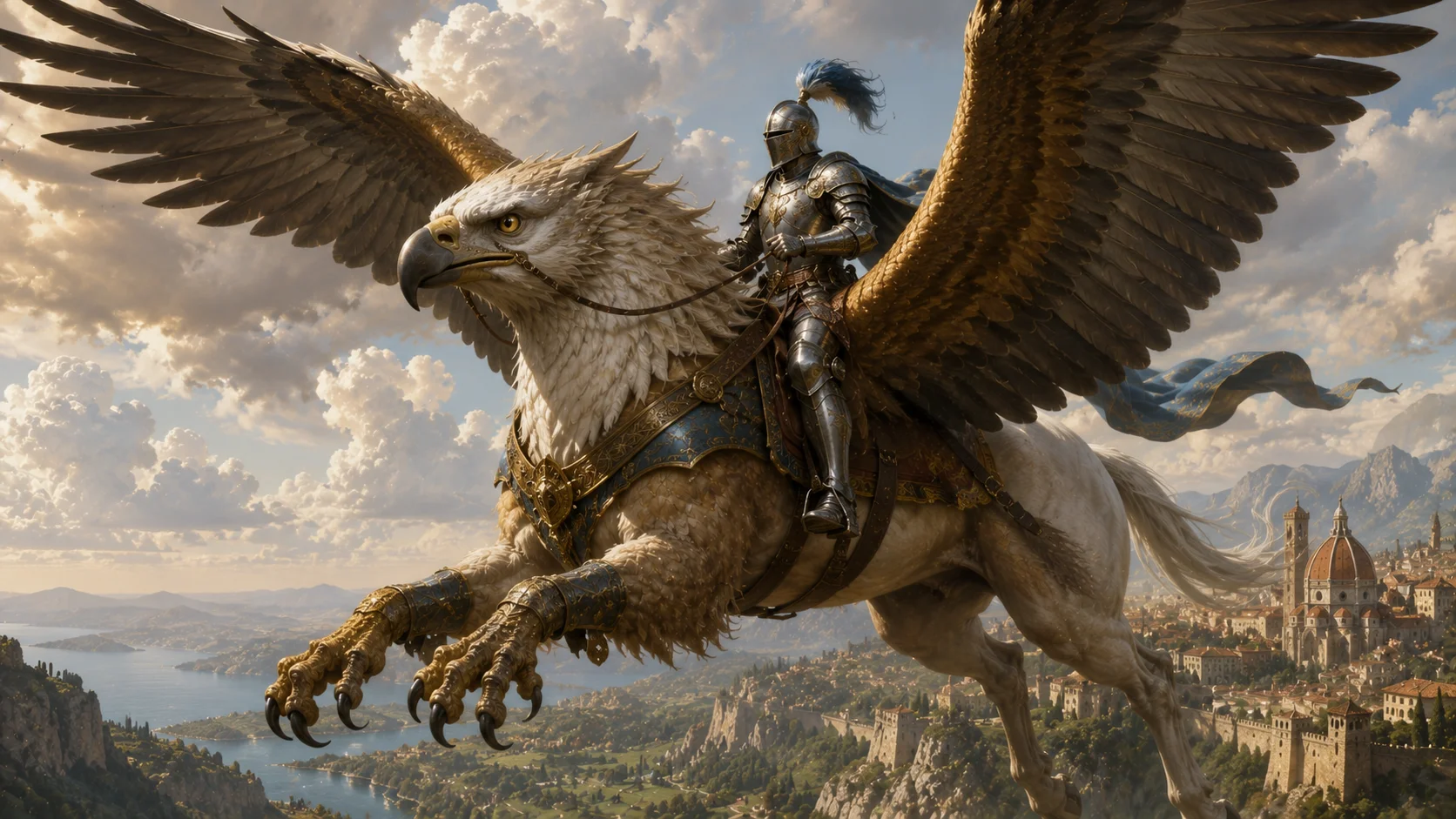
The Hippogriff (Hippogriffe) is the eagle-horse of European, especially Renaissance Italian, legend: a noble winged creature with the head, wings, and foretalons of a griffin (eagle) and the hindquarters and body of a horse, the offspring of a griffin and a mare, swift as the wind and able to fly around the world, famous as the magical steed of the knights of chivalric romance. It is the eagle-horse, the flying steed of romance.
The Offspring of Griffin and Mare
The Hippogriff (from Greek hippos, “horse,” and the griffin) is a creature most famously given form by the Italian Renaissance poet Ludovico Ariosto in his epic Orlando Furioso (1516), though it draws on older ideas. It is the offspring of a griffin (itself half-eagle, half-lion) and a mare — an unlikely union, since the griffin was the natural enemy of horses (it preyed on them), so that a hippogriff was proverbially a thing as rare and impossible as the love of enemies. It has the eagle’s head, feathered wings, and clawed forelegs of its griffin sire, and the body, hindquarters, and hooves of a horse.
The Steed of the Knights
In Orlando Furioso the hippogriff is a marvellous flying mount, swift as thought, that carries the knights on fantastic aerial journeys — the sorcerer Atlante rides it, and then the heroes Ruggiero and Astolfo, who fly upon it to far lands, even (Astolfo) to the moon. Tamed and bridled, it is a steed of incomparable speed and the freedom of the skies, soaring above the earth and bearing its rider wherever it will. Unlike a mere monster, the hippogriff is a noble and beautiful creature, the perfect magical steed of chivalric fantasy.
The Emblem of the Impossible
Because of the natural enmity of griffin and horse, the hippogriff became a symbol of the impossible made real, of paradox and of love uniting opposites — the very phrase “to mate griffins with mares” meant to join irreconcilable things. As a beautiful flying steed it has remained a beloved creature of literature and fantasy, distinct from its fiercer griffin parent. In the Hippogriff, the European (and especially Italian Renaissance) imagination gave form to the eagle-horse — the noble winged offspring of griffin and mare, swift magical steed of the knights of romance and emblem of the impossible made real, the flying steed of the chivalric world.
Virgil’s Impossible Pairing
Fifteen centuries before Ariosto dipped his pen, a Roman poet had already reached for the exact image the hippogriff turns into fact. In his eighth Eclogue, Virgil sets down a short list of things that will happen only once the world has been turned inside out by love, and the first item on it is griffins mated with mares — followed by timid deer coming to drink beside the hounds. Roman readers needed no footnote. The device has a name, adynaton: the impossibility invoked precisely because it can never occur. Ariosto knew his Virgil, and when he gave the world a creature literally born of a griffin and a mare he was not conjuring an eagle-horse out of nothing. He took a fifteen-hundred-year-old figure of speech for never and made it climb off the page, spread its wings, and fly.
What the Bestiaries Made of the Griffin
The line only works because the hostility behind it was old orthodoxy long before the Renaissance. The seventh-century Etymologies of Isidore of Seville places the griffin in the Hyperborean mountains — lion in every part of its body, eagle in wings and face — and adds the detail that matters here: it is violently hostile to horses, and men it tears apart on sight. Medieval bestiaries copied Isidore almost verbatim for centuries, until the claim hardened into a commonplace — where a griffin meets a horse, it kills the horse, and the rider with it. Greek writers from Herodotus onward had already stationed griffins in far northern mountains guarding gold, permanently at war with the one-eyed Arimaspians who rode in to steal it. Whichever thread a reader followed, it arrived at the same place, and Ariosto’s stroke of invention was to ask what would happen if the two beasts met and, for once, did something other than fight.
Ruggiero and the Runaway Flight
The hippogriff’s first extended scene with a hero is not a battle but a bolting horse. The wizard Atlante has been using the creature to raid the sky and stock his mountain fortress with captive knights and ladies; when that castle falls, Ruggiero mounts the hippogriff without the least idea how to fly it, and the animal simply takes him. It climbs over the mountains, out across open water, and keeps going, its rider hanging on with no more control than a man riding weather. Where it finally sets him down is the island of the sorceress Alcina, and one of the poem’s most famous seductions follows. That is the hippogriff’s real function in Ruggiero’s hands: not a steed carrying a knight toward an adventure he has chosen, but the instrument of losing control, depositing him exactly where his own judgement never would have gone.
Logistilla’s Bridle
A creature bred out of griffin and mare cannot be managed by ordinary horsemanship, and Ariosto shows it properly mastered only after a lesson. The better half of that same island belongs to Alcina’s wise sister Logistilla, and it is she who has the hippogriff bridled and teaches Ruggiero the actual craft of aerial reining — when to give it rein, when to check it, how to bring so contradictory an animal down out of the sky. Everything he does afterwards rests on that lesson, including his most celebrated ride: sighting from the air a woman chained naked to a bare sea rock as a sacrifice to a monster of the sea, and going down after her. The woman is Angelica, and Ariosto flags the borrowing himself, measuring the scene against Perseus and Andromeda. One correction to the popular version, though — Ruggiero does not kill the monster. His lance accomplishes nothing against it; he dazzles it blind with the blaze of his enchanted shield and carries Angelica off while it flounders. Killing the beast is left to Orlando, several cantos later, by means considerably less elegant.
Astolfo, the Horn, and the Harpies of Nubia
The hippogriff’s strangest journey belongs not to Ruggiero but to Astolfo, the English paladin who takes possession of the animal once Atlante’s enchantments are broken for good. Logistilla had armed him too, with a horn whose single blast sends anyone who hears it running in blind and undignified panic. He needs it. Flying south into Nubia, he finds the blind king Senapo — whom Ariosto identifies outright with the legendary Prester John — slowly starving inside his own palace, because every meal set before him is fouled by Harpies that drop out of the air the moment the table is laid. Astolfo sounds the horn, the Harpies scatter, and he drives them across the sky to the cavern they nest in. The episode reads less like a monster hunt than a relief mission, undertaken because one man happened to own the only animal capable of reaching a kingdom no army could march to.
Where the Hippogriff’s Journey Ends
One detail that popular retellings blur is worth getting right: the hippogriff does not fly to the moon. Astolfo goes there, to recover the wits Orlando has lost — kept in a stoppered vial among everything else the living have squandered — but the hippogriff’s share of that errand ends on a mountaintop, the summit of the Earthly Paradise, where the apostle John meets him and hands him on to a different vehicle entirely: the chariot of fire that carried Elijah up alive into heaven. The animal is left behind on the mountain while its rider finishes the trip by holier means. The distinction fixes precisely what kind of marvel Ariosto meant the hippogriff to be — a magnificent and thoroughly secular one, bred against nature and broken to the bridle by human skill, and pointedly not a conveyance fit for the sacred. Even in a poem stuffed with miracles, some journeys are out of a griffin-horse’s reach.
Ingres, Doré, and the Painter’s Hippogriff
No single image did more to fix the hippogriff’s silhouette in the European eye than Jean-Auguste-Dominique Ingres’s canvas of 1819, Ruggiero Freeing Angelica — the knight driving his lance down out of the air, the creature’s wings thrown wide, Angelica’s head fallen back against the rock. It hangs in the Louvre and has been reproduced ever since as the definitive picture of the scene, persuasively enough that a great many people who can describe it have never read the canto it comes from. Later in the same century, Gustave Doré’s engravings for an illustrated Orlando Furioso gave the whole poem, hippogriff included, the dense and shadowed Romantic treatment he had already brought to Dante and the Bible. The shape of the beast survives at least as much through its illustrators as through its verse.
Why the Impossible Still Flies
Unlike the werewolf, the hippogriff was never anybody’s nightmare, and it has no folklore of its own — no village ever reported a sighting, no charm was ever devised against it. It answers a different appetite: not the fear of what is out in the dark, but the wish that a rule might bend just once — that enemies might breed, that a horse might fly, that a man might go to the moon and come back with what he had lost. That is likely why it keeps being reborn in very nearly the shape Ariosto gave it, instead of drifting the way genuine folk tradition drifts. It is not passed down by frightened villagers; it is handed forward deliberately, poet to painter to novelist, as a controlled miracle — tame enough to bridle, wild enough that riding it still counts as flying on the impossible. Its best-known modern descendant, the Buckbeak of J. K. Rowling’s Prisoner of Azkaban, keeps the oldest rule intact: bow to the proud half-eagle before you touch it, and never insult it, because it will remember. Five centuries on, the trick Ariosto pulled with one line of Virgil still works exactly as advertised.
Sources & traditions
- EncyclopediaWikipedia — Hippogriff
- TraditionMedieval European texts, inscriptions and later retellings
Myths change from area to area and from time to time. This chronicle follows the most widely told versions; tellings in other villages, regions and eras may differ.