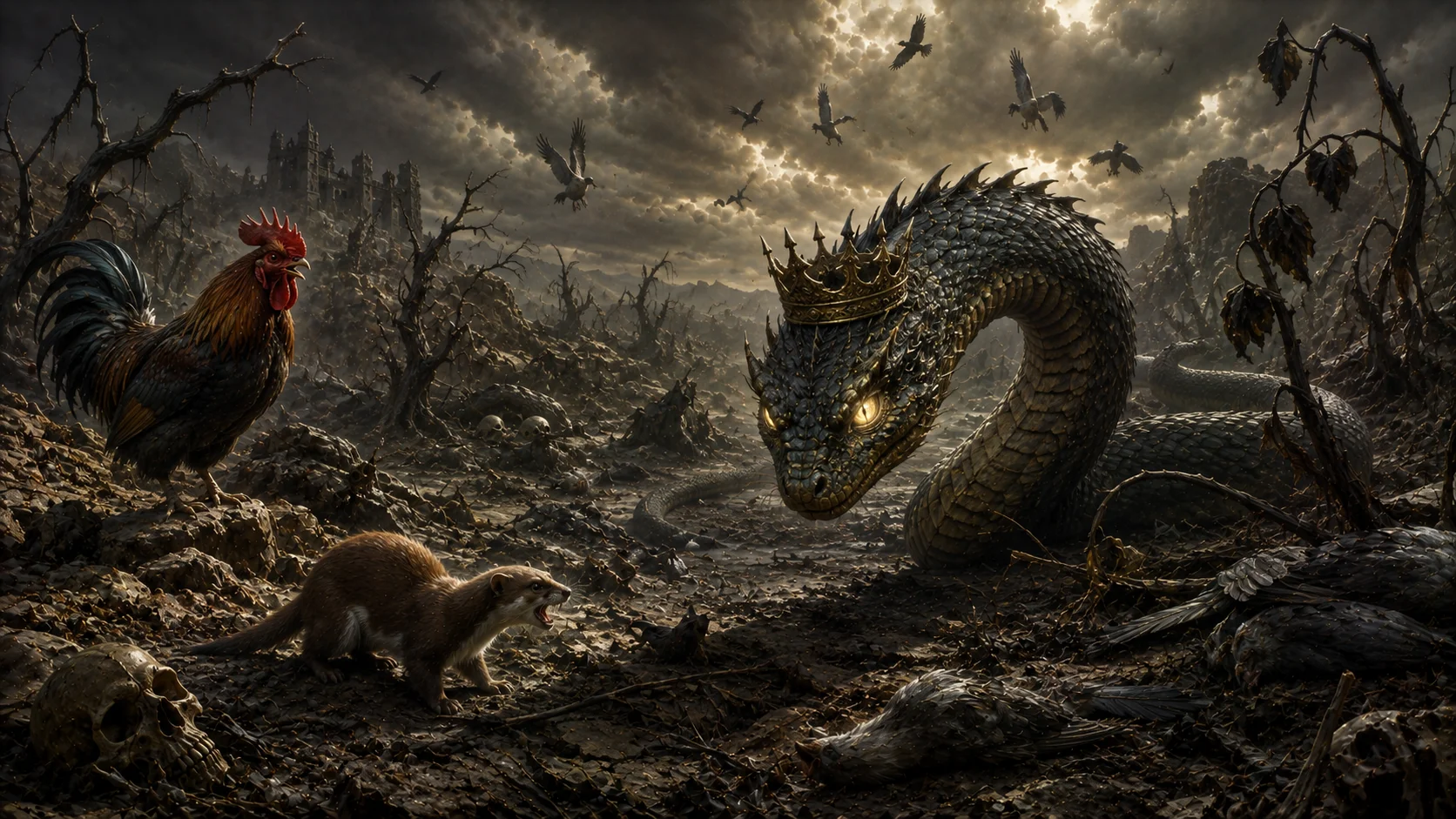
The Basilisk is the dread king of serpents of classical and medieval European legend: a small but supremely deadly reptile whose very gaze and breath bring death, able to slay with a look, to wither plants and crack stone, and so venomous that it poisons the very air around it, born, in the medieval telling, from an egg laid by a cock and hatched by a serpent or toad. It is the king of serpents, the death-dealing glance of the bestiary, a creature whose long transmission from Roman natural history through Christian allegory left it one of the most consistently feared monsters of the medieval imagination.
A Small Serpent Out of Cyrenaica
The earliest detailed account of the Basilisk comes not from a bestiary but from Pliny the Elder's Natural History, written in the first century CE. Pliny locates the creature in Cyrenaica, the coastal region of ancient Libya, and describes it as startlingly small — no more than a span in length, scarcely the spread of an open hand from thumb-tip to little-finger-tip. Its modest size belied a reputation unmatched by any other serpent known to the classical world. Other snakes, Pliny reports, fled at the mere sound of its hiss, abandoning territory rather than risk an encounter. This was a creature that ruled by terror alone, a small body carrying an outsized dominion over every other venomous thing that shared its ground. The name it would carry down the centuries, basiliskos in Greek, meaning "little king," captured exactly this paradox: diminutive in frame, absolute in authority.
The Crown That Named a King
The title "king of serpents," rex serpentum in the Latin tradition, was not merely poetic. Classical and medieval writers alike attributed it to a physical mark: a crest, or a pale crown-like blotch, set upon the Basilisk's head, as though nature itself had stamped the creature with its rank. Isidore of Seville, writing his Etymologiae in the early seventh century, preserved and transmitted this detail, describing the Basilisk explicitly as king of serpents and noting the mark that proclaimed it so. Isidore's account became one of the most heavily used sources for everything that followed — his description of the Basilisk's lethal gaze, its poisonous breath, and its power to kill vegetation and split stone with mere exhalation was drawn upon repeatedly by the bestiarists of the centuries after him. Through Isidore, a compact block of Plinian natural history passed almost intact into the encyclopedic Christian learning of the early medieval period, ready to be moralized and illustrated.
Death Carried on a Glance
What set the Basilisk apart from every other venomous creature in the bestiary was the sheer range of its lethality. Bite and sting were almost superfluous; the creature killed at a distance, through senses rather than through contact. Its gaze alone was fatal — to look upon a Basilisk was, by report, to die on the spot, the poison entering not through any wound but through the eyes themselves. Its breath carried the same power outward in a cloud: grass withered where it passed, shrubs blackened, and the exhaled venom was said to be strong enough to crack open rock and foul the water of streams, so that no living thing could survive for long in the Basilisk's vicinity. Even birds passing overhead were said to drop dead from the sky, felled by air the creature had merely breathed into. Some accounts extended the danger even further, holding that the menace did not end with the creature's death — its corpse, or even its shadow falling across a person, retained enough of its poison to harm the unwary.
Born of an Egg No Hen Ever Laid
Pliny's Basilisk had been a purely serpentine creature, unremarkable in origin if extraordinary in effect. The medieval bestiary tradition changed this decisively, giving the Basilisk an origin as unnatural as its powers. By the height of the bestiary period it was held that the creature hatched from an egg laid by a cock, an egg without a yolk, and that this egg required incubation not by a hen but by a serpent or a toad to bring forth its monstrous occupant. This cock's-egg origin became one of the defining features distinguishing the medieval Basilisk from its classical ancestor, and it did significant work for the bestiarists: an unnatural birth, crossing the boundary between bird and serpent, marked the creature from the moment of its conception as a violation of the created order, a fitting origin for a beast so thoroughly associated with death and evil.
The Weasel That Feared Nothing
No creature in the bestiary tradition was without a natural check, and the Basilisk's was famously specific: the weasel, mustela, was held to be immune to its gaze and was deployed by hunters, according to the topos repeated from the Physiologus-derived tradition through Pliny, Isidore, and the medieval bestiaries alike, to track the Basilisk to its den and kill it there. Illustrators seized on this pairing eagerly, and manuscript images commonly show the two locked in combat, the small serpent-king matched against the one animal unafraid to face it. Some tellings armed the weasel further still, giving it rue, the bitter herb, as protection against the creature's poison before the encounter, a detail that turned the contest into something closer to a ritual duel between a beast of pure menace and a beast of pure, sanctioned courage.
The Cock's Crow as a Second Death-Sentence
Where the weasel destroyed the Basilisk by combat, tradition held that the crowing of a cock could kill it outright, the sound itself proving fatal to a creature that, by the medieval account, had itself been born from a cock's egg. The symmetry was not lost on medieval audiences: the same bird that unwittingly fathered the monster also carried, in its voice, the power to undo it. This trait attached itself more consistently to the Basilisk once its identity had begun merging with the cockatrice, and it persisted into later medieval and early modern sources as one of the small number of things — alongside the weasel and, in some tellings, the creature's own reflection turned back upon it — capable of standing against a monster otherwise held to be unstoppable.
Physiologus and the Road Into the Bestiary
The Basilisk's journey from Roman natural history into the illuminated pages of the medieval bestiary ran through the Physiologus, the Greek proto-bestiary composed sometime in the second to fourth centuries CE that supplied the template for nearly every animal entry that followed it in the Latin West. Through the Physiologus and its Latin derivatives, the Basilisk arrived pre-fitted with the moral scaffolding that Christian bestiarists required of every creature they catalogued: a description of appearance and habit, paired with an allegorical reading fit for sermon and instruction. By the twelfth and thirteenth centuries this material had been standardized into the great Latin bestiaries of the period — the Aberdeen Bestiary and the Ashmole Bestiary among them — where the Basilisk took its settled place as king of serpents, its crest, its lethal gaze, and its cock's-egg birth all present as fixed points of the entry, ready to be copied, illustrated, and moralized across manuscript after manuscript.
The Serpent Trodden Underfoot
Christian moralization gave the Basilisk a meaning far heavier than natural history alone could carry. Its lethal gaze, entering through the eyes, was read as a figure for spiritual death arriving through sight — temptation working its way into the soul by the same route the Basilisk used to kill the body. Its title, king of serpents, aligned it readily with Satan, the prince of this world, so that the small crowned reptile of the bestiary page became, in the moral reading demanded of every entry, an image of the Devil himself. This reading found its scriptural anchor in Psalm 91:13, rendered in the Vulgate as Psalm 90:13 — "super aspidem et basiliscum ambulabis," thou shalt tread upon the asp and the basilisk. The verse gave the creature canonical standing in Christian iconography and was frequently illustrated with Christ trampling the Basilisk underfoot alongside the lion, the dragon, and the asp, four beasts together representing the full compass of the Devil's power, all defeated beneath a single pair of feet.
A Coxcomb, a Crown, a Serpent's Tail
Manuscript illuminators rendered the Basilisk with variety but with certain recurring signals of its royal and monstrous nature. Early depictions favor a small serpent or serpent-like creature marked with a crown or crest upon its head, the physical sign of its title made visible for the reader. As the later medieval period wore on and the Basilisk's identity increasingly merged with that of the cockatrice, illustrators added a cock's head, a coxcomb, wings, and a barbed serpentine tail, producing the hybrid bird-serpent form that would become the creature's most enduring visual signature. The pairing with the weasel remained a favorite subject throughout, the two creatures shown in combat as a visual shorthand for the whole entry — menace and its one sanctioned remedy captured in a single image.
Cockatrice: The Vernacular Twin
From roughly the fourteenth century onward, English usage increasingly reached for a second name — cockatrice — for what was substantially the same creature, particularly when emphasis fell on the cock-serpent hybrid hatched from a rooster's egg. Bestiary scholarship treats basilisk and cockatrice as having merged in vernacular usage even as Latin texts continued to favor the more classically rooted "basiliscus," alongside the near-synonyms "rex serpentum" and "regulus," kinglet, both used by Pliny and Isidore. The two names, one Latin and learned, one English and vernacular, described by this point essentially a single monster, and later medieval and early modern writers moved between them with little concern for distinguishing one from the other.
A Guardian Cut Into Stone and Blazoned on a Shield
Beyond the manuscript page, the Basilisk and its cockatrice variant found a second life in the visual culture of later medieval and early modern Europe. In heraldry the creature appears as a charge blazoned as a serpent-tailed cock, its ancient reputation for terror repurposed into a device meant to guard, to intimidate, or to signal a fearsome protector standing behind a coat of arms. The same imagery carried into ecclesiastical settings, where basilisk and cockatrice figures appear in church sculpture and in the marginal decoration of manuscripts as an emblem of sin, of evil more broadly, or of the Antichrist — an application entirely consistent with the moral reading the bestiaries had already fixed upon the creature, now carried out of the book and into stone, wood, and paint where a wider public could encounter it.
Skepticism Arrives, Centuries Late
The Basilisk's reputation proved durable enough to survive the end of the medieval period largely intact, remaining a recurring reference point in the natural history, medicine, and literature of the Renaissance. It took direct scholarly skepticism, most notably from Sir Thomas Browne in his seventeenth-century Pseudodoxia Epidemica, to begin dismantling the inherited tradition in print — Browne's work, though it falls after the medieval period proper, reflects back on centuries of bestiary material and works methodically to debunk it. That such a rebuttal was needed at all, so long after Pliny first described a small serpent of Cyrenaica, testifies to how thoroughly the Basilisk had lodged itself in the European imagination: a piece of classical natural history that passed through Christian allegory and emerged the other side as one of the continent's most persistent monsters, its crowned head, lethal glance, and unnatural birth carried forward wherever the bestiary tradition itself was read, copied, and believed.
Sources & traditions
- EncyclopediaWikipedia — Basilisk
- TraditionMedieval European texts, inscriptions and later retellings
Myths change from area to area and from time to time. This chronicle follows the most widely told versions; tellings in other villages, regions and eras may differ.