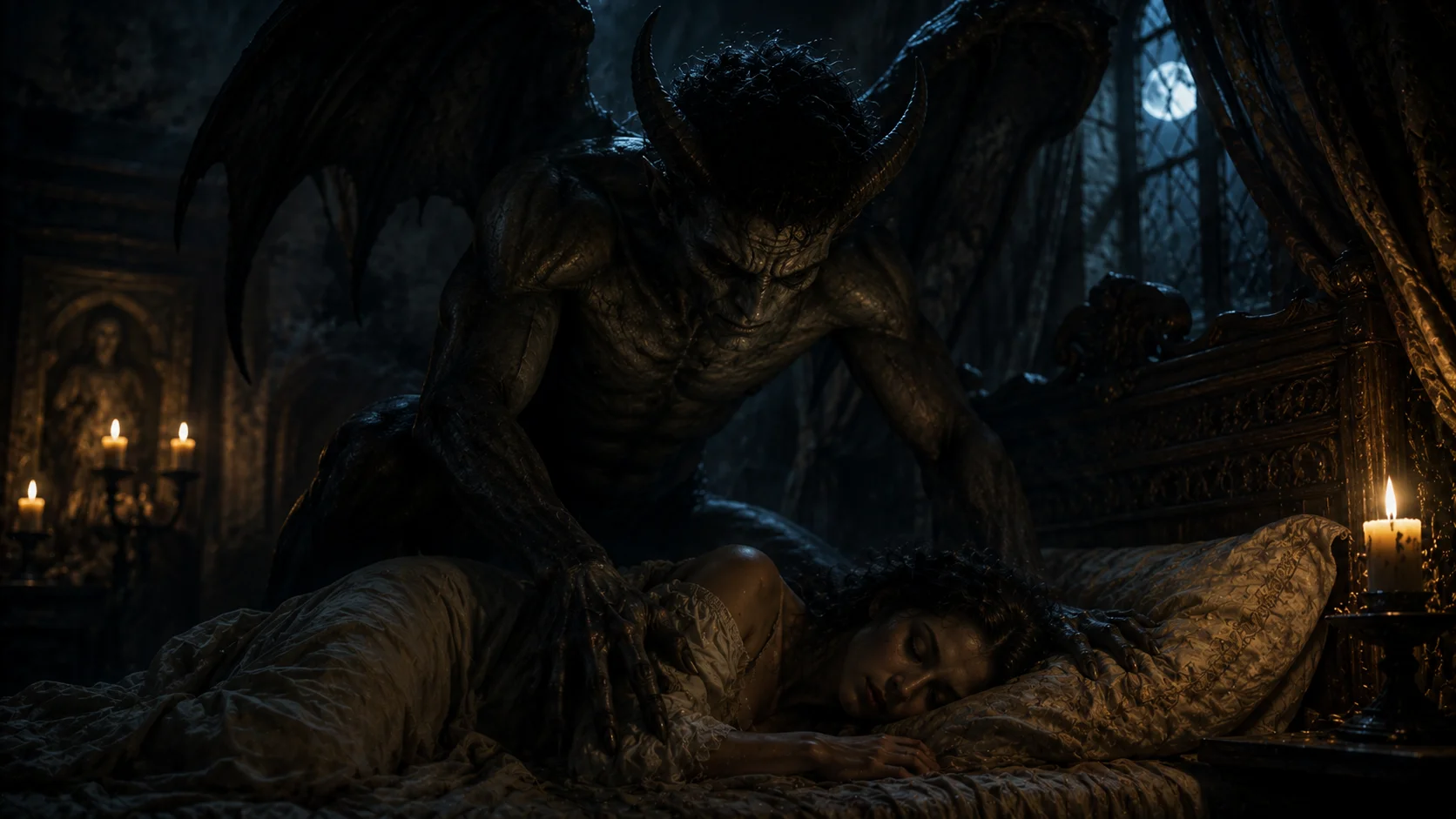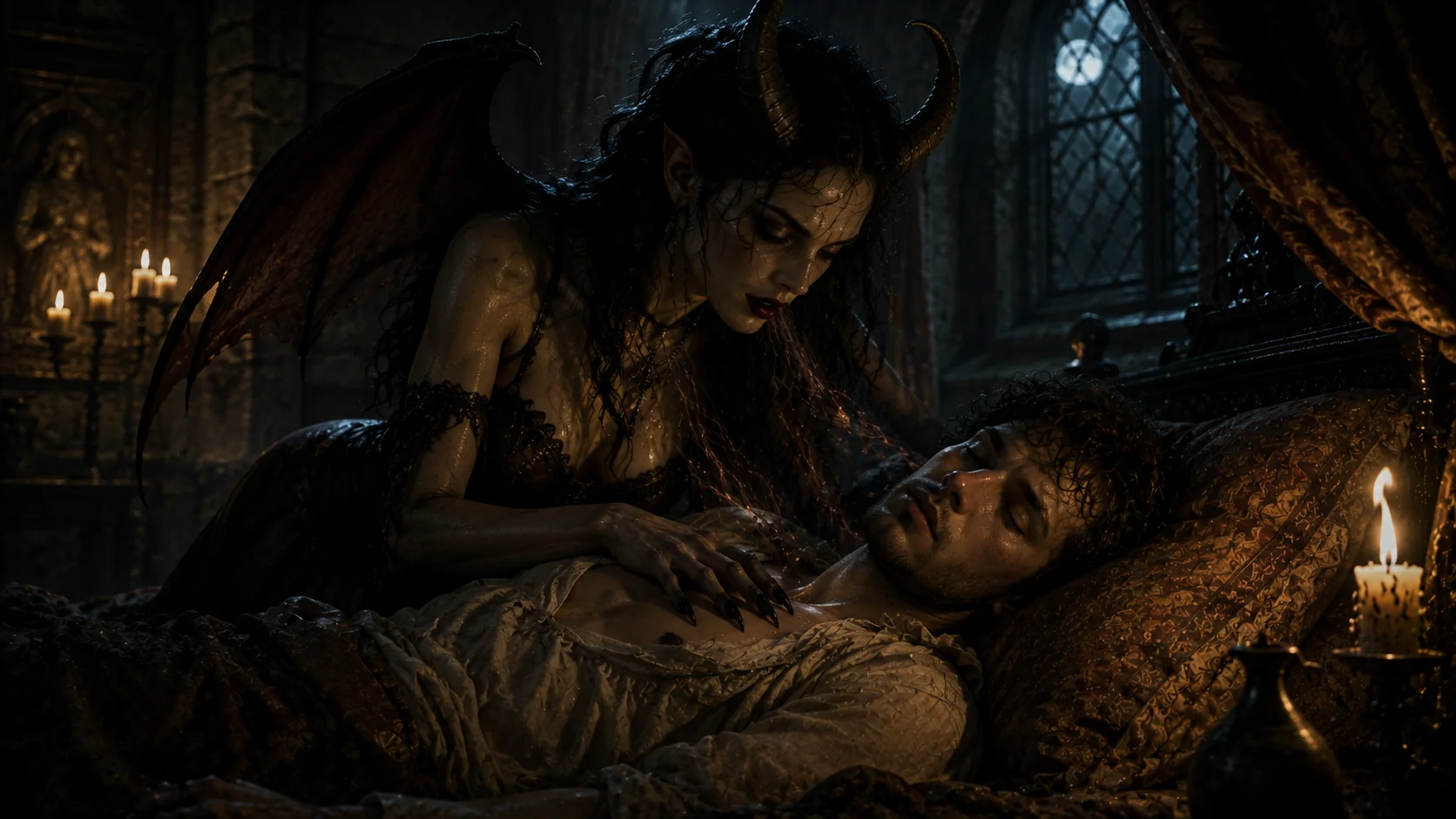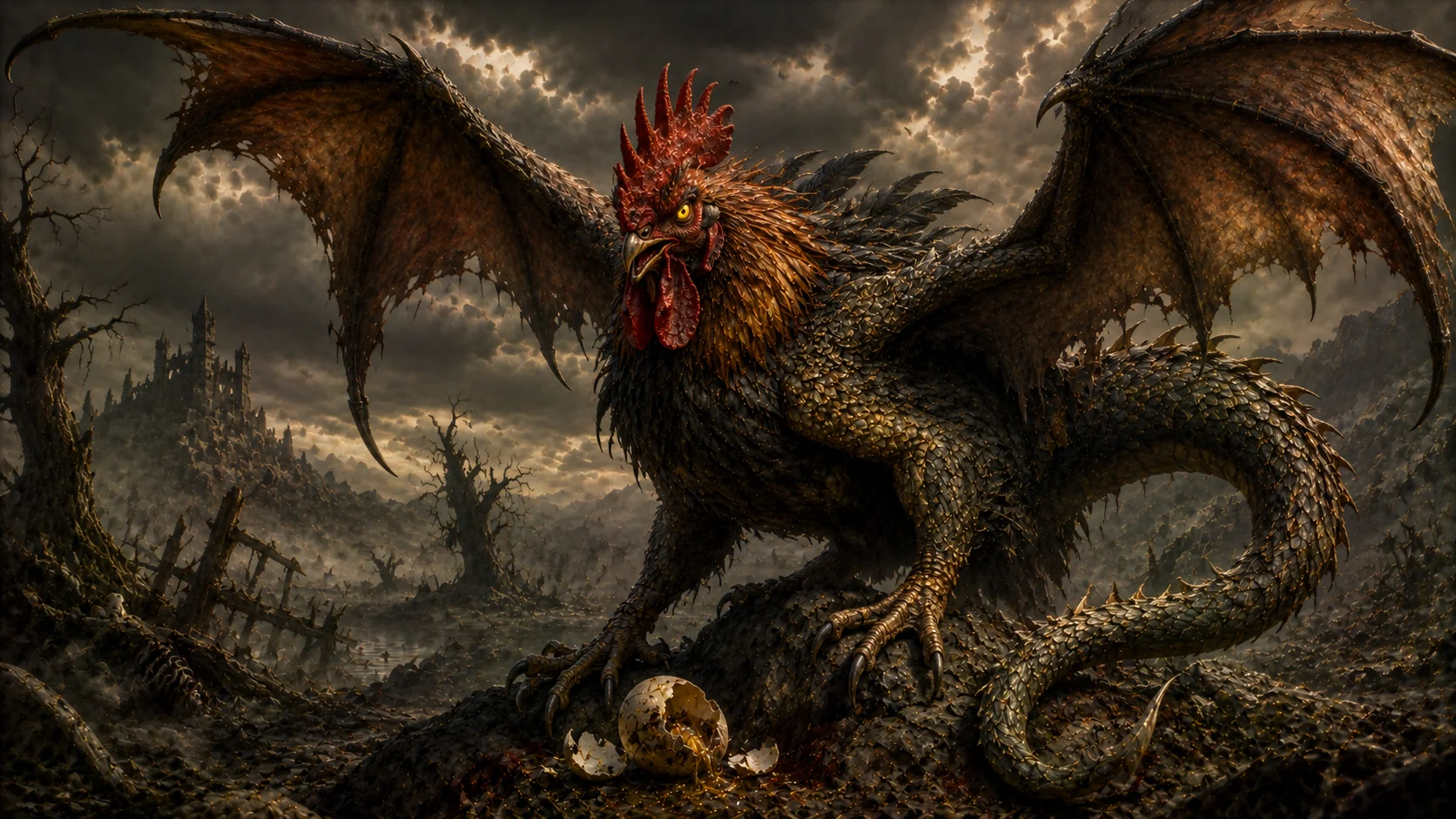
The Cockatrice is the dragon-rooster monster of medieval European legend: a fearsome hybrid creature with the head, wattles, and legs of a cock and the wings and barbed serpentine tail, and often the body, of a dragon, hatched from a cock's egg incubated by a serpent or toad, whose gaze and touch bring death, so closely related to the basilisk that the two became all but one. It is the dragon-cock, the death-dealing fowl of the bestiary.
A Serpent Out of Cyrenaica
The roots of the Cockatrice reach back long before the medieval bestiary, to Pliny the Elder's Natural History, Book VIII, where a small serpent of Cyrenaica is described bearing a power unlike any other creature of the ancient world: it could kill by its gaze alone, and its breath withered the grass it passed over, cracked stone, and struck birds dead in flight. Pliny called it the basilisk, and though it was reportedly no more than a few inches in length, every larger and fiercer beast of the wild gave it ground. This classical basilisk, small, venomous, and lethal at a distance, is the seed from which the entire later tradition grew, and it is worth holding in mind as the ancestor beneath the more elaborate medieval creature that would eventually bear the name Cockatrice.
The King Enthroned in the Bestiary
The basilisk's passage into the Middle Ages was secured above all by Isidore of Seville, whose Etymologiae, Book XII, gave the creature its most influential medieval description. Isidore named it basiliscus, drawing on the Greek basileus, meaning king, and called it the king of serpents, crowned with a small coronet-like crest upon its head. This single image, a serpent wearing the mark of sovereignty, did more than any other detail to shape how later centuries understood the creature: it was not merely dangerous but regal, set above the whole kingdom of venomous things, the terrible monarch at the summit of the serpent family. That royal framing, once fixed in Isidore's authoritative text, carried forward wholesale into the vernacular Cockatrice legends of later medieval Europe, where the crown motif persisted even as the creature's form began to change.
A Name Twisted Through Mistranslation
The word Cockatrice itself carries a curious history of linguistic drift. It descends through Old French cocatris from a Vulgar Latin form that traces, in turn, to the Latin calcatrix, meaning "tracker" or "one who treads." That word was itself a mistranslation of the Greek ichneumon, the name of the small mongoose-like animal traditionally held to be the basilisk's great enemy and hunter. In other words, the very name that would come to designate the deadly cock-headed dragon originated as a garbled label for its natural foe. Somewhere in the long relay of translation and copying between Greek, Latin, and Old French, the name of the hunter was mistakenly attached to the hunted, and the error stuck, hardening over generations of scribal transmission into the settled word Cockatrice.
Where Feather Meets Scale
By the later medieval period, the Cockatrice had developed a distinct visual identity that set it apart from its basilisk ancestor. Where the basilisk was more often rendered in medieval and Renaissance art as a crowned serpent or a small, essentially reptilian dragon, the Cockatrice took on an unmistakably avian character. It was typically depicted as a two-legged, wyvern-like dragon or serpent creature bearing a rooster's head complete with comb and wattles, sometimes given feathered wings in place of the leathery membranes of an ordinary dragon. This was a monster built at the seam between farmyard and nightmare, the familiar bird of the barnyard fused with the coiling menace of serpent-kind, and it is this fusion, more than any single trait, that gives the Cockatrice its particular horror: the domestic made suddenly, irreversibly lethal.
Born of a Yolkless Egg
The Cockatrice's most distinctive contribution to the tradition, one absent from the classical basilisk material entirely, is its origin legend. It was said to hatch from a small, round, yolkless egg laid against nature by an old cock, and that this impossible egg was then incubated to life by a serpent or a toad. This story is attested across medieval sources and persisted into early modern natural history, referenced by writers well into the sixteenth and seventeenth centuries as a settled piece of the creature's lore. The hatching legend matters because it marks the point at which the Cockatrice becomes recognizably its own tradition rather than a mere restatement of the basilisk: a monster whose very conception is a violation of the natural order, an old rooster doing what no rooster should, its unnatural egg quickened by a cold-blooded creature rather than warmed beneath its own kind. Out of that double transgression, medieval imagination reasoned, could only come a double horror.
Death Carried on a Glance
Whatever form it took, cock-headed or serpent-crowned, the creature's defining power remained constant across both strands of the tradition: it killed by its gaze alone. To meet its eyes was death, and this deadly stare was joined, in both the basilisk sources and the later Cockatrice folklore built upon them, by a poisonous breath capable of withering plants, cracking stones, and striking birds dead as they flew overhead. It was a creature whose mere presence poisoned the ground it occupied, radiating destruction outward without any need to strike or bite. This passive, almost ambient lethality is what distinguished the basilisk and Cockatrice from other monstrous serpents of the bestiary tradition; a viper might be avoided by care and distance, but a Cockatrice rendered an entire landscape dangerous simply by existing within it.
The Weasel's Reckoning
No creature so feared was left, in medieval thought, entirely without a natural check, and tradition supplied the Cockatrice with a single named adversary capable of undoing it: the weasel, inherited directly from the ichneumon of Pliny's classical basilisk account. This animal alone, bestiary writers held, was immune to the monster's lethal power and capable of killing it in turn. The pairing of basilisk or Cockatrice with weasel became a fixture of both text and image in the bestiary tradition, the two creatures set opposite one another as a study in balance, the deadliest of serpents matched against the one beast nature had armed to oppose it. In this the Cockatrice took its place within the broader taxonomy of serpent-kind that the bestiaries loved to construct, discussed alongside the dragon and the wider family of serpents, and classed among the most venomous and kingly of that whole order.
A Crest Without a Crown, in the Language of Arms
The Cockatrice found a second, more formal life in English heraldry, where it appears as a recognized charge in period armorials, rarer by far than the dragon or the wyvern but distinct and deliberately drawn. In strict heraldic usage the Cockatrice was blazoned apart from the wyvern specifically by its cock's head, comb, and wattles, and by a beak standing in place of any other creature's tooth or jaw. Heralds who chose the Cockatrice as a charge were reaching for a very particular symbolic weight: not the generic ferocity of a dragon, but the compounded unnaturalness of the hybrid, king of serpents wearing the face of the farmyard, a device meant to unsettle as much as to impress.
The Serpent as Emblem of the Adversary
Within Christian moralized bestiary and homiletic tradition, the basilisk and Cockatrice carried a weight far beyond natural history. Its deadly gaze was read as an emblem of the Devil himself, and its poison, spreading outward from a single small source to blight everything around it, became a fitting image for the corrupting power of sin, which likewise begins in one place and radiates outward to ruin. The creature's very title, king of serpents, echoing as it did Satan's own claimed dominion, made the association almost inevitable to medieval preachers and commentators, who found in this one monster a compact and vivid figure for spiritual pride and the venom of evil at its most concentrated.
Rendered Into Scripture
This symbolic charge was reinforced directly within the biblical translation tradition itself. The Vulgate, and later English translations following in its wake, including Coverdale's Bible and the King James Version, rendered the Hebrew tsepha and tsiphoni as "cockatrice" in several passages of the Old Testament, among them Isaiah 11:8, Isaiah 59:5, and Jeremiah 8:17. Through these renderings the Cockatrice was written directly into the text of scripture as it was read across England for centuries, its name standing for venomous evil and eschatological menace at moments of high prophetic and apocalyptic weight, and cementing, for generations of English readers, an association between the creature and the deepest forms of danger the biblical imagination could summon.
Two Names for a Single Terror
Across this long history, basilisk and Cockatrice were used by many medieval and early modern writers as near interchangeable names for what was, at bottom, the same terrible creature; by the high medieval period, however, "Cockatrice" had come to carry its own distinct iconography, the cock's head and the hatching legend, elements the purer classical basilisk description never possessed. Modern scholarship treats the boundary between the two names as genuinely blurred within the medieval sources themselves, and the honest way to understand the relationship is not that the cock-headed, cock-hatched Cockatrice replaced the basilisk, but that it developed alongside it, a vernacular and folkloric elaboration growing up beside the older classical description rather than supplanting it outright.
The Killing Look, Carried Into Verse
The core motif of the deadly gaze proved durable enough to migrate well beyond the bestiary and into vernacular literature, where it became a familiar poetic image. Early modern English writers, Shakespeare among them, invoked the killing look of a Cockatrice as a stock figure of speech, drawing on allusions found in plays including Romeo and Juliet and Richard III. That the image traveled so readily from natural history into metaphor speaks to how thoroughly the Cockatrice had settled into the English imagination by the sixteenth century, no longer merely a creature described in a bestiary but a byword, ready to hand whenever a poet needed to conjure a gaze sharp enough to kill.
In the Cockatrice, the medieval European imagination gave enduring form to the dragon-rooster, the monstrous hybrid of cock and serpent hatched from an unnatural egg, whose gaze and breath bring death across the ground it touches, opposed alone by the weasel, carried into the language of heraldry and scripture alike, and never fully separable from the ancient basilisk out of whose crowned and venomous majesty it first took shape.
Sources & traditions
- EncyclopediaWikipedia — Cockatrice
- TraditionMedieval European texts, inscriptions and later retellings
Myths change from area to area and from time to time. This chronicle follows the most widely told versions; tellings in other villages, regions and eras may differ.