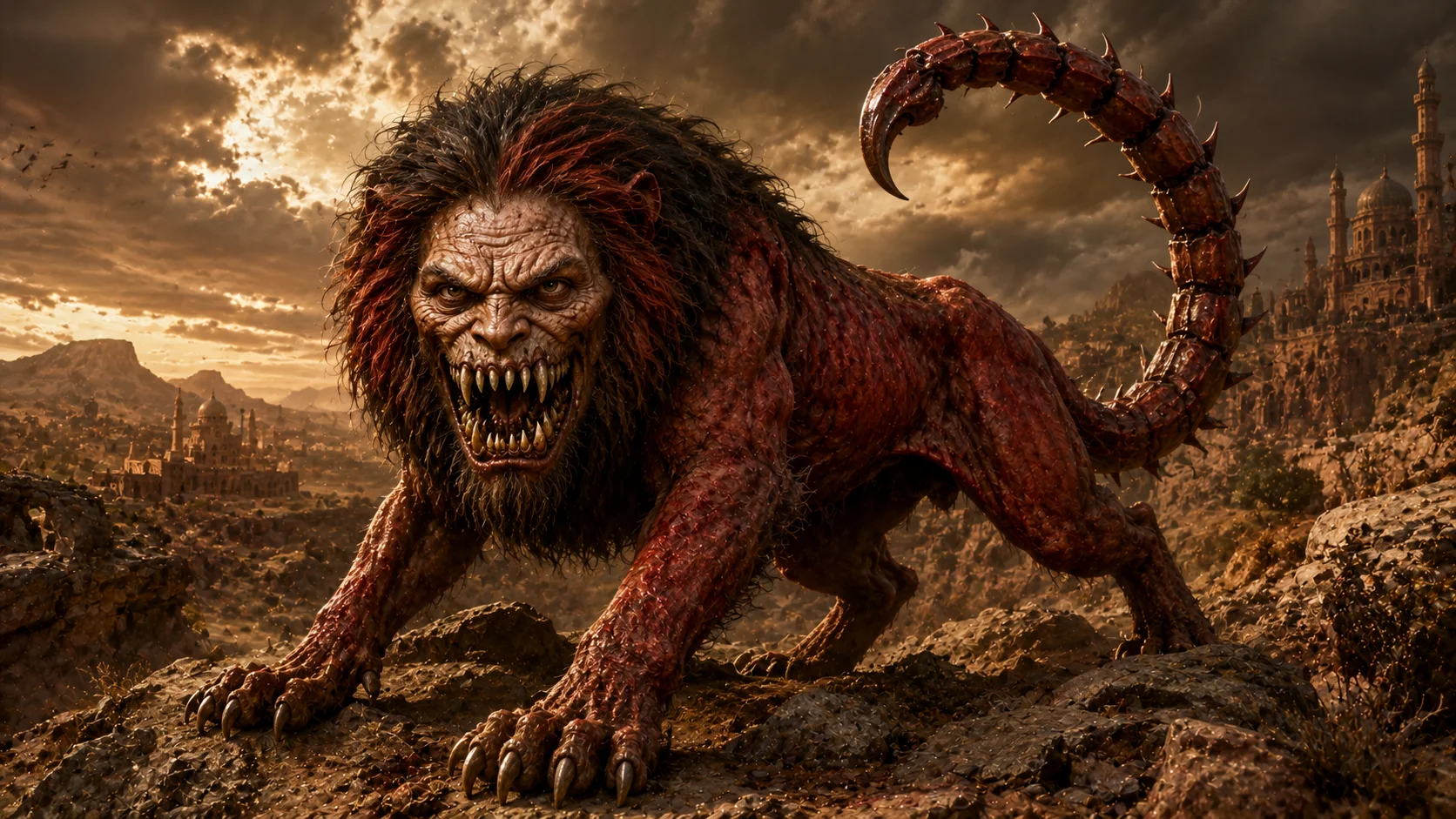
The Manticore is the man-eating monster of Persian and classical-medieval European legend: a fearsome beast with the face of a man, the body of a red lion, and a tail equipped with venomous, dart-like spines, armed with three rows of teeth and a voice like a trumpet mingled with pan-pipes, that devours human beings whole and leaves nothing behind. Across more than a thousand years of transmission, from a Persian court physician's lost notebook to the illuminated pages of English and French bestiaries, it remained one of the clearest images the medieval imagination possessed of appetite without limit.
A Report from the Persian Court
The manticore's earliest surviving trace in Western letters comes not from a naturalist standing in a forest but from a physician seated at a foreign court. Ctesias, a Greek in Persian service during the 5th century BCE, compiled an account of India's marvels, the Indica, drawing on what he heard secondhand and reported as natural history. The original work is lost, but its description of the manticore survived because later writers thought it worth copying. Aristotle preserved a version of it in the Historia Animalium, and Aelian carried it further into his own compendium of animal lore, De Natura Animalium. Neither Aristotle nor Aelian claimed to have seen the beast; both were repeating Ctesias, and in repeating him they fixed his report into the record as something closer to fact than folklore.
The Name That Explains the Creature
The manticore's name carries its own verdict. It descends from the Old Persian martiya-khvāra, meaning "man-eater," transliterated by the Greeks as martichora or mantichora. Unlike many bestiary names, which describe appearance or habitat, this one describes behavior, and it describes nothing else. A creature named for what it does to people carries that identity into every later retelling, regardless of what embellishments accumulate around it. The name is the oldest and most stable part of the tradition, older even than the details of its tail or its teeth, and every medieval scribe who copied "manticore" was, whether they knew the etymology or not, still writing "the eater of men."
From Ctesias to the Latin Encyclopedists
The path from a Greek physician's notebook to a French monastery's bestiary ran through Rome. Pliny the Elder absorbed the Ctesias account into Book VIII of his Natural History, the great Roman encyclopedia that later medieval compilers treated as an authoritative source on animals both real and fabulous. From Pliny the description passed to Solinus, whose Collectanea abridged and popularized Pliny's zoology for a later Latin readership, and from Solinus it reached Isidore of Seville, whose 7th-century Etymologiae, Book XI, became one of the most heavily used reference works of the entire Middle Ages. Medieval bestiary compilers, working in the 12th and 13th centuries, drew directly on Isidore and on the Physiologus tradition to produce the vernacular and Latin bestiaries, including the Aberdeen Bestiary and the Bestiaire of Philippe de Thaon, in which the manticore took the form most familiar to later readers. At no point in this chain did anyone claim new observation. Each writer's authority was the writer before him.
The Face That Should Not Belong to a Lion
What unsettled medieval readers most was the manticore's head. Bestiary and encyclopedic sources agree that it wore a human face, often described as red or blood-colored, set atop the body of a powerful lion. This was not a beast with a human's cleverness grafted symbolically onto animal cunning, the way a fable might use a fox; it was a literal composite, a face that belonged to a person looking out from a predator's body. Manuscript illuminators seized on this detail above almost any other, rendering the manticore in 13th-century English bestiaries with a bearded, human-like countenance fixed to a lion's frame, an image built to be recognized instantly and to disturb on sight.
Three Rows of Teeth
Pliny records the manticore's bite in a precise Latin phrase, triplici dentium ordine, a triple row of teeth, meeting like a comb in both jaws. Bestiary writers repeated the detail faithfully, treating it as a mark of the creature's predatory completeness: not merely sharp teeth but teeth arranged in redundant ranks, as though a single row could not be trusted to finish the work. Where the human face gave the manticore its uncanny familiarity, the triple bite gave it its mechanical horror, a mouth built for consumption rather than communication, however eloquent its voice.
A Tail That Strikes From a Distance
The manticore's most iconographically distinctive feature was its tail, described by Pliny and Aelian as tipped with venomous spines or stings that the creature could shoot like arrows or darts at its prey, in some accounts in more than one direction at once. Manuscript illuminators translated this into a curved, barbed appendage, scorpion-like or dragon-like, arched over the beast's back and poised to strike, and it is this tail, more than the lion's body or the human face, that identifies a manticore at a glance in bestiary art. The weapon mattered because it closed the distance a hunted person might hope to keep: a lion's claws require proximity, but a manticore's tail did not, and no flight from it could be counted safe.
A Voice Built to Deceive
Ancient sources describe the manticore's voice as a strange mixture of pan-pipes and trumpet, a sound at once musical and martial. Medieval retellings leaned further into this detail than Ctesias, Aristotle, or Pliny had, rendering the voice as sweet and sirenlike, a lure rather than merely a noise the animal happened to make. This embellishment was not incidental. A predator that sounds beautiful before it kills offered bestiary moralists exactly the image they needed: appearance and true nature pulling in opposite directions, the ear deceived just as the eye is deceived by the pleasant human face above a lion's shoulders.
The Devourer Who Leaves No Trace
The manticore's defining trait, embedded in its very name, is an appetite for human flesh above any other prey, and sources describe it as consuming victims so completely that nothing remained to be found, no bones, no clothing, no possessions, nothing for searchers to recover or bury. Bestiary writers used this detail symbolically as much as descriptively: a death that leaves no remains is a death that leaves no reckoning, no grave, no closure, and the manticore's total consumption of its victims became shorthand for a kind of erasure more frightening than ordinary killing.
India, Ethiopia, and a Roman Skeptic
Sources disagree, even in antiquity, about where the manticore was supposed to live. Ctesias, transmitted through Pliny, placed it in India; other strands of the tradition locate it in Ethiopia. The disagreement was never resolved and seems not to have troubled most medieval compilers, who were assembling authoritative citations rather than adjudicating geography. One classical voice did register open doubt: Pausanias, in his Description of Greece, suggested that the manticore might be nothing more than a garbled traveler's description of the tiger, its human-seeming face and reddish coat a distorted secondhand account of a genuine Asian predator few Greeks had ever seen firsthand. Pausanias's skepticism is a rare moment in the tradition where a classical writer questioned the chain of authority rather than extending it, and it went largely unheeded by the bestiary compilers who followed.
Kin Among the Marvels of India
The manticore did not travel through the bestiary tradition alone. It is consistently grouped alongside other hybrid predators traced to the same Ctesias-and-Pliny stratum of Indian marvels, most notably the leucrota and the crocotta, forming a recognizable cluster of exotic monstrous beasts distinct from the theologically weightier entries devoted to the lion or the unicorn. Readers encountering the manticore in a bestiary sequence were meant to recognize it as one specimen among several drawn from the same doubtful, distant source, animals whose authority rested on the same secondhand Persian report rather than on independent testimony.
A Warning Dressed as Zoology
Medieval bestiary moralization, working in the Physiologus tradition, read the manticore as more than a zoological curiosity. Its man-devouring nature invited association with the Devil, or with the sin of gluttony or wrath, while its beautiful, musical voice became a warning about the seductive nature of sin itself, the reminder that what sounds most pleasant may be what consumes most completely. In this reading the manticore's physical description and its moral function were never separate; the trumpet-voice and the human face were not decorative flourishes but the very mechanism of the warning, appearance offered as evidence against trusting appearance.
A Beast That Outlived Its Own Century
The manticore did not remain confined to the medieval bestiary. Attested under names including martichora and mantichora, and glossed simply as "man-eater," it was preserved and further embellished by later natural-history writers, most notably Edward Topsell in his 17th-century History of Four-Footed Beasts, extending the tradition's influence well past the medieval period proper. Modern scholarship, including the work of Debra Hassig on medieval bestiaries, has treated the manticore's unbroken run from Ctesias through Pliny, Solinus, Isidore, and the vernacular bestiaries as a textbook case of how a single classical zoological error could be faithfully copied and elaborated across thirteen centuries with almost no independent verification at any stage. The manticore's persistence says less about the animal it was meant to describe than about the compilatory, authority-citing method by which medieval natural history was written, a method that valued a trustworthy source over a firsthand look, and that, in this case, trusted a source that had never seen the beast either.
Sources & traditions
- EncyclopediaWikipedia — Manticore
- TraditionMedieval European texts, inscriptions and later retellings
Myths change from area to area and from time to time. This chronicle follows the most widely told versions; tellings in other villages, regions and eras may differ.