Beneath the restless skin of the ocean, in the cold dark where sunlight never reaches, dwell the Ponaturi — a people the old traditions remember not as monsters in the fairy-tale sense but as a real and dangerous tribe of the deep, bound by a single, absolute law: the sun must never find them above water. They belong to the wider family of Māori sea-beings alongside the great Taniwha that haunt rivers and coastlines, yet the Ponaturi are stranger still — a nocturnal nation with a grievance against humankind that reaches back to the ancestors of the storm-caller Tāwhaki himself.
A People Who Cannot Bear the Dawn
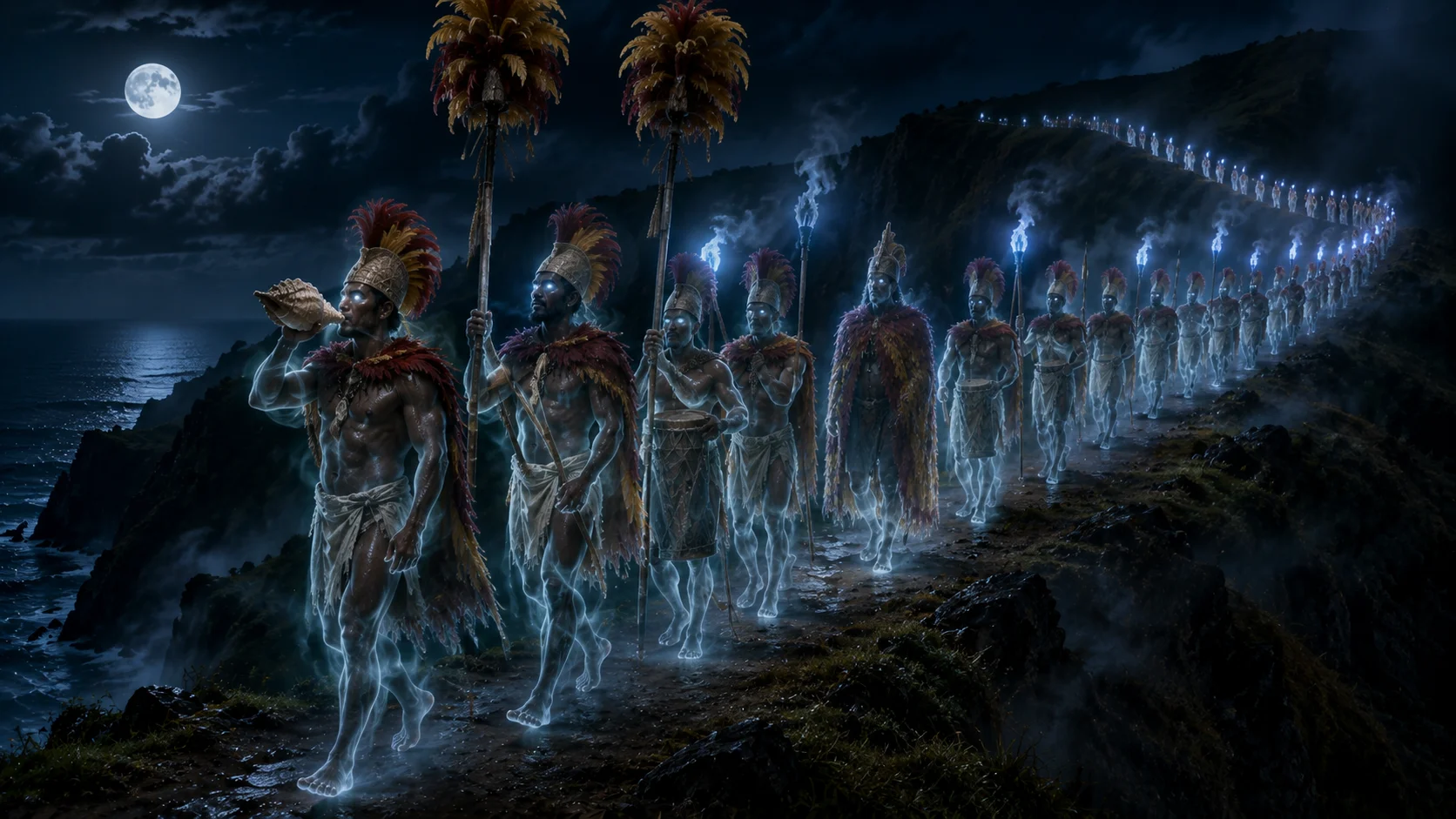
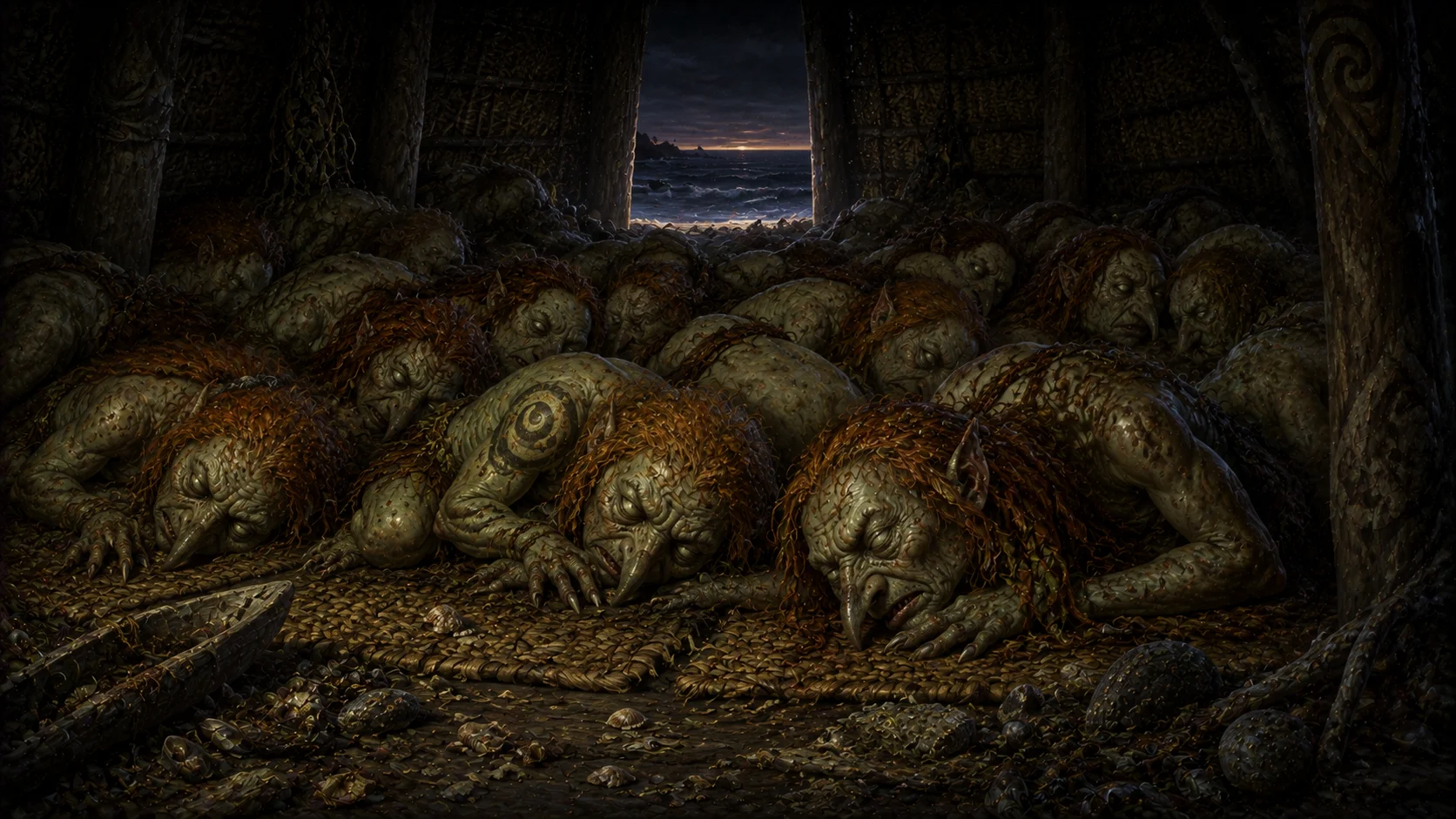
Every account of the Ponaturi agrees on this one defining trait: they are creatures of darkness in the most literal sense. Sunlight does not merely trouble them — it destroys them. Each night they rise from beneath the sea to walk on land, to raid, to sleep in the houses of men if they can claim them, but always with one eye on the horizon, because whatever business they conduct ashore must be finished and undone before the first light touches the water. This single vulnerability shapes everything about how the Ponaturi are remembered: not as an army that can be met and beaten by strength, but as a danger that can only be defeated by patience, cunning, and the turning of the earth itself.
It is worth pausing on how unusual this makes the Ponaturi within the wider bestiary of Māori tradition. Most fearsome beings of the deep — the great taniwha among them — are dangerous because of size, strength, or supernatural mana that a human simply cannot match by force. The Ponaturi's danger is almost administrative by comparison: it is a matter of timing. Survive until dawn, or trick them into believing dawn has not yet come, and the most fearsome tribe in the ocean becomes as vulnerable as anything else caught in the open under a rising sun. That inversion — a whole people undone by a clock they cannot control — is part of why the story of their defeat has stayed so memorable across generations of retelling.
Kin of the Patupaiarehe, Yet Apart
Māori tradition holds several peoples who are neither fully human nor fully spirit, each with its own relationship to light and shadow. The Patupaiarehe, the pale, fair-haired dwellers of misty forests and high country, share with the Ponaturi a horror of the sun and an existence lived at the margins of ordinary human life. Where the Patupaiarehe are remembered as skilled musicians — playing the kōauau and the pūtōrino, retreating into mist at the first fire or the first light of morning — the Ponaturi carry none of that gentler reputation. But where the Patupaiarehe retreat to mountain mist and are sometimes remembered as intermarrying with chiefly lines in places such as Pirongia and Pukeamaru, the Ponaturi belong to the sea rather than the forest, and their stories carry a harder edge — less enchantment, more menace. Together these beings mark out the limits of the human world: the water's edge and the forest's edge alike are places where ordinary law gives way to older, stranger powers, and both peoples are, in their own way, prisoners of the sun's schedule rather than free agents within it.
The House Beneath the Waves
Oral tradition describes the Ponaturi as living in a submarine world of their own, a house or settlement beneath the ocean where they gather once their night's business on land is finished. It is a mirror-image of a human village, ruled by its own customs, but existing entirely out of reach of the living except when the Ponaturi themselves choose to surface. This underwater dwelling reinforces the sense that the Ponaturi are not simply hostile animals to be hunted, but a people — with a home, a society, and a claim to have been wronged, just as much as they are accused of wronging others. That the decisive confrontation with them happens not in their own sunken hall but in a human house on land is itself significant: the Ponaturi are lured out of the one place where the ordinary rules of day and night cannot touch them.
The Capture of Hemā
The best-remembered episode binding the Ponaturi into the wider genealogy of Māori heroes concerns Hemā, father to the line that produces the great ancestor Tāwhaki. In the traditions recorded across various iwi, Hemā is captured — in some tellings killed — by the Ponaturi, an act of violence that reaches up through the generations and demands to be answered. This is the seed from which the whole Ponaturi story grows: not a random monster tale, but a wrong done to a specific whakapapa, one that a descendant is honour-bound to avenge. It places the Ponaturi squarely within the same web of ancestry that connects the storm-bringer Tāwhaki to his heavenly ascent and to the thunder-goddess Whaitiri, who is sometimes named as his forebear and who lends the family line its long association with weather and sky.
A Debt Owed Across Generations
What makes the Ponaturi narrative distinct among Māori sea-lore is this thread of inherited obligation. The taking of Hemā is not resolved in the moment it happens; it waits, sometimes for a generation, until a descendant with the strength and cunning to answer it comes of age. This is a familiar shape in Māori storytelling — wrongs are remembered exactly because whakapapa remembers them, and the working-out of utu, of balance restored, becomes the engine of the tale. In some versions of the wider Tāwhaki cycle it is Hāpai's own family — the women who later nurse the injured Tāwhaki back to health after his brothers-in-law leave him for dead — who carry the memory of the Ponaturi's crime forward, so that grievance and rescue sit side by side in the same genealogical line. The Ponaturi are thus not merely an obstacle in someone's path; they are the reason a hero's path exists at all.
Trapped by Trickery, Not by Force
When revenge finally comes, it does not come as a battle of spears. The traditions describe the Ponaturi being lured or trapped inside an enclosed house, deceived into believing the night is longer than it truly is, or otherwise kept from noticing the approach of dawn. The doors and openings are sealed, chinks of light blocked, until the moment is right — and then the walls are thrown open, or the light let in all at once, and the sun itself becomes the weapon. It is a satisfying inversion: a people who prey on the unwary by night are undone by their own unwariness in the one hour that matters most to them. The pattern echoes a broader Māori narrative habit, seen too in the trickster Māui's dealings with the fire goddess Mahuika, where cleverness rather than raw strength is what finally settles an old score.
Sunlight as Judgement
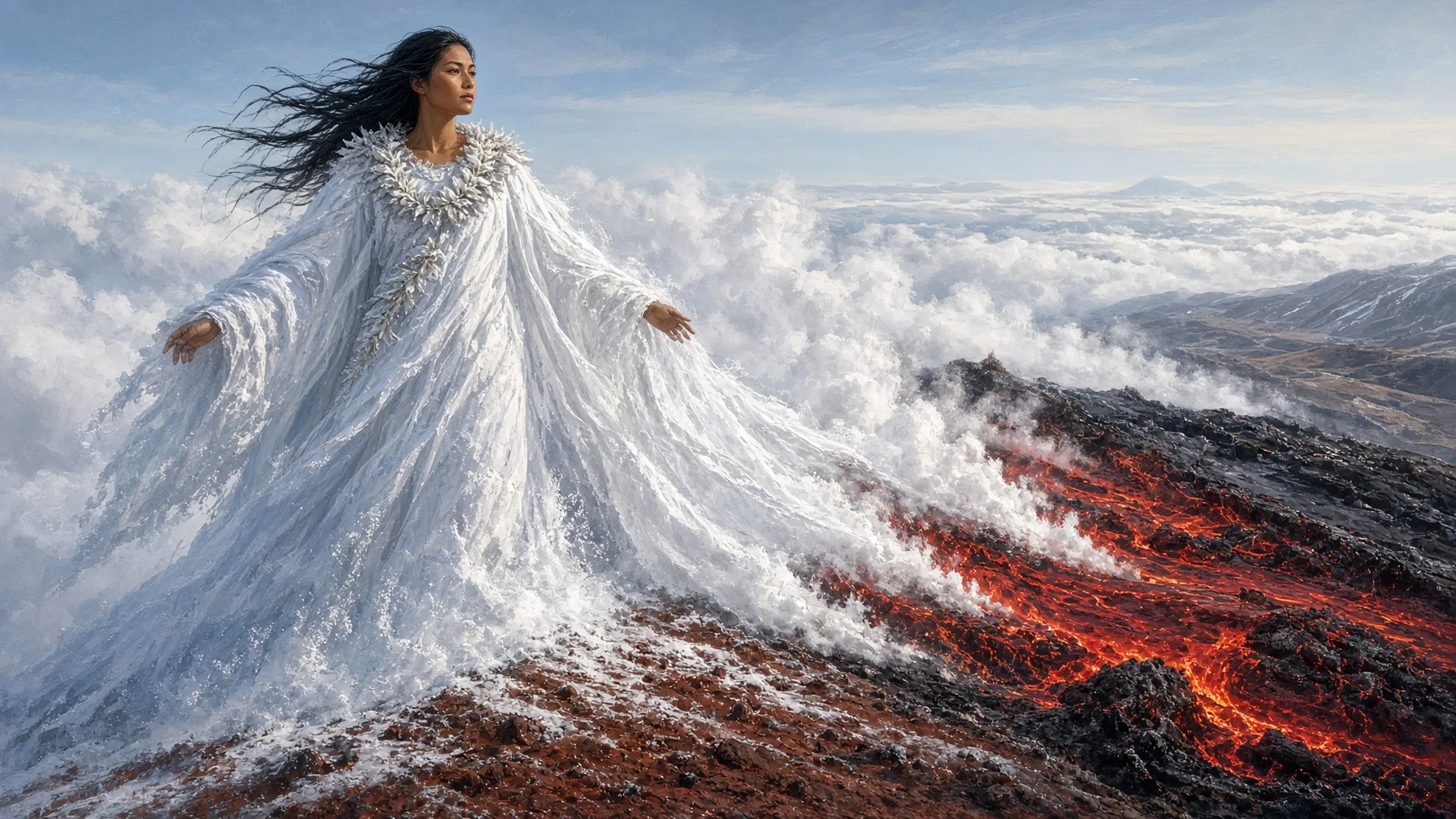
There is something close to natural law in the way the Ponaturi meet their end. They are not cut down; they are exposed. The sun does what it has always threatened to do, and no cunning of theirs can argue with it once the trap has closed. In this the Ponaturi story resonates with other Māori accounts in which the ordinary movements of sun, sea, and season are understood as forces with will and consequence — the same cosmos in which Tāwhaki stamps thunder into the sky, and in which the fire goddess Mahuika answers insult by hurling her last fingernail and setting the world alight, a blaze only ended when the trickster Māui calls on the rain gods to flood the flames. The Ponaturi's undoing belongs to that same moral universe, where the great natural forces are not neutral backdrops but active participants in the settling of scores — fire punishing insult in Mahuika's story, sunlight punishing an old capture in the Ponaturi's.
A Wider Ocean of Dangerous Beings
The Ponaturi take their place in a rich Māori cartography of the sea as a realm both bountiful and perilous. The Taniwha who guard rivers, harbours, and the open coast — some benevolent kaitiaki watching over a hapū, others hunters of the unwary — share with the Ponaturi the sense that water is never empty, never simply water. Named taniwha such as Horomatangi in Lake Taupō or Tuhirangi near Cook Strait are tied to real places across Aotearoa to this day, their presence acknowledged even in modern planning and resource-management decisions — a reminder that these traditions are not distant curiosities but living relationships between people and the places they belong to. The Ponaturi, dwelling in their own sunken house rather than in a single guarded river or strait, represent the more anonymous, more universally threatening face of that same ocean; where a taniwha might be named, bargained with, or appealed to as an ancestor, the Ponaturi remain a faceless tribe whose only known weakness is the clock of the sky.
Other Perils of the Overworld
It is worth setting the Ponaturi's underwater menace against the land-bound dangers Māori tradition also remembers, if only to show how varied the catalogue of supernatural threat really is. The bird-woman Kurangaituku of Te Arawa tradition, with her feathered body and clawed fingers able to mimic birdsong and lure the unwary hero Hatupatu into her cave, belongs to forest and mountain rather than sea, and meets her end not through sunlight but through pursuit and a hero's trickery near what is now remembered as Hatupatu's Rock close to Rotorua. The contrast matters: Māori cosmology does not offer one single formula for danger and its defeat. Fire has Mahuika, night and death have Hine-nui-te-pō, the forest has Kurangaituku and the Patupaiarehe, and the sea beneath the waves has the Ponaturi — each with its own rules, its own vulnerability, and its own place in the genealogy of the world.
Echoes in the Genealogy of Storms
Because the Ponaturi story is anchored in the whakapapa of Hemā and Tāwhaki, it cannot be read in isolation from the wider hero-cycle that follows. Tāwhaki's later ascent to the heavens by a vine or a web of spider-silk, his marriage into a family who nurse him back from near-death, his command over thunder and lightning called down by a stamp of his foot — all of it sits downstream, genealogically and narratively, from the violence the Ponaturi did to his father. In this way the Ponaturi function less as a self-contained "monster of the week" and more as the dark hinge on which a much larger heroic history turns, giving weight and motive to events that might otherwise read as simple displays of supernatural power. The same hero-cycle, shared in various forms across Hawaiian and other Pacific traditions, makes the Ponaturi's grievance part of a story that stretches well beyond Aotearoa's own shores.
Guardians of a Boundary Rule
Read together, the traditions of the Ponaturi preserve something more than a scary tale for children kept close to shore after dark. They preserve a boundary: between night and day, between the human world and the world beneath the waves, between a wrong committed and a wrong eventually answered. The Ponaturi's fatal weakness to sunlight is not an incidental detail but the whole shape of the lesson — that even the most fearsome power operating in darkness has its limit fixed by forces older and larger than itself. In the memory of the people who tell these stories, that limit is the same sun that rises over every coastline of Aotearoa, indifferent to the dwellings hidden beneath its waters until the moment it is finally let in.
Sources & traditions
- EncyclopediaWikipedia — Ponaturi
- TraditionMaori texts, oral tradition and village tellings (New Zealand)
Myths change from area to area and from time to time. This chronicle follows the most widely told versions; tellings in other villages, regions and eras may differ.