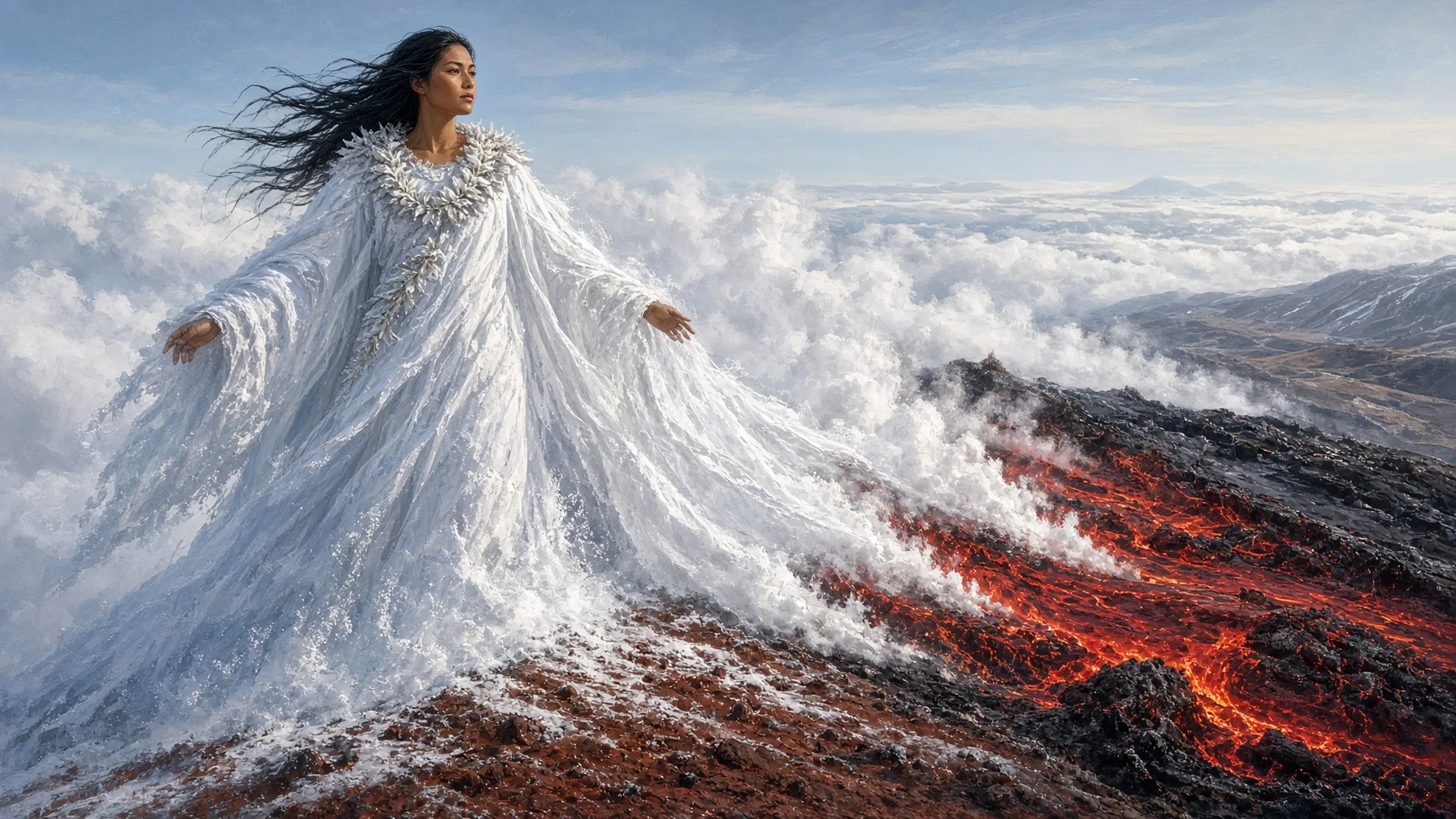
Mahuika is the Māori goddess of fire, an ancestress of great age and greater temper, who is said to carry flame itself within her own body rather than merely command it. In the traditions gathered from tribal knowledge-holders and set down by Sir George Grey in the nineteenth century, fire does not exist in the world as a separate, ownable thing until Mahuika chooses to give it away — she keeps it hidden beneath her fingernails, and in some tellings beneath her toenails as well, one flame apportioned to each digit. She is not merely a custodian of fire; she is its living source, and the story of how humankind came to possess fire is, at its centre, the story of what it cost to ask her for it.
An Ancestress Older Than Flame Itself
Mahuika belongs to the deep genealogical strata of Māori cosmology, the whakapapa that traces every being, force, and element back through generations to Ranginui the Sky Father and Papatūānuku the Earth Mother. In several tribal accounts her fire is bound genealogically to the volcanic and geothermal domain of Ruaumoko, the god of earthquakes and volcanoes, so that the heat she carries in her fingertips is understood as kin to the heat that moves beneath the land itself — the same restless energy expressed as steam rising from a geothermal field or as a mountain's sudden anger. To speak of Mahuika is therefore to speak of fire not as a tool invented by human ingenuity, but as an inherited, living force with its own temperament, its own ancestry, and its own right to be treated with respect.
The Goddess Who Keeps Fire Beneath Her Nails
The image at the centre of the Mahuika tradition is a striking one: an old woman whose fingers, when she chooses, can be made to blaze. Each fingernail holds its own store of flame, so that she can grant fire freely, nail by nail, without extinguishing herself entirely — at least, not until every nail has been spent. This is not fire as an abstract element but fire as something intimate, carried on the body of an ancestress, given as a gift rather than simply discovered. That framing matters: in the story that follows, every time fire is taken carelessly or demanded without gratitude, the taking becomes a kind of offence against her personally, not merely a request denied.
Māui's Repeated Visits
The best-known telling of Mahuika's story concerns the trickster and culture hero Māui, credited elsewhere in tradition with slowing the sun in its course and hauling up the North Island, Te Ika-a-Māui, from the depths of the sea. In this tale Māui is responsible for keeping the household fires burning, and — whether from mischief, carelessness, or a young man's testing of boundaries — he extinguishes them, again and again. Each time the fires go out, he travels to seek his ancestress Mahuika and asks her for a fresh flame. Each time, she grants it: plucking a nail from her hand and handing him the fire it carries, expecting that this one, surely, will be treated with the care it deserves.
Patience Spent, Nail by Nail
But Māui returns again. And again. The repetition is the heart of the story — not a single failure but a pattern of it, each visit a fresh demand on a generosity that was never meant to be inexhaustible. Mahuika obliges him through nail after nail, drawing down her own store of fire to satisfy a young relative who does not seem to grasp, or does not care, what he is asking her to give up. There is a lesson embedded in the shape of the story before it ever reaches its climax: that even a boundless-seeming gift has an origin, a cost, and a limit, and that presuming endlessly upon another's generosity — even an ancestress's — eventually provokes a reckoning.
Mahuika's Fury
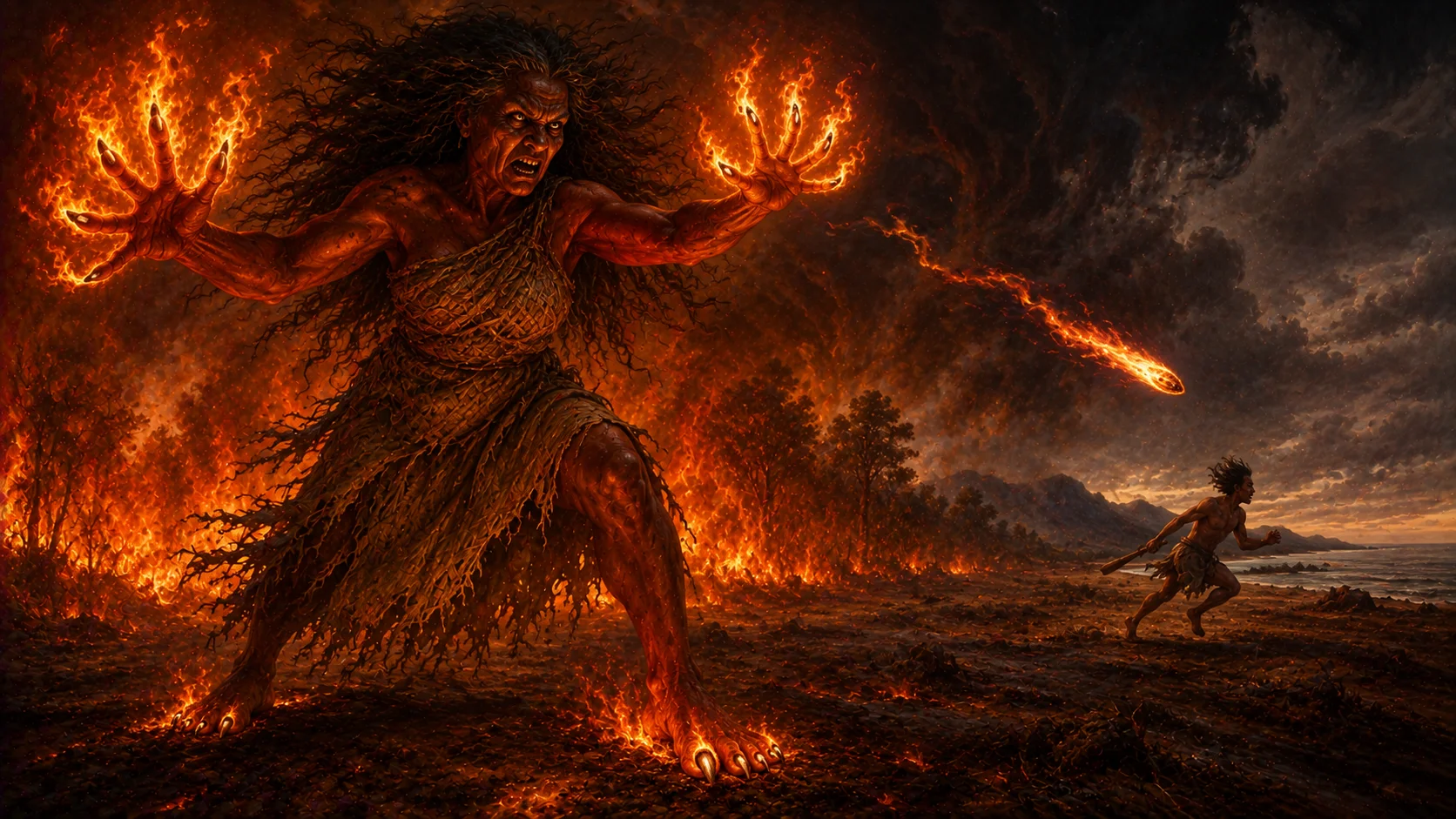
The reckoning comes when Mahuika reaches her final nail. Whether she sees through Māui's carelessness at last, or simply recognises that she has nothing left to give without endangering herself, her patience gives way to anger — a fury proportional to how much of herself she has already surrendered. She flings her last nail at him, and where it lands the ground itself catches: this is not a spark thrown in a moment of pique but the release of fire's full, ancestral force, and it does not stay contained. The world Māui stands in begins to burn.
A Chase Across a Burning World
What follows is one of the great pursuit sequences of Māori tradition: Māui fleeing a fire that spreads faster than he can outrun, the flames pressing at his heels as the whole landscape ignites behind him. He is, for the first time in his exploits, entirely outmatched — not tricked or outwitted by a rival, but simply overwhelmed by a force he provoked and cannot control. The story does not let its trickster hero win this encounter through cunning alone; it lets him nearly lose everything, and in doing so it makes plain that fire, however freely given, is not a force any one being, however clever, can master by will alone.
Calling Down the Rain
Māui's escape comes only when he calls upon the powers of weather and sky to intervene on his behalf — invoking the rain gods, named in different tellings as Whātitiri or Tāwhirimātea, to send down rain heavy enough to drown the flames Mahuika's last nail set loose. It takes the deluge of the heavens to answer the fire of the earth; no lesser response will do. The blaze is quenched, the world is saved from total conflagration, and Mahuika — her body's stores of fire entirely spent — is left without the flame she once carried so freely in her own fingers.
Sparks Given to the Trees
Yet fire is not lost to the world. In the aftermath, Mahuika is said to have flung the last surviving sparks of her fire into certain trees — among them the kaikōmako, the mahoe, and the tōtara — so that the flame she could no longer hold in her own body would still live on, hidden now in wood rather than in flesh. This is the story's true origin point for hika ahi, the traditional Māori technique of fire-making by friction: the dry wood of these particular trees was used precisely because it was understood to carry Mahuika's fire still within it, waiting to be coaxed back out by a firm hand and patient, rhythmic effort. Every fire lit this way was, in a sense, a small continuation of her original gift.
A Gift That Outlasted the Giver's Body
There is something quietly profound in this turn of the story: Mahuika does not simply vanish once her fire is exhausted, and the world is not left without flame simply because her fingers can no longer supply it. The fire she carried becomes distributed — placed into specific, namable trees, accessible to anyone who knows the right species and the right method, rather than remaining the sole possession of a single ancestress who might again be provoked past her patience. Read this way, the myth is also an explanation of how fire moved from being a scarce, personally-guarded gift to being a resource embedded in the natural world itself, available to all who approach it correctly.
Fire, Respect, and Consequence
The Mahuika tradition carries an ethical weight that sits alongside its explanatory purpose. It is, on one level, an account of where fire and fire-making wood come from. On another, it is a caution about the relationship between those who ask and those who give: Māui's fault is not curiosity or need, but repetition without gratitude, treating an ancestress's generosity as though it had no bottom. Mahuika's anger, in turn, is not portrayed as simple cruelty — it is what happens when a boundless-seeming gift is pushed past the point the giver can sustain. The near-destruction of the world is the cost of that imbalance, and the rain gods' intervention is what restores it.
Mahuika and Māui's Wider Story
Mahuika's tale sits alongside other Māui narratives as one of the moments where his boldness carries real risk rather than easy triumph. Elsewhere in tradition, Māui also seeks to conquer death itself by confronting Hine-nui-te-pō, the guardian of the underworld, and is destroyed in the attempt — a companion story that, together with the Mahuika episode, suggests a consistent shape to his character: a hero whose ambitions repeatedly exceed what the forces of the world, whether fire or death, are willing to yield to him without cost. Fire is granted, but only just barely, and only after nearly consuming the one who demanded it.
An Enduring Presence in Everyday Flame
For the communities who hold this tradition, Mahuika is not confined to a single ancient episode. Her presence is understood to persist wherever fire is kindled by friction from kaikōmako, mahoe, or tōtara wood, and in the broader association between her lineage and the geothermal, volcanic forces that still shape the land. She stands as one of the ancestral figures through whom an essential, everyday element — the fire that cooks food, warms a house, and lights the dark — is understood not as a neutral resource but as a gift with a history, a temper, and a debt of respect still owed to the one who first gave it away, nail by nail, until she had nothing left to give but the last, furious spark.
Sources & traditions
- EncyclopediaWikipedia — Mahuika
- TraditionMaori texts, oral tradition and village tellings (New Zealand)
Myths change from area to area and from time to time. This chronicle follows the most widely told versions; tellings in other villages, regions and eras may differ.