Maui is the great trickster-hero and demigod of Polynesia — the cunning, audacious culture-hero whose exploits are told from Aotearoa to Hawaii, from Tahiti to Tonga and Samoa. He fished up islands from the sea, snared and slowed the sun, won fire for humankind, and at last met his death in the boldest of all his attempts: the bid to defeat death itself. Few figures in the Pacific are told and retold as widely as Maui — scholars of Polynesian oral tradition, most notably Katharine Luomala in her study of "Maui-of-a-Thousand-Tricks," have traced independent cycles of his adventures across nearly every major island group, each community keeping the hero as unmistakably its own even as the shape of his story shifts from shore to shore.
A Child Cast to the Sea
In many tellings Maui's life does not begin as other children's do. He is born prematurely, or in some abnormal way, and his mother — unable or unwilling to raise what seemed a lifeless bundle — wraps him and casts him into the ocean. Māori and Hawaiian tradition both preserve this motif, though the particulars of the rescue differ from telling to telling: the infant is recovered, cared for by an ancestor or a being of the sea, and grows to strength away from his birth family before eventually returning to claim his place among his brothers. It is a story pattern many cultures know — the outcast child who comes back transformed — and in Maui's case it sets the terms for everything that follows. He arrives among his family already an outsider, already marked as different, and it is precisely that difference that will make him indispensable.
Youngest, Least Favored, Sharpest-Minded
Across the tellings, Maui is consistently the youngest of several brothers — and in a number of traditions, remarkably, several of those brothers share fragments of his own name. He is properly Maui-pōtiki, the last-born of a set that can include Maui-mua, Maui-roto, Maui-taha, and Maui-a-te-ihoiho, the elder Mauis serving mostly as a foil against which the youngest's cleverness stands out. He is not the strongest of them, nor the most respected at the outset; he is the one others are inclined to overlook. That underestimation is, again and again, the engine of his stories. Where his brothers rely on strength or standing, Maui relies on wit, patience, and a willingness to break rules that others would not dare touch. It is a shape familiar to trickster traditions the world over, but here it is bound tightly to genealogy — Maui out-thinks siblings who share his own name, and wins the place among them that his birth alone could not guarantee him.
The Jawbone Hook and the Fish of Maui
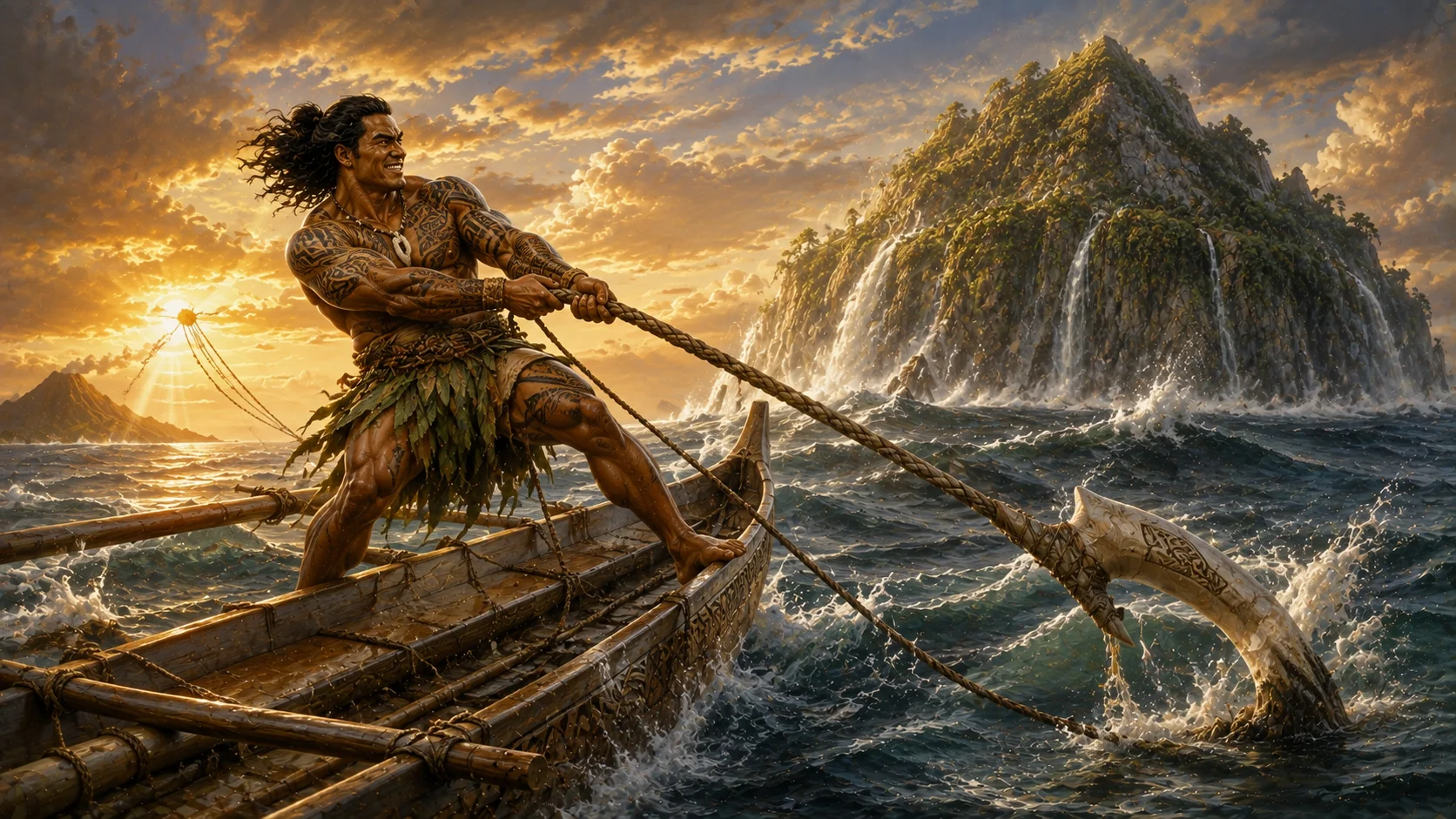
Of all Maui's feats, the fishing-up of land is the one told with the most consistency across the widest span of ocean. Armed with a magic fishhook — in the most resonant versions of the story, fashioned from an ancestor's jawbone — Maui puts out to sea with his brothers and casts down into waters no one else dared fish. What rises is not a catch of fish but land itself, hauled up from the deep on the strength of the hook and Maui's own daring. In Māori tradition this episode is anchored to a real and namable place: the North Island of Aotearoa New Zealand is Te Ika-a-Māui, the fish of Maui, its long coastline and mountain spine read in tradition as the very body of what he pulled from the sea. Tongan tradition, where the hero appears as Maui-kisikisi, and Samoan tradition each keep their own version of the same fishing feat, told with island-specific detail even where the broad shape — hook, ancestor's bone, land drawn up from the depths — holds remarkably steady from one archipelago to the next. Comparative scholarship has not settled which direction, if any, these versions travelled between island groups; what is certain is that the fishing-up of land is the closest thing Polynesian tradition has to a single shared Maui story.
Slowing the Sun's Swift Passage
A second feat travels nearly as widely: the snaring of the sun. In the tellings that carry it, the days had once been too short, the sun racing across the sky before the work of the day — in the version most often told, the beating out of tapa cloth by Maui's mother — could be finished. Maui and his brothers set out with ropes, lay in wait at the place where the sun rises, and when it comes they snare it and hold it fast, striking and pleading with it in turn until it agrees to slow its crossing and grant humankind a longer day. The episode appears in Hawaiian, Māori, and Tahitian tradition alike, but it is in Hawaii that it takes on a fixed and visitable geography: Haleakalā, "House of the Sun," the great volcanic summit on the island that itself bears Maui's name, is remembered as the very place where the sun was bound. Few culture-heroes anywhere have a mountain that stands as the physical record of their deed in quite so direct a way.
Wresting Fire from Mahuika
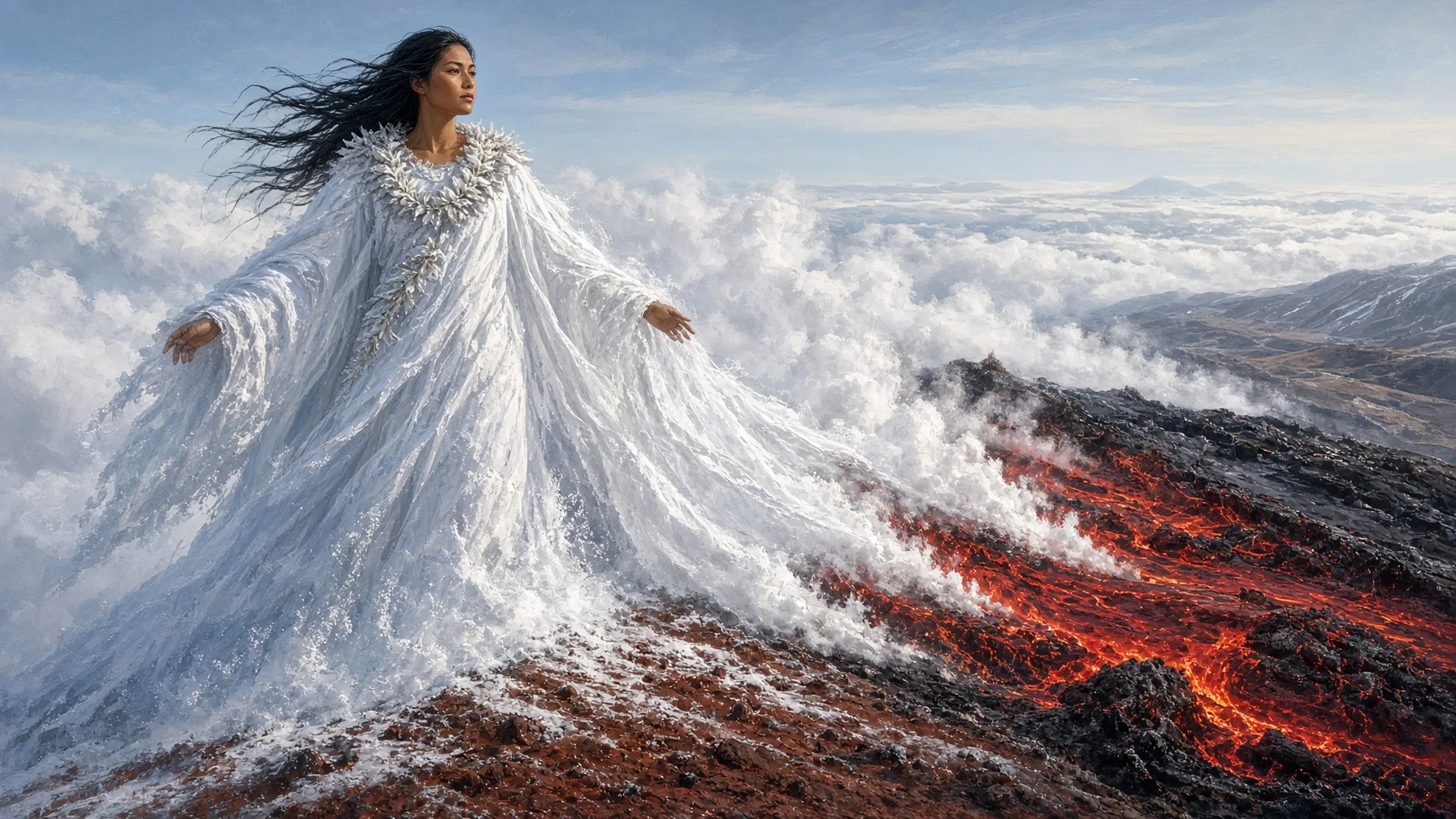
Fire, too, was not always humankind's to keep, and it was Maui who won it. In Māori tradition the keeper of fire is Mahuika, a fire-possessing ancestress, and Maui approaches her not with force but with the same trickery that serves him everywhere else — coaxing fingernail after fingernail of her burning claws from her, feigning that each fire has gone out by accident, until Mahuika realizes she is being played for a fool and, in fury, flings the last of her fire after him. Maui escapes the pursuing flames by calling down rain to quench them, and in some tellings by calling on other gods for aid. What survives of that scattered fire is said to have been preserved within certain trees — and this is offered as the reason fire can still be drawn out of wood by friction, a technical, explanatory thread of exactly the kind that runs through so much of Maui's story. His feats are not idle wonders; each one accounts for something the listener can still see, touch, or use.
A Name Divided Between Islands
Maui's family is not told the same way everywhere, and the difference is genuinely instructive rather than a simple error of transmission. In standard Māori tradition his mother is Taranga, while Hina is a separate figure, one bound up with the moon rather than with Maui's birth. In Hawaiian tradition, by contrast, it is Hina who is named as his mother. Both are authentic articulations of the tradition in their own regions; neither corrects the other. It is a reminder that Polynesian oral tradition was never a single fixed text copied faithfully from one island to the next, but a living, spoken inheritance, reshaped by each community that carried it — the same hero, the same broad arc of a life, filled in with different names for the people who surrounded him depending on where the story was told and who was doing the telling.
Gifts Beyond the Great Feats
Beyond fishing up land, slowing the sun, and winning fire, Maui is remembered in a great many tellings for smaller, more practical kindnesses to human beings — improvements that made ordinary life more workable. He is credited in various traditions with refining the fishhook itself into a more effective tool, a fittingly self-referential gift from the figure whose own hook did so much. In Cook Islands and Tahitian tellings he is further credited with passing on agricultural or other technical knowledge to people. These are quieter feats than defying a fire-goddess or binding the sun, but they belong to the same pattern: Maui is, before anything else, a hero whose cleverness exists in service of human beings, who leaves the world more workable than he found it, deed by deed, at real cost to himself.
The Descent Toward Hine-nui-te-pō
Maui's boldest undertaking, and his last, was the attempt to conquer death itself. In Māori tradition, death is embodied in Hine-nui-te-pō, the great goddess of night and the underworld, and Maui resolves that if he can pass through her body while she sleeps and emerge alive from the other side, death will be undone for humankind forever — mortals will live as gods do. He sets out with a company of small birds as companions, transforms himself, and creeps toward the sleeping goddess, warning the birds before he enters that they must not laugh, whatever they see, until he has passed safely through and out again. It is an attempt of extraordinary daring even by Maui's own standard, staged not against a rival or a natural force but against the very fact of mortality.
The Fantail's Laughter and the World Left Mortal
The attempt fails at the smallest possible margin. As Maui enters the sleeping goddess, the little fantail — the pīwakawaka — cannot hold back its mirth at the sight and laughs aloud. Hine-nui-te-pō wakes, and Maui is killed. Because of that single moment, humankind remained mortal ever after; the story is told explicitly as the reason death exists in the world, the hero who had given people longer days and the gift of fire unable, in the end, to give them the one thing that would have undone dying altogether. Variant forms of this contest between the trickster and death appear elsewhere in Polynesia as well, differing in detail but carrying the same weight: a boundary was tested, and it held.
A Hero, Not a Maker of Worlds
It matters, in placing Maui correctly within the wider tradition, that he is not counted among the primary cosmogonic deities. Folklorists classify him as a culture-hero and trickster figure, distinct from the great creator gods of Māori tradition such as Tāne, who separates earth and sky and clothes the forest, or Tangaroa, lord of the ocean and its creatures. Maui does not make the world; he acts within a world already made, bending it, testing it, wresting gifts out of it for the people who live in it. That distinction is part of what makes him so beloved rather than simply revered — he is closer to human scale than the great gods are, clever rather than omnipotent, capable of failure as well as triumph, and it is that nearness to human limitation, alongside his boundless daring, that has carried his name across so many oceans and so many centuries of telling.
An Inheritance Held in Common
What endures most in Maui's story is its sheer breadth — a hero recognizable from Aotearoa to Hawaii, from the Marquesas to Tonga and Samoa and the Cook Islands, each community's version distinct in its names and its emphases yet unmistakably telling of the same restless, clever, generous figure. He remains, across all of it, the youngest brother who refused to be the least; the outcast child who returned to give his people islands to stand on, longer days to work in, fire to warm themselves by, and, in the one contest he could not win, the sober knowledge of why life does not last forever. It is a story held not by any single island but by the ocean between them, carried and kept, in its many true forms, by the communities who have never stopped telling it.
Sources & traditions
- EncyclopediaWikipedia — Māui
- TraditionPolynesian folk and village traditions
Myths change from area to area and from time to time. This chronicle follows the most widely told versions; tellings in other villages, regions and eras may differ.