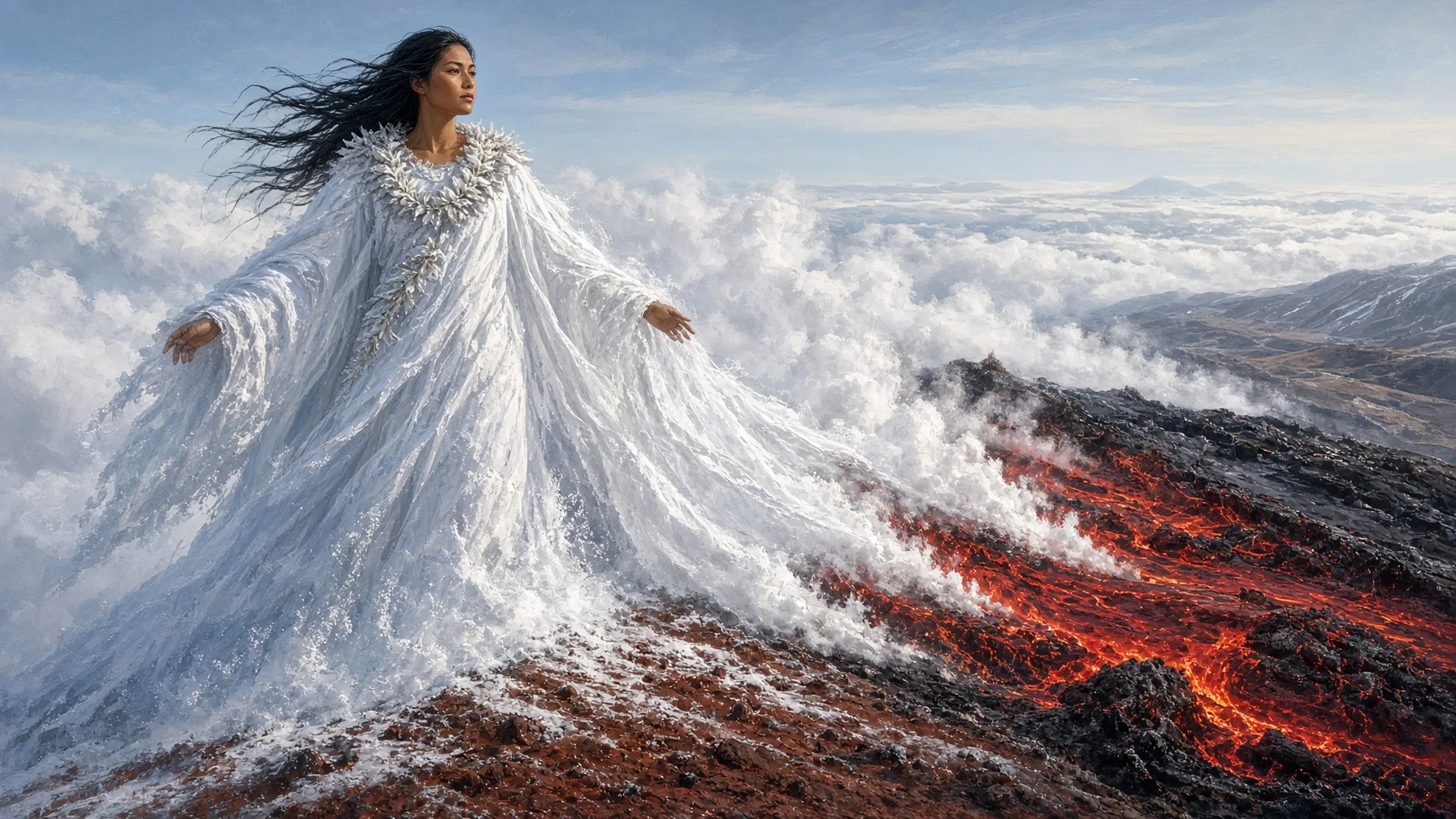
Hina — known across the islands as Sina, ʻIna, Hine — is not a single goddess but a constellation of them: a name-root carried by voyaging peoples from Hawaiʻi to Tahiti and the Society Islands, through the Cook Islands and Sāmoa, out to the Marquesas. The scholar Katharine Luomala, studying this breadth of attestation, cautioned against flattening it into one unified deity. What the islands share is a root, not a single biography — regionally distinct figures bound by a name and a cluster of recurring themes: the moon, the labor of women's hands, the sea and its creatures, the turning of cycles that do not belong to the sun-bright deeds of male culture heroes.
A Name Woven from Moonlight
Comparative Polynesian linguistics reconstructs Hina and Sina from a Proto-Polynesian root carrying the sense of grey or pale — the color of moonlight on water, on tapa cloth freshly beaten, on hair silvered by age. This is the thread scholars use to draw the far-flung Hinas of the Pacific into a single family of names. Whether the tellers of these tales, generations before any comparative linguist arrived, understood themselves to be speaking of one goddess wearing many masks, or of separate figures who happened to share an old word for pale, is a question the tradition itself leaves open. Both readings deserve respect: the kinship is real in the language, and the distinctness is real in the stories.
The Woman Who Fled to the Moon
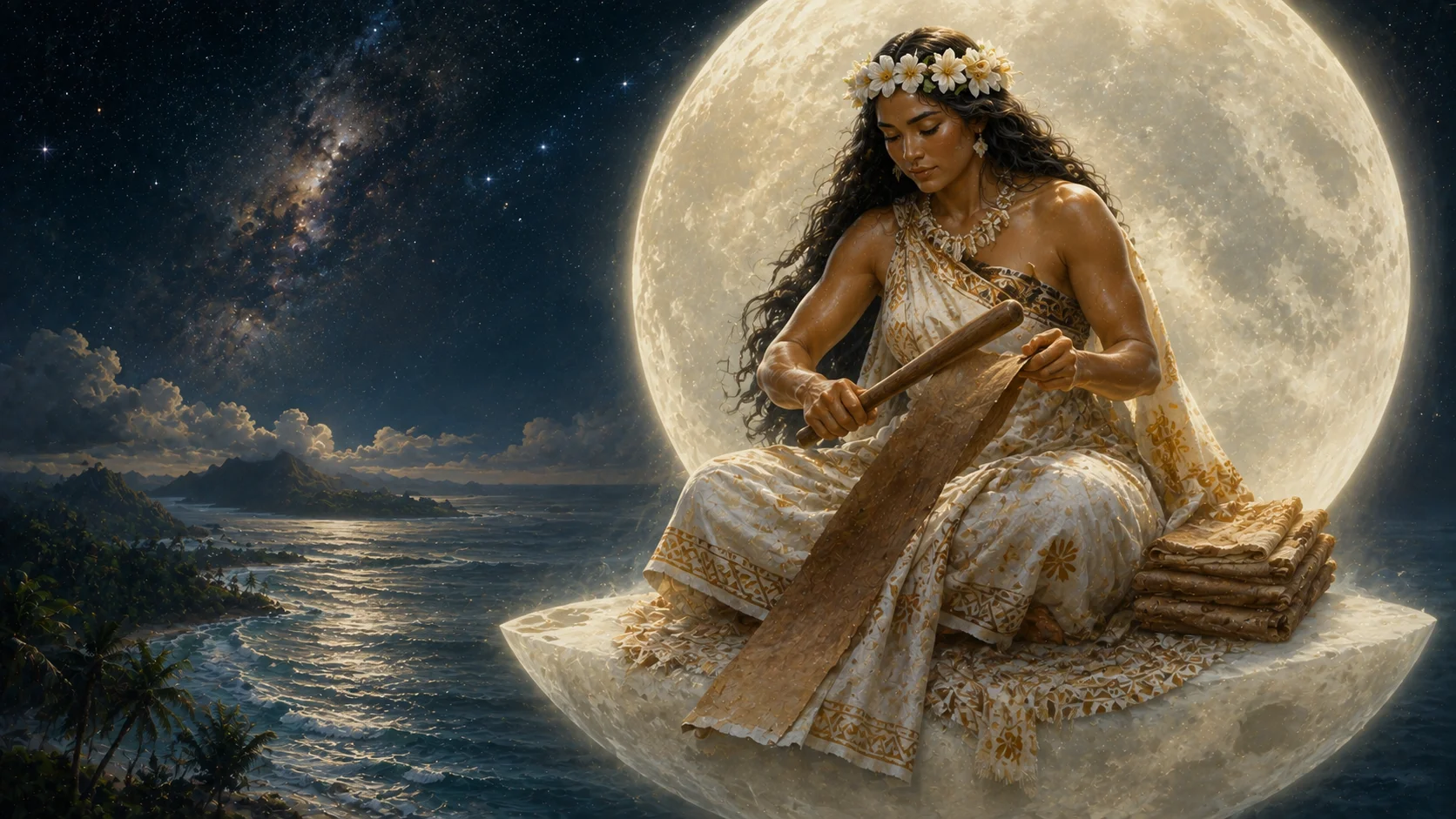
In Hawaiian tradition, Hina's association with the moon is carried by a particular and much-told motif: a woman, worn down by an overbearing husband or by the endless, aching labor of beating tapa, climbs away from the earth and makes her home in the moon rather than continue as she was. Variants of this flight recur, in different shapes, in other island groups — the same impulse toward escape and elevation, told with different companions and different provocations depending on where the story is kept. What stays constant is the destination: the moon becomes, and remains, hers.
The Discipline of Tapa and Thread
Across nearly every regional tradition that names her, Hina is bound to kapa — tapa-cloth — and to weaving: the beaten bark transformed by repetition and skill into cloth, one of the central and most demanding forms of women's productive labor in Polynesian life. This is not an incidental detail attached to a moon goddess; in several traditions it is the very labor she is fleeing, or the very skill she is honored for perfecting. The moon's marked, pale face is read, in places, as her cloth spread out to dry — the sky itself pressed into service as the site of an ordinary, exhausting, essential craft.
Tuna's Death and the First Coconut
One of the most widely carried episodes in the Hawaiian and Tahitian cycles concerns Hina and the eel Tuna. The eel is killed, and its head, buried, grows into the first coconut tree — the three marks on the coconut's shell read ever after as Tuna's face looking back. The precise nature of Tuna's bond to Hina shifts from version to version: suitor, husband, antagonist — the tradition does not insist on a single relationship, and no single version can be treated as the authoritative one. What holds steady across the variants is the transformation itself: death converted into the most useful tree in the Pacific, a myth of origin doing the quiet work of explaining where sustenance comes from.
Sina and Her Own Eel, an Ocean Away
In Sāmoan tradition, the story of Sina and the Eel arrives independently, supplying its own version of the coconut's origin. Scholars treat this as a cognate tale — kin to the Hawaiian and Tahitian Tuna cycle by shared root and shared shape, not a direct retelling passed hand to hand across the sea. The distinction matters: it is testimony to how a single narrative core, the death of a beloved or antagonistic eel and the coconut that grows from it, could take root independently in more than one part of the ocean, each telling answering to its own audience and its own Sina.
Mother of Maui, in Hawaiʻi
In Hawaiian tradition specifically, Hina — sometimes named Hina-a-ke-ahi or in related forms — is mother to the trickster-hero Maui, and their stories are entwined. This is a regional fact, not a Pacific-wide one: other traditions, including Māori tellings and some Cook Islands versions, name a different mother for Maui, most notably Taranga. This divergence is not an inconsistency to be resolved or a competing claim to be adjudicated; it is the ordinary shape of oral tradition carried across a vast ocean by many peoples, each with its own genealogy for its own hero.
The Ground That Remembers Her: Molokaʻi
Hawaiian oral tradition ties Hina with particular strength to the island of Molokaʻi, where place-names and specific sites carry her association into the physical landscape itself. Where many deities live chiefly in narrative, Hina is here also written into geography — a goddess whose presence a person could walk toward, not only recite. This rootedness in a named place is part of what distinguishes the Hawaiian Hina from her cousins elsewhere in the Pacific, who are held instead by different islands, different shores, different memories.
Not One Goddess but Several, Even Within Hawaiʻi
The multiplicity does not stop at the boundary between island groups — it exists within Hawaiian tradition itself. Martha Beckwith's Hawaiian Mythology records several distinct figures bearing the name Hina: Hina-puku-ʻai, associated with food plants; Hina-of-the-fire; and the moon Hina most widely known today. These are not simply epithets of one goddess but named, separable figures sharing a name the way relatives might share a surname — each with her own domain, her own stories, her own claim to the name Hina. To speak of "the" Hina, even within a single tradition, is already a simplification the tradition itself resists.
Ina and the Shark's Back, at Mangaia
In the Cook Islands, particularly at Mangaia, the cognate figure Ina appears in her own distinct narrative: a voyage and marriage story built around a sea-crossing on the back of a shark that ferries her across the water. This is not a variant of the Hawaiian moon-exile tale wearing a different name — it is its own plot, with its own emphasis on passage, risk, and arrival by sea rather than ascent to the sky. Set beside the Hawaiian moon story, it is a useful reminder of how differently a shared name can be inhabited from island to island.
Contested Lines in the Genealogical Chants
Hina's relationships to male deities, as recorded in Hawaiian genealogical chant traditions, are genealogically intricate and not settled among scholars or across chant lineages. Specific pairings differ from one chant tradition to another, including in versions adjacent to the Kumulipo. Rather than resolving these differences into a single family tree, the honest account holds them as they are: contested, plural, and dependent on which chant, which reciter, which lineage is being followed. A goddess this old, carried this far, was never going to fit one diagram.
Cycles Against the Grain of Heroic Deeds
Where male culture-hero figures such as Maui are remembered chiefly for feats — deeds done once, dramatically, and finished — Hina's symbolic weight in the broader Polynesian pattern runs the other way: toward cyclical renewal. The moon's phases, waxing and waning and returning; fertility that recurs rather than resolves; the tide that goes out only to come back. This is not a lesser mode of power beside Maui's exploits, but a different one — the steady, recurring current beneath the ocean's more visible events, and one that several regional traditions place at the center of what Hina, in her many names, represents.
A Goddess Too Wide for One Telling
To gather Hina, Sina, and ʻIna under a single heading is to make a scholar's argument, built on a shared root meaning pale, moonlit, grey — and it is a defensible one. But the traditions that carry these names were not built to agree with each other, and treating them as interchangeable would erase exactly what makes each worth keeping: a Hawaiian goddess written into the hills of Molokaʻi and mother to Maui in that telling alone; a Sāmoan Sina whose eel and coconut arrived by a separate root; an Ina at Mangaia who crosses the sea on a shark's back rather than climbing to the moon at all. What holds across all of them is not a single goddess but a single kind of attention — to the moon's changing face, to the discipline of women's hands at the tapa beater and the loom, and to the ocean that carried both the name and the story, differently, to every shore that kept it.
Sources & traditions
- EncyclopediaWikipedia — Hina (goddess)
- TraditionPolynesian folk and village traditions
Myths change from area to area and from time to time. This chronicle follows the most widely told versions; tellings in other villages, regions and eras may differ.