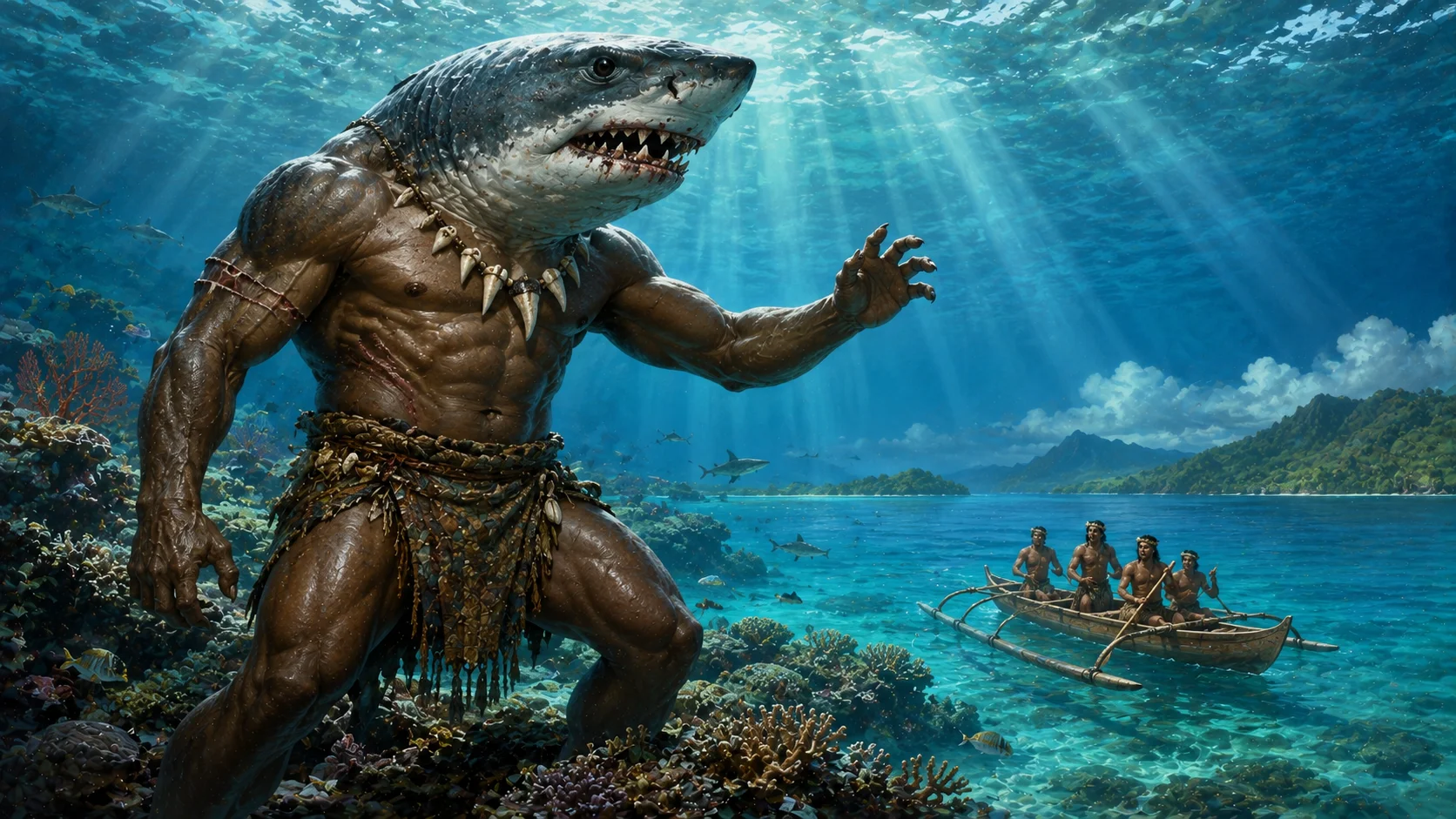
Dakuwaqa is the great shark god of Fijian (iTaukei) tradition — lord of the reefs and deep passages around the islands, a shapeshifting spirit whose true and most feared form is the shark itself. In Fijian cosmology he embodies the ocean's double nature: the sea that feeds and carries a coastal people, and the sea that can just as easily take them. Sailors and fishermen across the archipelago have long held him in a mixture of reverence and wariness, for the god who guards a canoe home through the passage is, in other tellings, the same predator who tests it.
A God Cut From the Reef Itself
Dakuwaqa belongs specifically to Fijian, iTaukei tradition, and to the waters of the Fiji archipelago rather than to any single pan-Pacific catalogue of ocean spirits. Fiji sits at a crossroads where Melanesian and Polynesian cultural currents meet, and shark veneration of one kind or another surfaces elsewhere in the wider Pacific — but Dakuwaqa's story, his named encounters, and the reef geography that anchors them belong to Fiji alone. He is not a Solomon Islands figure wearing a Fijian name, and the specifics that follow should not be read as generic "Pacific shark god" material. They are local, and they are told as such by the communities who tell them.
Master of the Reef Passages
In his most commonly described role, Dakuwaqa rules the ocean around Fiji — its reefs, its channels, and the passages a canoe must thread to reach open water or come safely home. He is widely described as the patron of sailors and fishermen, a guardian who could see a vessel through dangerous water. Just as often, he is described as a territorial and dangerous predator of those same reefs, quick to attack what strayed into his domain. Fijian storytelling does not treat these as contradictory faces of two different gods; they are held together as one character, whose favour is not owed but earned, and whose temper is part of what makes the sea worth respecting.
The Shape the God Chooses to Wear
Shapeshifting sits at the center of who Dakuwaqa is. His most natural and most frequently described form is the shark — vast, swift, unmistakably his own — but tellings also give him the ability to take other sea-creature forms, and even to walk as a man among people on land or on the shore. This fluidity is not treated as a magician's trick; it is part of what makes him uncanny and unpredictable, a god who might be the fish circling a canoe, or the stranger standing at the water's edge, and a listener is never entirely sure which encounter they are having until the story reveals it.
The Rampage Along the Islands
A recurring pattern in the Dakuwaqa tradition holds that each Fijian island or reef system once had — or still has — its own guardian spirit, a local tutelary power bound to that particular stretch of water. In numerous tellings, Dakuwaqa's mythic restlessness took the shape of a rampage: moving from island to island, reef to reef, challenging these local guardians in turn, and in most versions defeating them. The pattern does real cultural work — it sketches a network of marine guardianship across the archipelago, with Dakuwaqa as the power that measured itself, and often prevailed, against every other. It is this rampage that sets up the tradition's most famous reversal.
Kadavu's Watchful Octopus
The best-known single episode in the Dakuwaqa tradition is his contest with the octopus god of the Kadavu region, sometimes named Masilaca. Having gone unbeaten through his tour of the reef guardians, Dakuwaqa met, in the waters off Kadavu, an opponent whose strength lay not in size or speed but in grip and cunning. The octopus took hold of him and would not let go, and by strength or cleverness — accounts differ on which — the shark god found himself overpowered for the first time. It is worth being plain about how this is remembered: Fijian oral legend, or talanoa, is not a single fixed scripture, and the exact mechanics of the octopus's victory shift between the people who tell it. What holds constant across the Kadavu-centered versions is the outcome and its consequence.
The Vow That Followed Defeat
Beaten by the octopus, Dakuwaqa is said to have sworn never again to attack the people of that region — a vow offered, in the tellings that carry it, as the price of his release, or as an oath of respect for the strength that had bested him. This promise is the story's hinge: it is the piece that explains, within the tradition itself, why the waters around Kadavu are held to be reef-safe in ways attributed directly to the god's word. The vow does not erase Dakuwaqa's power or his temper elsewhere in Fijian waters; it marks out one place where his word is understood to still stand, generations on from whatever moment first won it.
An Archipelago of Local Guardians
Because the rampage-and-challenge pattern touches so many islands, the wider tradition implies a whole hierarchy of marine spirits across Fiji, each tied to its own reef or channel, each with its own relationship — won, lost, or still contested — to Dakuwaqa. Which guardian he fought, how the fight went, and what place-names attach to the memory of it differ from province to province and from source to source within Fiji itself. There is no single authorized version of the Dakuwaqa cycle, and that variation is not a flaw in the record; it is the ordinary shape of a legend carried by voice, from village to village, across a scattered archipelago rather than fixed once in writing.
Words Spoken Carefully at Sea
Among Fijian coastal and island fishing communities, practical customs have grown up around the belief that Dakuwaqa answers to how he is treated. Some traditions describe offerings made to him, and a care taken with what is said while out on the water — an avoidance of words that might provoke or disrespect the sea and the god who moves through it. The underlying logic is consistent even where the specific practices vary: a sailor's safety was understood to depend not only on skill and weather but on the standing of that relationship, kept in good order by ordinary acts of respect rather than grand ritual.
The Sea's Two Faces, Given a Name
Beyond any single episode, Dakuwaqa functions in Fijian cosmology as a personification of the ocean's own contradiction — the same water that provides the catch a family eats and carries a canoe safely to its destination is the water that can capsize, drown, and destroy without warning. Giving that unpredictability a face and a will, rather than leaving it as blind chance, let Fijian communities hold a relationship with the sea rather than simply endure it. Other Pacific traditions have their own shark gods who serve a comparable function for their own peoples — this is a resemblance of role, not a claim of shared identity, and the two should not be folded into one figure.
Not to Be Mistaken for His Pacific Kin
Because "shark god" reads as a tidy category, comparative retellings sometimes lump Pacific shark deities together as variations on one theme. Dakuwaqa should be kept distinct from shark gods belonging to other, separate island traditions — Hawaiian figures such as Kamohoaliʻi among them — each of which carries its own culture, its own named episodes, and its own theology. Dakuwaqa is Fijian; his story is not a regional dialect of someone else's myth, and treating it as such would erase exactly the local detail — Kadavu, the octopus, the reef-by-reef contest — that makes the tradition what it is.
Encounters Kept to Their Own Shores
Some tellings pair Dakuwaqa with particular human figures or chiefs, describing an encounter at sea specific to one village or one stretch of coast. These stories are highly localized, tied to the place and the family or community that keeps them, and they are not part of one standard pan-Fijian narrative alongside the Kadavu episode. Where such a story is known, it belongs to its locale and should be told as belonging there — a village's own memory of the god, rather than a universal chapter in his legend.
A Fin Still Seen Today
Dakuwaqa has not stayed confined to the past. He remains a living presence in contemporary Fijian popular and tourism culture — lending his name to places and dive sites, appearing in children's books and cultural presentations, retold for visitors and for a new generation of Fijians alike. This modern visibility is real and worth noting in its own right, but it is a distinct phenomenon from the older oral tradition itself, a layer of reception built on top of talanoa rather than a continuation of it in the same voice. The two are worth naming separately: the god as he has been told for generations at sea, and the god as he now appears on a resort sign or a storybook page.
What the Record Can and Cannot Say
Fijian oral legend has historically been documented in Western ethnographic sources less extensively than some other Pacific traditions, and much of what circulates in English is compiled or popularized from oral sources rather than drawn from a single settled text. That matters for how precisely Dakuwaqa's story can be pinned down: claims about a fixed divine parentage, a single creation-myth origin, or a definitive genealogy are not firmly attested and vary by source. The honest shape of the tradition is a cluster of related, regionally varying stories bound by common figures — the shark, the octopus, the reef guardians, the vow — rather than one authoritative account with fixed edges. That looseness is not a gap to be filled with invention; it is the tradition's own character, and it is best respected by naming, plainly, where certainty ends and variation begins.
Sources & traditions
- EncyclopediaWikipedia — Dakuwaqa
- TraditionPolynesian folk and village traditions (Fiji)
Myths change from area to area and from time to time. This chronicle follows the most widely told versions; tellings in other villages, regions and eras may differ.