The Adaro is a sea-spirit recorded in the oral traditions of the Solomon Islands, in Melanesia — most fully documented among the Kwara'ae and other communities of Malaita, with related but not identical accounts from San Cristobal (Makira) and neighboring islands. Ambivalent or outright malevolent, the Adaro is described as a being of the open ocean, part human and part fish, that rides the waterspout and the rainbow and strikes the unwary swimmer or fisherman with a hurled flying fish. It belongs to a wider Melanesian world of tapu — sacred, spiritually charged and often dangerous — beings that populate the sea, and it stands as one of the clearest examples in the region of a spirit built to explain the real hazards of life on the water.
A Being of Fin and Gill
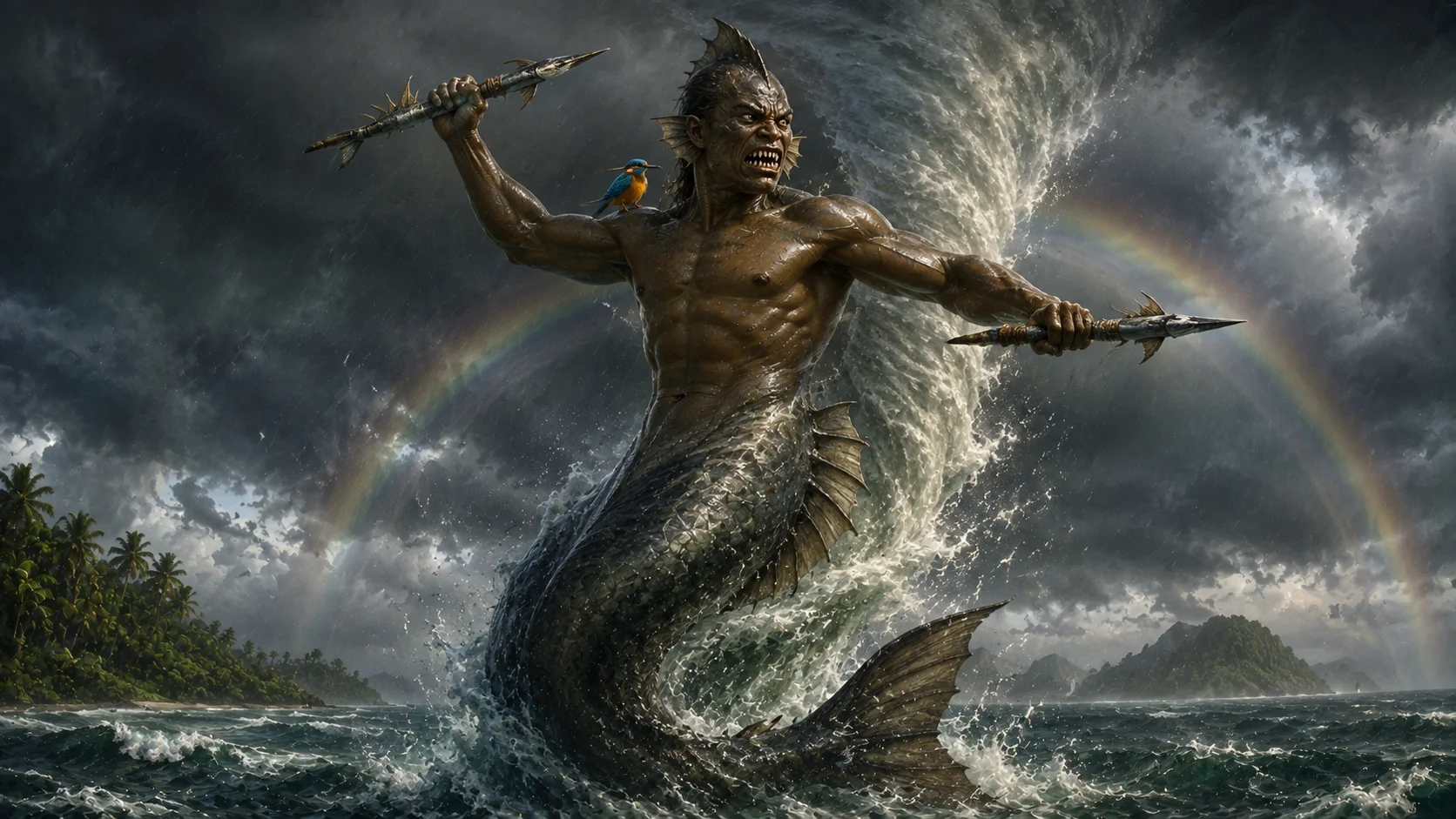
In the accounts gathered from Malaita-area communities, the Adaro is not simply a fish nor simply a man but a being that carries the marks of both. A fin or shark-like ridge is said to rise along its back, gills are placed behind its ears, and its feet are described as finned rather than plain. Some tellings add a horn-like protrusion from the head, sharpening the sense that this is a creature assembled from the sea's own weapons — spine, blade, gill — rather than a being with a single fixed silhouette. The variation itself is worth noting: Solomon Islands communities did not share one uniform description, and the differing level of detail recorded on Malaita versus San Cristobal reflects genuinely separate local traditions rather than one myth imperfectly remembered.
Riding the Waterspout
The Adaro's traditional mode of travel is as distinctive as its form. It is said to move across open water riding a waterspout, or to travel astride a flying fish, closing the distance between deep sea and shore far faster than any human vessel. This detail does more than furnish an image — it ties the spirit directly to a real and frightening maritime phenomenon. A waterspout sighted from a canoe is a genuine danger in Pacific waters, and a tradition that names the Adaro as its rider gives that danger a face and a will, transforming an impersonal weather event into an encounter with an intentional being.
The Rainbow as a Ladder
Among the most frequently cited details in the ethnographic record — set down in the early twentieth century by the missionary-ethnographer Charles E. Fox, who worked extensively on Malaita and San Cristobal custom — is that the rainbow itself is understood as the Adaro's road. It is the path or ladder along which the spirit travels between the sea and the sky, and by extension between the ocean and the land. Where other cultures have read the rainbow as a bridge, a covenant, or a boundary, this tradition reads it as a route of passage for a being whose true home is the water below. Seeing a rainbow arc over the sea, in this framework, is seeing the shape of the Adaro's own crossing.
The Flying Fish as a Weapon
The Adaro's characteristic means of attack, recorded across several tellings, is the flying fish — not eaten, not merely encountered, but hurled or ridden as a weapon against a chosen victim. A fisherman struck by this thrown fish might fall senseless or die from the blow; other accounts describe the harm as coming through poisoned tools or poisoned fish rather than a direct strike. Whichever form the attack takes, the underlying logic is consistent: an animal that is a common and expected sight above Solomon Islands waters — the flying fish breaking the surface in a school — becomes, in the presence of the Adaro, a possible instrument of harm. The tradition does not ask people to fear the fish itself, but to recognize that the sea's ordinary creatures can be turned to a spirit's purpose.
Ghosts of the Drowned
Several recorded tellings place the Adaro's origin not in a distinct act of creation but within the broader Melanesian understanding of the dead. In this framing, Adaro are the spirits of those who drowned, or of the deceased generally insofar as they become associated with the sea — a category of ancestor-ghost or tapu spirit rather than a being created separately from humankind. This matters for how the Adaro should be understood: not as a monster invented whole, but as one expression of a wider belief that the dead do not simply vanish, and that those who die by or upon the water may remain bound to it, their presence felt by the living who venture out after them.
Peril Upon the Water
Toward the living, the Adaro's role is unambiguous in the sources: it is dangerous. Swimmers and travelers upon the sea are its natural prey, and the harm it causes is drowning, sudden illness, or death. In communities whose lives were built around canoe travel, reef-fishing, and the daily crossing of open water, a tradition that names a spirit responsible for these dangers serves a clear and serious purpose — it gives shape and caution to risks that were otherwise unpredictable, and it marks the sea as a place to be entered with respect rather than carelessness. The Adaro, in this sense, functions as a warning as much as a figure of fear.
An Embodiment of the Unpredictable Deep
Set within the wider taxonomy of Melanesian sea-spirits, the Adaro takes its place among the tapu beings whose presence explains why the ocean cannot be trusted to remain calm or safe. It is not alone in this role — other spirits inhabit reef and current in other island groups — but the Adaro's specific combination of attributes, the fin, the gills, the waterspout, the rainbow-road, the thrown flying fish, marks it as a distinct figure within that larger family rather than an interchangeable stand-in for "sea danger" in general. It gives voice to the ocean's unpredictability: calm one moment, lethal the next, and never fully separable from the memory of those it has already claimed.
No Single Telling
It bears stating plainly, in keeping with how the tradition has actually been recorded, that there is no single canonical Adaro myth. What exists instead is a family of related local accounts, gathered island by island and community by community, agreeing on a shared core — a fish-marked sea-spirit, dangerous to those on the water, moving by rainbow and waterspout — while differing in the specifics attached to any one telling. A detail drawn from a Malaita account and a detail drawn from a San Cristobal account may both be true to their own sources without both being true of "the Adaro" as a single fixed figure, and any close reading of this tradition should keep that regional specificity in view rather than flattening it into one story.
What the Record Can and Cannot Say
Much of what circulates in English-language accounts of the Adaro traces back to a relatively small number of early-twentieth-century missionary and ethnographic collectors, Fox chief among them, whose work remains the foundation for most later popular and encyclopedic summaries. This is worth naming honestly: the depth of contemporary primary documentation accessible to general readers is comparatively thin, and highly specific narrative episodes — a named individual Adaro, a fully detailed origin saga — are not well attested in that accessible scholarship. Where such specifics appear elsewhere, they should be treated as uncertain unless they can be traced to a named collector and source. The core elements recorded here — form, weapon, travel, the rainbow, the drowned-ghost association, the danger to seafarers — are the load-bearing facts of the tradition; anything more elaborate ventures beyond what the record actually supports.
Distinct Waters, Distinct Spirits
The Adaro belongs specifically to Solomon Islands tradition and should not be folded into the sea-being traditions of Fiji or of Polynesian island groups, which carry their own names, their own cosmologies, and their own sourcing entirely separate from Fox's Malaita and San Cristobal material. Nor should the Adaro be conflated with other Melanesian shark- and sea-spirit complexes found elsewhere in the region — shark-calling traditions among them — which are related in kind, as neighboring expressions of a shared oceanic worldview, but are not the Adaro tradition itself. Each of these bodies of belief deserves to be read on its own terms, true to the specific communities that shaped it, rather than blurred into a single generic "Pacific sea-monster" figure.
The Shape of a Warning
Taken together, the recorded pieces of the Adaro tradition — the fin and the gill, the waterspout ridden like a mount, the rainbow read as a road home, the flying fish turned to a weapon, the quiet suggestion that the spirit may once have been a drowned person among the living — form less a single narrative than a working vocabulary for talking about the sea's danger. It is a tradition shaped by people who depended on the ocean daily and who built, out of careful observation and inherited belief, a way of naming what could not always be explained: why a calm sea could turn suddenly fatal, and why respect for the water was never optional.
Sources & traditions
- EncyclopediaWikipedia — Adaro (mythology)
- TraditionPolynesian folk and village traditions (Solomon Islands)
Myths change from area to area and from time to time. This chronicle follows the most widely told versions; tellings in other villages, regions and eras may differ.