Sina is one of the most widely honored heroine figures in Samoan oral tradition, a young woman of legendary beauty whose story explains the origin of the coconut palm. Known in various tellings across Samoa and the wider Pacific by related names — Hina, Sina-tagataga, Sina-ma-lelei — she belongs to a name-complex that recurs, in regionally distinct forms, throughout Polynesian storytelling. In Samoa she is remembered above all through two enduring narrative strands: the tale of the eel who loved her, and, in some tellings, her ascent to the moon. Samoan oral tradition is transmitted village by village and family by family rather than fixed in a single official text, so the details recounted here — as with any Samoan legend — vary in their particulars from teller to teller, district to district, while the shape and meaning of the story remain recognizable across the islands.
The Maiden Who Kept an Eel
The best-documented and most beloved of Sina's stories is known as Sina ma le Tuna — Sina and the Eel. In its Samoan form, the tale begins simply: Sina, a young woman celebrated for her beauty, keeps a small eel as a pet, raising it in a pool or spring near her home. The eel is not remarkable at first. It is small enough to be fed by hand, tended with the kind of casual affection a girl might show any creature she has raised herself. Over time, though, the eel grows — and grows further still, until it is no longer the modest pool-dweller Sina once knew, but something larger, stranger, and possessed of intent that unsettles her.
An Unwelcome Pursuit
As the eel matures, it begins to press an unwanted attention on Sina, making advances that frighten rather than flatter her. Recognizing that the creature she raised has become a threat, Sina and her family flee. The eel does not let the matter rest. It pursues her — across pools, across the distance between villages, through the account's various tellings — with a persistence that marks it as no ordinary animal. Some versions of the cycle treat the eel as more than a simple creature at all: an enchanted or supernatural being, a suitor transformed, echoing similar eel-gods and ancestral eel-figures found elsewhere in Polynesian cosmology. Whether beast or transformed being, the pursuit ends only when the eel is finally caught and killed.
The Dying Request
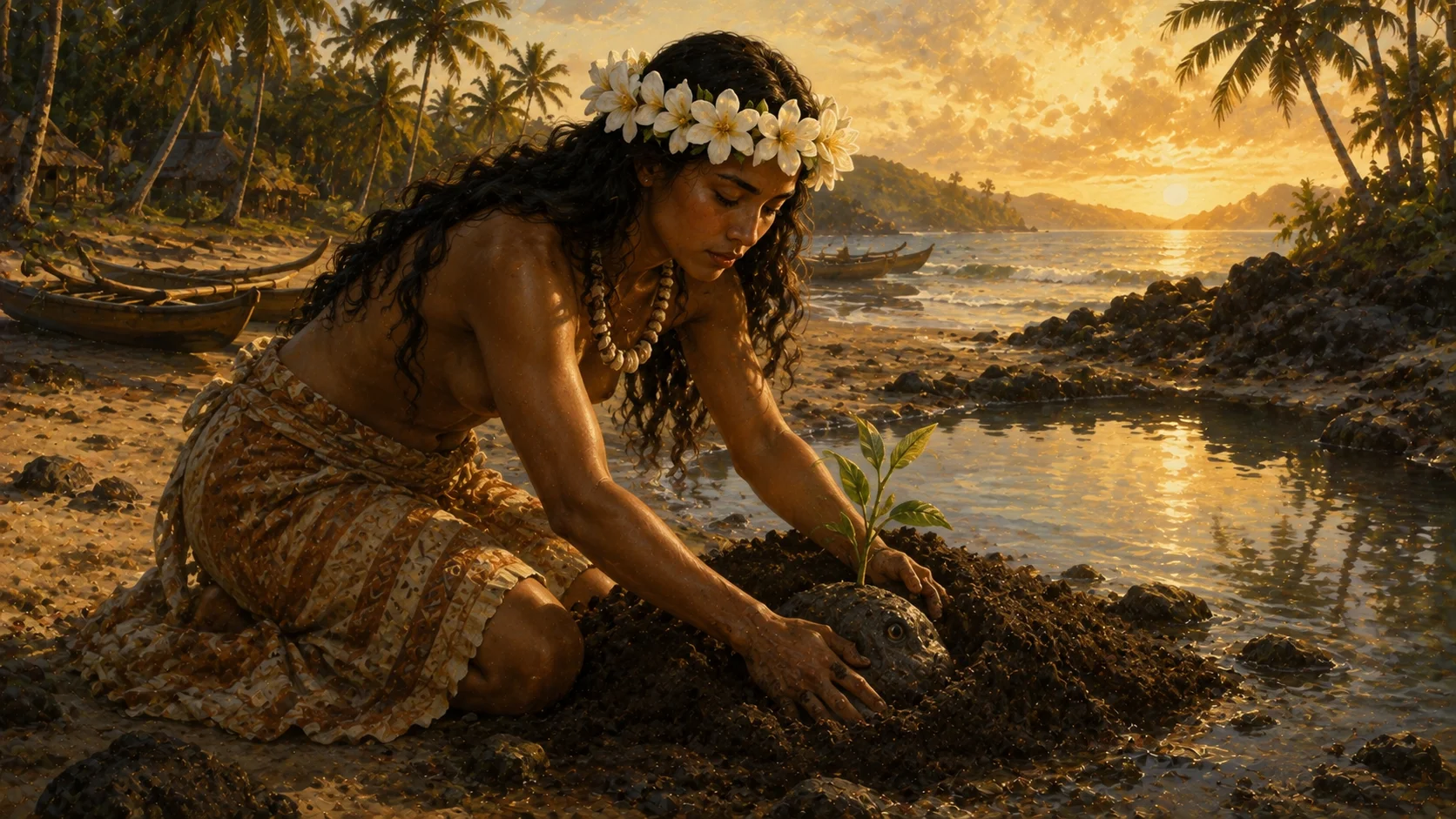
What distinguishes this legend, and what gives it its lasting emotional weight, is what happens after the eel's death. Before it dies, the eel makes a final request of Sina: that she take its head and bury it in the ground. It is a strange and tender request from a creature that had, moments before, been an object of fear — and Sina honors it. She buries the eel's head, closing the story of pursuit with an act of quiet mercy rather than triumph or revulsion.
Where the First Coconut Grew
From the buried head, a new and wondrous tree rises — the first coconut palm, appearing in Samoa for the first time as a direct consequence of Sina's act. The story does not end with the tree's growth alone. Look closely at a husked coconut, Samoan tradition says, and you will see the eel's face still there: three marks on the shell, two resembling eyes and one a mouth, said to be the very features of the eel that once pursued her. To drink from a coconut, in this telling, is to drink from the face of Sina's suitor — a small, everyday reminder, repeated across generations of Samoan households, of a story about desire, fear, death, and an unlikely final kindness.
A Legend Rooted in the Land
The Sina-and-the-eel story is not told identically from one end of Samoa to the other. The location of the pool where Sina kept her eel, the village her family called home, the precise reason the eel's pursuit turned frightening — these details shift between published collections and between the oral traditions of different districts. This is not a flaw in the record but a documented and expected feature of how Samoan oral literature works: it is carried by families and villages, not centralized in a single canonical scripture, and a story's local shape often reflects the land and lineage of the people telling it. In some Samoan genealogical traditions, Sina herself is treated as an ancestress connected to particular chiefly lines or villages — meaning her legend carries weight beyond folklore alone, touching on real claims to land and title in the way Samoan myth and genealogy are often woven together.
A Second Story, Not Always Reconciled
Alongside the eel legend, a separate and distinct narrative strand associates Sina with the moon. In some Samoan and broader Polynesian tellings, Sina ascends to the moon, sometimes explained as an escape from an abusive husband, carrying a child and a mat-beater in her arms as she rises. Samoans looking up at the moon's face, in this telling, see the shadow-shapes of Sina herself, still bearing what she carried at the moment of her ascent. This moon narrative sits alongside the eel story rather than merging into it — the two are not always reconciled into a single continuous biography in any given telling, and a listener may encounter one, the other, or both, depending on who is doing the telling. The moon association places Sina within a much larger Polynesian pattern: a "woman in the moon" figure recorded under cognate names across the Pacific, most notably as Hina in Hawaiian tradition.
Woven Into the Fine Mats
Beyond the eel and the moon, some tellings connect Sina to weaving and to the tapa and fine-mat traditions of Samoa. This association is documented less in the narrative texts of her core myths than in the broader ethnographic literature on Samoan material culture — but it is a meaningful thread nonetheless. Fine mats, known as ie toga, sit at the center of Samoan ceremonial exchange, marking status, sealing relationships, and carrying social weight far beyond their function as woven objects. To link Sina, even loosely, to this tradition is to place her not only among stories told for their beauty but among the practical, prestige-bearing arts through which Samoan society organizes itself.
A Companion Named Tinilau
In several cognate cycles found across the wider Polynesian world — recorded in Samoa but developed with greater prominence in Tongan, Fijian, and Tahitian tradition — Sina, under her related name Hina, is linked to a chiefly or semi-divine figure named Tinilau, associated with fish and the ocean. The strength of this pairing is uneven across the region: in core Samoan versions of her story, Tinilau plays a comparatively minor role next to the eel and the moon, while in other island traditions the relationship between the two takes on far greater narrative importance. This unevenness is itself worth noting, since it illustrates how a shared name and a shared story-world can carry very different weight from one Polynesian tradition to the next.
A Mortal Woman, Not Quite a Goddess
One of the more striking features of Sina's Samoan portrayal is that she is most often described not as a full deity but as a mortal woman of extraordinary beauty and virtue. Her stories, though, carry cosmogonic weight — they explain the existence of things in the world, from the coconut's face to the moon's markings — in a way usually reserved for the deeds of gods. This blending of mortal biography and world-shaping consequence is a hallmark of how she is remembered: less a goddess to be worshipped than a heroine whose personal history becomes, through the logic of story, part of the fabric of the visible world.
An Unsettled Question of Worship
Whether pre-Christian Samoan religion actually treated Sina as a worshipped deity, as opposed to a culture-hero or legendary mortal, remains an open question in the ethnographic record. The difficulty is one of timing: most of the detailed written documentation of her story was recorded after the 1830s, once Christian missionary influence had already begun reshaping how Samoans presented their traditional narratives to outside collectors such as George Turner, whose 1884 account of Samoan tradition remains one of the foundational ethnographic sources on her legend. What reached the written record, in other words, had already passed through decades of religious change — leaving the precise nature of Sina's earlier standing, deity or heroine, genuinely uncertain rather than settled.
One Name, Many Pacific Faces
The name-complex Sina belongs to — shared with Hina, Ina, and related forms — appears throughout Polynesia with narratives that are related in feeling but not identical in content. Hawaiian tradition remembers Hina as a moon goddess and, in some genealogies, mother to figures connected with Maui. Similar figures appear in the traditions of the Tuamotus, the Cook Islands, and Tahiti, each shaped by its own local telling. Comparative scholars of Polynesian mythology, building on early work by researchers such as Nathaniel Emerson and later generations of Pacific ethnographers, treat these figures as related through a shared linguistic and cultural root rather than as one single figure appearing under different regional names. Treating the Samoan Sina and the Hawaiian Hina as directly and simply the same being remains a scholarly hypothesis about deep Polynesian origins — a reasonable and widely discussed one, but not a settled identity, and each island tradition's version of her story deserves to be understood first on its own terms.
What Endures in Her Telling
Across her variations, Sina functions as an archetype of Samoan feminine beauty, virtue, and resourcefulness, and her stories consistently do the work that so much Polynesian oral literature does: explaining the visible world through personal, often intimate, history. A coconut's three marks become a face remembered. The moon's shifting shadows become a woman still carrying what she held the moment she rose beyond reach. These are not incidental details but the very mechanism by which the story survives — carried in the land, the food, and the sky themselves, retold wherever a family opens a coconut or looks up on a clear Samoan night.
Sources & traditions
- EncyclopediaWikipedia — Sina and the Eel
- TraditionSamoan folk and village traditions
Myths change from area to area and from time to time. This chronicle follows the most widely told versions; tellings in other villages, regions and eras may differ.