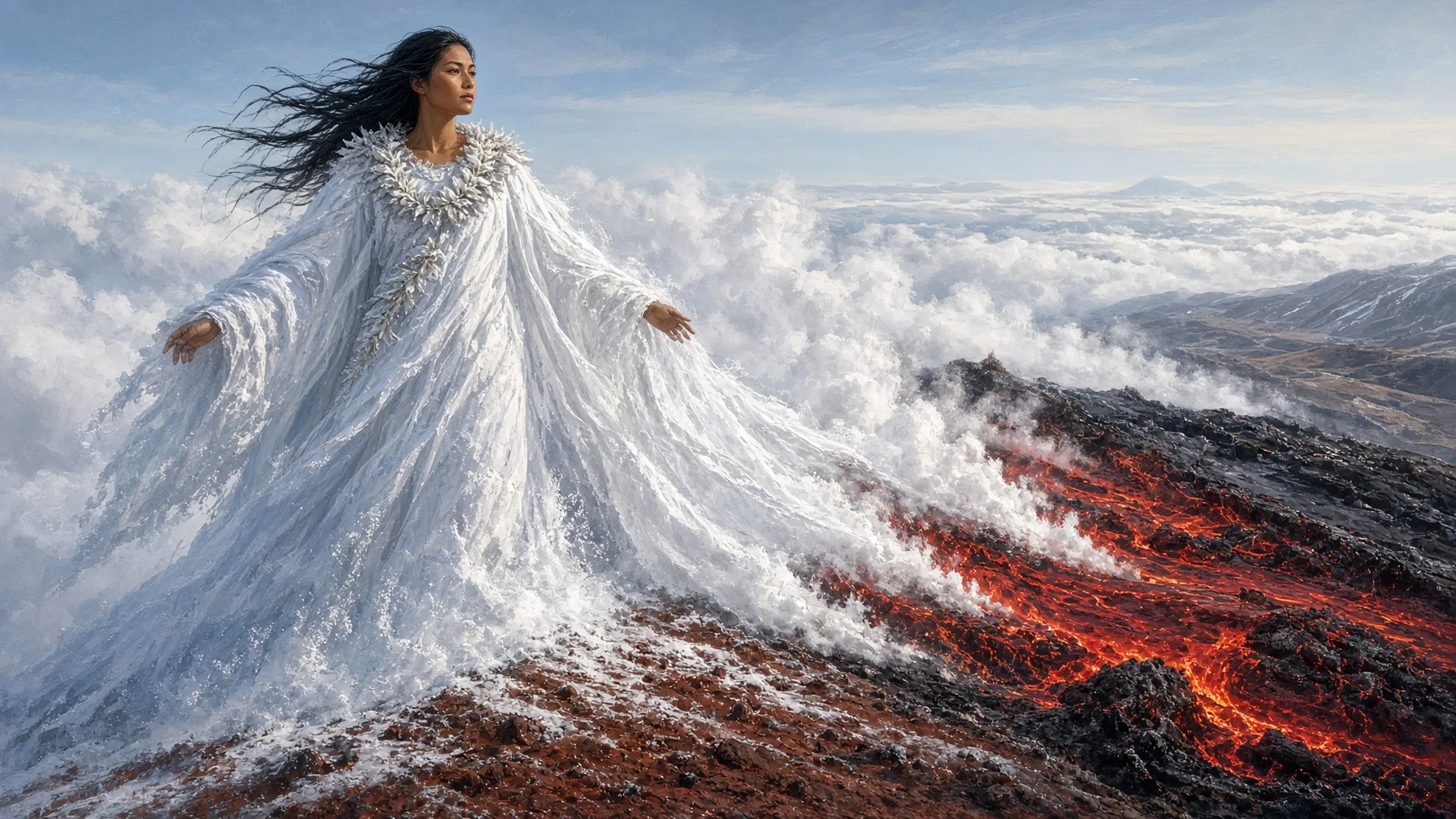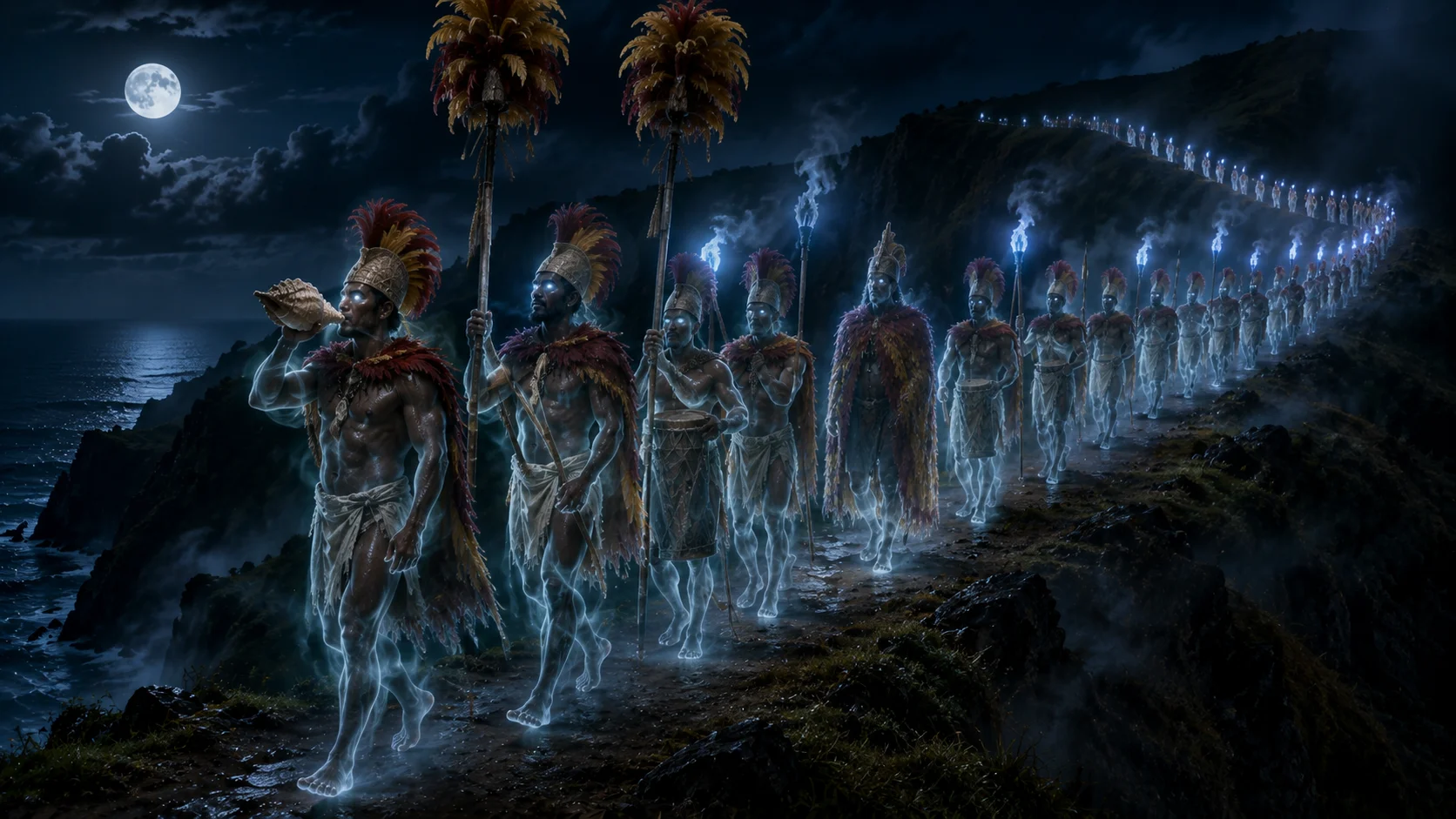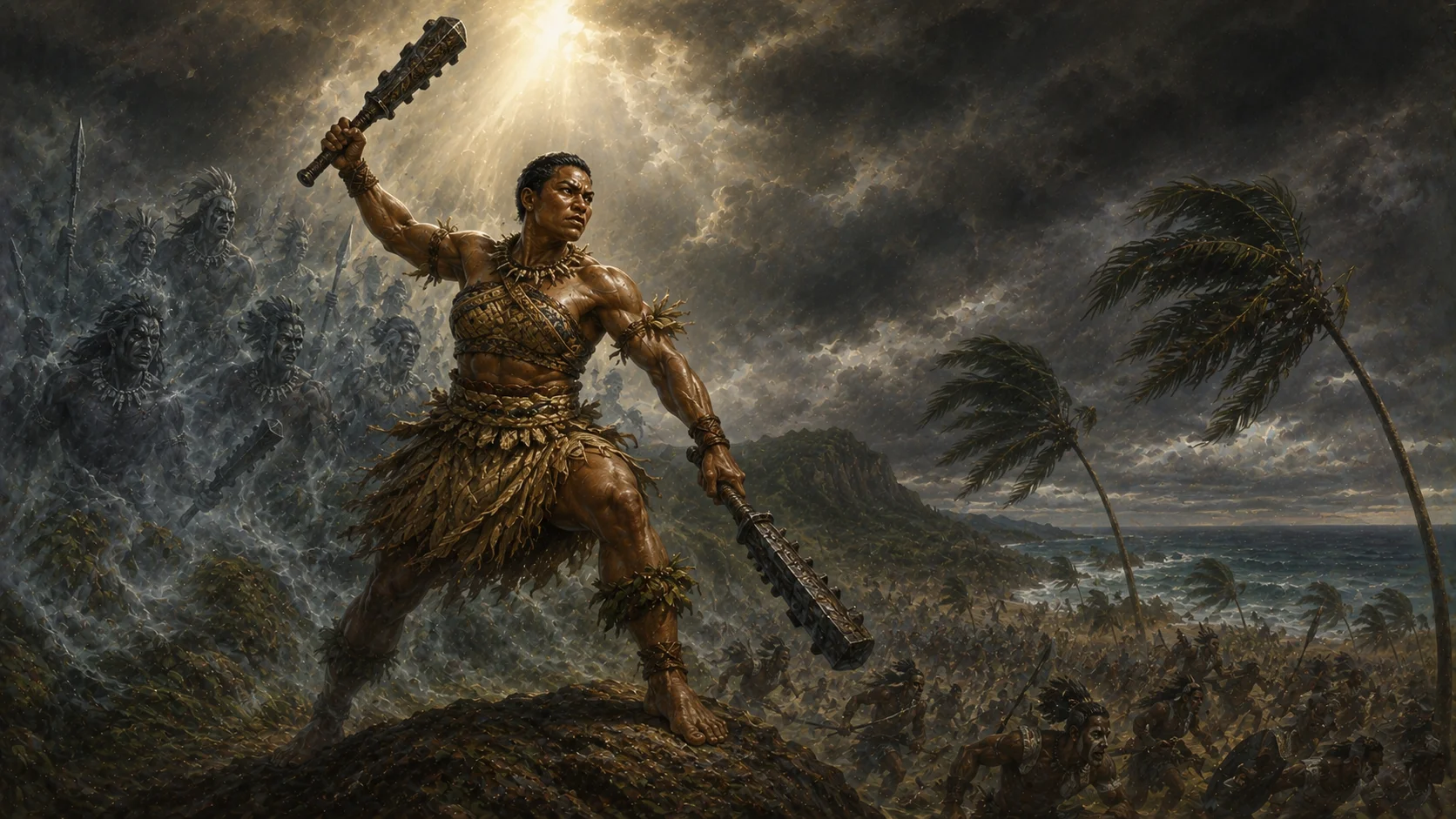
Nafanua is the great war-goddess of Samoan oral tradition, a woman-warrior of divine and underworld descent whose victory in the wars of Savai'i reshaped the political order of the islands. Her narrative is centered on the district of Falealupo, on the western end of Savai'i, where it was recorded by nineteenth-century ethnographers George Turner and John B. Stair and has continued to be told, and invoked in oratory, into the present day. Among the deities of Samoan tradition she stands out for this continuity: she is not only a figure of ancient story but a presence still called upon in genealogy and chiefly speech from Falealupo and allied districts.
Born in the Spirit-World of Pulotu
The traditions place Nafanua's origin in Pulotu, the Samoan spirit-world associated with the west and with the dead. She is held to be the daughter of Saveasi'uleo, the eel-tailed god-king who rules there, and of Tilafaiga, named in the most cited version as one of a pair of conjoined-twin sisters — Taema and Tilafaiga — credited in Samoan tradition with bringing the art of tatau, or tattooing, to the islands. Western Savai'i tellings, closest to Nafanua's own cult site, give this parentage most fully; other variants recorded across the archipelago name her mother differently, and the ethnographic record preserves that disagreement rather than resolving it into a single fixed account. What the traditions agree on is the weight of the lineage itself: a daughter of the ruler of the dead, born at the threshold between the world of spirits and the world of the living, carrying from birth an inheritance that was never going to remain hidden.
The Log That Hid a Goddess
One of the most distinctive and specifically remembered details of Nafanua's early life is the concealment of her identity in decayed matter — the infant or young Nafanua wrapped in, or associated with, a rotting log, so that her power and her true nature would not be recognized by those who might have wished her harm. Ethnographers who recorded this motif treated it as a particular narrative element belonging to Nafanua's story specifically, not a generic device borrowed loosely from elsewhere in the tradition. It is the kind of detail that oral tradition preserves precisely because it is strange and exact: not simply "she was hidden," but hidden in this way, inside this decay, so that the child who would become the mightiest war leader of Samoa first passed unseen through the world as something already given up for spent.
Sent from Pulotu to the War of Savai'i
The central myth cycle of Nafanua tells of the civil war that divided Savai'i, in which the eastern districts held the western districts under oppression. Nafanua, raised or sent forth from Pulotu by her father Saveasi'uleo, came to Savai'i to lead the western districts — the Falealupo-based forces — against the eastern chiefs. Different tellings pair her with different allied war leaders or chiefs in the fighting, a variation the eastern Atua and A'ana district versions recorded by Stair and Turner preserve differently again from the western accounts. What holds constant across every version is the outcome: Nafanua led the western forces to a decisive victory, ending the conflict and closing the war that had divided the island.
Revealed as a Woman in the Field of Battle
Several versions of the war record a turning point in which Nafanua, having fought concealed or in disguise, is revealed to be a woman — a moment treated in the tradition as the narrative hinge that establishes her exceptional status as a female war leader inside a chiefly system built around men. Related tellings record her withholding one of the highest titles until a suitor or claimant had proven himself worthy of it, a further test layered onto the aftermath of the war. Both episodes turn on the same recognition: that the power which had just won the war belonged, undisguised, to a woman, and that this fact was not incidental to her authority but central to how the tradition remembers her.
The Founding of the Four Paramount Titles
After her victory, Nafanua is credited with an act that Samoan political tradition treats as a founding charter: the distribution of the four highest titles of Samoa, the Tama a 'Aiga or papa titles, to the chiefs she judged deserving of them. In the standard listing these are Tui Atua, Tui A'ana, Gato'aitele, and Tamasoali'i. The exact list and the order in which she granted them vary slightly between district tellings, western Savai'i versions again giving the fullest and most reverent account, eastern district versions sometimes differing on which chief received which honor. What does not vary is the significance of the act itself: a war goddess, at the close of a war she had just won, laid down the terms by which legitimate chiefly authority in Samoa would afterward be recognized.
A Living Charter, Not Only a Story
This is the detail that sets Nafanua apart from many other figures of Samoan tradition: her title-granting myth is not folklore alone. The Tama a 'Aiga titles she is credited with founding remain central to Samoan matai politics today, cited in real constitutional and title-dispute contexts, including in the selection of the Head of State. A myth cycle recorded by nineteenth-century ethnographers continues, in the twenty-first century, to underwrite an actual and functioning system of chiefly legitimacy — a kind of living documentation unusually well attested compared to the more purely cosmogonic deities of the wider tradition.
Goddess of War and Guardian of Falealupo
In her established role, Nafanua is the aitu o taua, the goddess of war, associated with military victory and with the political legitimacy of chiefly title. Her secondary association is with Falealupo itself, the district that remains her cult center and the place from which her fullest and most reverently kept accounts are told. Oratory, or lauga, from Falealupo and its allied districts invokes her name to assert precedence in matters of chiefly standing — her authority is not simply remembered but actively drawn upon, generation after generation, in the speech of those who trace their standing back to her victory.
The Disputed Prophecy of a Coming Kingdom
Nafanua is also linked, in some tellings, to a role as prophet — a documented, though inconsistently worded, prophecy concerning the arrival of a new religion or a new kingdom to Samoa. This has been interpreted retrospectively by some Christian Samoans as a foretelling of the arrival of Christianity in 1830. The claim deserves to be held carefully rather than stated as settled fact: later scholars regard the specific identification of the prophecy with Christianity's arrival as very likely a retrospective reinterpretation, laid over an earlier and more general prophecy motif, rather than a verifiable pre-contact prediction. The precise wording of the prophecy itself is reported inconsistently across the sources that preserve it, which the ethnographic record notes explicitly rather than smoothing over. It is a place where the tradition's own layers are visible — an older story, and a later reading of it, both still carried forward together.
Genealogy at the Edge of the Tagaloa Line
Through her father Saveasi'uleo, ruler of Pulotu, and her mother Tilafaiga, co-twin origin figure of tatau, Nafanua's descent is distinct from the great Tagaloa cycle that anchors much of Samoan cosmogony. Her political role on Savai'i nonetheless brought her into connection with the broader Tagaloa-descended chiefly lines, without her being herself a figure of that myth cycle. She stands, in other words, somewhat apart — a war goddess whose authority was won on the battlefield and confirmed in the granting of titles, rather than one woven into the cosmogonic genealogy from the outset. That separateness is part of what gives her story its particular shape: hers is a power established by action within history-as-myth, not simply inherited from the order of creation.
A Name Invoked for Women's Authority
In modern Samoan discourse, including feminist and cultural-revival contexts, Nafanua is frequently cited as a pre-colonial example of recognized female political and martial authority. Scholars note that this usage is a modern re-emphasis of her story rather than necessarily the framing the earliest ethnographic accounts gave it — a distinction worth keeping clear, and one that does not diminish the fact on which it rests. The tradition itself, across every version, records a woman who led armies, won a civil war, and set the terms of chiefly legitimacy afterward. Whatever emphasis later generations have placed on that fact, the fact itself belongs to the oldest layer of her story.
Variation Across the Districts of Samoa
No single canonical telling of Nafanua's story exists, and the ethnographic record is explicit about this rather than resolving it into one authorized version. Falealupo and the western Savai'i tellings closest to her cult site give the fullest and most reverent account of her war leadership and her granting of titles. The eastern Atua and A'ana district versions recorded by Stair and Turner sometimes name different chiefs as her military allies, or give a different sequence for which title went to whom. The wording of her prophecy varies most of all. This is not a flaw in the record but a feature of a tradition that has been told, differently, in different places, by people whose own standing was shaped by which version they told.
What Endures
Nafanua's story ends where most great war narratives end — not with the war itself, but with what the war made possible afterward: titles granted, precedence settled, a system of legitimate chiefly authority given its founding shape by the one who had just finished fighting for it. She remains, in Falealupo and beyond, a name spoken in oratory to assert standing that traces back to her, a goddess of war whose victory is still, in a very literal sense, part of how authority is recognized in Samoa today. Few figures in the wider tradition carry that particular kind of continuity — myth that never fully receded into the past because the institutions it founded never stopped being used.
Sources & traditions
- EncyclopediaWikipedia — Nafanua
- TraditionSamoan folk and village traditions
Myths change from area to area and from time to time. This chronicle follows the most widely told versions; tellings in other villages, regions and eras may differ.