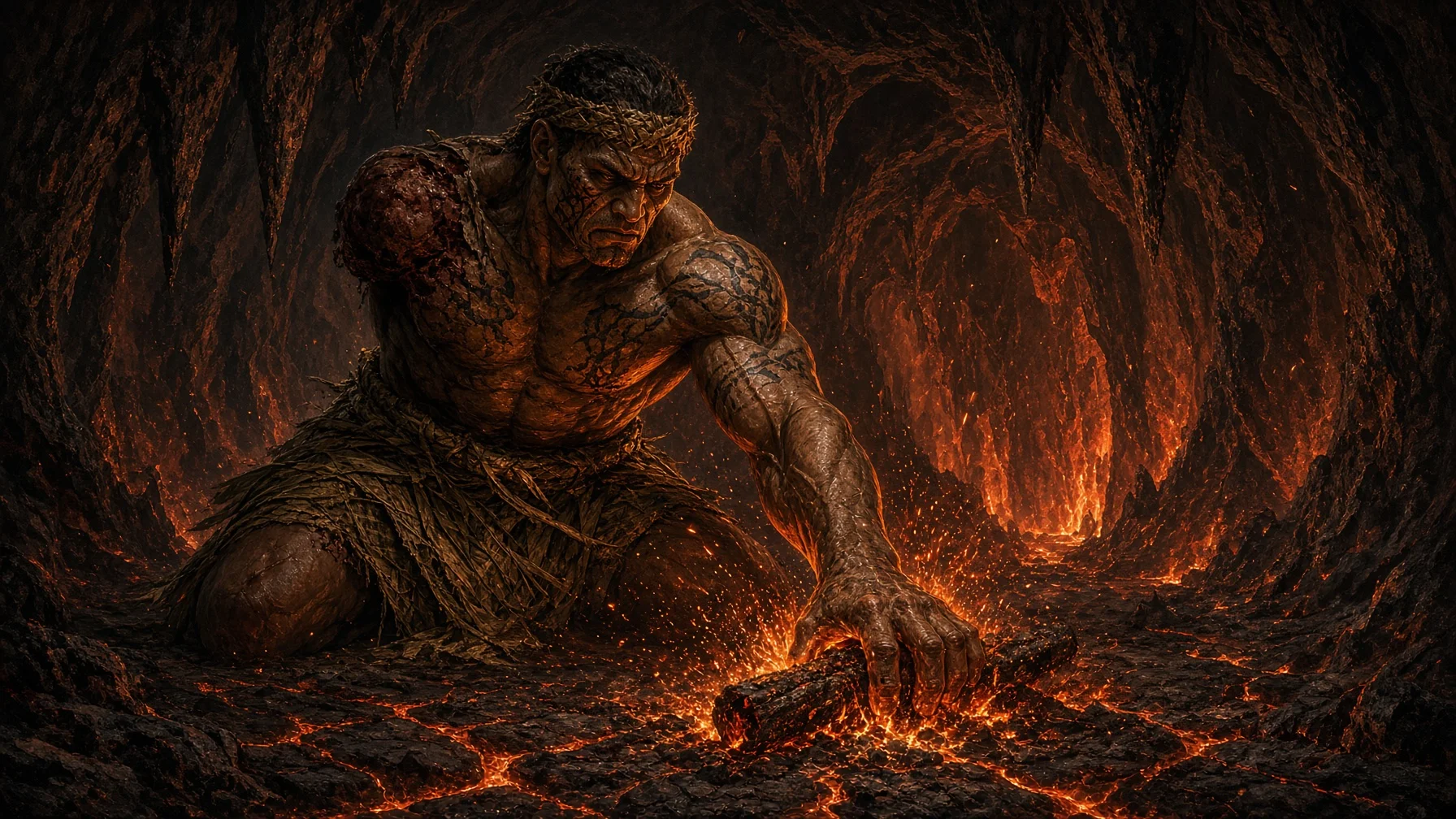
Mafui'e is the god of earthquakes and the keeper of subterranean fire in Samoan mythology — the fierce, one-armed deity who dwells in the underworld and guards the fire of the earth, whose shifting and shaking causes the earthquakes that tremble through the islands. Famous for the loss of one of his arms in his struggle with the hero who stole fire for humankind, Mafui'e is the volatile lord of the earth's fiery depths.
A Name Carried Across Missionary Ink
What is known of Mafui'e today survives because two 19th-century missionary-ethnographers wrote it down after hearing it from Samoan informants: George Turner, in Samoa a Hundred Years Ago and Long Before (1884), and John B. Stair, in Old Samoa (1897). Neither man invented the tradition; both were transcribing an oral culture already old when they arrived, and their two records do not always agree with each other in spelling or in the fine detail of the story. The god's name itself appears variously as Mafui'e, Mafuiʻe, or Mafui-e — small orthographic differences that mark the boundary between spoken Samoan tradition and its fixed, written English-language record. There is no single canonical Samoan text of the Mafui'e story; there are, instead, two respected recordings that overlap, diverge, and together form the whole of what outsiders can reliably say about him.
Lord of the Fire Beneath the Ground
Mafui'e's domain is not the sky and not the sea, which sets him apart from the war gods and ocean gods who populate much of the Samoan pantheon. He is a chthonic figure, a ruler of the underworld, and specifically of the fire that burns beneath the earth's surface. In some tellings this domain is described as a fire-filled or volcanic pit lying below the world of the living — a place where flame is kept rather than merely present, held and controlled by Mafui'e as a possession rather than simply a hazard. Ethnographers have noted a small irony in this picture: Samoa itself has comparatively limited volcanic activity next to islands such as Hawai'i, so the fire-god motif attached to Mafui'e is generally understood as an inherited feature of a wider Polynesian religious inheritance, carried into Samoan tradition rather than grown directly out of Samoa's own geology.
One God Among Samoa's Aitu
In the broader structure of Samoan belief, Mafui'e belongs to a category of spirits and gods, the 'aitu, who are each bound to a particular natural force. This distinguishes him from a figure like Tagaloa, the supreme creator god of the Samoan pantheon, whose remit is vast and foundational. Mafui'e's role, by contrast, is narrow and specific: he is the explanation for one thing, seismic activity, and the tradition around him rarely reaches beyond that single, sharply defined function. He is not recorded as a god of the sky, of the sea, of war, or of creation — his identity begins and ends with fire held underground and the shaking that fire, and its keeper, can produce.
The Descent of Ti'iti'i
The central narrative of the Mafui'e tradition is a fire-theft myth, and its hero is Ti'iti'i, son of Talaga — in some recordings rendered more fully as Ti'iti'i-a-Talaga, in others simplified to the shorter Tiitii. Ti'iti'i is described as descending into the underworld, into Mafui'e's own domain, in pursuit of fire for the benefit of humankind above. This descent places the story within a recognisable Oceanic pattern: a culture-hero travels down into a chthonic or ancestral realm to obtain something essential to human life from a being who already possesses it. The Samoan telling gives that essential thing as fire itself, and gives its guardian a name, a domain, and — crucially — a body that can be fought.
A Struggle Underground
What follows the descent is a wrestling match. Ti'iti'i and Mafui'e grapple for possession of the fire, and Ti'iti'i wins it — not through trickery alone, in the way some Polynesian fire-theft heroes prevail, but through a physical contest in which he overpowers the underworld god. The struggle is remembered as the decisive act of the whole cycle: it is the reason fire belongs to human beings at all, carried up out of the underworld by a hero willing to fight its keeper for it. Some versions of the tale connect Ti'iti'i's victory to his lineage, tying him through Talaga into the wider Samoan genealogical-mythic framework that links earthly heroes back toward the gods — a reminder that in this tradition, heroism and descent are often bound together.
The Arm That Was Broken
The wrestling match leaves a permanent mark on Mafui'e. In the struggle, Ti'iti'i breaks, or wrenches off, one of the god's arms. The two ethnographic sources differ slightly on the exact mechanism — whether the arm is torn away outright or merely injured — a variation entirely characteristic of material that passed through oral transmission before either Turner or Stair fixed it in writing. What both agree on is the consequence: Mafui'e is left with only one good arm, and that loss becomes the etiological hinge of the entire tradition. It is not a wound that heals or fades from the story; it is the permanent, defining condition of the god from that point forward, and it is the detail that gives the whole myth its purpose — explaining not just how fire came to humankind, but why the earth still shakes.
Why the Ground Still Trembles
With one arm gone, Mafui'e continues to dwell in the underworld, and it is said that he shakes the ground with his remaining arm when he is disturbed or angered. This is the etiological core of the tradition: earthquakes, in Samoan belief as recorded by Turner and Stair, were explained as Mafui'e stirring or striking below the earth's surface. He is functionally an explanatory deity, in much the same way that other Pacific traditions each supply their own figure to account for the same terrifying, unpredictable phenomenon. Every tremor felt on the islands could be understood, within this framework, as a sign of Mafui'e's movement far beneath the feet of the living — the one-armed god of the depths reminding the surface world that he is still there, still holding fire, still capable of shaking what stands above him.
A Story Told Across the Ocean
The Ti'iti'i and Mafui'e cycle does not stand alone in the Pacific. It belongs to a broader Polynesian mythological pattern in which a trickster or culture-hero obtains fire from a chthonic or ancestral figure, by force or by cunning — a pattern visible in Maui myths recorded in Hawaiian, Māori, and Tongan tradition. Samoan tradition's version, centred on Mafui'e and Ti'iti'i, is a regionally localized variant of this widespread Oceanic mytheme rather than an isolated invention unique to Samoa. Recognising that kinship does not diminish the Samoan telling; it situates it within a family of related stories spread across the Pacific, each shaped by its own islands, its own heroes, and its own name for the god who first held the fire underground.
What the Old Sources Do Not Settle
Because the entire corpus rests on oral tradition recorded through missionary intermediaries, scholars are careful to note what remains genuinely uncertain. Mafui'e's full genealogy, his exact appearance, and the complete extent of his powers beyond the guardianship of fire and the causing of earthquakes are not consistently attested across the surviving sources. What can be stated with confidence is limited to what Turner and Stair actually recorded: his domain, his role as fire-keeper, the loss of his arm, and the earthquake explanation that follows from it. Beyond that core, later details should be treated as reconstruction rather than settled doctrine — a caution that applies to any tradition preserved through a narrow set of 19th-century recordings rather than a continuous, self-documenting textual history.
The Legend in Later Hands
In the 20th and 21st centuries, the story of Ti'iti'i and Mafui'e has found a second life in Pacific children's literature and popular folklore retellings, which have helped keep the earthquake legend known well beyond specialist ethnographic circles. These later versions often smooth over the very divergences that make Turner's and Stair's original recordings valuable — harmonizing the differing details of the arm, the exact route of the descent, or the precise naming of Ti'iti'i's lineage into a single simplified narrative. They are worth noting as evidence of the story's continuing life, but they are retellings, not primary attestation, and the two 19th-century ethnographic sources remain the foundation on which everything else about Mafui'e ultimately rests.
The God the Ground Remembers
Mafui'e endures in the record as a narrow but vivid figure: not a creator, not a war god, not a lord of the open sea, but the one-armed keeper of underground fire whose old wound is also his ongoing story. Every element of what survives about him — the underworld domain, the wrestling match with Ti'iti'i, the broken arm, the shaking that follows — fits together into a single explanatory whole, preserved by two careful listeners more than a century ago and carried forward since in the retelling of a phenomenon no one on a seismically restless island could ever fail to notice.
Sources & traditions
- EncyclopediaWikipedia — Mafuiʻe
- TraditionSamoan folk and village traditions
Myths change from area to area and from time to time. This chronicle follows the most widely told versions; tellings in other villages, regions and eras may differ.