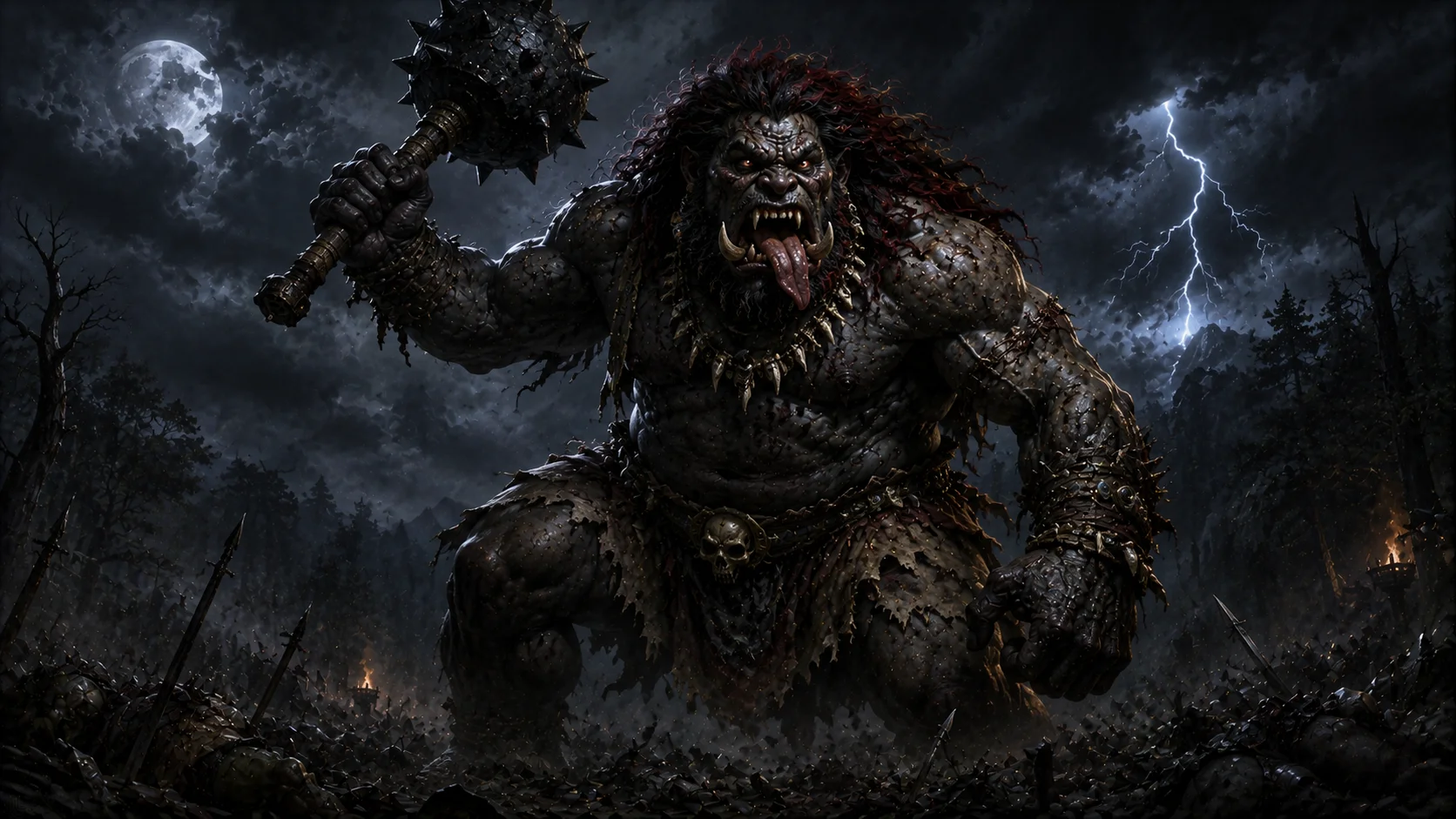
Rakshasa — Rākṣasa, feminine Rākṣasī — is the great Hindu category of malevolent, shape-shifting, often man-eating beings: the demons, ogres, and night-prowlers who oppose gods and heroes throughout the Vedas, the Ramayana, and the Mahabharata. Where the asuras are the cosmic adversaries of the gods, the rakshasas are the more earthbound terror — the thing in the forest, the disturber of sacrifices, the eater of corpses and of the living.
Origin and Name
Puranic sources do not agree on where the rakshasas came from, and the disagreement is itself part of the tradition rather than a puzzle to be resolved. One account holds that they sprang from the breath or the foot of Brahma at creation, born so ravenous that they cried out — some say "Rakshama!," "let us protect," and others heard in the same cry "let us devour." The word raksha means "to guard," and the irony sits at the root of the name: these beings were reportedly set as guardians of the primeval waters and turned instead to predation. A second, separately attested lineage traces many rakshasas to the sage Pulastya, one of the mind-born sons of Brahma, whose descent is what makes Ravana — a king counted among the rakshasas — simultaneously a brahmin-descended figure by blood and a demon by nature and deed. Both traditions are carried in the textual record; neither cancels the other.
What the Word Covers
"Rakshasa" is not a single species so much as a broad class, and its edges blur into neighbouring categories. Hindu cosmology recognises several orders of formidable non-human beings — asuras, daityas, danavas, and rakshasas among them — and traditional and scholarly usage does not always draw the line between them the same way twice. What distinguishes the rakshasa within this crowded field is less a fixed anatomy than a set of recurring associations: predation on flesh, mastery of illusion, hostility to sacrificial order, and a habit of appearing wherever holy rites are being performed, precisely in order to spoil them.
The King of Lanka
The most prominent rakshasa in all of Hindu literature is Ravana, the ten-headed sovereign of Lanka in the Ramayana. It is Ravana who abducts Sita, the wife of Rama, and that abduction is the hinge on which the entire epic turns — the act that sets an exiled prince, a devoted brother, and an army of allies on the road to war. Ravana's power in the narrative is not brute strength alone: tradition holds that boons won from the gods through prolonged austerity, tapas, made him all but invincible against the very beings whose favour he had sought, a strength that a mortal-born hero would ultimately have to answer in a way the boons had not anticipated.
A House Divided
Ravana does not stand alone in the record; his household supplies some of the best-known named rakshasas in the tradition, and their differences from one another are as significant as their shared blood. His brother Kumbhakarna is remembered above all for a single, almost fable-like trait — a giant who slept for six months at a stretch, waking only briefly between long spans of unconsciousness. Another brother, Vibhishana, took the opposite path entirely: adherence to dharma led him to break from Ravana and cross over to Rama's side, a defection the tradition treats not as betrayal but as the correct choice of righteousness over kinship. Ravana's son, Indrajit — also called Meghanada — appears as a formidable warrior in his own right within the same conflict, a third generation of the same rakshasa line engaged in the same war.
The Wound That Started a War
Ravana's sister, Surpanakha, belongs to this same family and carries her own consequential role in the epic's chain of causation. It is her mutilation at the hands of Lakshmana — her nose and ears cut off — that sets in motion the sequence of grievance and retaliation leading directly to Sita's abduction. The episode is treated in the tradition as a genuine hinge-point: a personal injury to one rakshasa figure that escalates, through her brother's fury, into a war between a kingdom of rakshasas and an army of men and their allies.
Enemies of the Sanctified Fire
Across both great epics, rakshasas recur as the traditional enemies of brahmins, of ascetics, and above all of the yajna — the Vedic fire-sacrifice — which they delight in disrupting or defiling. The forest of Dandaka is remembered as a place where sages performing their rites were repeatedly harassed by rakshasas, a persecution serious enough that it drew Rama's own intervention on their behalf. The pattern recurs so often across the literature that it functions as a kind of narrative signature: wherever a hermitage's sacred fire is lit in a lonely place, a rakshasa is not far off, waiting to pollute what the sages have consecrated.
Encounters in the Exile Forests
The Mahabharata supplies its own gallery of named rakshasas, met by the Pandava brothers during their years of forest exile. Hidimba and Bakasura both appear in these episodes as rakshasas ultimately killed by the Pandavas — encounters remembered as trials of strength and cunning against beings who stood, in the story's own terms, squarely on the side of predation rather than dharma. These forest confrontations sit alongside the Ramayana's Dandaka-forest episodes as the two great epic reservoirs of rakshasa lore, each supplying its own cast of named figures rather than repeating the other's.
Not One Nature but Many
What keeps the rakshasa from being a simple stock villain across this literature is that the moral alignment of individual rakshasas is depicted as genuinely variable rather than uniform. Vibhishana stands as the clearest proof: a rakshasa by birth who upholds dharma against his own brother, and who is rewarded for it by Rama with nothing less than the throne of Lanka itself once the war is won. That reward is not incidental — it is the tradition's own verdict that a rakshasa's conduct, not his birth, is what determines whether he is an enemy of the gods or a king raised up by one.
The Rakshasis
Female rakshasas, the rakshasis, hold an equally prominent and equally varied place in the record. Tataka and Surpanakha appear within the Ramayana as formidable and destructive figures, while Hidimbi and Simhika belong to the wider Mahabharata and Puranic material. Hidimbi in particular is remembered with a sympathy the category does not always receive: rather than remaining an adversary, she becomes bound by kinship to the heroes she might otherwise have opposed, a reminder that "rakshasi" describes a lineage and a set of powers, not a fixed disposition.
Dominion of Night and Ash
Rakshasas are bound, in this tradition, to darkness and to the places darkness collects most thickly — cremation grounds, deep and trackless forests, the impure and inauspicious margins of settled, sacrificial life. Night is understood to be the hour of their true strength, their power rising as daylight fails and receding again toward dawn. This nocturnal character is inseparable from their reputation as illusionists: shape-shifting and maya, the power to assume any form at will, are counted among their defining abilities, alongside the far greater boons of near-invincibility that figures such as Ravana are said to have won from gods including Brahma and Shiva through austerity.
A Demon That Travelled
The rakshasa did not remain confined to the subcontinent. It passed into Buddhist tradition and from there travelled across Southeast Asia, taking root under new names and new local forms wherever it went — evidence of how far a single figure from Hindu mythology could carry once set loose along the routes of trade, pilgrimage, and shared story. Within Hindu devotional and ritual culture itself, the rakshasa has endured as the standing symbolic embodiment of adharma, of chaos and unrighteousness, the thing that a heroic or divine figure exists to overcome — a role kept visibly alive each year in festival traditions such as Dussehra and Vijayadashami, which commemorate Rama's defeat of Ravana, the rakshasa king, as their central act.
Sources & traditions
- EncyclopediaWikipedia — Rakshasa
- TraditionHindu texts, oral tradition and village tellings (South Asia)
Myths change from area to area and from time to time. This chronicle follows the most widely told versions; tellings in other villages, regions and eras may differ.