Ghatotkacha — Ghaṭotkaca — is the heroic half-rakshasa giant of the Mahabharata: son of the Pandava strongman Bhima and the demoness Hidimbi, a towering shape-shifting warrior of immense power whose self-sacrifice on the battlefield is one of the war’s great turning points. Loyal, mighty, and tragic, he is the nephew of gods’ sons who gives his life to save his uncle Arjuna.
The Bald-Headed Giant
His name means “pot-headed” (ghata, pot; utkacha, bald) — for he was born with a smooth, pot-shaped hairless head. He was the child of Bhima’s forest marriage to Hidimba’s sister Hidimbi during the Pandavas’ first exile; like all rakshasa-born he grew to full strength in a single day, and being half-demon he commanded the rakshasa powers of his mother’s line — flight, illusion, shape-shifting, and the ability to grow to colossal size and conjure phantom armies — while inheriting his father’s heroic loyalty. Though raised among the rakshasas, he loved his Pandava father and vowed to come to his aid whenever called, simply by thinking of him.
The Night Battle
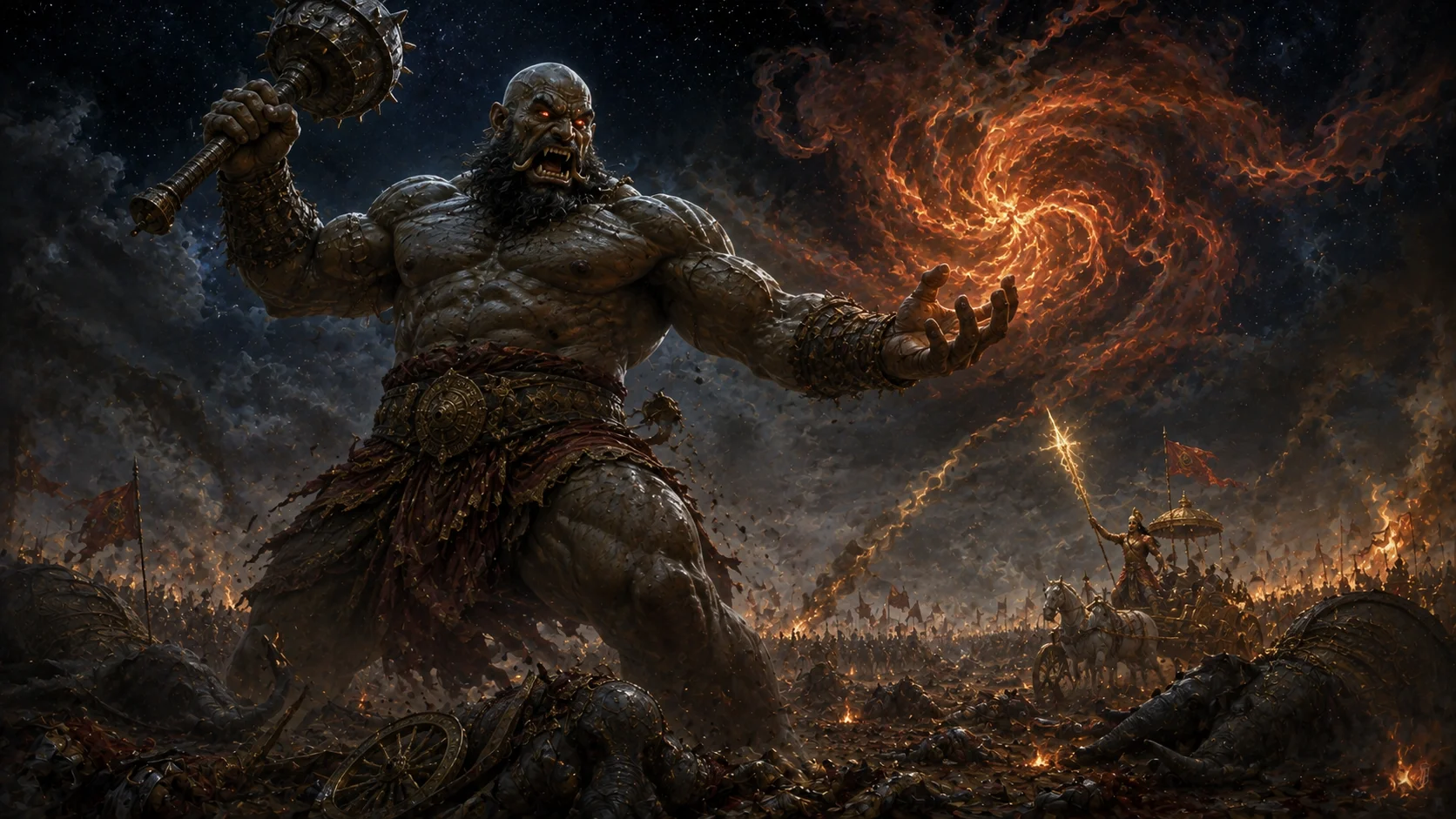
When the great war came, Ghatotkacha answered the call and fought for the Pandavas with devastating effect, for rakshasa power waxes at night. On the fourteenth night — when the battle, against all custom, raged on past sunset — Ghatotkacha came into his full terror, growing mountainous, raining boulders and trees and weapons, conjuring illusions and phantom hosts, and slaughtering the Kaurava army in the darkness. The Kauravas were being annihilated; Duryodhana begged Karna to stop the giant at any cost.
The Sacrifice
Here lies the strategic heart of his death. Karna possessed the Vasavi Shakti — an infallible single-use divine spear given by Indra — which he was hoarding to kill Arjuna, the one weapon that could surely slay Bhima’s greatest brother. As Ghatotkacha threatened to destroy the entire Kaurava force, Karna had no choice: he hurled the Shakti and killed the giant. Dying, Ghatotkacha used his last power to swell to gigantic size and crush thousands of Kaurava soldiers beneath his falling body — a final blow even in death. Krishna alone rejoiced amid the Pandavas’ grief, for he understood what had happened: by drawing out and spending the unstoppable Shakti, Ghatotkacha had saved Arjuna’s life. The half-demon nephew had died so that the hero of the Gita might live to win the war.
The Beloved Half-Demon
Ghatotkacha embodies the Mahabharata’s refusal to make “demon” mean “evil”: a rakshasa by blood, he is among the most selfless and loving figures in the epic, a devoted son who lays down his life without hesitation for a father’s family. His own son Barbarika would inherit his power and his tragic destiny. Across India and especially in folk and tribal traditions he is honoured as a mighty protector, and his self-sacrifice remains one of the most poignant deaths in all the war — the giant who turned even his dying into a final gift.
Avenging Iravan: The Death of Alambusha
The night that killed Ghatotkacha was also the night he settled an old debt. Six days earlier, on the war’s eighth day, Duryodhana had sent the rakshasa Alambusha against Iravan — Arjuna’s son by the Naga princess Ulupi, and so Ghatotkacha’s own cousin. Iravan had already cut down five Gandhara princes and stalled the Kaurava advance when Alambusha reached him and struck off his head with a sword. He was the first of the Pandavas’ sons to fall in the war, and it was not forgotten. On the fourteenth day — in the very night battle that would end with Karna raising the Shakti — the two demon champions were finally thrown at each other, each side’s answer to the other’s sorcery, and Ghatotkacha killed Alambusha, paying for Iravan in the coin it had been taken in. He killed Alambusha’s companion Alayudha the same night, cut off his head, and carried it to Duryodhana’s chariot to set it down there as a gift. It is easy to remember only how that night ended, and to forget that Ghatotkacha spent the hours before it doing exactly what he had been called to the war to do.
The Illusion-Weaver: The Wedding at Mayabazar
Not every story about Ghatotkacha ends in blood. In the folk expansion of the epic that grew up across the Telugu- and Tamil-speaking south, he is remembered as much for mischief as for war. In the best-loved of these tales — Sasirekha Parinayam, which borrows the epic’s characters but has no place in the Mahabharata itself — his cousin Abhimanyu loves Balarama’s daughter Sasirekha, called Vatsala in the Tamil telling, and she has been promised instead to Duryodhana’s son. Krishna devises the counter-plot; Ghatotkacha carries it out. He spirits the sleeping bride away to his forest hermitage, takes her exact form, and goes back to the wedding in her place — where, with his rakshasa helpers Chinnamaya, Lambu and Jambu, he raises an illusory town of markets and palaces, invites the Kauravas to lodge in it, and torments the bridegroom out of the match while the real Sasirekha is quietly married to Abhimanyu elsewhere. That phantom town gives the story its name and the 1957 film its title: Mayabazar, the market of illusions, shot simultaneously in Telugu and Tamil, with S. V. Ranga Rao’s Ghatotkacha still among the best-loved performances in Indian cinema. Notice what the tale does with his gift — the same māyā that flattens armies at Kurukshetra is turned here to comedy and matchmaking.
Ghatotkacha on the Sanskrit Stage
Centuries before the cinema found him, Ghatotkacha was given the leading role in one of the oldest surviving Sanskrit plays. Among a group of dramas recovered from Kerala manuscript collections and attributed to Bhasa — a playwright whose dates and even authorship remain disputed, but who is placed well before Kalidasa — is a one-act piece called the Mādhyama-vyāyoga, “the play of the middle one.” In it Ghatotkacha is hunting a human being to break his mother Hidimba’s fast, and he stops a Brahmin family — father, mother, three sons — crossing the forest, demanding one of them. The eldest is his father’s favourite and the youngest his mother’s, so the middle son offers himself, and is granted leave to bathe in the river before he dies. He is slow coming back. Ghatotkacha calls for the middle one — madhyama — and the wrong middle one answers: Bhima, the middle Pandava, who goes by exactly that name. The play that opened with a rakshasa collecting a human meal closes instead on recognition, father and son and the waiting Hidimba reunited, and the Brahmin’s family walking away whole. The entire reversal turns on a pun.
A Shrine Under a Deodar
Ghatotkacha is worshipped, not merely told about, and the geography of that worship follows his mother’s. At Dhungri in Old Manali the sixteenth-century Hidimba Devi Temple honours Hidimba as a goddess in her own right; roughly a hundred metres away stands her son’s shrine, open to the air beneath an enormous deodar, hung with bells, red threads and tridents, with animal horns and iron blades fixed into the trunk. There is no tower and no carved sanctum — only a small figure of Ghatotkacha under a very old tree, and people who climb up to it asking for strength. Mother and son are venerated within sight of each other, in the mountains where local tradition places their meeting, and the whole arrangement has nothing of the Sanskrit court about it.
The Son Who Watched the War: Barbarika and Khatu Shyam
Ghatotkacha’s afterlife in living religion runs largely through his son — and, tellingly, through a story the Mahabharata never tells. Barbarika belongs to folk and devotional tradition rather than to the epic proper, and in that tradition he carries three infallible arrows and could have ended the whole war with them. The danger was not his strength but his vow: he had sworn to fight always for the losing side, which meant that whichever side he joined would stop losing, and the war would never end. Krishna came to him disguised as a Brahmin and asked for the one thing he could not refuse — his head, given in charity. Barbarika gave it, asking only to see the war he would now not fight in. His head was set on a hill above Kurukshetra and watched all eighteen days; afterwards, when the victors fell to arguing over which of them had won it, the head answered that it had seen no human hand at work at all, only Krishna’s discus. Krishna promised him worship in the age to come under Krishna’s own name, Shyam — and today Khatu, in Rajasthan’s Sikar district, draws pilgrims in their millions to Khatu Shyam Ji. Ghatotkacha died on a battlefield to buy Arjuna one more day; his son never fought at all, and ended with a following that has long outgrown the epic it came from.
The Many Afterlives of a Half-Rakshasa
What is strange about Ghatotkacha is not that he was remembered, but how differently. A Sanskrit one-act play makes him a son who cannot finish the errand his mother sent him on. A Telugu comedy makes him a trickster who wins a wedding by wearing the bride’s face. A deodar tree in Himachal makes him a granter of strength. A temple in Rajasthan barely remembers him at all, except as the father of someone larger. Each tradition took the part of him it had a use for — the appetite, the illusion, the loyalty, the sacrifice — and none of them needed the others to be complete. He is one of the few figures in the epic whose story kept growing after the epic itself stopped, and it grew in four directions at once.
Sources & traditions
- EncyclopediaWikipedia — Ghatotkacha
- TraditionHindu texts, oral tradition and village tellings (South Asia)
Myths change from area to area and from time to time. This chronicle follows the most widely told versions; tellings in other villages, regions and eras may differ.