Draupadi — Draupadī, also called Panchali and Krishnaa — is the fire-born queen at the heart of the Mahabharata: shared wife of all five Pandava brothers, the woman whose public humiliation ignites the great war, and one of the most complex heroines in world epic. Proud, learned in dharma, and unwavering once wronged, she is venerated in her own right as a goddess in parts of South India and is numbered, in later devotional tradition, among the panchakanya, the five women whose names are recited for merit.
Risen from the Sacrificial Flame
Draupadi entered the world already grown, stepping from a Vedic fire-altar rather than being born of a womb. King Drupada of Panchala had commissioned the yajna for one purpose: to obtain the means of avenging himself upon Drona. From that same fire rose two children at once — her twin brother Dhrishtadyumna, destined in time to slay Drona in the war at Kurukshetra, and Draupadi herself, who for this origin carries the epithet Yajnaseni, "she who is born of the sacrificial fire." There was no infancy for her to grow through and no ordinary household to be raised in; she and her brother arrived already formed, already bound to the purpose that had called them into being — his to end a teacher's life on a battlefield still years away, hers to become the pivot on which that same war would eventually turn.
Names That Carry Her Story
Draupadi is rarely named only once in any retelling, and each of her names marks a different fact about her. Panchali identifies her simply as the princess of Panchala, the kingdom whose king had prayed her into existence. Krishnaa, distinct from the god Krishna in spelling and meaning alike, refers to her dark complexion. Yajnaseni, older than either, insists on the manner of her birth every time it is spoken — that she was not born but produced, out of fire, for a reason. Taken together, the names read almost like a compressed account of her: where she is from, what she looked like, and how she came to exist at all, before a single event of her adult life has even been told.
The Bow, the Wheel, and the Reflected Eye
Draupadi's hand was won at her swayamvara, a self-choice marriage contest built around a feat few could attempt, let alone complete: stringing an unyielding bow and striking a moving target by aiming only at its reflection, the target itself kept turning out of a direct line of sight. It was a test that punished haste and rewarded a very particular combination of strength and stillness — the strength to bend a bow that had already defeated other claimants, and the stillness to look away from the target itself and trust a mirrored image instead. Where assembled kings and princes failed, Arjuna succeeded, and so claimed her as his bride.
One Bride, Five Husbands
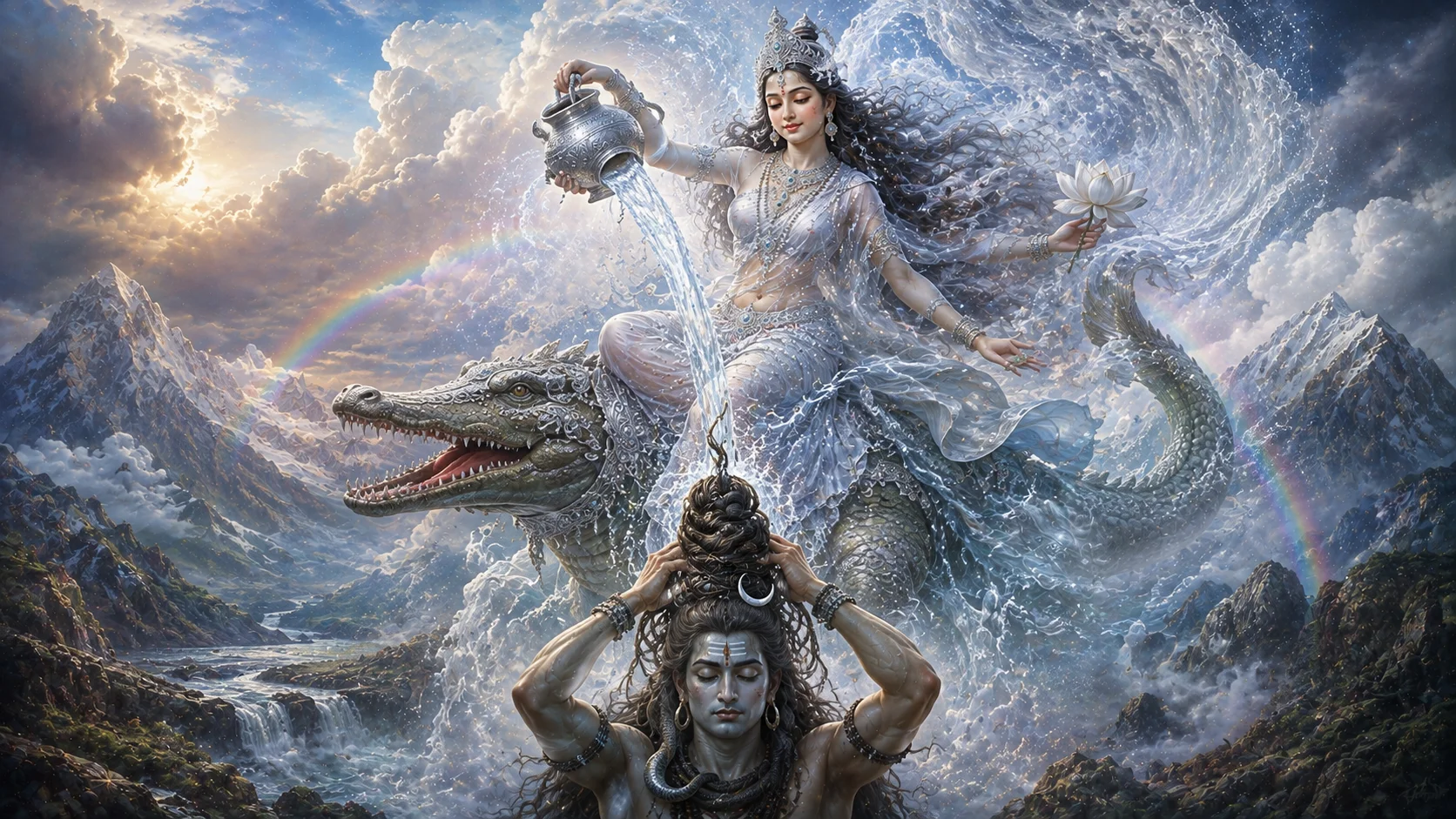
What followed is the arrangement that sets Draupadi apart from every other heroine of the epic: she became wife to all five Pandavas — Yudhishthira, Bhima, Arjuna, Nakula, and Sahadeva — rather than to Arjuna alone. The epic itself offers two accounts of how this came to be. One holds it as the fulfilment of a boon from Shiva earned in a former life, in which she had asked, five separate times, for a husband, and so was granted five. The other traces it to a single unwitting sentence: Kunti, mother of the Pandavas, told her sons to share what Arjuna had won without knowing what — or who — the "prize" was, and her word was honoured as binding. Neither explanation is offered by the epic as more authoritative than the other; both are carried side by side, as if the story itself could not settle on a single account of how something so unusual came to be treated as ordinary.
Queen to Five Kingdoms of the Heart
To be wife to five men bound Draupadi to five different temperaments and five different fates, and the epic treats her standing among them as central to her identity rather than incidental to it. She became mother to five sons, the Upapandavas, one by each husband — her son by Arjuna recorded in some lists as Shrutakirti, though the names given to the five vary somewhat between sources. Whatever the precise roster, all five were killed together in a single night raid carried out by Ashwatthama after the war had already been won, a loss that falls on Draupadi with a weight the epic does not soften — five sons, five fathers who had each survived the war itself, and a mother left to grieve them all at once in the moment of victory rather than in its long shadow.
The Hall Where the War Was Decided
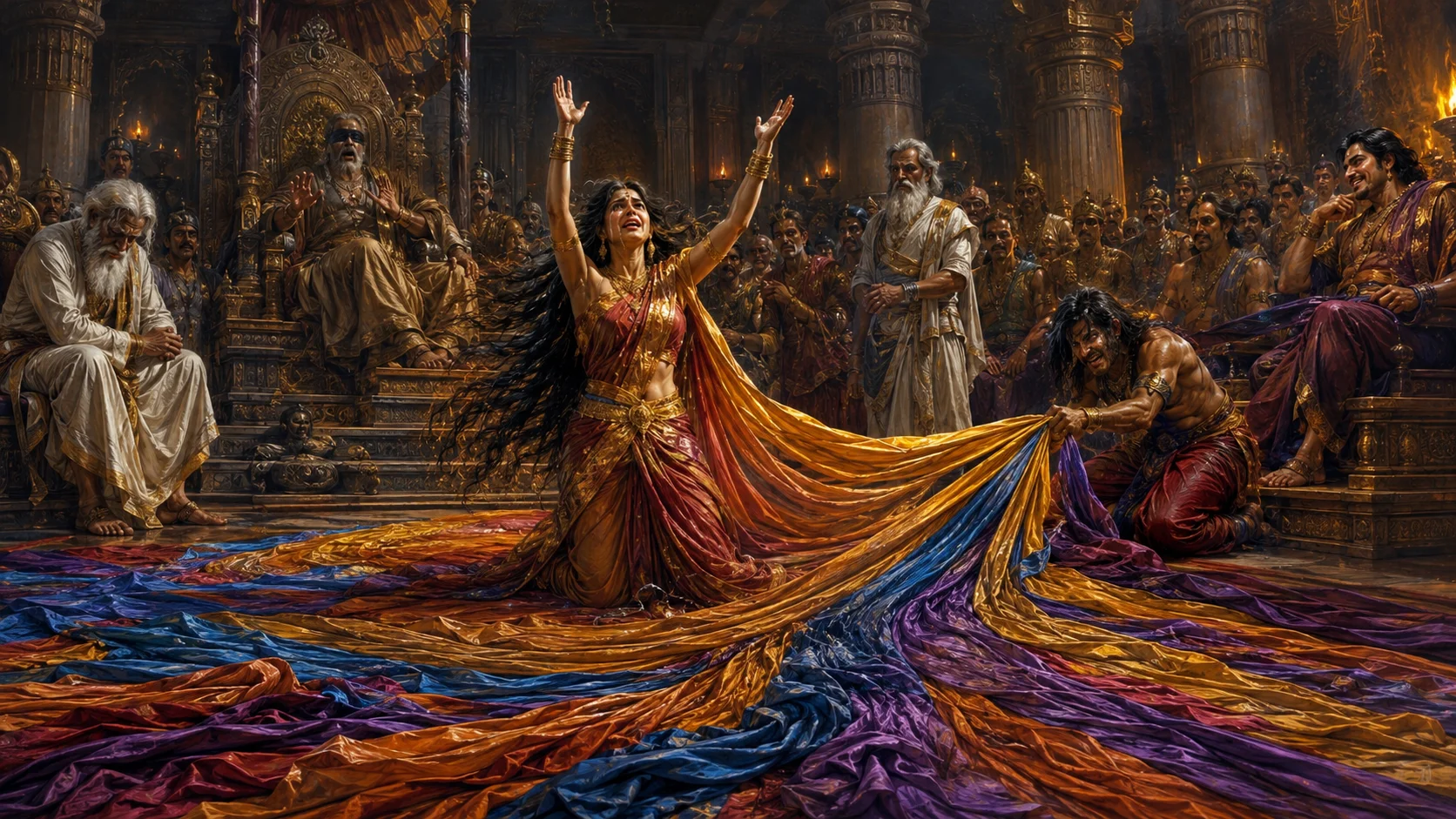
The catastrophe that precipitates the Kurukshetra war is staged around Draupadi directly. Yudhishthira, drawn into a rigged game of dice, wagers and loses his kingdom, his brothers, himself, and finally Draupadi. She is brought into the Kaurava court and, on Duryodhana's order, Dushasana sets about disrobing her before the assembled elders, none of whom intervenes. Later devotional retellings describe Krishna miraculously extending her sari into an endless stream of cloth, so that Dushasana pulls and pulls without ever exposing her — though the austere Sanskrit critical edition of the epic treats the scene with far less embellishment than the tradition that grew up around it. What the text agrees on without qualification is the vow Draupadi takes in that hall: she will not bind up her hair again until it has been washed in Dushasana's blood. It is a vow made in a room full of kings, elders, and her own five husbands, none of whom had acted to stop what was happening to her — and it is spoken not as a plea but as a promise she intends to see kept herself.
A Vow Carried Through the Years of Exile
That oath does not fade with time. It is carried through the Pandavas' long exile and into the war itself, where Bhima — bound by an oath of his own — kills Dushasana and brings his blood to Draupadi so that her vow can be fulfilled at last. The unbound hair she carried for years stands, in the narrative, as a visible and continuous reminder of the debt owed to her, one that is not allowed to be forgotten or diplomatically set aside by anyone at court. Every year of exile that passed without that debt being paid was a year in which the humiliation in the hall remained unanswered, and the epic lets that unresolved state sit in plain view rather than letting the passage of time quietly absorb it.
Sakhi to the God
Across the epic, Draupadi's bond with Krishna is depicted as one of the steadiest relationships in her life — not romantic, but a devoted and protective friendship, sakhya bhava, in which he repeatedly appears as her confidant and her defender. It is to Krishna that she calls out in the dice hall, and it is that same closeness, rather than any of her marriages, that the tradition returns to as the surest constant of her story. Where her marriages are shaped by boons, misunderstandings, and the shifting fortunes of five different men, her bond with Krishna is presented as steadier than any of them — untouched by the disputes, exiles, and battlefield losses that reorder everything else around her.
The Final Ascent
In the epic's closing journey, the Mahaprasthanika Parva, the Pandavas and Draupadi set out together on foot toward the Himalayas, walking toward heaven. One by one, the party falls away on the climb, and Draupadi is the first of them to go down. Yudhishthira, asked why, gives his own explanation: her partiality, among her five husbands, toward Arjuna. It is a striking way for her story to close — not with the vindication of the dice hall or the vow fulfilled on the battlefield, but with a private judgment passed on her by the husband walking ahead of her, offered as the reason she alone falls first.
Counted Among the Panchakanya
Later devotional tradition — though this is not a designation uniform within the core Sanskrit text itself — places Draupadi among the panchakanya, the five maidens invoked together in a well-known verse recited for the merit believed to come from naming them. Her inclusion sits alongside her lived history as a wife to five men and a mother whose sons were taken from her, a juxtaposition the tradition has never fully smoothed over: a name recited for auspiciousness belonging to a woman whose actual story is built almost entirely out of humiliation endured, oaths kept, and losses absorbed one after another.
Goddess of the Tamil Fire Rites
Separate from her place in the pan-Indian epic narrative, Draupadi is worshipped as a form of the Goddess in her own right within the Draupadi cult traditions of Tamil Nadu. This is a distinct regional devotional development, with its own rites and its own theology, rather than a simple extension of the Mahabharata's Draupadi into worship — a second, independent life the character has taken on outside the text that first gave her a name. In this setting she is not merely remembered as a wronged queen from an old epic but approached directly as a form of the Goddess, with a devotional life of her own that runs alongside, rather than simply retelling, the Sanskrit narrative.
The Fire That Would Not Be Quiet
From the altar that produced her to the hall where her humiliation set two armies on their collision course, Draupadi's story is one in which nothing that happens to her is allowed to be forgotten, set aside, or resolved quietly. Voiced from birth by a fire that made no promise of gentleness, she remains, across every version of her story, the figure the Mahabharata cannot move past without reckoning with first — a queen whose names, marriages, vow, grief, and final steps on the mountain all trace back, in the end, to the fire that first gave her form.
Sources & traditions
- EncyclopediaWikipedia — Draupadi
- TraditionHindu texts, oral tradition and village tellings (South Asia)
Myths change from area to area and from time to time. This chronicle follows the most widely told versions; tellings in other villages, regions and eras may differ.