Bhishma — Bhīṣma, “the terrible vow” — is the grand patriarch of the Mahabharata: the celibate warrior-prince who renounced his throne and his line for his father’s happiness, the grand-uncle and tutelary guardian of both the Pandavas and Kauravas, and one of the mightiest warriors ever to live. Granted the boon of choosing the hour of his own death, he is the still pillar of the Kuru dynasty — and the most heartbreaking casualty of its self-destruction.
The Vow That Named Him
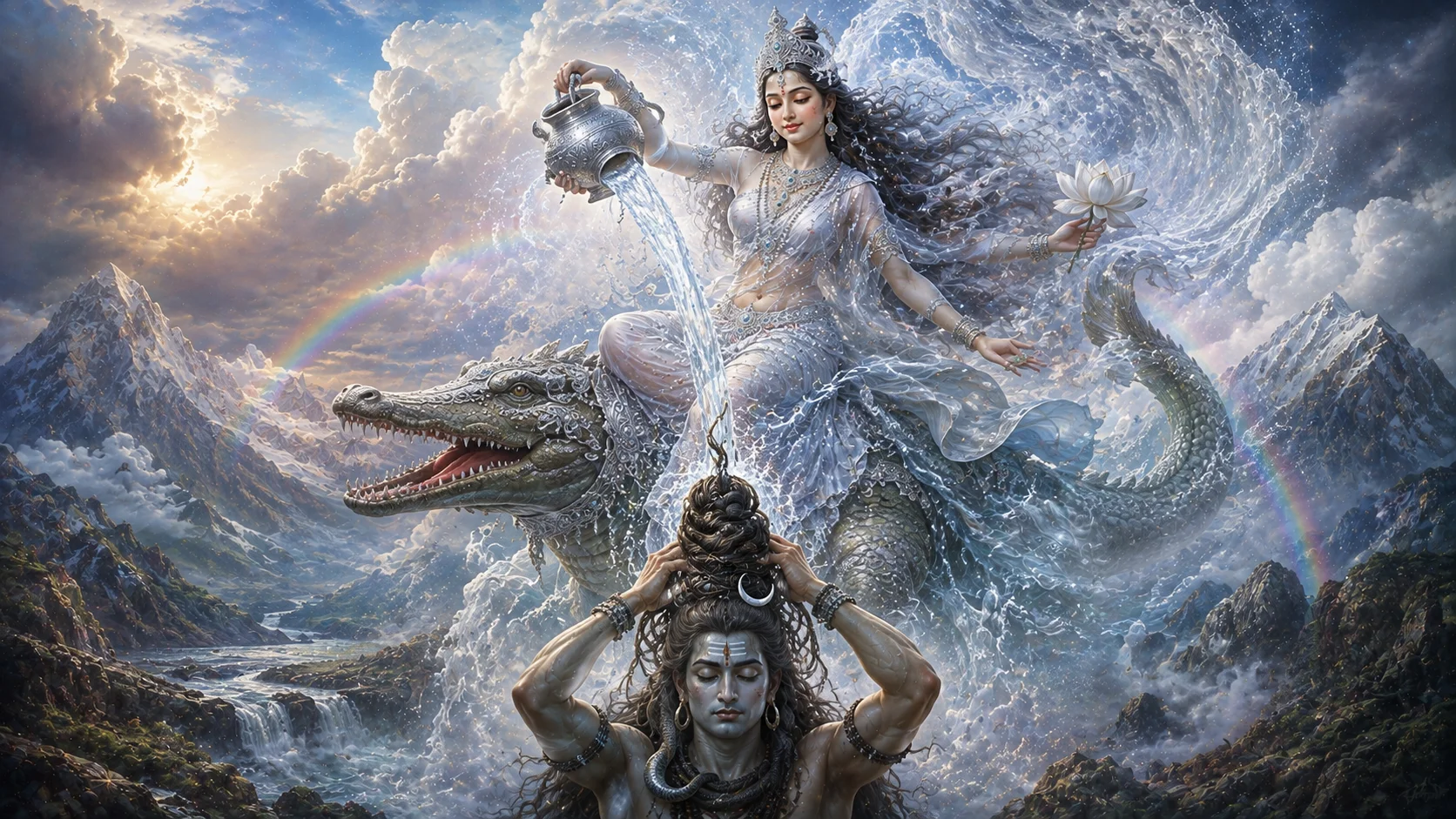
Born Devavrata, he was the son of King Shantanu of Hastinapura and the river-goddess Ganga — the eighth incarnation of the celestial Vasus, the only one of Ganga’s sons she did not return to the river. When the aging Shantanu fell in love with the fisher-maiden Satyavati, her father would consent to the marriage only if her children, not Devavrata, would inherit the throne. To win his father’s happiness, the prince made a double oath of staggering renunciation: he gave up his right to the throne, and he vowed lifelong celibacy so that no descendant of his could ever contest it. The gods rained flowers, and he was named Bhishma — “he of the terrible vow.” For this sacrifice his father granted him Ichchha-Mrityu: he would die only when he himself chose to.
The Guardian of the Throne
Bhishma became the rock on which the dynasty rested for three generations. He raised the orphaned princes, installed kings, fought off invaders, and held the realm together through every crisis — yet his terrible vow bound him always to the throne of Hastinapura itself, whoever sat upon it. This is his tragedy: when the blind Dhritarashtra’s son Duryodhana usurped the Pandavas’ rights and the unjust war became inevitable, Bhishma — who loved the Pandavas and knew their cause was just — was bound by his oath of loyalty to the crown to fight on the side he knew to be wrong. He sat silent, too, in the dice-hall when Draupadi was disrobed, his duty paralysing his conscience — a failure the epic does not let him forget.
The Bed of Arrows
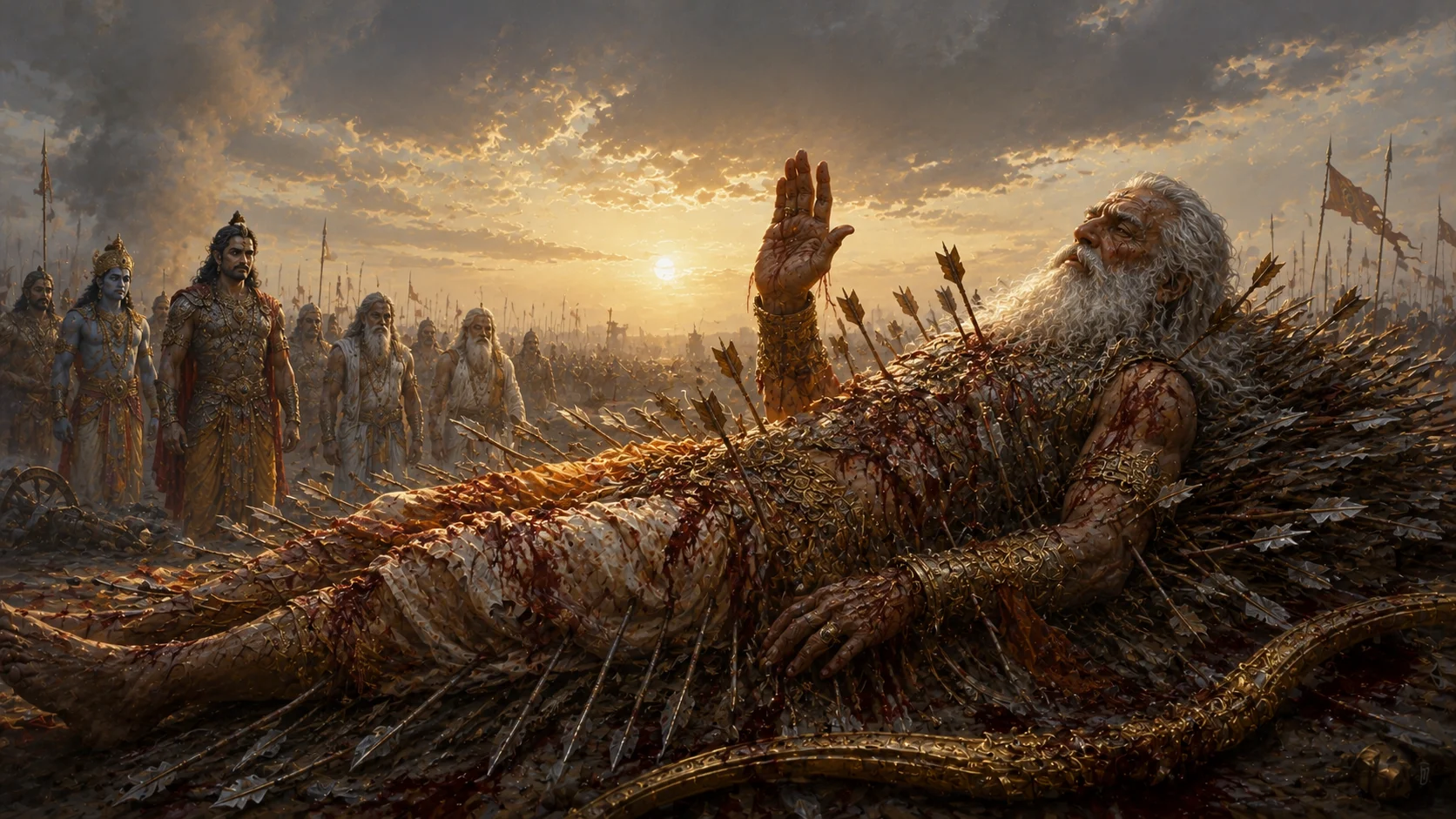
Made supreme commander of the Kaurava host, Bhishma was invincible — he could not be killed against his will, and he cut down the Pandava armies for ten days. He had vowed never to fight one who had been born a woman; so on the tenth day Arjuna placed before his own chariot the warrior Shikhandi — born female and become male — and behind that shield loosed arrow after arrow until Bhishma fell. His body was held above the earth by the very arrows that pierced him, a bed of shafts (sharashayya); he asked for a pillow, and Arjuna gave him one of three arrows under his head. There, choosing to delay his death, the patriarch lay on his bed of arrows through the rest of the war.
The Last Teaching
Bhishma waited for the auspicious northward turn of the sun (Uttarayana) to release his life, and in those final days — with the war won and Yudhishthira grieving at his feet — he delivered the vast discourses on duty, kingship, law, and liberation that fill whole books of the Mahabharata (the Shanti and Anushasana Parvas), including the thousand names of Vishnu, the Vishnu Sahasranama, still recited daily by millions. Only then did he will his death and depart. Bhishma is the epic’s monument to the cost of an absolute vow: a man so bound by his own word that his goodness could not save him from serving a wrong cause — the noblest figure of the Kuru line, undone by the very greatness of his renunciation.
The Curse Behind the Boon
Before he was a hero, Bhishma was a sentence being served. The eight Vasus — elemental gods of sky, wind, fire, dawn and the rest — once passed the hermitage of the sage Vasishtha and admired his wish-granting cow, Nandini. At the urging of one Vasu’s wife, who wanted the animal for a mortal friend, the company carried her off. Vasishtha perceived the theft by his ascetic sight and cursed all eight to be born among men — for a god the harshest sentence available, since it meant the loss of heaven for the whole length of a human life. Seven had merely gone along; when they begged forgiveness he relented so far as to release them from the human body within a year of their birth. The eighth — Dyu, who had actually driven the cow away — was condemned to serve the full term, with the compensation that he would live long, know the scriptures, and have no equal in arms. That is the Vasu who was born to Shantanu as Devavrata.
Read backwards from the curse, Ganga’s drowning of her first seven infants stops being monstrous and becomes punctual: she was returning seven gods to heaven exactly on the schedule the sentence allowed. The eighth she spared only because Shantanu, unable to watch another child go into the water, broke the silence he had promised her and begged for the boy’s life — the words that cost him his wife and gave his dynasty its heir.
The Bride-Raid at Kashi
The vow of celibacy did not release Bhishma from the duty of continuing his father’s line. It only meant he had to discharge it through other men’s marriages. When his half-brother Vichitravirya came of age, Bhishma went alone to the swayamvara of the three daughters of the king of Kashi — Amba, Ambika and Ambalika — claimed the warrior’s right to take a bride by force of arms, defeated the assembled princes, and drove all three away in his chariot to be married to his brother. It is worth pausing on the strangeness of the scene: a man under a lifelong oath of continence fighting an entire hall of suitors for wives he is forbidden to touch, on behalf of a younger brother who will die childless anyway. Nearly everything that ruins him afterwards comes out of that afternoon.
The Woman Who Became His Death
The eldest of the three, Amba, spoke before the wedding rites could begin: her heart was already given to King Shalva of Saubha, and Bhishma — whose conquest had never been courtship — let her go to him. Shalva refused her at the door. A woman won by another man’s arms in open contest, he said, could not become his bride, whatever she wanted for herself. Rejected by the man she loved and unable to marry the man who had carried her off, Amba turned back with a single demand: that Bhishma marry her himself, since it was his bow that had emptied her future. He would not break the vow even to repair the damage the vow had done. She went from king to king looking for someone willing to kill him, and found no one — until she reached Parashurama, the axe-bearing avatar of Vishnu, and the man who had taught Bhishma the use of weapons.
Parashurama took up her cause and summoned his old pupil to the field of Kurukshetra: marry her, or fight. Bhishma fought. Teacher and student traded celestial weapons for days with neither gaining the advantage, and the duel ended not in a victory but in an intervention, gods and sages descending to stop it before the weapons could do worse. The one man living who might have killed Bhishma had trained him too well, and Amba went unavenged.
So she turned from arms to austerity. Her penance was severe enough to bring Shiva himself, who granted precisely what she asked — the death of Bhishma — but not in the body she was wearing. She built a pyre and walked into it, and was born again as a daughter of Drupada of Panchala, raised as a son on Shiva’s promise that the child would one day be a man, and made one in fact by a yaksha named Sthuna, who traded his sex for hers outright. What stands in front of Arjuna’s chariot on the tenth day of the war, then, is not a loophole in Bhishma’s invincibility. It is a debt. Shikhandi is Amba, and the oath that will not let him lift a weapon is the same oath that ruined her.
Bhishma Ashtami: A Rite With No Descendants to Perform It
Hindu funerary practice runs on sons. It is a son’s tarpana — the offering of water and sesame to the ancestors — that is held to sustain a father among the dead, and Bhishma’s vow guaranteed he would never have one. Tradition closed the gap by making him everybody’s ancestor instead. On Bhishma Ashtami, the eighth day of the waxing moon in the month of Magha, remembered as the day he finally released his life, worshippers stand in the water and offer tarpana to Bhishma by name, most visibly at Kurukshetra. Anyone may make the offering, but it is held to matter most for those with no son of their own to see to their rites — a gift directed, by people worried about being forgotten, at the one figure in the tradition guaranteed to have no descendant to remember him.
The Figure That Outlived the Epic
What survives of Bhishma in Indian visual culture is almost never a battle. It is the arrow-bed: the old man laid out on a mattress of shafts, head propped on arrows, still talking — the moment the soldier turns into a teacher. Temple relief, manuscript painting and modern calendar print all return to that one tableau, and it is the image most people carry of him even if they could not name a single engagement he won. The honorific Bhishma Pitamah, “grandfather Bhishma,” left the epic long ago and entered ordinary Indian speech, where it attaches to any elder whose authority rests on decades of service rather than on present power: the veteran too respected to be argued with, the institution in human form. It is not always kind. To be called a Bhishma is to be praised for constancy and reminded, in the same breath, that constancy once kept a good man in his seat while something unforgivable happened in front of him.
The Uncomfortable Hero
The epic gives Bhishma the most honoured death it has to give and still declines to acquit him. The reproach comes from inside the story, spoken by the people who love him, not from later readers tidying up after it — which is why the question has never closed. Commentators have used him ever since to press what the Mahabharata itself refuses to settle: whether fidelity to a vow remains a virtue once the vow has begun to serve an injustice. That unresolved verdict is very likely why he has outlasted nearly every other secondary figure in the epic. He is the ancestor everyone reveres and nobody is entirely certain they should copy.
Sources & traditions
- EncyclopediaWikipedia — Bhishma
- TraditionHindu texts, oral tradition and village tellings (South Asia)
Myths change from area to area and from time to time. This chronicle follows the most widely told versions; tellings in other villages, regions and eras may differ.