Varuna is one of the most ancient and originally most exalted of the Vedic gods — the celestial sovereign who upholds rita, the cosmic and moral order that keeps the universe from collapsing into chaos, and who watches over the truthfulness of every oath sworn beneath the stars. Over the long span of Hindu history his role gradually narrowed until he became chiefly the god of the oceans and waters, and he stands today as Dikpala, guardian of the western quarter of the world.
The Great Sovereign of Rita
In the earliest layers of the Rig Veda, Varuna is described in terms that rival or even exceed those given to Indra: he is the all-seeing king who stretched out the sky, fixed the earth, and set the sun on its course, the god whose thousand eyes — the stars themselves — watch every action of every being without ever closing. He is the personification and guarantor of rita, the underlying principle of cosmic, natural, and moral order that Vedic thought held to govern everything from the movement of the seasons to the truthfulness of human speech. To violate rita — to lie, to break a vow, to act against the natural order — was to invite Varuna’s wrath, most commonly imagined as affliction by dropsy or other bodily illness, since a body swollen with retained water was seen as a fitting punishment from the lord of the waters for a soul swollen with falsehood.
Varuna is most often paired in the hymns with Mitra, and the compound deity Mitra-Varuna represents two complementary faces of sovereignty: Mitra governs the more social, contractual, daylight aspect of order — the bonds of friendship, alliance, and agreement between people — while Varuna presides over the more mysterious, nocturnal, almost magical aspect of cosmic law, the hidden connections between gods and mortals that operate beyond ordinary sight. Together they were invoked to bless treaties and to witness the keeping of promises, their joint authority spanning both the visible contracts of daily life and the invisible moral order underlying the cosmos.
From Sky-Sovereign to Ocean God
As the centuries passed and the religious landscape of India shifted from the sacrificial cosmology of the Vedas toward the temple-based devotionalism of the Puranas, Varuna’s vast portfolio as universal sovereign contracted. The rise of Indra as king of the gods in a more martial, storm-centered pantheon, and later still the ascendancy of the Trimurti — Brahma, Vishnu, and Shiva — left Varuna with a diminished but still dignified inheritance: lordship over the oceans, rivers, and all waters, and guardianship of the western direction. He retained, even in this reduced role, his ancient function as witness and punisher of falsehood, and his authority over oaths and truthfulness never entirely disappeared from later tradition, surfacing still in rituals and invocations that call upon him to bear witness to solemn vows.
Iconography and Attributes
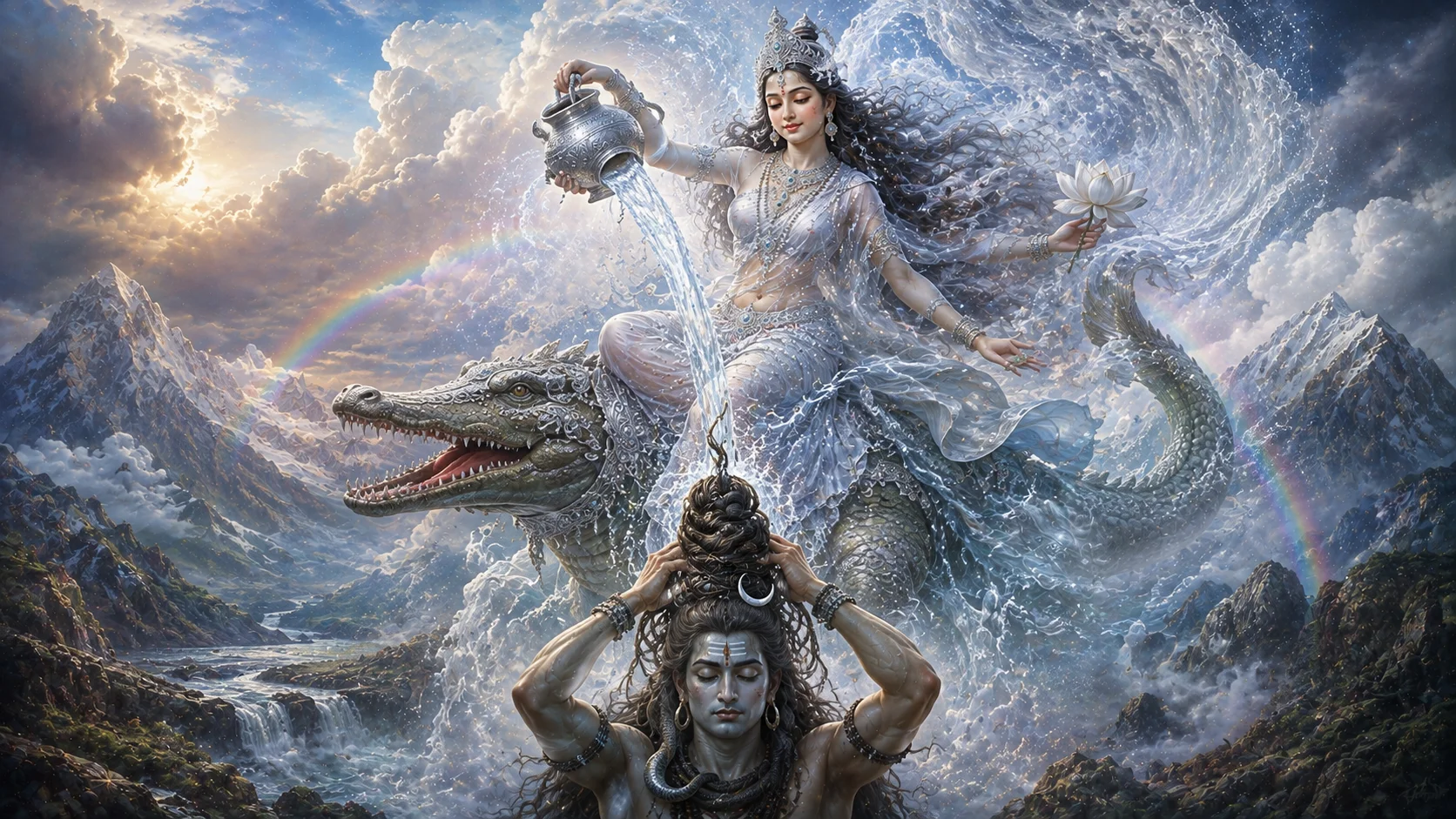
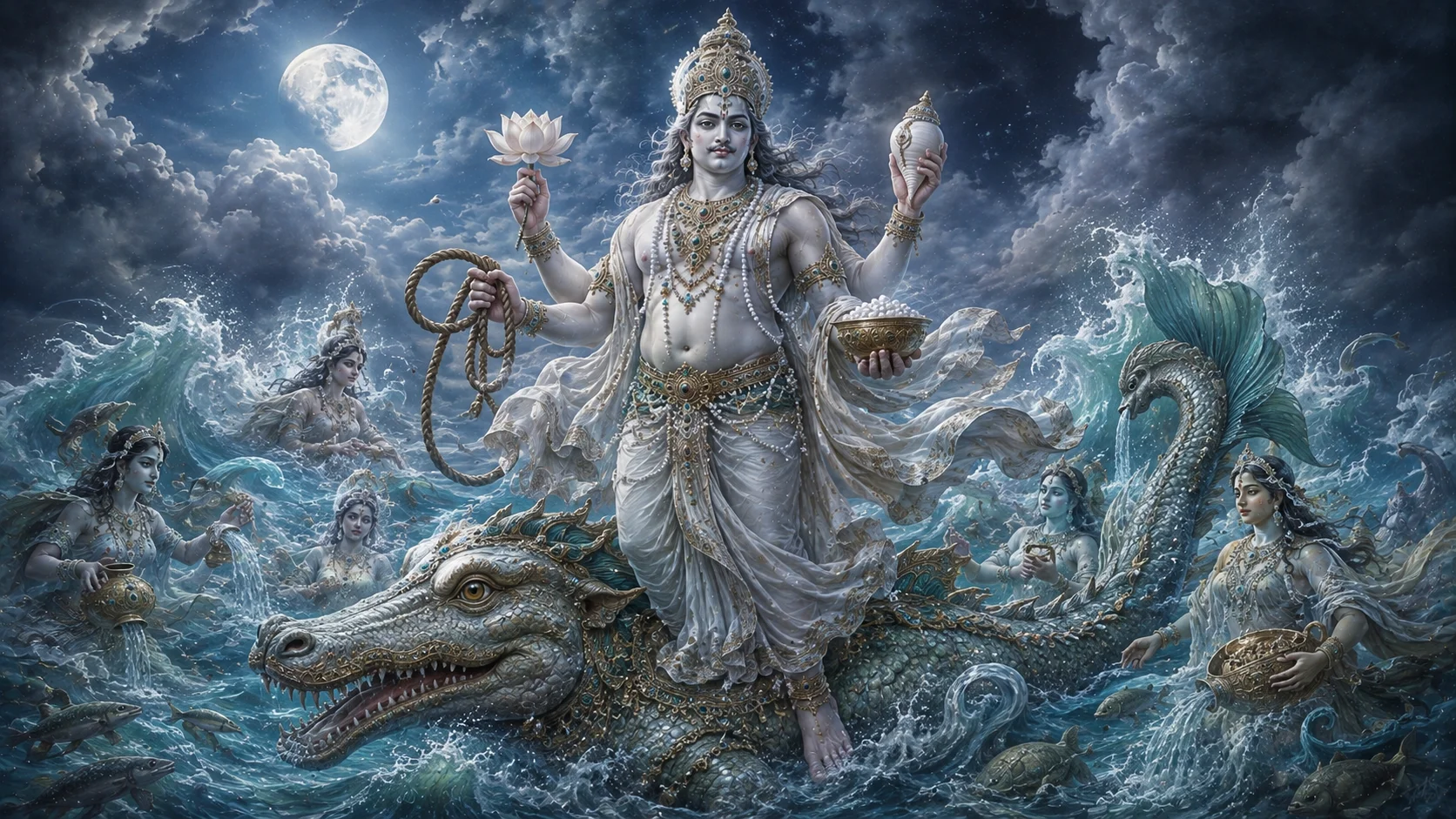
Varuna is typically depicted as a fair-complexioned deity, often four-armed, seated or standing upon his vahana, the crocodile-like aquatic creature known as the Makara, which itself became one of Hindu iconography’s most enduring mythic beasts, later associated as well with the river goddess Ganga and with Kama. In his hands Varuna carries a noose called the pasha, the instrument with which he is said to bind those who transgress rita or swear false oaths — a symbol of inescapable cosmic justice rather than mere physical restraint. He is frequently shown attended by the river goddesses Ganga and Yamuna, reflecting his sovereignty over all flowing waters, and his crown and ornaments in temple sculpture often incorporate aquatic and lunar motifs, since the moon, tides, and the ocean’s rhythms were all understood as falling within his domain.
Chief of the Adityas
Varuna holds a position of special seniority among the Adityas, the group of solar deities born of the mother goddess Aditi, and in many Vedic hymns he functions as their chief, first among the six or more Aditya-gods who together represent the various facets of cosmic sovereignty and moral order. His close association with his mother Aditi’s theme of boundlessness reinforces his character as a deity whose authority is not confined to any single domain but stretches, at least in the earliest conception, across the whole of the manifest and unmanifest universe.
Guardian of the West
Within the mature system of the Ashta-Dikpalas, the eight guardians assigned to protect the cardinal and intercardinal directions, Varuna presides over the west (Varuna disha), a fitting assignment given that in India the great expanse of the Arabian Sea lies to the west of much of the subcontinent. Temple architecture and the principles of Vastu Shastra accordingly designate the western portion of a building as Varuna’s domain, traditionally associated with water storage, wells, and drainage, in keeping with the god’s enduring lordship over all things liquid. Alongside Indra (east), Agni (southeast), Yama (south), Nirriti (southwest), Vayu (northwest), Kubera (north), and Ishana (northeast), Varuna completes a cosmological ring of protection encircling the inhabited world.
Myths and Relationships
Among the notable episodes attached to Varuna is his role in the story of King Harishchandra, whose unwavering commitment to truth was tested at Varuna’s own instigation after the king had promised the god his firstborn son in exchange for an heir; the tale, one of the most celebrated moral narratives in the Puranic corpus, turns on Harishchandra’s refusal to break his word even at ruinous personal cost, a plot entirely consistent with Varuna’s ancient character as guardian of truthfulness and the keeping of oaths. Varuna is also linked to the sage Vasishtha, said in some accounts to be his son, and his daughter Varuni, associated with wine and intoxicating drink, appears in cosmogonic myths concerning the churning of the ocean of milk.
Varuna and Vasishtha
Puranic genealogy links Varuna to the great sage Vasishtha, one of the seven celestial rishis (Saptarishi) and a central figure across the Ramayana and Mahabharata as royal preceptor to the solar dynasty. Several accounts describe Vasishtha as born of Varuna's own seed, sometimes in the company of Mitra, an origin story that ties Varuna directly into the priestly and royal lineages that shape the great epics. Vasishtha's later rivalry with the sage Vishwamitra, one of Hindu literature's most storied conflicts between accumulated spiritual power and inherited priestly authority, thus carries, at its root, a connection back to Varuna's ancient office as guarantor of proper order and legitimate succession.
Varuna and the Ordeal of Truth
Varuna's character as enforcer of truthful speech surfaces vividly in the story of King Harishchandra, a ruler renowned across Hindu tradition for his absolute, uncompromising commitment to honesty. Having promised Varuna his own son in exchange for the god's blessing of an heir, and then delaying the fulfillment of that vow, Harishchandra is tested severely, losing his kingdom, his wife, and reducing himself to servitude in a cremation ground, all rather than break his word once given. The tale, retold across the Markandeya Purana and other sources, functions as a moral parable whose emotional force depends entirely on the ancient understanding of Varuna as the deity before whom no falsehood, and no broken vow, could ultimately stand unpunished, even when upholding the truth demanded almost unbearable sacrifice.
Living Worship
Varuna’s worship today survives most visibly in rituals connected with water: he is invoked at the start of many Vedic ceremonies through the placement of a consecrated water-vessel, or kalasha, believed to house his presence, and Hindu prayers for rainfall, for safe sea voyages, and for the blessing of new wells or reservoirs still commonly call upon him by name. Coastal and riverine communities across India continue to make offerings to Varuna before fishing expeditions or before undertaking journeys by water, a direct continuity with his most ancient identity as sovereign of the seas. Though he no longer commands the vast temples and cults that once surrounded India’s greatest gods, Varuna’s presence persists in the quiet, essential rituals that accompany humanity’s relationship with water itself.
The Noose of Varuna and the Machinery of Cosmic Law
Varuna’s most distinctive attribute, and the instrument through which Vedic poets most often pictured his authority, is the pasha, the noose or lasso with which he is said to bind wrongdoers. His very name is built from a root carrying the sense of encompassing or binding, and the Vedic hymns describe the whole visible cosmos as something Varuna surrounds and holds together, so that the noose functions simultaneously as a weapon of punishment against those who violate rita, the cosmic and moral order, and as a symbol of the totalizing reach of his gaze, from which no falsehood or broken oath can ultimately hide. To be “caught in Varuna’s noose” became a recognized poetic idiom for suffering the consequences of sin, illness, or a broken vow, and hymns addressed to him frequently take the form of confession and plea for release from that binding, making Varuna one of the few Vedic gods regularly approached in a mood of moral anxiety rather than simple petition for favor. His constant pairing with Mitra sharpens this picture further: where Mitra presides over the sunlit, contractual bonds between one person and another, Varuna governs the more mysterious, nocturnal register of the bond between mortals and the unseen order of the universe itself, so that the compound deity Mitra-Varuna, invoked throughout the Rig Veda as a single dual entity, expresses the Vedic conviction that human society and cosmic law are ultimately two faces of one and the same binding truth. Varuna’s gradual transformation across Vedic and Puranic literature, from the awesome sovereign who enforces rita over gods and mortals alike into the more circumscribed Puranic sea god and regent of the western quarter, mirrors the broader shift in Hindu religious life away from the abstract juridical universe of the earliest hymns toward the more narratively concrete, temple-centered devotionalism of the epics and Puranas, even as fragments of his older cosmic authority survive in his lasting title as guardian of oaths and truth.
Sources & traditions
- EncyclopediaWikipedia — Varuna
- TraditionHindu texts, oral tradition and village tellings (South Asia)
Myths change from area to area and from time to time. This chronicle follows the most widely told versions; tellings in other villages, regions and eras may differ.