Agni is the Vedic god of fire — sacrificial flame, household hearth, and cosmic energy all at once — and one of the most exalted deities of the Rig Veda, second in the frequency of his invocations only to Indra. As the tongue of flame that carries oblations from the human world to the gods, Agni is the great mediator of Vedic religion, and in the later scheme of the guardian deities he presides as Dikpala over the southeast quarter of the universe.
The First Word of the Rig Veda
The very first hymn of the Rig Veda opens with his name: agnim íḷe purohitam, “I praise Agni, the household priest.” That opening is no accident of compilation — it reflects Agni’s literal centrality to the sacrificial religion the Vedas describe. Of the collection’s 1,028 hymns, some 200 are addressed to him, a concentration of devotion exceeded only by hymns to Indra. Agni’s name is cognate with the Latin ignis and the English “ignite,” a linguistic thread reaching back to the shared Indo-European root for fire, and testifying to how ancient and how universal this reverence for flame was among the peoples who eventually settled the Indian subcontinent.
Unlike gods who dwell remotely in the heavens, Agni is present at every household hearth, every sacrificial altar, every act of cooking and warming and burning. He is described as having been born three times — from the sky as lightning, from the waters, and from the friction of two sacred sticks (the arani) kindled by human priests — a threefold birth that makes him simultaneously a celestial force and a domesticated, everyday presence. This intimacy is central to his character: no other great Vedic deity is so continuously and physically near to human beings.
Messenger and Mediator Between Worlds
Sacrifice, or yajna, stood at the very heart of Vedic religious life, and Agni stood at the heart of sacrifice. Every oblation poured into the sacred fire — grain, clarified butter, soma, the flesh of sacrificial animals — was believed to be carried upward by Agni’s flames and smoke to whichever deity the offering was addressed to. In this role he is called havyavahana, “the carrier of oblations,” and he is simultaneously priest, messenger, and witness. When a Vedic sacrificer needed to summon a god to the altar, it was Agni who was invoked first, precisely because without him no other deity could be reached at all.
This mediating function extended into a role as universal witness. Because Agni burns in every home and every altar fire across the land, nothing done in his presence — a vow taken, an oath sworn, a marriage solemnized — escapes his sight. To this day, the Hindu wedding rite centers on saptapadi, the seven steps a couple takes together around the sacred fire, with Agni as the eternal witness to their union. A vow made before Agni is understood to be unbreakable, because the god who sees it is the same god present in every fire that will ever be lit thereafter.
Three Forms, One Fire
Agni is traditionally said to exist in three forms across the three worlds: as ordinary fire on earth, as lightning in the atmosphere, and as the sun in the heavens. Vedic iconography sometimes represents this triplicity by giving Agni three heads, three tongues, or three legs, all understood as a single essential flame manifesting differently at different cosmic levels. Ritual literature further divides the sacrificial fire itself into three named fires tended by priests: the Garhapatya, the perpetual domestic hearth-fire maintained by the householder from which the other fires are kindled; the Ahavaniya, the fire placed to the east of the sacrificial ground into which offerings to the gods are poured; and the Dakshinagni, the southern fire used in rites for the ancestors, the pitrs. This threefold fire cult, elaborated across the Brahmana texts, made the maintenance of sacred fire a lifelong discipline for the Vedic householder, not a single ceremonial act.
Among his many epithets is Vahni, “the carrier,” a name that emphasizes his partnership with the wind — fire fanned and driven by Vayu — as together they animate the visible and invisible worlds. He is also called Jataveda, “knower of all born things,” Hutashana, “devourer of oblations,” and Vaishvanara, “belonging to all men,” a name that stresses the universality of fire across every household regardless of caste or station.
Iconography and Attributes
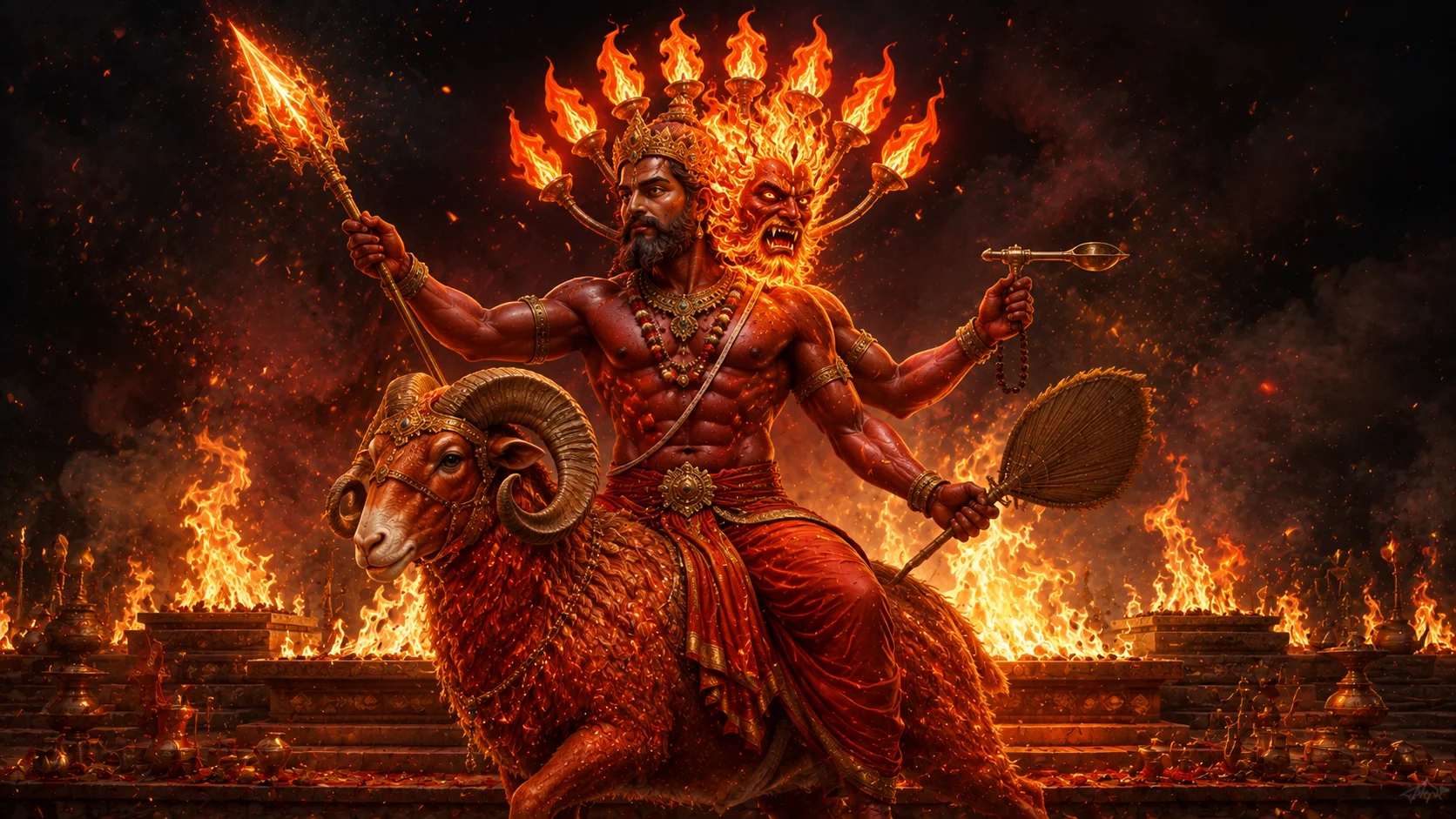
Agni is most commonly depicted as a red-skinned deity with two or sometimes seven flame-like tongues, riding a ram, occasionally shown with multiple arms bearing a sacrificial ladle, an axe, a torch, and a rosary. His characteristic vehicle, the ram, along with his fierce, radiant countenance and often a beard suggesting the crackling texture of flame, mark him instantly in temple sculpture and manuscript painting. Smoke is said to be his banner, and he is sometimes shown with a halo of fire encircling his whole body, an unmistakable visual shorthand across the subcontinent’s religious art for the presence of sacrificial or purifying flame.
Guardian of the Southeast
In the developed system of the Dikpalas — the guardian deities set to watch over the cardinal and intercardinal directions of the cosmos — Agni presides over the southeast (Agneya), the direction named for him. This is why, in traditional Vastu Shastra and temple architecture, the southeast corner of a home or sacred compound is reserved for the kitchen or the hearth: the direction is understood to belong to Agni by right, and cooking fires kindled there are thought to draw on his protective and purifying presence. Alongside Indra (east), Yama (south), Varuna (west), Kubera (north), and the other guardians of the intermediate points, Agni forms part of a cosmological architecture in which the whole of space is watched over, quarter by quarter, by a specific divine power.
Key Relationships
Agni’s genealogy varies across sources: some texts make him a son of the sky-father Dyaus and the earth-mother Prithvi, while others describe him as born of the sage Kashyapa, or invoked independently as a self-existent primal force present since the beginning of creation. He is closely bound to Soma, the personification of the sacred ritual drink, since the two are so often invoked together in the fire-and-libation structure of the sacrifice. He is also intimately linked with Surya and with lightning, in keeping with his threefold cosmic nature, and he is the vehicle by which every other deity in the Vedic pantheon receives what is offered to them — making him, in a functional sense, indispensable to the worship of all the others.
Enduring Worship
Agni in the Great Epics
Beyond his ritual role, Agni appears as an active mythological character in the Mahabharata, most memorably in the story of the burning of the Khandava forest. Having overindulged for years on the rich, greasy oblations of the sacrifice, Agni finds himself weakened and unable to digest properly, and is told by physicians that only the marrow-rich fat of the entire Khandava forest — consumed whole, all at once — can restore his strength. But the forest is protected by Indra, whose friend the serpent king Takshaka dwells within it, and every previous attempt Agni has made to burn it has been extinguished by Indra’s rains. Agni appeals to Krishna and Arjuna, who agree to hold back Indra and the other gods while Agni consumes the forest unimpeded; in gratitude, Agni presents Arjuna with the celestial bow Gandiva, an inexhaustible quiver, and a great chariot, and gives Krishna his discus, the Sudarshana Chakra — two of the most important divine weapons in the entire epic, both owed to this single episode of Agni's hunger.
Agni also plays the decisive role in one of the Ramayana's most emotionally weighted scenes, the Agni Pariksha, in which Sita, having been rescued from Ravana's captivity, walks into a blazing fire to prove the purity of her conduct during her long imprisonment. Agni himself receives her into the flames and returns her unburned and radiant, testifying before Rama and the assembled hosts that she remained faultless throughout her ordeal — a divine verdict rendered directly by the god of fire in his ancient capacity as impartial witness to truth, a function he shares in some respects with Varuna, though Agni's testimony operates through ordeal rather than through the more abstract enforcement of cosmic law.
Agni and the Doctrine of Sacrifice
Vedic and later Mimamsa philosophical thought treated the mechanics of sacrifice with extraordinary precision, and Agni's role within that mechanism was considered indispensable rather than symbolic. Because he alone could carry an oblation from the visible to the invisible world, ritual manuals prescribed exacting procedures for his invocation, kindling, and maintenance: the fire had to be produced correctly, fed with the proper fuel and in the proper measure, and never allowed to go out during the course of a major sacrifice, since an extinguished sacrificial fire was considered a serious ritual failure with potentially dangerous consequences for the patron of the sacrifice. This is part of why Vedic households traditionally maintained a perpetual domestic fire passed down and tended across generations, treated less as a household convenience than as a living, inherited relationship with the god himself.
Agni’s worship never became a matter of temples and images in the way that later devotional Hinduism embraced murti-worship of Vishnu, Shiva, or the Goddess; instead, his presence remains woven into ritual practice itself. The havan or homa — a fire ritual in which offerings of ghee, grains, and herbs are placed into a consecrated fire while Vedic mantras are recited — continues to be performed at weddings, housewarmings, funerals, and temple consecrations across India today. Every strand of orthodox Hindu ritual practice that involves a sacred fire, from a simple daily agnihotra performed by a household priest to elaborate multi-day Vedic yajnas conducted by teams of specialist priests, is understood as an act of invoking and honoring Agni directly. In this sense, Agni is among the most continuously worshipped gods in the entire Hindu tradition, even though he rarely receives a temple of his own: he is present, and venerated, wherever the sacred fire is lit.
The Agnicayana and the Architecture of Fire
Among the most elaborate rites ever devised in Agni’s honor is the Agnicayana, the “piling of the fire,” a Vedic ritual described at length in the Shatapatha Brahmana and still performed, rarely and at great expense, by traditional communities in South India today. The Agnicayana stands as the clearest surviving demonstration of a principle stated plainly throughout the Brahmanas: that Agni is not merely one god among many to whom sacrifice is offered, but the very mouth of sacrifice, the being through whom every offering to every other deity must necessarily pass.
Agni and the Later Puranic Corpus
The relationship between the god Agni and the text that bears his name, the Agni Purana, is more complicated than the title suggests. This framing device, in which the fire god becomes the vehicle for transmitting a huge body of sacred and practical knowledge to humankind, echoes his oldest Vedic role as the divine messenger and mediator who carries communications between the human and celestial spheres. Even as Agni’s personal cult receded behind that of Vishnu and Shiva, his function as intermediary and witness remained too fundamental to Hindu religious life to be dispensed with, so that his name continued to anchor sacred texts even when their content moved far beyond fire itself.
Sources & traditions
- EncyclopediaWikipedia — Agni
- TraditionHindu texts, oral tradition and village tellings (South Asia)
Myths change from area to area and from time to time. This chronicle follows the most widely told versions; tellings in other villages, regions and eras may differ.