Kubera, also called Vaishravana or Dhanada, “giver of wealth,” is the Hindu god of riches and the king of the Yakshas, guardian spirits who watch over the hidden treasures of the earth. Half-brother to the demon-king Ravana, and once the sovereign of Lanka before he was dispossessed of it, Kubera today rules from the Himalayan city of Alaka and stands as Dikpala, guardian of the northern quarter of the cosmos.
Origins and Lineage
Kubera is the son of the sage Vishrava and his first wife Ilavida (also called Ilavila), a lineage that places him within one of Hindu mythology’s most consequential families. Vishrava later married a second wife, the rakshasi princess Kaikesi, and from that union came Ravana, Kumbhakarna, and Vibhishana — making Kubera the elder half-brother of the very demon-king whose downfall forms the climax of the Ramayana. This shared paternity, spanning both a righteous god of wealth and a rakshasa tyrant, is treated across the tradition as a study in contrasts: two sons of the same father who took utterly divergent paths, one toward austerity and reward, the other toward conquest and ruin.
The Loss of Lanka
According to the Ramayana and associated Puranic accounts, Kubera originally ruled the golden city of Lanka, having been granted it, along with the celestial flying chariot Pushpaka Vimana, as a reward for his devotion and austerities. Ravana, consumed by envy and ambition, drove his half-brother out of Lanka by force, seized the city for himself, and appropriated the Pushpaka Vimana as his own means of transport — the very chariot in which he would later abduct Sita and in which Rama would eventually fly home to Ayodhya after his victory, the vehicle having changed hands yet again with the fall of its usurper. Dispossessed of his city, Kubera relocated to Alaka, a magnificent city nestled in the Himalayas near Mount Kailash, which became his new capital and remains, in Hindu cosmological geography, the seat of his continuing rule.
King of the Yakshas
As sovereign of the Yakshas — nature spirits associated with forests, mountains, hidden groves, and buried treasure, generally benevolent though sometimes capricious guardians of wealth and natural bounty — Kubera commands a vast host tasked with protecting the world’s riches: gold, gems, and treasure hidden within the earth and beneath mountain roots. He is the appointed treasurer of the gods themselves, a role that places him in a position of trust distinct from the mercantile associations wealth deities sometimes carry; Kubera's wealth is guarded wealth, held for the maintenance of cosmic and divine order rather than accumulated for personal indulgence, and this custodial character defines much of his worship as a bestower of prosperity rather than mere riches.
Austerities and Boons
Puranic tradition attributes Kubera’s exalted position to a long period of severe austerity performed in his youth, through which he earned the favor of Brahma, who granted him immortality, the guardianship of wealth, friendship with Shiva, and eventually kingship over the Yakshas. His relationship with Shiva is especially notable: several accounts describe Kubera performing penance on Mount Kailash and being rewarded not only with treasure but with the enduring friendship of the great ascetic god himself, a bond commemorated in some regional traditions through joint invocations of Kubera alongside Shiva and Parvati during prosperity rites.
Iconography
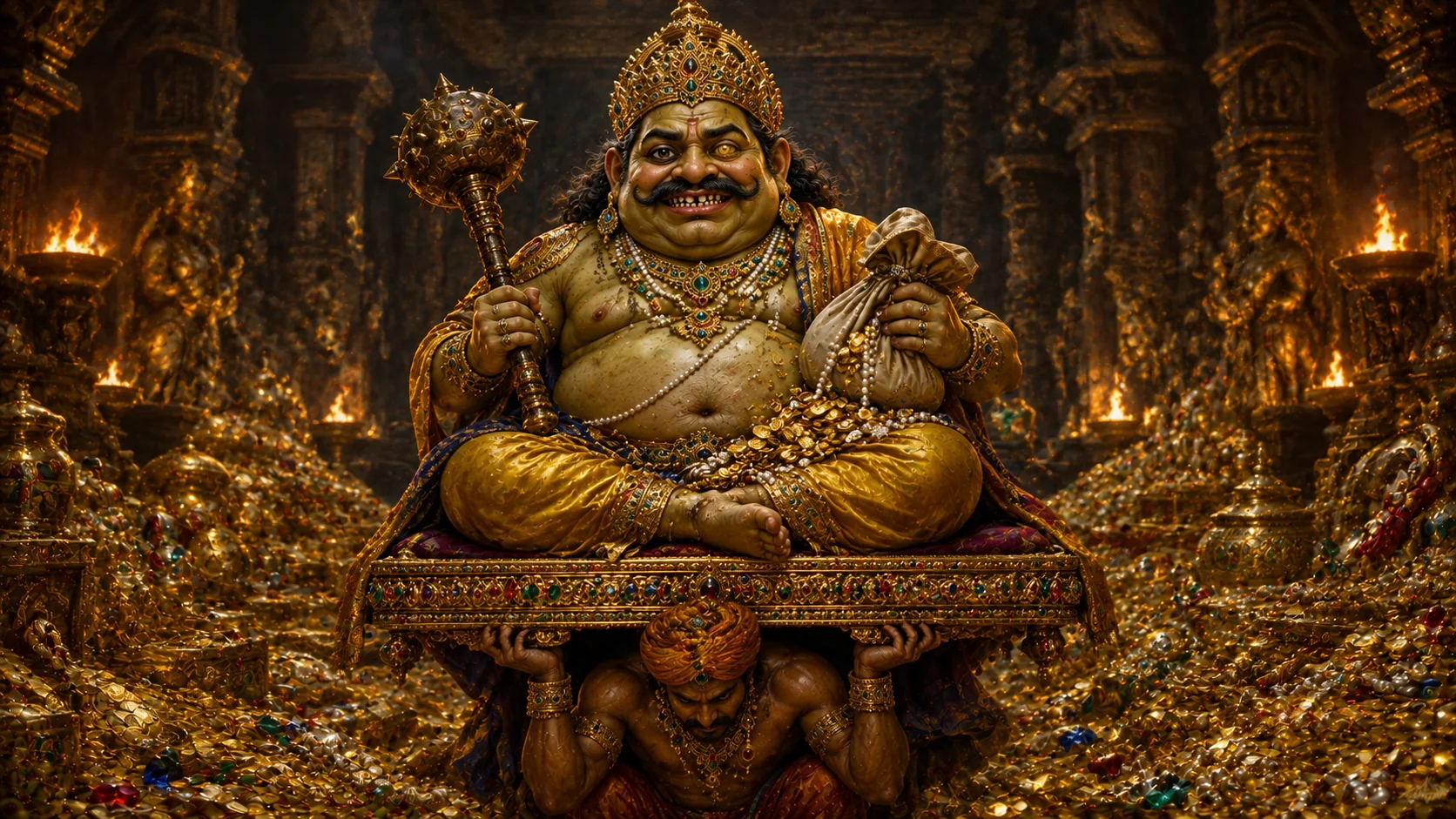
Kubera is traditionally depicted as a stout, pot-bellied figure adorned with jewels and ornaments befitting his wealth, often shown with one leg drawn up and the other resting on the ground, seated in a posture of relaxed abundance. He is frequently portrayed holding a money-pot (nidhi) or a mongoose that vomits jewels — a motif shared with the closely associated deity Jambhala in Buddhist iconography — and in some depictions he is shown with a missing eye or tooth, explained by various Puranic tales as the result of past conflicts or curses that nonetheless did nothing to diminish his stature or his treasures. His vahana is most commonly a man, sometimes interpreted as a Yaksha attendant carrying him, though other traditions describe him riding a horse or an elephant.
Guardian of the North
Within the system of the Ashta-Dikpalas, the eight guardians of the cardinal and intercardinal directions, Kubera presides over the north, a placement consistent with his Himalayan capital at Alaka. He stands alongside Indra (east), Agni (southeast), Yama (south), Nirriti (southwest), Varuna (west), Vayu (northwest), and Ishana (northeast) in this cosmological architecture, and traditional Vastu Shastra designates the northern portion of a home as especially auspicious for the storage of wealth and valuables, directly invoking Kubera’s protective association with that quarter. Many Hindu households and businesses place an image of Kubera, sometimes alongside Lakshmi and Ganesha, in the northern corner of their premises specifically to invite his blessing upon their finances.
Key Relationships
Beyond his fraught half-brotherhood with Ravana, Kubera maintains close ties with Shiva as noted above, and he is counted among the attendants and allies of the broader circle of gods who assist in maintaining cosmic order against the forces of chaos represented by rakshasas and asuras. His wife is generally named Riddhi (or in some traditions Bhadra or Charvi), a figure associated with prosperity and abundance in her own right, fitting company for a god whose entire mythological identity centers on the safeguarding and bestowal of riches.
Kubera and Ravana's Prosperity
The rivalry between Kubera and Ravana extends beyond the single episode of Lanka's seizure into a broader contrast the tradition draws between righteously earned and forcibly seized wealth. Kubera's treasures, the Puranas emphasize repeatedly, were won through decades of austerity and devotion and are held by him as a custodian for the benefit of the cosmic order, distributed as blessings to the deserving rather than hoarded for personal indulgence. Ravana's Lanka, though undeniably magnificent — described in the Ramayana as a city of gold with palaces surpassing even Kubera's own former capital — is presented as wealth built on conquest and violence rather than merit, doomed by that very origin to be lost again, as indeed it ultimately is when Rama's forces destroy Ravana's kingdom at the epic's climax. This moral contrast between the two half-brothers, one whose wealth endures because it was righteously gained and one whose wealth collapses because it was seized by force, is frequently cited in Hindu ethical teaching as an illustration of the difference between dharmic and adharmic prosperity.
Kubera's Court and the Meghaduta
Kubera's celestial capital, Alakapuri, receives its most vivid literary treatment in Kalidasa's Sanskrit poem Meghaduta ("The Cloud Messenger"), composed sometime in the classical Gupta period. The poem's narrator is a Yaksha in Kubera's own service who has been cursed and exiled for a year to a remote mountain for neglecting his duties, and who, overcome with longing for his wife left behind in Alakapuri, implores a passing monsoon cloud to carry a message of love across the length of India to his beloved. The poem's loving, detailed description of Alakapuri as a city of crystal palaces, singing Yakshas, and perpetual pleasure has profoundly shaped the popular imagination of Kubera's court ever since, cementing the association between Kubera's wealth and an atmosphere of refined, almost decadent aesthetic beauty rather than mere accumulation of riches.
Kubera and the Ravana Rivalry Beyond Lanka
The rivalry between Kubera and Ravana extends beyond the single episode of Lanka's seizure and colors much of Ravana's broader characterization across the Ramayana tradition. Ravana's subsequent military campaigns against the other gods and against various kingdoms are frequently framed by the text as extensions of the same overreaching ambition that first drove him to dispossess his own half-brother, and several retellings have Kubera sending emissaries to warn Ravana against further conquest, warnings that Ravana rebuffs with characteristic arrogance, only deepening the eventual justice of his downfall at Rama's hands. Some regional traditions also credit Kubera with quietly aiding the forces gathering against Ravana during the war for Sita's rescue, a fitting continuation of the sibling rivalry that had begun with the loss of Lanka itself.
Kubera's Court and the Yaksha Realm
Kubera's capital of Alaka is described across Sanskrit poetry, most famously in Kalidasa's celebrated lyric the Meghaduta, as a city of extraordinary opulence, its palaces built of crystal and precious stone, its gardens perpetually in bloom, and its inhabitants living in a state of refined, artistic leisure quite unlike the martial courts of Indra or the ascetic isolation of Shiva's Kailash. This portrait of Alaka as a realm devoted to beauty, music, and romantic longing (the Meghaduta itself is framed as a message sent by a Yaksha exiled from this paradise to his beloved) reinforces Kubera's character as a god whose wealth is bound up not merely with material riches but with a broader ideal of cultured abundance and aesthetic refinement, distinguishing his court from every other divine capital in Hindu cosmological geography.
Living Worship
Kubera remains an actively worshipped deity across contemporary Hinduism, most visibly during Dhanteras, the festival marking the start of the Diwali season, when households across India purchase gold, silver, or new utensils and perform prayers invoking both Kubera and the goddess Lakshmi for prosperity in the year ahead. Businesses frequently keep a small shrine or image of Kubera near their cash registers or account books, and Kubera Yantras — geometric diagrams believed to channel his blessing — are commonly installed in homes and shops seeking financial stability. Unlike gods whose worship centers on grand standalone temples, Kubera’s cult persists largely through these domestic and commercial rites of everyday prosperity, a fitting continuation for a deity whose ancient role was always that of a steady, trustworthy custodian of the world’s wealth rather than a distant celestial sovereign.
Kubera Beyond Hinduism: Vaishravana and Jambhala
Kubera’s identity as king of the yakshas and guardian of the north proved durable enough to cross religious boundaries entirely, carrying him into both Buddhist and Jain cosmology largely intact. In Buddhist tradition he is known as Vaishravana, one of the Four Heavenly Kings who guard the cardinal directions and protect the Buddhist teaching itself, retaining his Hindu role as regent of the north and overlord of the yakshas even as he is reframed within a Buddhist cosmological system. That three separate religious traditions native to India each retained a version of the same wealth-guarding yaksha king, adapting his iconography to their own doctrinal needs while preserving his essential character, testifies to how deeply the older, pre-sectarian layer of yaksha worship that produced Kubera had embedded itself in the shared religious imagination of the subcontinent long before Hinduism, Buddhism, and Jainism fully diverged as distinct traditions.
Sources & traditions
- EncyclopediaWikipedia — Kubera
- TraditionHindu texts, oral tradition and village tellings (South Asia)
Myths change from area to area and from time to time. This chronicle follows the most widely told versions; tellings in other villages, regions and eras may differ.