Ganga is the goddess who personifies and animates the sacred river Ganges, revered across India as the most holy of all waters, capable of washing away sin and liberating the souls of the departed. Her descent from the heavens to earth — secured through the extraordinary penance of the sage-king Bhagiratha and broken in its fall by the matted locks of Shiva — is among the most beloved narratives in Hindu mythology, and it explains both her cosmic origin and the profound reverence in which her waters are held to this day.
Origins in the Heavens
Ganga is described in Puranic literature as originating in the celestial realm, flowing there as a heavenly river before her descent to earth, and various traditions associate her birth with the washing of Vishnu's foot or toe by Brahma, from which the celestial Ganges is said to have originally sprung — linking her waters directly to the body of the preserver god and lending them their extraordinary purifying power even before she ever touched the earth. In the heavens, she flows as the Milky Way, or Akashaganga, the “Ganga of the sky,” before the events of Bhagiratha's penance bring her down into the world of mortals.
The Penance of Bhagiratha
The central myth of Ganga's descent, known as the Ganga Avataran, begins generations before her actual arrival on earth, with the sixty thousand sons of King Sagara, who while searching the world for their father's sacrificial horse disturb the meditation of the sage Kapila and are reduced to ashes by his wrathful glance. Their souls remain trapped, unable to attain liberation, until their descendant, the devoted King Bhagiratha, learns of their fate and resolves to redeem them. Bhagiratha undertakes an extraordinarily long and difficult penance, first to Brahma, securing the promise that Ganga will descend from heaven to earth, and then to Shiva, whose intervention is necessary because the force of Ganga's fall, unchecked, would be powerful enough to shatter the earth itself. Bhagiratha's name has since become proverbial in Indian languages for any feat of heroic, sustained, near-impossible effort undertaken for the sake of others — a “Bhagirath prayatna,” a Bhagiratha-like endeavor.
Caught in Shiva's Matted Hair
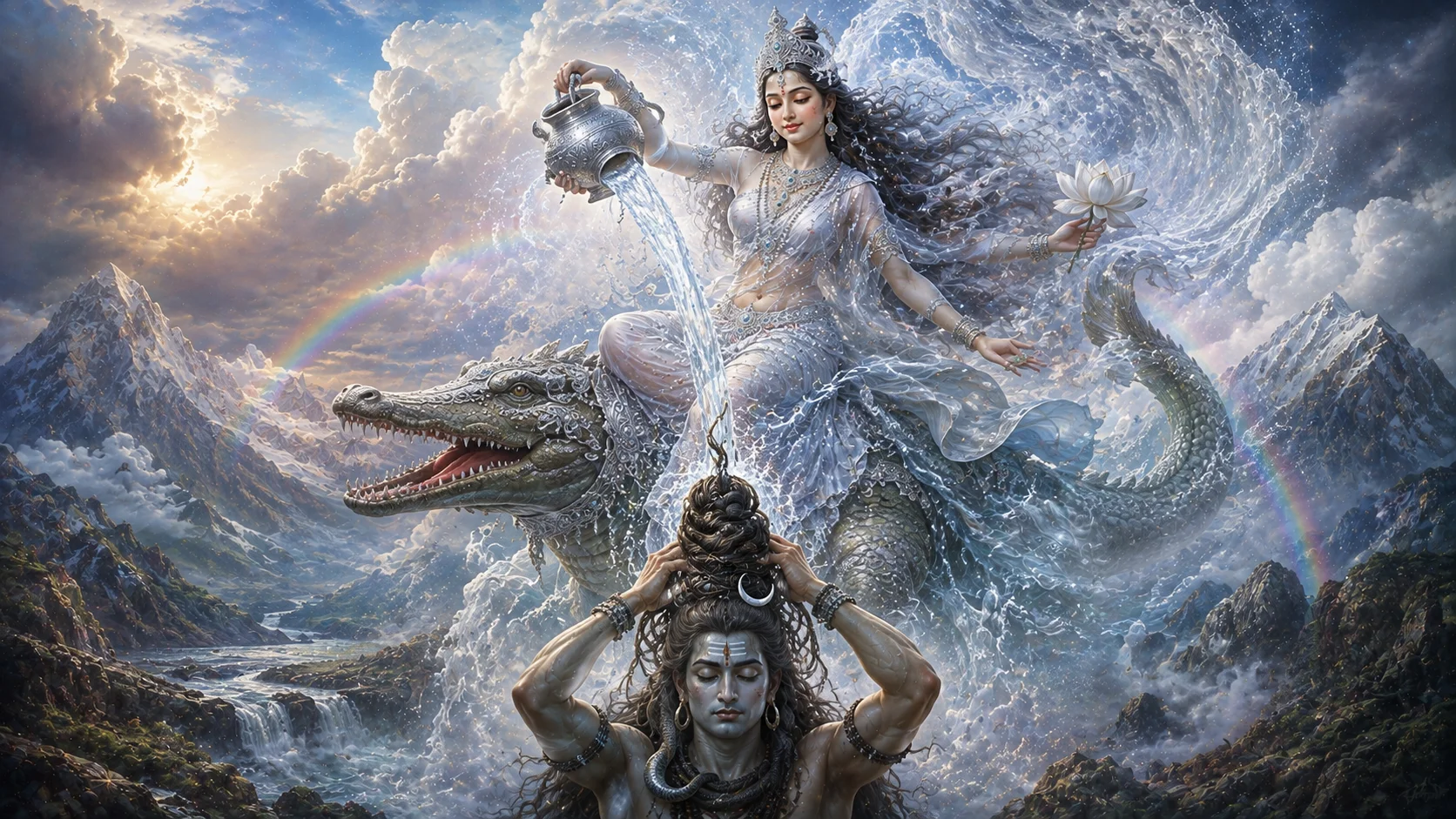
When Ganga descends from heaven, her force is so tremendous that, left unchecked, it threatens to devastate the world beneath her. Shiva, honoring Bhagiratha's penance and recognizing the danger, positions himself to receive her fall directly onto his head, catching her entire torrent within the vast expanse of his matted locks (jata). Some traditions describe Shiva as deliberately humbling Ganga's pride in her own power by trapping her so thoroughly within his hair that she wanders lost for a time before he releases her, gently, in a controlled stream, down onto the Himalayan peaks and from there into the plains of India, where she finally reaches the site where Sagara's sons' ashes lie, touches them, and releases their souls into liberation at last. This episode is why Shiva is venerated under the epithet Gangadhara, “Bearer of the Ganga,” and why images of Shiva across India so often show a small figure of the river goddess emerging from his piled, matted hair — a permanent iconographic record of this act of controlled, compassionate restraint transforming an overwhelming cosmic force into a gentle, life-giving stream.
Theological Meaning: Purification and Liberation
Ganga's core theological significance lies in her association with purification, both physical and spiritual: her waters are believed to cleanse the sins of anyone who bathes in them with sincere devotion, and to ensure liberation, or at least a favorable rebirth, for the souls of the dead whose ashes are immersed in her. This belief underlies the immense importance of cremation and the immersion of ashes at sites along her banks, above all at Varanasi, regarded as one of the holiest cities in the world precisely because of its position on the Ganges. Her descent narrative also carries a broader message about power and restraint: an uncontained cosmic force, however beneficial in its ultimate purpose, requires a mediating, disciplining presence — Shiva's hair — to become a source of nurture rather than devastation, a theme echoed throughout Shaiva theology's broader vision of Shiva as the force that holds destructive and creative energies in careful balance.
Iconography and Relationships
Ganga is typically depicted as a beautiful woman riding a makara, a crocodile-like mythical river creature, often bearing a water pot and lotus, her flowing hair and garments evoking the movement of the river itself. She is closely linked to Shiva both through the descent myth and, in some traditions, as a secondary consort alongside Parvati, a relationship that occasionally becomes a source of gentle mythological tension between the two goddesses, reflecting the way major rivers and mountains were both, in ancient India, understood as living, divine presences bound up with the household of Shiva on Kailash.
Living Worship
Ganga worship remains one of the most vibrant and continuously practiced devotional traditions in contemporary Hinduism. Millions of pilgrims bathe in her waters at sacred cities along her course — Haridwar, Varanasi, Prayagraj (Allahabad), and others — and the daily Ganga Aarti ceremonies performed at her ghats, especially the famous evening rites at Varanasi and Haridwar, draw enormous crowds of devotees who offer lamps, flowers, and prayers to the river as a living goddess. The festival of Ganga Dussehra celebrates her descent to earth, and the immersion of a departed relative's ashes in her waters remains, for countless Hindu families, one of the most sacred final acts of devotion that can be performed on behalf of the dead.
The Sangam and the Three Sacred Rivers
At Prayagraj, Ganga is joined by the Yamuna and, according to tradition, the invisible, subterranean Saraswati at a confluence called the Sangam, regarded as one of the most sacred spots in all of India and the site of the Kumbh Mela, the vast periodic pilgrimage gathering that draws tens of millions of devotees to bathe at this confluence. The presence of three sacred rivers meeting at a single point is itself read theologically as an image of the convergence of distinct streams of divine grace and knowledge into a single point of access for the ordinary devotee, and bathing at the Sangam during the auspicious astrological windows of the Kumbh Mela is held to bestow purification of extraordinary potency, understood by pilgrims as a rare alignment of cosmic time and sacred place.
Ganga's Seven Sacred Sisters
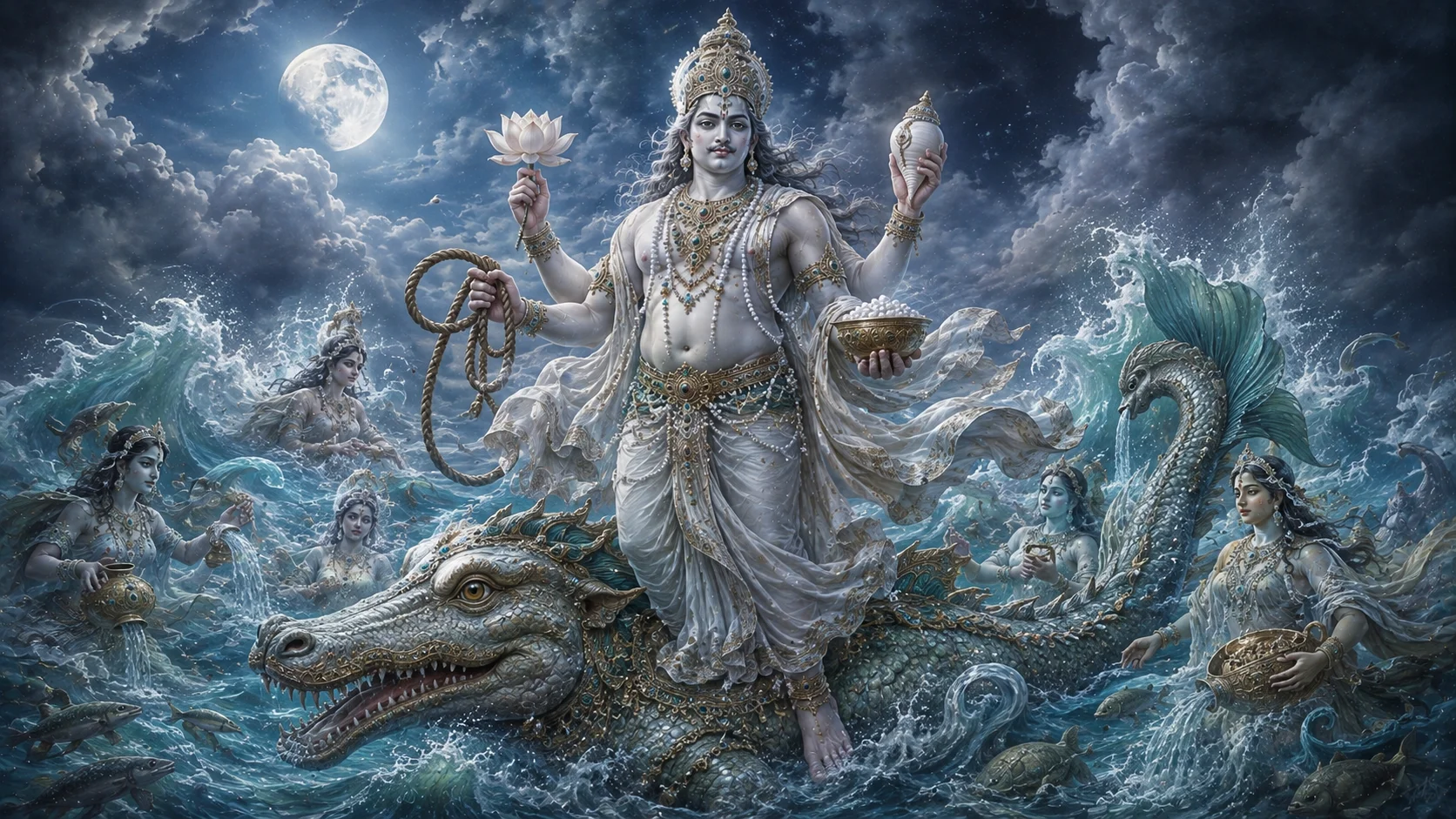
The Ganges is traditionally counted among the seven most sacred rivers of India, a group that also includes the Yamuna, Godavari, Saraswati, Narmada, Sindhu, and Kaveri, each personified as a goddess in her own right and each invoked together in a well-known verse recited during ritual bathing anywhere in India, in which a devotee calls upon all seven rivers to be symbolically present in whatever water is at hand. This practice reflects a broader and important principle within Ganga's theology: while the physical Ganges holds a uniquely elevated status, her sanctity is understood as radiating outward, so that her purifying presence can, through proper invocation, be called into any body of water, making the goddess accessible to devotees far from her literal banks. This principle of extended presence is invoked daily by observant Hindus performing home rituals anywhere in the world, who recite the names of the seven rivers over their bathing or offering water precisely so that Ganga's purifying grace need not depend on physical proximity to the river itself, a devotional accommodation that has allowed her worship to travel wherever her devotees have settled, from riverside villages along her own banks to households and temples far beyond the borders of India itself, wherever her devotees carry the memory of her waters with them.
Sources & traditions
- EncyclopediaWikipedia — Ganga (goddess)
- TraditionHindu texts, oral tradition and village tellings (South Asia)
Myths change from area to area and from time to time. This chronicle follows the most widely told versions; tellings in other villages, regions and eras may differ.