Ravana is the ten-headed demon-king of Lanka, the mighty rakshasa lord of the Ramayana whose abduction of Sita set the great epic's war in motion — a scholar, a devotee of Shiva, and a ruler of vast power undone at last by Rama.
Born of Sage and Asura
Ravana's lineage is itself a study in contradiction. He was the son of the sage Vishrava, a descendant of the great rishi Pulastya, and of Kaikasi, an asura princess. By paternal blood he was a Brahmin, heir to a line of seers and Vedic learning; by his mother's blood he was raised among rakshasas and came to rule them. This double inheritance — divine scholarship joined to demonic dominion — runs through everything told of him. He was not a beast wearing a crown; he was a Brahmin's son who became the sovereign of demons, and the epic never lets that tension rest.
He was not without kin who chose differently. His half-brother Kubera, born of Vishrava's first wife, became the god of wealth. His full brothers were the colossal Kumbhakarna and the loyal Vibhishana; his sister was Shurpanakha. One house, one father, and yet its children scattered across the moral map of the epic — a wealth-god, a giant, a traitor to his own brother's cause, and Ravana himself.
Ten Heads, Twenty Arms
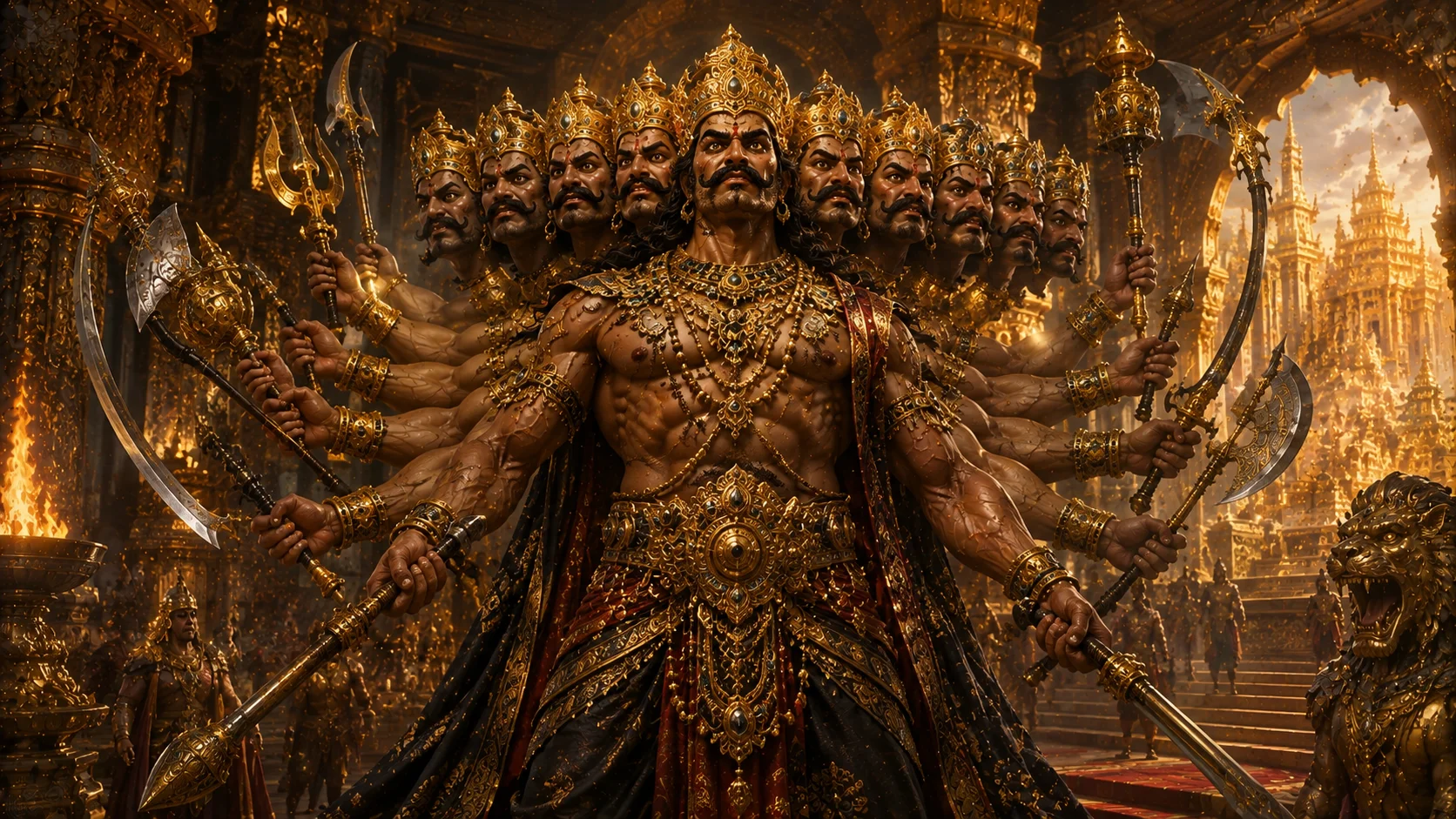
Ravana is known above all by his form: ten heads — Dashanana, Dashagriva — and twenty arms. Tradition reads the heads as a sign of his mastery: knowledge of the four Vedas and the six shastras, the many faces of a mind that had absorbed the whole of sacred learning. The arms speak more plainly, to raw physical power multiplied tenfold. Together the image is not simply monstrous but doubled — a body built to hold both a scholar's total learning and a warrior's total strength, each head and each arm insisting that no single measure of Ravana could ever be enough.
Austerities Before Brahma
His power was not inherited but earned. Ravana performed severe austerities in devotion to Brahma, discipline sustained until the god granted him a boon: invincibility against gods, gandharvas, and the other supernatural orders of the cosmos. In his pride, Ravana asked for nothing against humans or beasts — such creatures, he judged, were too far beneath a king of his stature to ever threaten him. The boon was granted exactly as asked, and it made him, for an age, unconquerable by anything he considered worth fearing. The one door he left unbarred was the one through which his death would eventually come.
Scholar, Devotee, Musician
Ravana's learning was not incidental to his character; it is one of the pillars the tradition builds him from. He is remembered as a formidable scholar of the Vedas, and as a devoted worshipper of Shiva, a devotion so deep and so accomplished that he is credited in tradition as the composer of the Shiva Tandava Stotra, a hymn in praise of Shiva's cosmic dance. Alongside this he is remembered as a skilled player of the veena. A demon-king who wrote hymns and played music to the god he served — that combination of ferocity and reverence is central to why Ravana has never been read as a simple monster, in Lanka or beyond it.
The Golden Deer's Ruse
The act that defines the epic's plot was Ravana's abduction of Sita, wife of Rama, during the couple's exile in the forest at Panchavati. He did not attempt it by open force. He sent the demon Maricha ahead, disguised as a golden deer, to draw Rama away from Sita's side on the pretext of the hunt. With Rama gone and the clearing undefended, Ravana came for Sita and carried her off to Lanka. The deception is remembered as carefully as the abduction itself — Ravana's approach to Sita was never a straightforward assault but a plan built on disguise and misdirection, fitting a king who prized cleverness as much as force.
Captive in the Ashoka Vatika
In Lanka, Ravana held Sita captive in the Ashoka Vatika, a grove set apart within his kingdom. There he pressed his suit again and again, urging her to accept him as her husband and queen of Lanka in Rama's place. Sita's answer never wavered: she refused him at every approach, holding to her devotion to Rama through what tradition remembers as a long and difficult captivity. The grove became the fixed stage for this standoff — a demon-king with the power to command continents, unable to command the one loyalty he wanted.
A Brother's Warning, A Brother's Departure
Not every voice in Lanka supported the abduction. Vibhishana, Ravana's own brother, urged him repeatedly to return Sita to Rama and avert the war that was gathering. Ravana refused to hear him. Rebuffed and unable to turn his brother from the course he had set, Vibhishana left Lanka and crossed over to Rama's side, joining the Vanara army against the kingdom of his own birth. It is one of the starkest images the epic offers of Ravana's isolation: a brother who tried counsel before conflict, and a king too proud to take it.
The Bridge Across the Sea
Rama did not come to Lanka alone. With Hanuman, the Vanara king Sugriva, and their assembled army, he undertook the building of Rama Setu, a bridge spanning the sea to Ravana's island kingdom. The construction of that bridge marks the turn from search to war — the moment Ravana's island stronghold, long protected by water as much as by his boon, stood open to an approaching army for the first time.
The Gathering War
What followed was full-scale war between Rama's forces and Ravana's rakshasas, fought across Lanka and recounted in the epic's Yuddha Kanda. Ravana commanded his kingdom's full strength in the defense of what he had taken and refused to surrender. The war is remembered as vast and costly on both sides, the culmination of everything set in motion by the deer in the forest and the grove that followed it.
The Loophole in the Boon
Ravana's boon had made him safe from gods, gandharvas, and every supernatural power he thought worth guarding against — but he had never asked for protection from a human. Rama was, by tradition, the seventh avatar of Vishnu, walking the earth in human form. It was precisely the boundary Ravana had drawn around his own invincibility — the boundary of his own pride — that left him open to the one adversary he had never bothered to fear. In the epic's telling, that omission was not incidental to his fall; it was the fall's entire mechanism.
Single Combat and the Fall of Lanka
The war's climax came in single combat between Rama and Ravana, and it was there, in the Yuddha Kanda, that Rama slew the demon-king. With Ravana's death the war that had consumed both kingdoms came to its end, and Sita's long captivity in the Ashoka Vatika was over. The kingdom that Ravana had ruled from behind the shield of an unbreakable boon passed, in the space of a single combat, out of his hands entirely.
Effigies at Dussehra
Ravana's defeat is not remembered only in text but in observance. Every year at Dussehra, also called Vijayadashami, effigies of Ravana — often standing alongside effigies of Kumbhakarna and Meghanada, also called Indrajit — are burned across North India. The festival marks the victory of Rama over Ravana as a living commemoration, re-enacted annually rather than left to the page alone, and it remains one of the most widely observed festivals built around a single epic's climax.
The King Some Traditions Still Honour
For all that the Ramayana casts him as its principal antagonist, Ravana has never been remembered as a flat villain. He is a scholar-king who mastered the Vedas, a devoted worshipper of Shiva credited with composing hymns in that god's honour, and a ruler of formidable power — qualities the tradition holds in the same breath as his abduction of Sita and his refusal of his brother's counsel. In certain communities, including some in Sri Lanka and specific traditions within India, Ravana is regarded with genuine reverence, a minority devotional strand that stands apart from the epic's mainstream narrative of his defeat. That divide — condemned by the central story, honoured at its margins — is as much a part of Ravana's memory as the ten heads themselves.
Sources & traditions
- EncyclopediaWikipedia — Ravana
- TraditionHindu texts, oral tradition and village tellings (South Asia)
Myths change from area to area and from time to time. This chronicle follows the most widely told versions; tellings in other villages, regions and eras may differ.