Bhuta — Bhūta — is the Hindu ghost: the restless spirit of one who has died a bad or untimely death and cannot pass on. The word means literally "a being that has been" — one who was — and the bhutas are the wandering, often malevolent dead who haunt the living. They are among the most pervasive of all Hindu supernatural beings, woven into daily folk-belief across the subcontinent, and their worship in the coastal south has become one of India's most spectacular living ritual traditions.
The Unquiet Dead
A bhuta is created when a person dies by violence, accident, suicide, or execution, or otherwise before their time, or when the proper funeral rites are not performed for them — leaving the soul unable to complete its passage to the realm of the ancestors. Such a spirit is trapped between worlds, attached to the place of its death or to unfinished business, and turns its frustration on the living. Bhutas are believed to be capable of possessing the living, causing illness, misfortune, or erratic behavior, and a great body of folk-exorcism exists to drive them out — mantra, amulets, and offerings deployed against a presence that is felt long before it is named.
What the Word Does Not Mean
"Bhuta" carries a second, older sense that has nothing to do with ghosts. The Sanskrit root bhu, "to become" or "to have been," also gives the word its cosmological meaning: an element, a being that has come into existence. The five bhutas — as in the phrase pancha bhuta, the five elements — belong to that elemental scheme, not to five kinds of ghost. The ghost-spirit sense is a narrower, later usage that rode on the same word without displacing the first. A reader who meets bhuta in a philosophical text and in a village exorcism is meeting two branches of one root, not one idea told twice.
A Crowded Register of the Dead
Classical taxonomy is careful to keep the bhuta distinct from its neighbors, even where popular usage blurs them. The preta is a hungry ghost, awaiting the rites that will move it onward to its proper afterlife transition — a state of transit rather than a settled condition. The pishacha is flesh-eating and more overtly malevolent, a spirit whose hunger has curdled into predation. The vetala is a spirit that animates a corpse, a distinct and unsettling category of its own. The churel is the ghost of a woman who died in childbirth, a figure with her own particular dread attached to her. The rakshasa belongs to a broader demonic race entirely, with its own lineages, not a category of the restless dead at all. The bhuta sits among this crowded kin as the specific case of a soul denied its proper passage — not starving like the preta, not feeding like the pishacha, not bound to a corpse like the vetala, but simply unable to leave. In practice, popular usage often lets the labels blend into one another, even as the classical taxonomy keeps them apart.
The Threshold Between Ghost and Ancestor
What separates a bhuta from a pitr — a settled, honored ancestor — is not fate but procedure. Popular belief and ritual practice hold that cremation performed correctly, followed by the shraddha rites carried out by descendants, is what allows the deceased to cross from the uncertain state of the newly dead into the stable company of the ancestors, where offerings continue to reach them and their memory is folded into the family's ongoing life. Skip the rites, or die in a way the rites cannot properly close, and the soul stalls at the threshold. This is why the bhuta is so often a story about the living as much as the dead: it names a duty unmet, a family unable or unwilling to see someone off, and the wandering spirit is the visible cost of that failure.
Ground the Dead Are Drawn To
Bhutas are believed to linger in liminal, ominous places. The cremation ground (smashana), still carrying the trace of the rite that either succeeded or failed, is the most direct of these. Crossroads, where paths and choices multiply, are another. Old or abandoned houses, emptied of the living order that once organized them, are a third. And certain trees — the peepal and the banyan above all — are commonly cited as haunts. A village that avoids a particular tree after dark, or will not build on a certain crossroads, is often carrying this belief forward without needing to explain it.
Bhairava's Retinue and the Lord of Ghosts
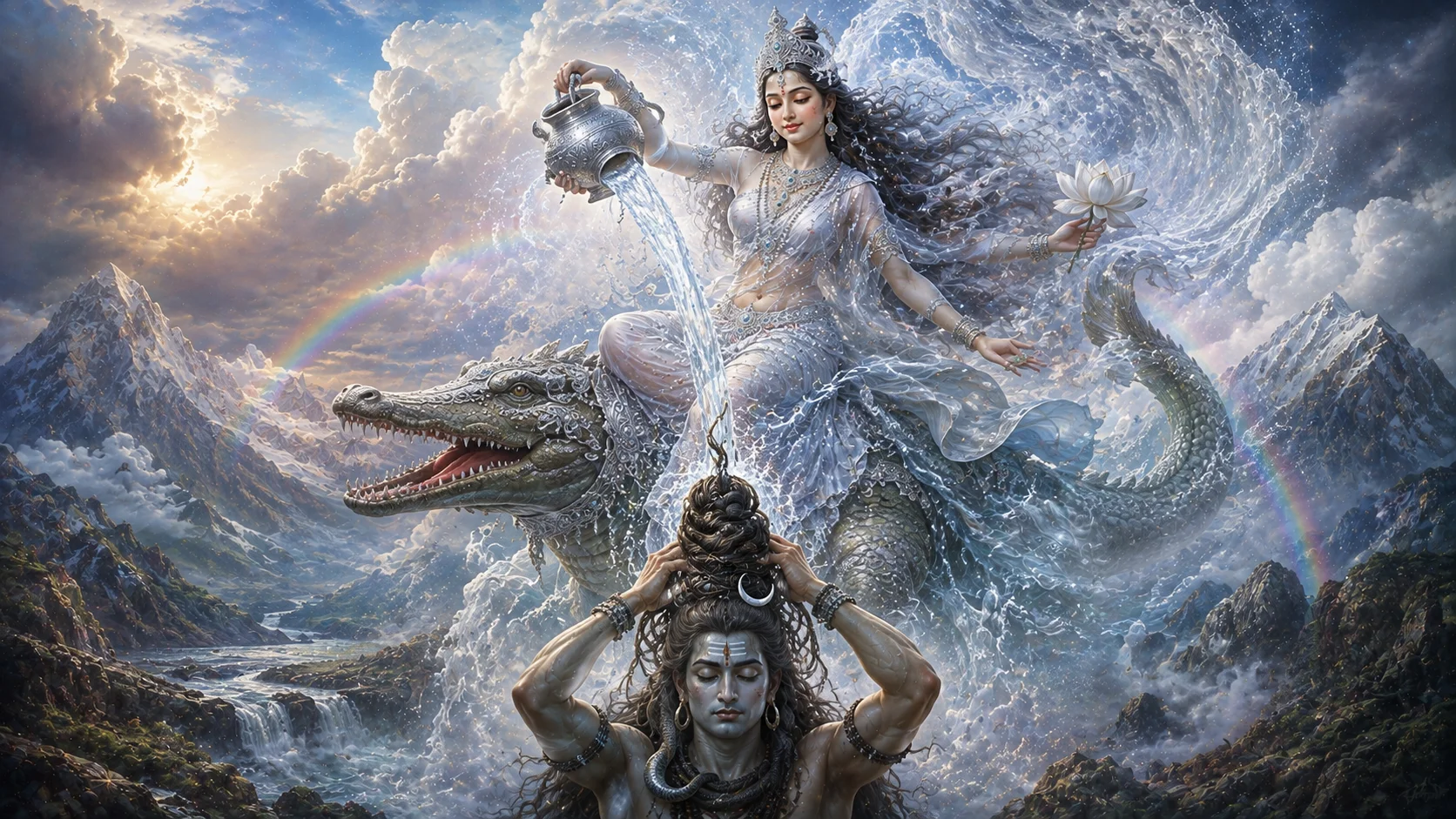
Shiva, in his fearsome aspect, is traditionally described as the lord of bhutas and ghostly beings, bearing the epithets Bhutanatha and Bhuteshvara — "lord of ghosts" or "lord of beings." In his form as Bhairava he is attended by a retinue of ganas and bhuta-like followers, a wild court drawn from exactly the margins that orthodox ritual otherwise tries to keep at bay. This is one of the great god's characteristic reversals: rather than standing apart from the restless dead, he presides over them, making a place at the center of Hindu cosmology for the very beings that domestic ritual works to exclude. The Puranas and epics generally list bhutas among the categories of semi-divine or spirit beings that inhabit this retinue alongside the ganas and the yakshas — a broad taxonomy of supernatural attendants rather than the subject of any single independent narrative myth, unlike named figures such as the apsaras.
An Offering Owed Every Day
Some Puranic and dharmashastra passages fold this recognition into the most ordinary rhythm of orthodox life. Bhuta-yajna — offerings made to spirits and beings, bhutas among them — appears as one of the five great daily sacrifices (pancha-mahayajna) enjoined on the householder. This is worth pausing on: it means the acknowledgment of bhutas was never confined to folk margins or emergency exorcism. It sat inside the household's own daily obligations, a small ritual gesture toward beings that might otherwise be forgotten, made before any particular bhuta had caused any particular trouble.
The Coastal South's Living Worship
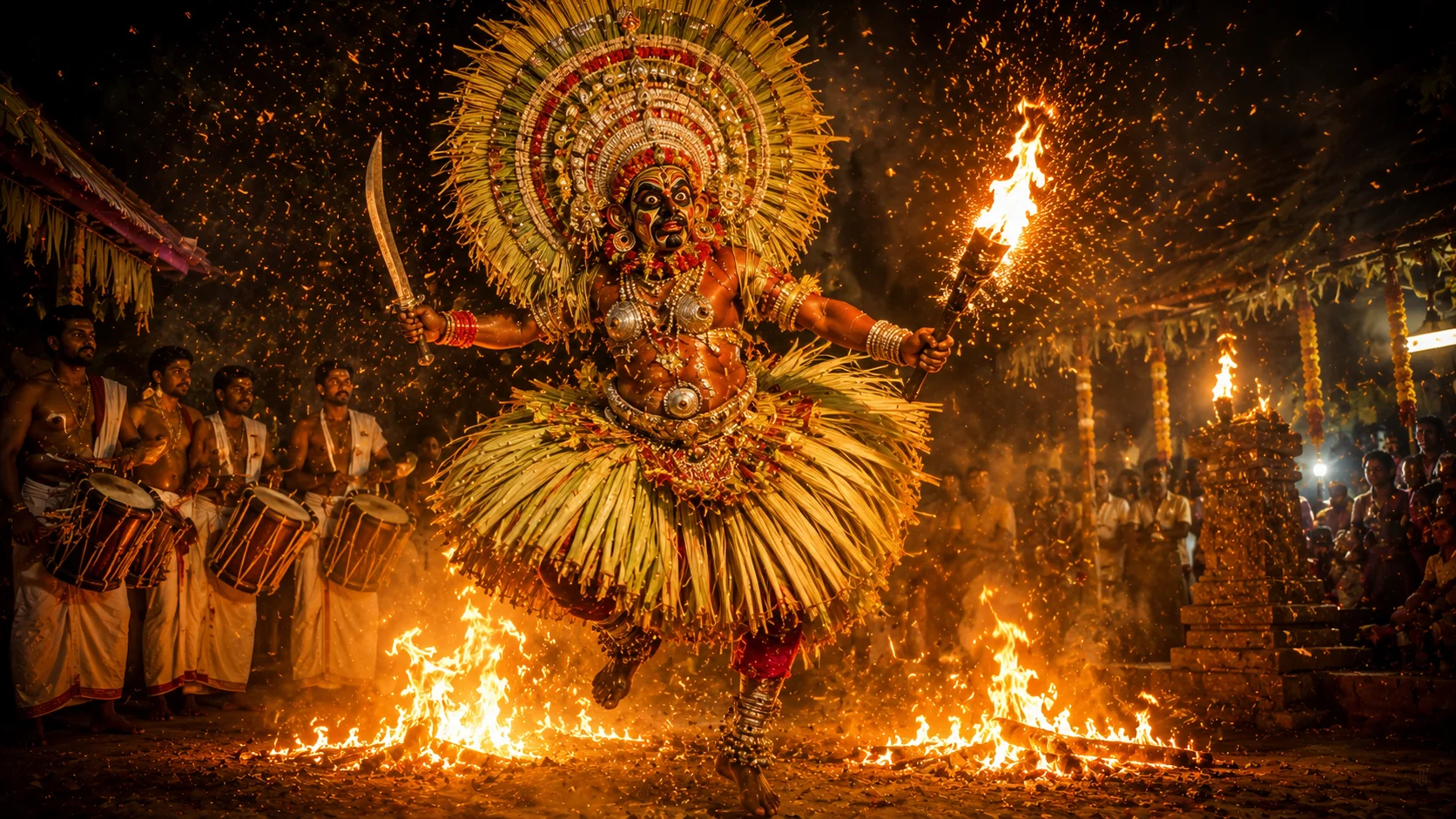
In the Tulu-speaking coastal region of Karnataka (Tulunadu), the bhuta is not merely feared but magnificently worshipped, and this regional folk-religious development stands apart from the Sanskritic epic and Puranic material as its own distinct devotional tradition. Bhuta Kola — "spirit play" — is the structured worship built around it: a performer, in elaborate costume and painted face, becomes possessed by a bhuta-deity and dances through the night. The practice is closely related to Keralan Theyyam, the neighboring coastal tradition of possession-worship, and both belong to the same wider stratum of regional guardian-spirit cults that developed across village deity traditions, propitiating bhutas as guardian spirits through possession ritual, offerings, and festival rather than treating them only as a danger to be expelled.
Voice Given to the Guardian
Within the Bhuta Kola, the possessed performer is understood to become, for the duration of the ritual, the very spirit invoked. In that state the dancer delivers oracles, settles disputes brought by the community, and offers blessing, functioning as a channel through which the guardian spirit's judgment reaches the living directly. These guardian-spirits are frequently the deified figures of local memory — heroes, ancestors, or named animal-spirit guardians such as the boar-spirit Panjurli, honored within specific village traditions — and their worship represents a stratum of devotion whose forms are locally distinct from village to village.
No Single Story, Many Local Ones
Because "bhuta" functions largely as a broad vernacular category rather than a figure with one fixed origin myth — unlike a named figure such as Markandeya or Kumbhakarna — its particulars vary considerably by region and community. There is no single canonical narrative that explains where the first bhuta came from or lays out one authoritative account of its habits. Instead the category is populated locally — this village's crossroads spirit, that family's unresolved ancestor, this coast's particular guardian cult — and any description of "the" bhuta is really a composite drawn from many regional practices that share a family resemblance rather than a single source.
The Screen's Version, Kept at Arm's Length
Later popular culture — Indian folklore anthologies and regional cinema especially — has drawn heavily on bhuta traditions, spinning them into ghost stories and anthologized tales that have shaped how many people first encounter the word today. That reception is real and influential in its own right, but it is a modern cultural afterlife rather than an extension of the textual and ritual tradition itself, and the two are best understood as related but separate: one a living devotional and folk-ritual practice with centuries of continuity, the other a more recent and more theatrical inheritance built on top of it.
What Lingers
The bhuta spans the whole range of the Hindu relationship with the dead: the dreaded revenant to be exorcised, and the powerful guardian-deity to be venerated, sometimes within the very same regional tradition. To name something bhuta is to name what lingers — the passage not completed, the rite not performed, the soul caught at the threshold between what it was and what it should become. The elaborate rites surrounding it, from the household's daily offering to the coastal south's all-night dance of possession, together represent a long and still-living negotiation with the unquiet dead, one that treats their claims on the living as neither fully banished nor fully welcomed, but permanently, carefully, attended to.
Sources & traditions
- EncyclopediaWikipedia — Bhoota (ghost)
- TraditionHindu texts, oral tradition and village tellings (South Asia)
Myths change from area to area and from time to time. This chronicle follows the most widely told versions; tellings in other villages, regions and eras may differ.