Apsara — Apsarā — is the celestial nymph of Hindu (and Buddhist) myth: a being of supernal beauty and grace, mistress of dance and the arts, who dwells in the heaven of Indra and embodies the pleasures and dangers of divine eros. Born from the churning of the cosmic ocean, the apsaras are the dancers of the gods, the rewards of fallen heroes, and the agents sent to break the penance of sages too powerful for the gods to allow. Though the class originates in Vedic and epic Hinduism, the figure of the apsara was carried into Buddhist cosmology as well, where she appears among the classes of celestial beings inhabiting the heavens above the human world — a transmission later carried further still into the Buddhist temple art of Southeast Asia.
Born of the Churning Sea
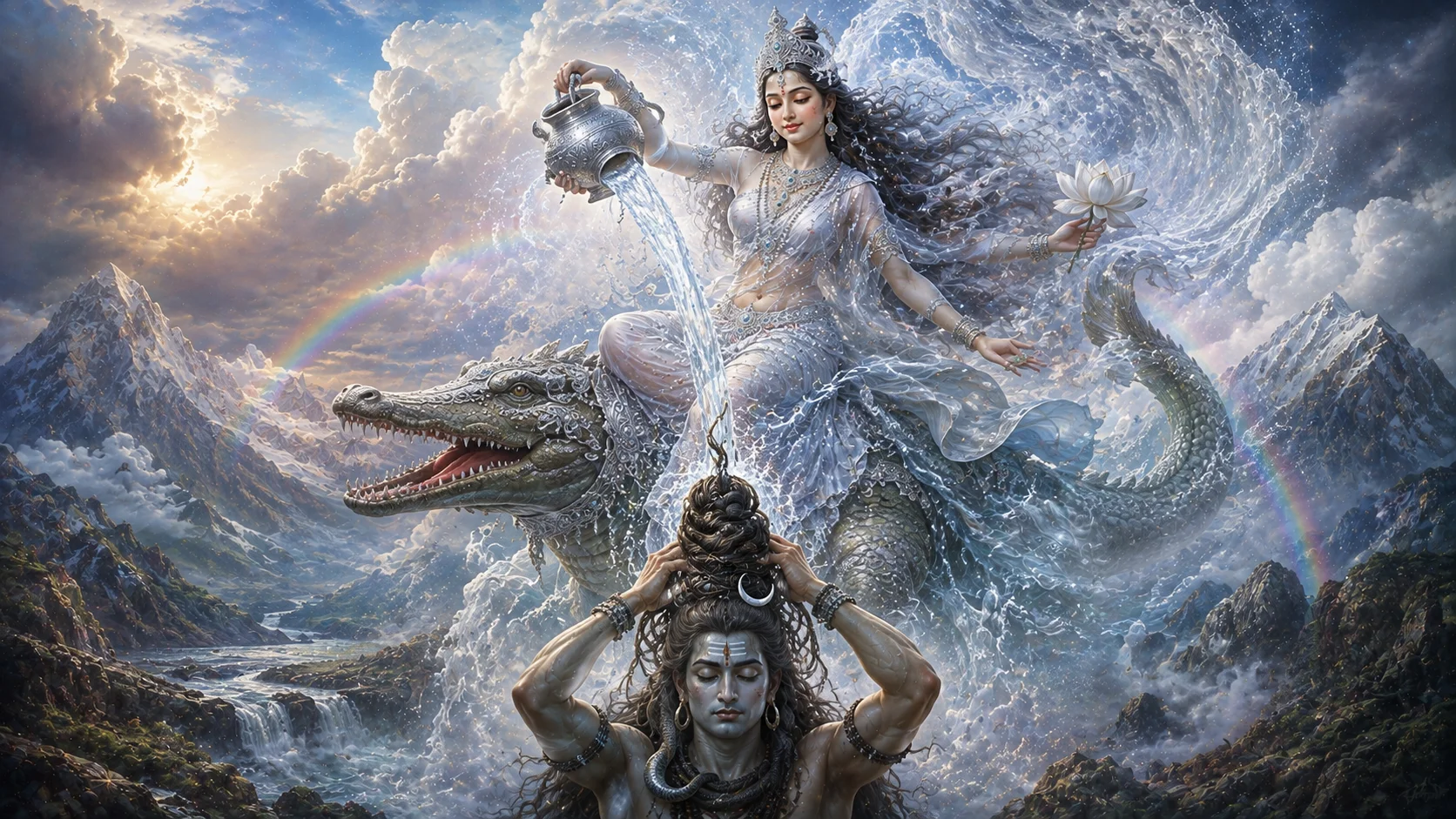
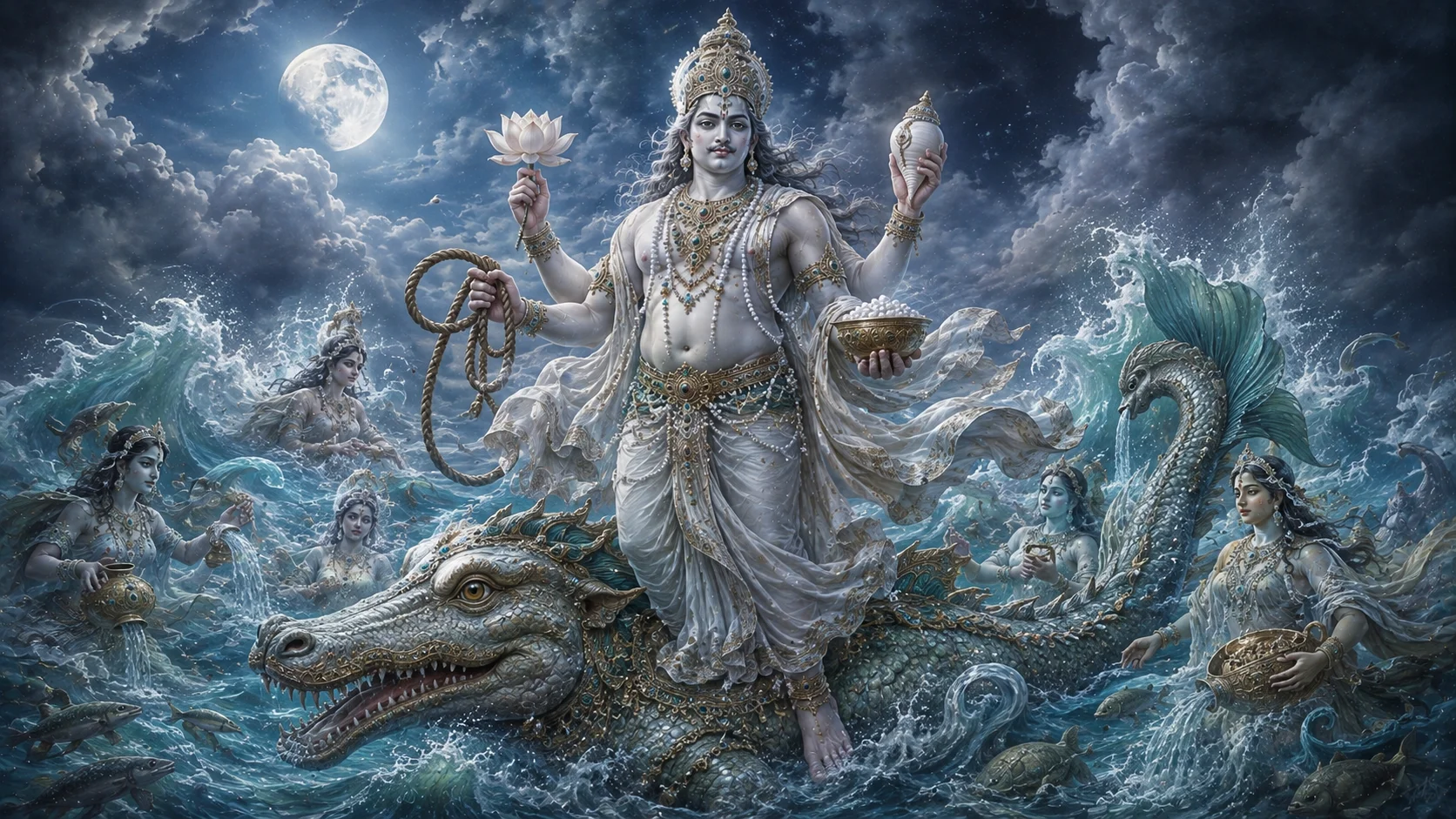
The apsaras rose, by the great myth, from the Samudra Manthana — the churning of the ocean of milk — among the treasures that emerged when gods and asuras turned Mount Mandara to win the nectar of immortality. They surfaced alongside Lakshmi herself and the Amrita, the nectar that was the churning's ultimate prize, making the apsaras among the primordial products of that cosmogonic labour rather than beings created afterward or born of any single parent. So lovely were they that neither gods nor demons would claim them as wives, and they became common to all — the shared celestial company of heaven, beyond the bonds of marriage. Their name is often read as linked to apsu, "in the water," and they are associated with water more broadly — rivers, clouds, the shimmer of light on a moving surface — an origin that ties their beauty to the same primordial ocean that gave the world its nectar of immortality.
Dancers of Indra's Court
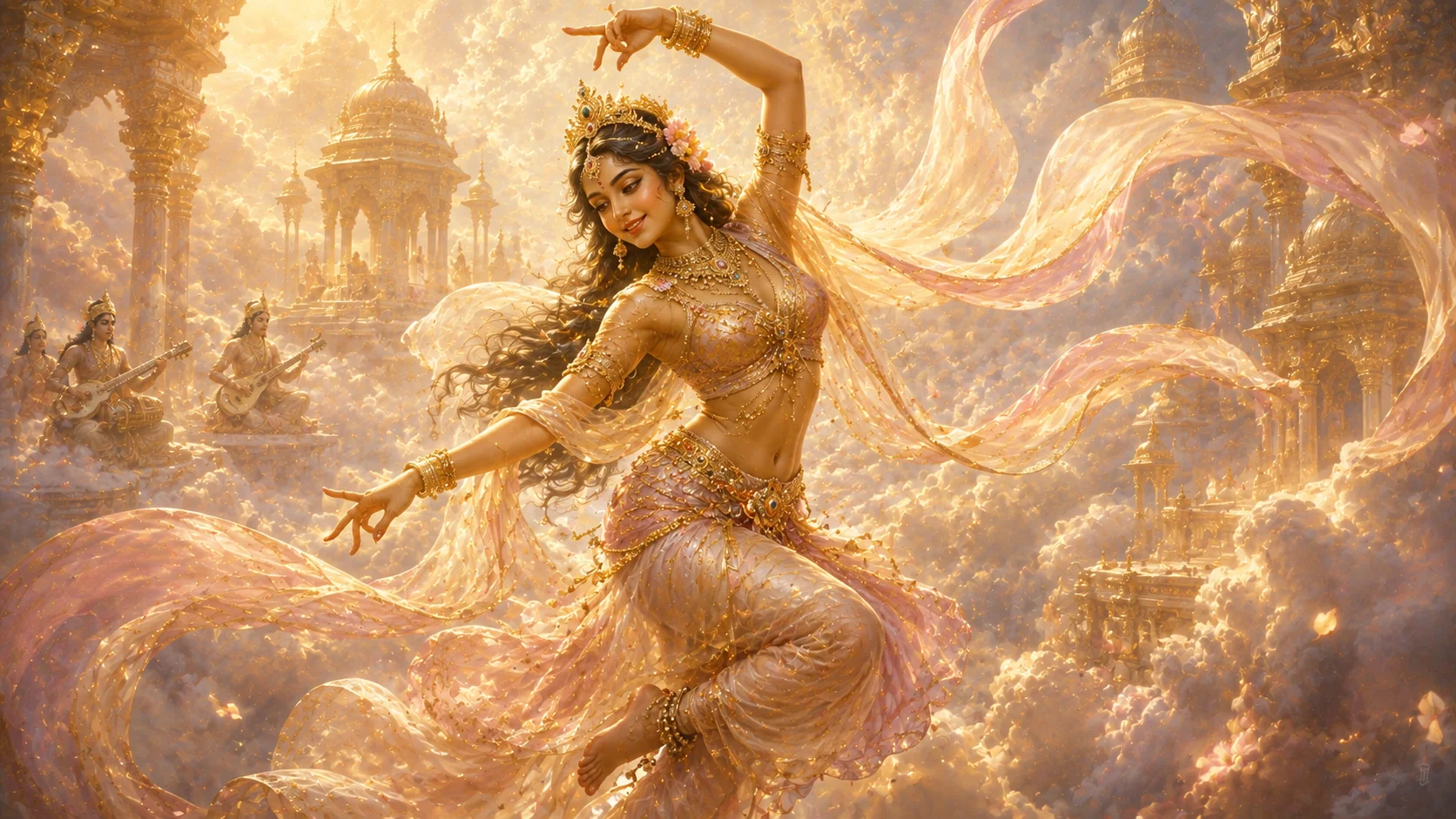
In Svarga, Indra's heavenly court, the apsaras dance to the music of the gandharvas, the celestial male musicians who are their typical companions and consorts. Together the two classes of being form the entertainers of the gods — the gandharvas playing, the apsaras dancing — a functional pairing repeated across the epics and Puranas rather than a single fixed marriage. Later Puranic literature widely describes warriors who die valiantly in battle as welcomed into Indra's heaven and celebrated there by the apsaras, though this motif varies from text to text rather than standing as one fixed doctrine; where it appears, it casts the apsaras as a kind of martial honour, the celestial companions who receive the valiant dead.
Menaka and the Undoing of Vishvamitra
Among the individually named apsaras — Menaka, Rambha, Urvashi, Tilottama, and Ghritachi recur most often — Menaka's story is bound to one of the frame narratives of the Mahabharata itself. Sent by Indra to disrupt the sage Vishvamitra's tapas, whose growing spiritual power threatened the gods' own standing, Menaka succeeded where austerity should have made her powerless: their union produced a daughter, Shakuntala, who would in turn become the mother of Emperor Bharata. The episode is central not only to the Mahabharata's frame narrative but to Kalidasa's celebrated play Abhijnanashakuntalam, which draws the whole of its drama from the aftermath of that meeting between a sage's discipline and a nymph sent to break it. Vishvamitra's austerities resume afterward, the interruption absorbed into the larger arc of a sage whose power the gods had reason to fear and reason, again and again, to test.
Urvashi, Pururavas, and the Curse Upon Arjuna
Urvashi stands among the oldest named figures in the entire corpus: her romance with the mortal king Pururavas is one of the oldest narrative fragments preserved in the Rigveda, predating even the epics that would later expand upon the apsaras as a class. In the Mahabharata she appears again in a very different register — approaching Arjuna during his sojourn in Indra's court and offering herself to him. Arjuna refused her, and Urvashi cursed him to live a year as a eunuch. Indra intervened to commute the curse to exactly that single year rather than a permanent state. Arjuna would later put the curse to strategic use: during the Pandavas' year of concealment, the Agyatavasa, he lived disguised at the Matsya court as Brihannala, a dance and music teacher — the curse that should have humbled him becoming the very shape of his hiding. The episode sits oddly beside her earlier story with Pururavas: the same figure who once pursued a mortal king across the Rigveda's oldest verses here refuses to be refused by one, and answers that refusal with a curse rather than sorrow.
Tilottama and the Ruin of Sunda and Upasunda
Not every apsara entered the world through the churning of the ocean. Tilottama was created deliberately, by the divine architect Vishwakarma, for a single purpose: to seduce and set against each other the asura brothers Sunda and Upasunda, whose combined power had made them invincible to gods and demons alike so long as they remained united. Vishwakarma built her for exactly this fracture, and the plan worked precisely as designed — the two brothers, each desiring Tilottama for himself, turned on one another and brought about their own mutual destruction. Where Menaka's and Urvashi's stories unfold through desire that arises in the course of events, Tilottama's is engineered from the outset, desire built and deployed as a weapon rather than discovered as a consequence.
Rambha's Two Refusals
Rambha appears in myth chiefly through the men who wanted her and were denied. She rebuffed Ravana, and that refusal became the ground for a curse laid against him — one thread among the many that shape his later story. Separately, Rambha was also sent to tempt the sage Vishvamitra during his austerities, joining Menaka as one of the apsaras dispatched against that particular ascetic's tapas across different tellings. Taken together, her appearances mark her less as a figure with a single defined myth of her own and more as a recurring name attached to the larger pattern the apsaras serve throughout the tradition — beauty offered, and refused, at real cost to those who refuse it.
Ghritachi, the Fifth Name
Ghritachi is named consistently alongside Menaka, Rambha, Urvashi, and Tilottama as one of the individually recognised apsaras of the tradition, her name recurring across the epics and Puranas even where the tales attached to it vary by telling. Set beside her four better-documented companions, she stands as a reminder that the class of apsaras is wider than its handful of famous protagonists — the named few whose stories survive in detail sit atop a larger company whose presence in Indra's court the tradition takes for granted without dwelling on each of them in turn.
Breakers of Penance
Across these individual stories runs one consistent function: the apsara as Indra's instrument against ascetic power. When a rishi's accumulated tapas grew vast enough to threaten the gods' own position in the cosmic order, Indra's recourse was not force but seduction — an apsara sent to shatter the sage's concentration and, with it, the merit that concentration had built. Menaka against Vishvamitra, Rambha against the same sage, even Urvashi's approach to Arjuna in a related register, all repeat this device across the epics and Puranas: desire deployed deliberately, by heaven's king, against a threat heaven could not otherwise contain. The apsaras' beauty in these tales is never incidental ornament — it is the mechanism by which the story's conflict resolves.
Pleasure Against Discipline
Hindu cosmology conventionally sets the apsaras apart from both the devas and the rishis in a specific way: they are impermanent, pleasure-associated celestial beings, in contrast to the austere, dharma-bound status that defines both the gods proper and the ascetics who pursue liberation through tapas. Their role in the tradition is largely to mediate between divine order and the world of worldly, sensory temptation — neither fully of the disciplined heaven that Indra rules nor of the earthly world the sages renounce, but a presence that moves between the two and tests the boundary each time it is crossed. It is this in-between status that lets the same beings function equally as heaven's entertainers, a hero's celestial welcome, and the instrument of a sage's undoing, depending on which side of the boundary the story needs tested.
A Court Without a Single Face
No single apsara stands for the whole class, and that is by design as much as by accident of transmission. Menaka's story turns on consequence — a daughter, a lineage, a play built on the aftermath. Tilottama's turns on engineering — a being made for one outcome and achieving it exactly. Urvashi's turns on refusal answered by curse. Rambha's turns on refusal alone, repeated against two very different men. Together they show a company of beings put to many different narrative uses by the tradition, sharing a nature — beauty, impermanence, association with Indra's court — without sharing a single fate or a single kind of story.
From Sacred Verse to Carved Stone
In later devotional and classical arts, the apsara became a foundational model rather than only a mythic figure. Indian temple sculpture at sites such as Khajuraho and Konark drew directly on the apsara as an iconographic type, and Indian classical dance traditions took her as a choreographic model for grace and expressive movement. The figure travelled further still: through the later cultural transmission of Hindu and Buddhist mythology into Southeast Asia, apsaras were adopted into Khmer sculptural tradition, most famously across the bas-reliefs of Angkor Wat — a temple complex built within a Khmer religious world that moved between Hindu and Buddhist frameworks — where the type was reinterpreted within that distinct artistic and religious context. This reception belongs to the later spread and reworking of the mythology rather than to the core Vedic and epic corpus itself — a separate chapter built on the figure the earlier texts had already given shape, carried by artisans and dancers who never read the Rigveda's fragments of Urvashi but inherited, all the same, the idea of the apsara as the measure of celestial grace.
Sources & traditions
- EncyclopediaWikipedia — Apsara
- TraditionHindu texts, oral tradition and village tellings (South Asia)
Myths change from area to area and from time to time. This chronicle follows the most widely told versions; tellings in other villages, regions and eras may differ.