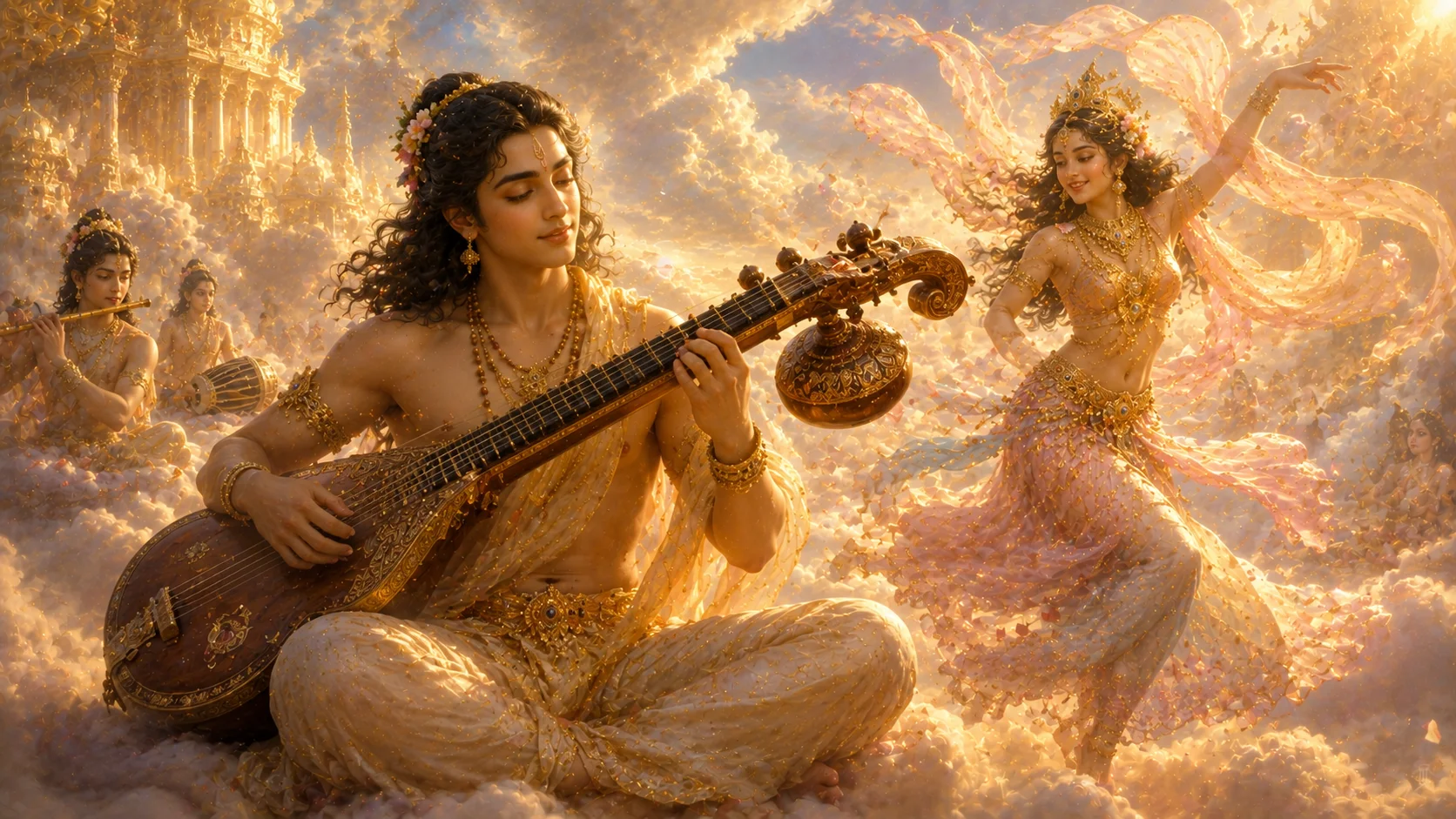
Gandharva — Gandharva — is the celestial musician of Hindu myth: a class of male nature-spirits and demigods who are the singers and instrumentalists of the gods’ court, masters of the secret lore of soma and medicine, guardians of the heavenly realms, and the consorts of the apsaras. Half-divine, often part-bird or part-horse in older descriptions, the gandharvas are the very voice of heaven’s pleasure — and the namesakes of the love-match made for love alone.
Singers of the Gods
The gandharvas dwell in the heaven of Indra, where they make the music to which the apsaras dance, filling Svarga with song and the air with fragrance — their name is connected by folk-etymology to gandha, scent. In the Vedas a single Gandharva guards the celestial soma, the elixir of the gods, and knows the deepest secrets of the heavens and of the sacred plants; the gandharvas are keepers of esoteric and medical knowledge, and physicians invoke them. They are ruled by kings such as Chitraratha, “he of the bright chariot,” the foremost of the gandharva-lords, who appears in the epics teaching and testing mortal princes.
Music, Magic, and the Mirage
The gandharvas are associated with illusion and the insubstantial. The shimmering, vanishing cities sometimes seen in the sky or over deserts are called gandharva-nagara, “cities of the gandharvas” — the Sanskrit term for a mirage, and a favourite philosophical image for the unreal, dreamlike nature of the phenomenal world. Skilled in maya, they can be capricious; some tales make them jealous guardians who quarrel with mortals who trespass on their groves or waters.
The Gandharva Marriage
The gandharvas’ most enduring legacy is the gandharva vivaha, the “gandharva marriage” — one of the eight classical forms of Hindu marriage, and the one founded purely on mutual love and desire, contracted by the consent of the couple alone without rites, dowry, or the approval of parents. It is the love-match, the elopement of the heart; the great example is the secret union of King Dushyanta and Shakuntala in the forest. That the most romantic and least formal of marriages bears the gandharvas’ name reflects their nature as spirits of beauty, music, and untrammelled love.
Kin and Counterpart
The gandharvas are the male counterpart to the female apsaras, their eternal partners in heaven. They overlap with the kinnaras (the half-bird celestial musicians) and the yakshas (the nature-spirits of Kubera), and in Buddhist cosmology the gandharvas (Pali gandhabba) become a recognised class of heavenly beings and even the spirit awaiting rebirth. In Zoroastrian myth a related Gandarewa is a monstrous water-dragon — a reminder of the gandharva’s ancient, ambiguous, half-wild origins beneath his later role as the polished minstrel of the gods.
The One in the Waters
Before there were many gandharvas, there was one. In the Rigveda the Gandharva is almost always singular, and far stranger than the courtly minstrel he later becomes: a solitary figure standing in the waters, or upon the vault of heaven, at the outer edge of what the hymns are willing to describe. In the dialogue of Yama and Yami the Gandharva in the waters and the woman of the waters are named as the origin and highest kinship of the human race — which makes him not an entertainer at all but an ancestor, and an unsettling one. He is closer to a guardian at a threshold: whatever the sacrifice most needs, he already has, and he will not simply hand it over.
The ritual texts turn that refusal into a transaction. To explain why the soma plant must be bought before it can be pressed, the Brahmanas tell how the gandharvas held the soma and would not release it, until the gods made Speech herself into a woman and sent her across — the gandharvas being, as the text says without embarrassment, fond of women. The soma came back. Then both sides courted her to keep her: the gandharvas recited the Veda at her, the gods built a lute and sang, and she turned away from the reciters towards the players. It is a wry little theory of art, and the priests kept the bargain alive in the ritual itself — every haggle over a bundle of stalks at the opening of a soma sacrifice is a re-enactment of that purchase. The gandharvas were paid. What they were paid in walked back out again the moment somebody played better music.
The Bridegroom Before the Bridegroom
The wedding hymn of the Rigveda is still recited at Hindu marriages, and it carries a line that later tradition prefers not to linger on: before her human husband, the bride has already had three. Soma took her first, the Gandharva second, Agni third; the man born of woman is only the fourth. In the same hymn the Gandharva Vishvavasu is addressed to his face and told to get up and leave — this girl has a husband now; go and find some other maiden waiting in her father’s house.
That is not a compliment paid to a celestial minstrel. It is an eviction, and it tells you what the Vedic poets thought a gandharva actually was: an invisible claimant with a prior interest in a woman’s body, who has to be spoken to, named, and sent away before a marriage can safely begin. The Atharvaveda is blunter still, preserving charms that use a pungent herb to drive gandharvas and apsaras out of a settlement the way one drives out vermin — away from the woman, away from the fields, away.
The classical medical literature inherited the anxiety along with the vocabulary, keeping a gandharva among the seizing spirits blamed for sudden derangement, so that the physician treating such a case inherited the old charmer’s job. Hold that beside the gandharva vivaha, the marriage made of nothing but mutual desire, and the shape of the whole idea becomes visible. The gandharva is what happens when longing arrives from outside the social order. Name it as love and it becomes the most romantic marriage in the law books. Name it as intrusion and it becomes something you burn herbs to expel. It was always the same force.
Angaraparna at the Ford
The Mahabharata introduces its greatest gandharva by having him lose a fight. The five Pandavas, in exile and travelling by night, come down to the Ganga where the gandharva Angaraparna is sporting in the water with his wives. He is furious — no mortal walks in on a gandharva at night — and challenges them. Arjuna answers with a weapon of fire, burns the beautiful chariot the gandharva was named for, and drags him out by the hair, alive.
What happens next is the part worth keeping. Spared, and renamed Dagdharatha, “he whose chariot was burnt,” the gandharva becomes a friend and a teacher. He gives Arjuna the chakshushi lore, by which its holder may see whatever he wishes to see; he offers the Pandavas horses of the gandharva breed — swift, tireless, able to go where they are willed; and then he does the thing gandharvas do best. He tells them stories, and out of the stories comes advice. Princes who travel without a household priest, he says, come to exactly this kind of grief. The Pandavas take the point and appoint one. It is a very gandharva sort of victory: beaten in combat, he wins the conversation.
Captors, Teachers, and the Cursed
Gandharvas cut across the epics at odd angles, and the results are rarely what the reader expects.
When Duryodhana rides out to the forest lake at Dvaitavana specifically to display his wealth in front of his exiled cousins, it is not the Pandavas who humiliate him. It is a gandharva. Chitrasena’s people are already using the lake; the Kaurava retinue is routed, and Duryodhana himself is carried off through the air as a prisoner. The exiles are then obliged to rescue the man who exiled them — a rescue that costs Duryodhana more than the capture did.
The same Chitrasena reappears as a music master. During Arjuna’s long stay in Indra’s heaven he is handed over to the gandharva king to be taught song and dance, and the lessons look like a courtly indulgence in the middle of a weapons-training arc. They are not. Years later, cursed to spend a year without his manhood, Arjuna walks into King Virata’s palace disguised as the dance teacher Brihannala — and the disguise holds because the skill is real. The greatest archer in the world hides inside a gandharva’s art.
Others fall the other way. Vishvavasu — the very Gandharva the wedding hymn tells to go away — fathers a daughter on the apsara Menaka; abandoned in the forest and raised by a sage, Pramadvara is betrothed to the young brahmin Ruru, dies of a snakebite on the eve of her wedding, and is bought back only when Ruru surrenders half the years of his own life. Tumburu, the finest singer in heaven, is cursed by Kubera into the body of the monstrous Viradha, and because a boon has made him proof against weapons, Rama and Lakshmana must break his arms and bury him in a pit — whereupon the gandharva rises out of the ruined body and goes home. Huhu, one of the pair of gandharva singers whose names ring through the epic guest-lists, offends an ascetic and spends an age as the crocodile clamped to the leg of the elephant Gajendra, released only when the god his victim was calling on finally comes. The pattern is consistent enough to be a moral: a gandharva who forgets himself is not destroyed, he is demoted into matter — made heavy, made scaled, made mute — until something cuts him loose.
Pancasikha Sings to the Lord Buddha
One of the loveliest scenes in the Pali canon has a gandhabba as its opening act. Sakka, lord of the gods, wants an audience with the Lord Buddha, who is deep in meditation in a cave, and knows better than to interrupt him directly. So he sends Pancasikha ahead with his lute. The gandhabba sits down at a respectful distance and sings a love song — a real one, addressed to Bhadda Suriyavaccasa, daughter of the gandhabba king Timbaru, whom he has wanted for a long time and has not won. Into that song he braids the Lord Buddha, the awakened ones, and his own longing for release, so that desire and dharma run through the same melody. The Lord Buddha’s response is the detail nobody would think to invent: he compliments the musicianship, remarking that the sound of the strings and the sound of the voice agreed perfectly with one another.
Buddhist cosmology gave the gandhabbas a permanent address as well. They serve Dhritarashtra, the Great King who guards the eastern quarter, and they take their place in the ranks of beings who assemble whenever a Lord Buddha teaches. In one much-discussed passage on how a life begins, the gandhabba is named as the third condition of conception alongside the union of the parents and the mother’s season — the being who must be present for a birth to happen at all. That single line is the seed of the whole later notion of the gandhabba as the spirit awaiting rebirth, and it has been argued over ever since.
Travelling east, the name kept its scent. Chinese translators rendered the gandharva as an incense spirit and took the old fragrance-etymology at face value: this is a being that eats nothing but perfume. As one of the eight classes of non-human beings who protect the teaching, he arrives in Japan as Kendatsuba, and the eighth-century sculptors of Kofuku-ji in Nara gave the whole company faces — young, grave, oddly human faces — that visitors still queue to see.
The Science That Bears Their Name
Indian tradition did not merely say the gandharvas were good at music. It named the discipline after them. Gandharva Veda is counted among the applied Vedas attached to the Samaveda, the body of knowledge concerned with sound and song, and in the theoretical literature gandharva becomes a technical term: the fixed, rule-bound, ancient music that pleases the gods, as distinct from the freer composed music made to please an audience. To call something gandharva music was to say it was not entertainment. It was the older thing, the thing entertainment came from.
The word never went out of service. In Hindustani music the title is still a crown handed to the very greatest — Sawai Gandharva, Bal Gandharva, Kumar Gandharva — and the conservatories founded to carry that tradition forward took the name too, so that children in Indian cities are enrolled today in schools called after celestial musicians nobody has ever seen.
In Nepal the word names living people. The Gandharba, also called Gaine, are a hereditary community of musicians who play the four-stringed sarangi, and their traditional work was to travel from village to village carrying news, genealogy, and lament in song — the country’s memory, moving on foot. That vocation has cost them dearly in a caste order that treated the singer as low while treating the song as sacred, and the community has spent recent decades fighting for the standing its own name implies. They continue to perform, to teach, and to record, and a mythology page is a poor place to pretend that the myth and the men are the same thing. Heaven kept the name. So did a people, at a much higher price.
How to Recognise One
In stone and paint the gandharva is almost always in flight. Look along the upper registers of a Buddhist railing or the ceiling panels of a rock-cut hall and you will find them: airborne figures, usually paired with an apsara, legs trailing behind them in the swimming posture Indian art uses for the sky, carrying garlands, scattering flowers, or holding an instrument — a vina, a flute, a small pair of cymbals, a drum tucked under one arm. Whatever the older texts make of their horse and bird affinities, the sculptors give him a wholly human body and no wings at all. He flies the way music does, by being weightless.
The reliable way to tell him from his neighbours is anatomy and duty. A kinnara has a bird’s body or a bird’s legs; a yaksha is heavy, earthbound, planted at a gate with a purse or a tree; a gandharva is fully human in form and always in the air, and his hands are occupied with sound. In the Buddhist art of the northwest he often turns up as a garland-bearer with a distinctly Mediterranean drape to his clothing — one of the clearest places in the world to watch two artistic vocabularies agree that heaven is full of flying musicians.
Why the Gandharva Endures
Every culture that has music eventually has to explain it, and the explanations tend to be embarrassed. Music does nothing. It cannot be eaten, stored, or carried; it exists only while it is vanishing; a performance is over at the instant it is finished and leaves nothing behind but the change it made in you. The gandharva is South Asia’s answer to that problem, and it is a bolder answer than most: the insubstantial is not a lesser kind of thing, it is a class of being, with kings and lineages and a court of its own.
Which is why everything attached to him is made of the same stuff. He eats scent. His cities are mirages. His marriage needs no witnesses, no fire, and no property, only two people who mean it. The elixir the gods cannot do without sits in his keeping, and the only price he will take for it is desire — which he then loses to a better song. He is what a civilisation looks like when it decides that the things which cannot be held are worth more than the things that can — and then, being honest about people, admits that such things are also dangerous, that a spirit of pure desire arriving out of the air is not automatically a blessing, and that you may one day need a herb and a formula to send it away.
Sources & traditions
- EncyclopediaWikipedia — Gandharva
- TraditionHindu texts, oral tradition and village tellings (South Asia)
Myths change from area to area and from time to time. This chronicle follows the most widely told versions; tellings in other villages, regions and eras may differ.