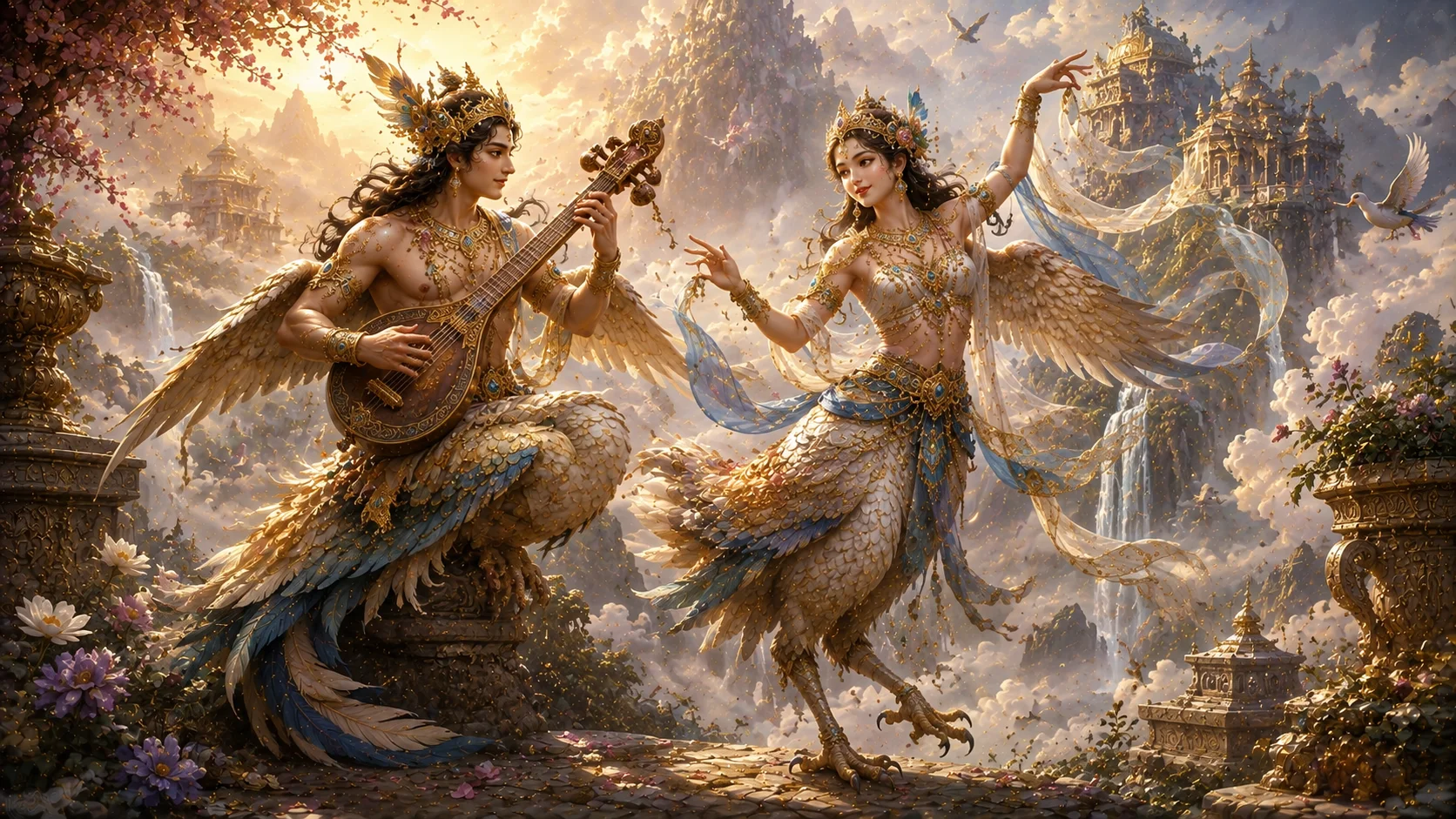
The Kinnara, and their female counterparts the Kinnaris, are a class of celestial beings in Hindu mythology, most commonly described as half-human, half-horse or as human-headed birds — the exact form shifting by text and by region. They are known above all as musicians, dancers and poets of the heavenly courts, and as the very pattern of devoted, faithful love between husband and wife. Neither fully divine nor fully earthly, the Kinnaras occupy a gentle middle order of creation: artists rather than warriors, courtiers rather than rulers, lovers rather than conquerors.
A Question in Their Own Name
The word Kinnara is itself said to carry a puzzle inside it — a form close to asking "is this a man?", a fitting name for a being whose body refuses to settle into one shape. Sanskrit sources are not uniform about what a Kinnara actually looks like. In some texts and in some regions, the Kinnara is horse-headed atop a human body; in others, the more familiar form prevails — a human head and torso set upon the body of a bird. Ancient Indian art bears this out directly: at sites such as Sanchi, Kinnaras appear rendered purely theriomorphically, as horses bearing human heads, with no bird element at all. The now-common image of a human-torsoed, bird-bodied Kinnara is therefore not the original or the only attested form, but a later or regionally variant development layered on top of an older, more purely equine conception.
Kin to the Kimpurushas
Complicating the picture further is the term Kimpurusha, a related class of being whose relationship to the Kinnaras is genuinely unsettled in the textual record rather than fixed by any single doctrine. Some Sanskrit sources treat Kimpurusha as simply another name for Kinnara, describing the same beings under two labels. Others hold the two apart as distinct, related classes. This is not a case of one tradition being correct and another mistaken — the ambiguity itself is part of how these beings were understood, their identity never quite pinned down, much like their composite bodies.
Children of the Sage Kashyapa
In the genealogies recorded across various Puranas, the Kinnaras are numbered among the offspring of the great sage Kashyapa, placing them formally within the vast family of semi-divine beings descended from him. This lineage sets the Kinnaras alongside the Gandharvas, the Yakshas, and the other classes of celestial and semi-celestial creatures that populate the Hindu cosmos — all drawing, in the Puranic imagination, from a common ancestral source, each class then diverging into its own nature, its own realm, and its own function in the heavens.
Court Musicians of Kubera's Paradise
The Mahabharata and various Puranas place the Kinnaras as denizens of Alaka, the paradise realm of Kubera, the god of wealth, and of the sacred heights of Mount Kailasa and the wider Himalayan region. There they serve as court musicians and attendants in Kubera's retinue, their music and dance filling his heavenly court much as it fills the mountain air around it. To dwell in Kubera's paradise is to dwell among treasure and splendor, and the Kinnaras' role there is not to guard the wealth or wield it, but to make the place beautiful with sound — singers and instrumentalists whose art is itself a kind of offering to the god they serve.
The Vina and the Voice
Music is the Kinnaras' defining excellence, the trait by which Hindu cosmology remembers them above all others. They are depicted playing the vina and singing in the courts of the gods, their artistry held up as a symbol of musical and artistic perfection itself. Where other celestial classes are known for beauty, for dance, for wealth, or for austerity, the Kinnaras are known for the sound they make — an art so refined that its very existence in the heavens is taken as proof of what music can be at its highest.
Companions of the Gandharvas
The Kinnaras are frequently paired, in narrative company and in conceptual kinship, with the Gandharvas — the other great class of celestial musicians in Hindu myth. The two are not the same order of being; they remain distinct classes with their own separate identities. But in the courts of the gods they appear together often enough that the pairing becomes almost a fixed image: Gandharvas and Kinnaras performing side by side, fellow artists sharing the same heavenly stage, two different lineages united by the same devotion to music.
Witnesses at the Edge of the Great Epics
In the Ramayana, the Kinnaras are named among the many classes of celestial and semi-divine beings who inhabit the sacred and paradisiacal regions of the world, and who come to pay homage to great figures such as Lord Rama. Across the epics and Puranas more broadly, this is the characteristic role of the Kinnaras — appearing as celestial witnesses and attendants at the edges of major cosmic and heroic events, present in the description of the scene rather than driving its action. They are background figures of paradise, not protagonists of their own myths; their significance lies less in what they individually do than in the beauty and reverence their presence signals wherever they gather.
A Devotion Held Up as the Model of Love
Beyond music, the Kinnaras and Kinnaris are traditionally regarded as the very image of the devoted, eternally loving couple. Sanskrit literature invokes them again and again as symbols and paragons of romantic devotion and conjugal love — a Kinnara and his Kinnari bound not by circumstance but by an affection considered complete and unbroken. To compare a human pair to the Kinnaras was to pay them the highest compliment love poetry had to offer: that their devotion approached something celestial, something that belonged, by rights, to the heavens rather than the earth.
A Named Division of the World Itself
The Kinnaras' place in Hindu cosmology is not confined to myth and court — it is written into the very geography of the Puranic universe. Among the nine mythical divisions, or varshas, of Jambudvipa, the great world-continent of Puranic cosmology, one is named Kimpurusha-varsha, after the Kinnara-Kimpurusha beings themselves. That an entire region of the cosmos should carry their name reflects how deeply their presence was woven into the traditional map of creation — not a passing detail of a single story, but a fixed coordinate in how the world itself was understood to be arranged.
Gentle Company in a Crowded Heaven
The heavens of Hindu myth are populous places, and the Kinnaras take their place there among Gandharvas, Yakshas, and the many other orders of celestial and semi-divine beings who fill the courts of the gods and the slopes of the sacred mountains. Among this crowd, the Kinnaras are remembered as musicians and as lovers above all — gentle, artistic, devoted, their contribution to the heavenly order measured in melody and in faithfulness rather than in feats of arms or displays of power.
A Motif That Traveled Far Beyond Its Origin
The Kinnara and Kinnari motif proved to be one of Hindu mythology's most far-traveling exports. In the centuries after its earliest appearances, the figure spread into Buddhist mythology and from there into the art and folklore of Southeast Asia — Thailand, Myanmar, Indonesia among them — where the Kinnari in particular grew into a major subject of dance and visual art in her own right. This later spread belongs to the history of the motif's reception across cultures and traditions, a testament to how far the image of the half-human musician-lover carried once it left the textual corpus in which it first took shape.
The Enduring Image
What survives most vividly of the Kinnaras, across the shifting details of horse-head or bird-body, Kinnara or Kimpurusha, is the double impression they were built to leave: sound and devotion. They are remembered as the musicians whose vina and voice graced Kubera's paradise and the courts of the gods, and as the lovers whose faithfulness to one another became a byword in Sanskrit poetry for what devoted love should look like. Half-glimpsed at the margins of the great epics, named in the very geography of the Puranic cosmos, and carried onward into the art of distant lands, the Kinnaras endure less as characters in any single story than as an idea the tradition kept returning to — that beauty, music, and faithful love belong together, and that somewhere in the heights above Kailasa, a Kinnara still plays for the one who loves him.
Sources & traditions
- EncyclopediaWikipedia — Kinnara
- TraditionHindu texts, oral tradition and village tellings (South Asia)
Myths change from area to area and from time to time. This chronicle follows the most widely told versions; tellings in other villages, regions and eras may differ.