Garuda is the divine bird-being of Hindu myth, part man and part eagle, born to free his mother from bondage and ending as the eternal mount of Vishnu himself. Half-brother to the sun god's charioteer and, through no fault but their shared father, kin to the very serpents he was fated to devour, Garuda's story is one of ransom, defiance, and a debt paid in nectar that was never meant to be drunk.
A Wager Over the Colour of a Horse
The tale that defines Garuda begins not with him but with his mother. Vinata and her co-wife Kadru, both married to the sage Kashyapa, made a wager over the colour of the divine horse Uchchaihshravas. Kadru won the bet by deception, and the terms of the wager bound Vinata to servitude — enslaved to Kadru, the mother of the Nagas, the serpent race. It is this single lost wager, recorded in the Adi Parva of the Mahabharata, that sets every later event of Garuda's life in motion. He was not born into conflict with the serpents by nature alone; he was born into it by his mother's debt.
Born of Kashyapa and Vinata
Garuda is the son of the sage Kashyapa and Vinata, which makes him half-brother, through their shared father, to Aruna — Vinata's elder son and the charioteer of the sun god Surya. Through Kashyapa's other wife Kadru, Garuda is bound by the same paternal line to the Nagas themselves, though that kinship is adversarial rather than fraternal in any warm sense. It is a lineage built on contradiction: one house, two mothers, and an enmity that would outlast every one of them. Garuda grew into a being of immense power and speed, and it was that power his mother's servitude would soon put to the test.
The Ransom the Serpents Demanded
To free Vinata from her bondage, Garuda undertook to bring the Nagas what they demanded as ransom: amrita, the nectar of immortality, held by the Devas. It was not a request he could simply make. The nectar was guarded, and the gods who guarded it had no reason to hand over the one substance that made them deathless. Garuda's quest for amrita is the central act of his myth — not a display of power for its own sake, but a son's answer to a mother's enslavement, undertaken because there was no other way to pay what Kadru's wager had claimed.
Past the Guardians of the Nectar
Garuda flew to where the amrita was kept and fought the Devas who stood between him and it, overcoming even Indra, the king of the gods, in the course of the struggle. This was no minor skirmish — it placed Garuda, newly grown, against the assembled defenders of heaven's most guarded treasure, and he prevailed. The confrontation did what confrontations with Garuda tended to do: it did not end in his defeat, and it did not end in simple triumph either. It ended in negotiation, because the gods he had just beaten recognised something in him worth keeping as an ally rather than an enemy.
A Boon From the God He Would Carry
In the course of fetching the amrita, Garuda also earned the favour of Vishnu. The preserver-god granted Garuda immortality and the position of his eternal mount — a boon that transformed Garuda from a formidable being who had bested Indra into the fixed, permanent companion of Vishnu himself. This is the moment the two halves of Garuda's identity converge: the son who fought to free his mother becomes, in the same episode, the vahana who will bear the preserver-god across the worlds for the rest of time. The nectar he carried for the Nagas' ransom was never his own reward. Vishnu's boon was.
The Enmity Sealed With Indra
Indra, for his part, secured something too: a promise from Garuda that serpents would remain his natural prey. This is the moment the Garuda-Naga enmity stopped being a private grievance over a wager and became something closer to cosmic order — an arrangement struck between Garuda and the king of the gods, in which the eagle's appetite for serpents was not merely tolerated but affirmed. Garuda went on to deliver the amrita as the ransom demanded, and through a trick, the Nagas never actually drank it; Vinata was freed regardless, her debt paid. What remained afterward was the enmity itself, now permanent, now blessed by Indra's own word.
Vainateya, Suparna, Khagaraja
Garuda carries a cluster of epithets that trace the shape of his myth in single words. Vainateya, "son of Vinata," keeps his mother's ordeal attached to his name even in triumph. Suparna, "the fair-feathered" or "well-winged one," speaks to the sheer physical splendour of his form. Tarkshya is a name associated with him in some texts. And Khagaraja or Pakshiraja, "king of birds," names the rank he holds among every winged creature in the tradition — not merely a great eagle, but the eagle above all others, the one whose wings define what the category means.
The Banner of Garudadhvaja
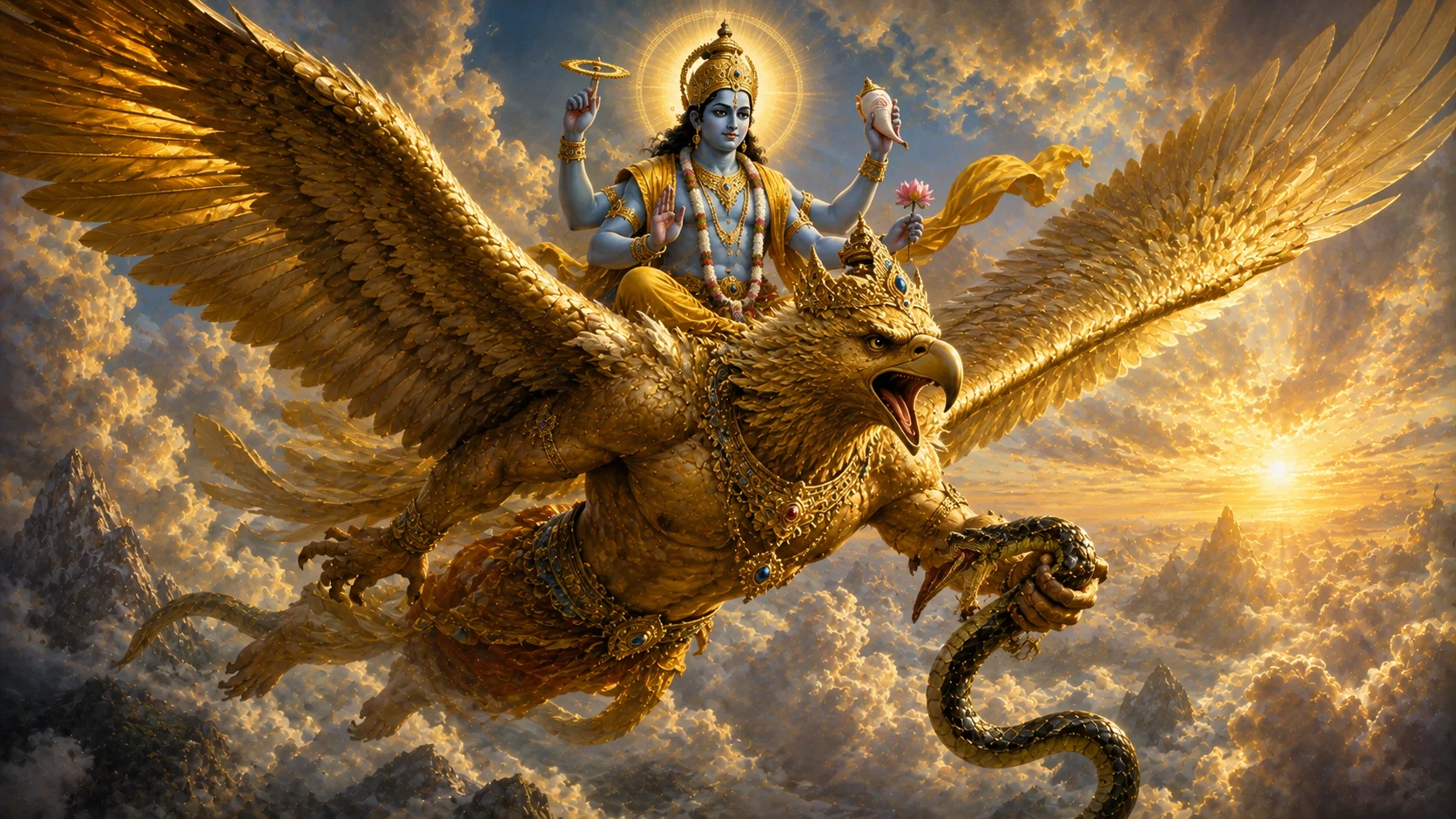
Vishnu is given the epithet Garudadhvaja — "one whose banner bears Garuda" — a title that fixes the eagle permanently into the god's own identity. Iconography follows the same pattern: Garuda is depicted carrying Vishnu, and often Lakshmi as well, borne through the heavens on the back of the being who once fought Indra to free his mother. The image is not incidental decoration. It is the visual shorthand for the entire relationship — devotion earned through struggle, then made eternal.
Devourer of the Serpent Race
Garuda's enmity with the Nagas recurs throughout Hindu myth as one of its most persistent motifs. He is traditionally depicted as a devourer of snakes, an image that carries meaning well past the literal: it stands for the conquest of poison and of evil forces more broadly. Garuda is honoured as a fierce protector deity, invoked in some traditions specifically for protection against snakebite and poison — the same enmity that began in a wager over a horse's colour becomes, generations of storytelling later, a shield offered to the ordinary person afraid of what moves in the grass.
The Naga-Pasha Undone at Lanka
Garuda appears again in the Ramayana, in a moment that shows the Naga enmity working in his favour rather than as his motive. When Rama and Lakshmana are bound by the Naga-pasha — a serpent-noose weapon used by Indrajit, son of Ravana — it is Garuda who rescues them. His mere presence is enough: the serpents forming the binding weapon flee at the sight of him, and the two brothers are freed without Garuda needing to fight the battle itself. It is a quieter appearance than the amrita quest, but it rests on the same fact established there — that no serpent, woven into a weapon or otherwise, wants to be anywhere near the being who was promised them as prey.
Stone Pillars Before the Preserver's House
Garuda is worshipped in his own right, not only as an attendant figure in Vishnu's iconography. Garuda pillars, or stambhas, are placed before Vishnu temples across the tradition — freestanding markers of the eagle's own standing, positioned at the threshold of the god he serves. The practice reflects something the myth itself makes clear: Garuda's devotion to Vishnu never diminished him into a mere accessory. He is honoured as a being worth a monument of his own, set at the very door of the temple he guards by association.
The Purana That Bears His Name
Garuda is listed among the Puranic categorisation of divine beings, and he lends his name to the Garuda Purana, one of the eighteen Mahapuranas. Notably, this text is not primarily concerned with Garuda's own exploits — it deals extensively with death, funeral rites, and the afterlife, a subject matter that sits somewhat apart from the amrita quest and the Naga enmity that define his narrative myth. That a text so focused on mortality and its rites should carry the name of a being granted immortality by Vishnu is one of the tradition's quieter ironies.
Neither Avatar Nor Ordinary Mount
In some Puranic cosmology, Garuda is considered closely tied to Vishnu's function as maintainer of cosmic order, an aspect of the preserver's ongoing work in the world. It is worth being precise here: Garuda is not counted among Vishnu's dashavatara, the ten principal avatars. Popular retelling sometimes loosely conflates the two — the eagle who bears the god mistaken for a form of the god — but the tradition keeps them distinct. Garuda's power, his boon of immortality, and his permanent post at Vishnu's side are all real; incarnation is not among them.
Wings Beyond the Hindu World
Garuda's reach extended past the tradition that produced him. Garuda and Garuda-type figures were adopted into Buddhist mythology, and the name and image became part of the national iconography of Indonesia and Thailand — Indonesia's national emblem, Garuda Pancasila, and Thailand's royal Garuda emblem both carry his figure forward into contexts well outside the Mahabharata and the Ramayana. This later cross-cultural and cross-religious reception is a separate strand from the core Hindu material — a testament to how far a single divine eagle, born of a mother's wager and a son's ransom, was carried once his myth left the ground it started on.
Sources & traditions
- EncyclopediaWikipedia — Garuda
- TraditionHindu texts, oral tradition and village tellings (South Asia)
Myths change from area to area and from time to time. This chronicle follows the most widely told versions; tellings in other villages, regions and eras may differ.