Vasuki is the great serpent-king of Hindu myth — Nagaraja, king of the Nagas, son of the sage Kashyapa and Kadru, the mother of serpents. He is the great Naga who coils as a living ornament around the throat of Shiva, and who lent his own vast body to the gods and demons as the rope with which they churned the primordial ocean. Counted among the foremost of all serpent-kings, Vasuki stands at the meeting point of two of Hindu myth's most consequential stories: the churning that won the Devas their immortality, and the near-annihilation of his own serpent race generations later, averted only by the courage of his sister's son.
Born of the Serpent-Mother
Vasuki's lineage places him at the very root of the Naga race. Puranic genealogy names him a son of the sage Kashyapa and Kadru, the primal mother of serpents, whose countless offspring populate the hidden realms beneath the earth. Among Kadru's brood, Vasuki rises to a station few of his kin achieve: he is not merely a Naga but a king among Nagas, ranked alongside Shesha (Ananta), who bears Vishnu, and Takshaka, as one of the three most exalted of the serpent lords. Where Shesha is honoured as foremost of all Nagas for his eternal service to Vishnu, Vasuki's greatness is measured differently — through his suffering, his endurance, and his willingness to be used as an instrument of cosmic necessity. His very name, carried across Puranic and epic literature alike, is inseparable from the title Nagaraja, king of serpents — an epithet that follows him through every telling of his story, whatever role that telling gives him.
The Rope Wound Around the Mountain
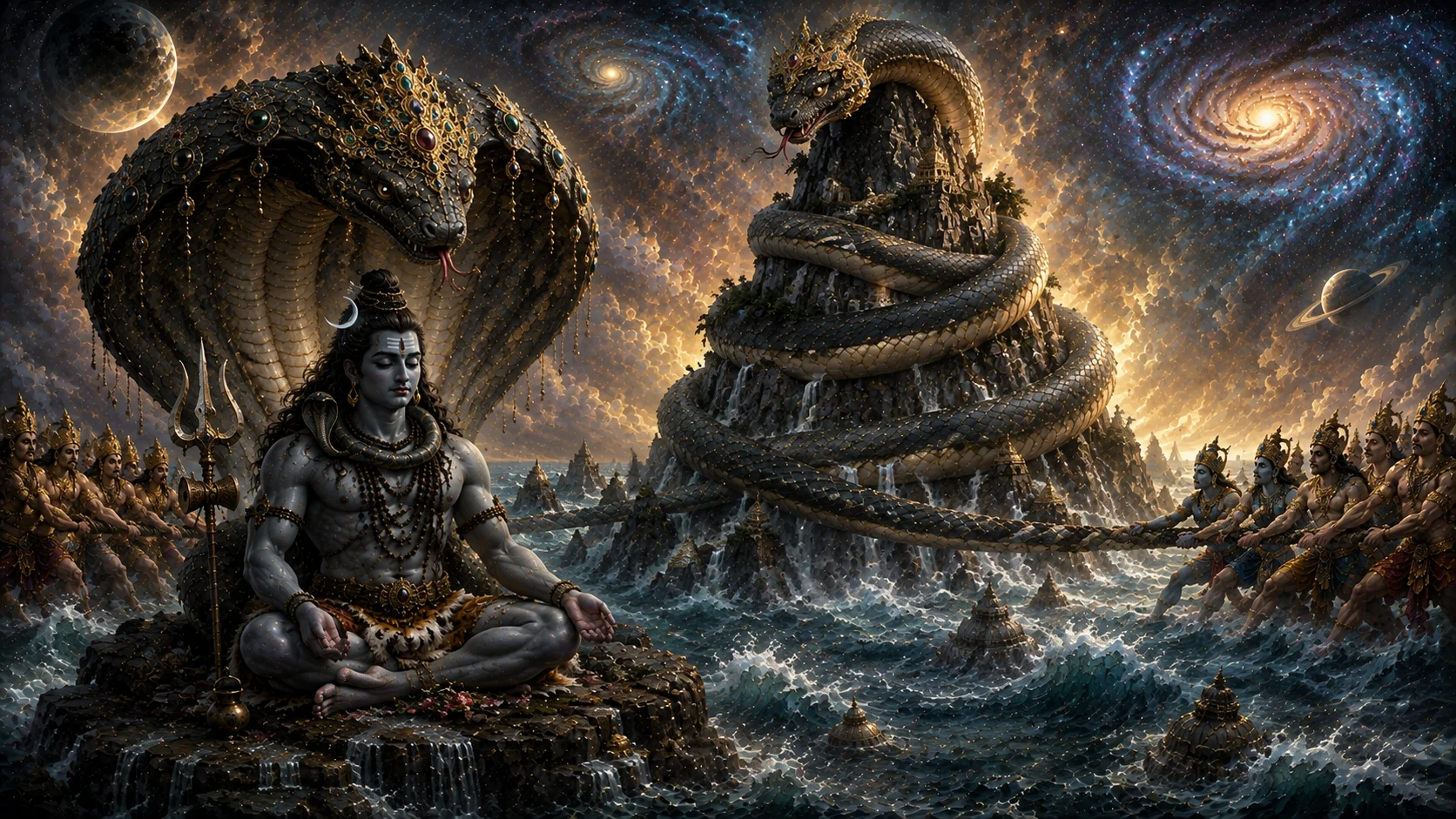
Vasuki's defining myth is the Samudra Manthana, the Churning of the Ocean of Milk. When the Devas and Asuras sought the treasures hidden in the cosmic ocean — chief among them the amrita, the nectar of immortality — they required a mountain to serve as the churning-rod and a rope massive enough to wind around it and spin it. Mount Mandara was set upright in the waters, and Vasuki's own body became that rope, coiled around the mountain's flanks from base to peak. The Devas took hold of his tail; the Asuras seized his head. Pulled alternately by each side, the mountain turned, and the ocean began to churn. In this single image — a king of serpents wound about a mountain and hauled between two armies of gods and demigods — the myth fixes Vasuki permanently as the being through whom the cosmos itself was set into motion.
What the Churning Cost Him
The labour was not gentle. As the mountain ground against his coils and the two great armies hauled him back and forth without pause, Vasuki suffered tremendously — the friction of stone against scale, the unrelenting strain of being pulled from both ends at once. It was in this agony that the churning produced its first and most terrible yield: from Vasuki's mouths came the halahala, a poison so virulent it threatened to unmake all of creation before the nectar could even be reached. The serpent who had offered his body to serve the gods now became, unwillingly, the vessel through which the world's ending nearly arrived. Nothing in the tradition suggests Vasuki chose this outcome or foresaw it; the poison was simply the price the churning exacted from the body doing the churning, and Vasuki bore that price first, before any god or demon did.
The Poison Shiva Chose to Keep
It was Shiva who met the halahala's threat, drinking the poison to spare the universe its ruin and holding it forever in his throat rather than letting it pass further — the act that earns him the epithet Nilakantha, the blue-throated one. That the poison born of Vasuki's ordeal should be swallowed by the very god who wears Vasuki as an ornament draws the two figures closer still: serpent and deity bound together first by suffering, then by adornment, two halves of a single sacred image. The sequence matters — the poison comes from the churning that used Vasuki's body, and only afterward does Shiva take Vasuki onto his own body as an ornament, so that the two moments, agony and honour, sit side by side in how the tradition remembers him.
The Ornament at Shiva's Throat
Beyond the churning, Vasuki is known above all as the serpent Shiva wears — coiled at the neck, twined through the matted hair, wound about the arms, appearing wherever Shiva's iconography is rendered. This is not a passing detail but one of the most continuously depicted elements of Shiva's image across temple sculpture and painting: the ascetic god, master of poison and death, adorned by the very serpent whose venom he once swallowed. For Vasuki, the role is one of high honour — to be chosen as Shiva's living ornament marks him as ennobled among his kind, a serpent-king whose devotion is expressed not in speech but in the intimacy of proximity to the god's own body. Wherever an image of Shiva is set — in matted hair, at the throat, coiled along an arm — the serpent shown there is understood by the tradition to be Vasuki, so that Shiva's iconography and Vasuki's presence have become, over centuries of depiction, nearly inseparable from one another.
A King Watching His Race Threatened
Generations after the churning, Vasuki's story resumes in the Mahabharata's Adi Parva, where the fate of the Nagas hangs in the balance a second time — not from poison, but from fire and royal vengeance. King Janamejaya, seeking to avenge his father Parikshit's death at the fangs of the serpent Takshaka, undertakes the Sarpa Satra, the great snake-sacrifice, a ritual designed to draw every serpent in creation into its flames and destroy the Naga race entire. As the sacrifice draws serpent after serpent to their end, Vasuki, as king of the Nagas, is the one who must reckon with the extinction bearing down on his people. Where the churning had asked Vasuki to give his body, the Sarpa Satra asks something harder still: a king's helplessness, watching a fire he cannot enter and cannot extinguish consume kin after kin.
The Nephew Sent to Save a Race
Vasuki's sister had been given in marriage to the sage Jaratkaru, and their son — Vasuki's own nephew — is Astika. Fearing the destruction of the Nagas as the sacrifice rages on, Vasuki turns to Astika and sends him to intervene. It is Astika who approaches King Janamejaya directly and, through his pleading, persuades the king to halt the Sarpa Satra before it can consume the Naga race entirely. Where Vasuki had once lent his body to serve the gods at the ocean's churning, here he lends his lineage — the son of his own sister becomes the instrument through which his people are spared, a second act of survival won not through Vasuki's own strength but through the kinsman he entrusted with it. The two rescues frame Vasuki's whole story: once he was the instrument that saved others' hopes of immortality, and once he was the king whose own race was saved only because he chose, at the crucial hour, the right person to send.
Ruler of the Serpent Depths
In certain Puranic accounts, Vasuki is named among those who hold rule over Patala, the netherworld realm associated with the Nagas — a distinction also attributed variously to other great serpents such as Shesha, reflecting the layered and sometimes overlapping sovereignty of the serpent-kings across different tellings. Whether or not a single account grants him sole dominion, Vasuki's stature as Nagaraja, king of serpents, is consistent across the tradition: a ruler among beings who are themselves ancient, numerous, and powerful. That the sources do not agree on a single, tidy hierarchy of who rules Patala is itself telling — it shows a tradition with more than one great Naga worth calling sovereign, and Vasuki's name recurs among them regardless of which account is followed.
Between Two Warring Sides
What distinguishes Vasuki most among Hindu myth's great serpents is his position not as combatant but as instrument — the churning-rope stretched between Devas and Asuras, belonging fully to neither side, straining under forces pulling in opposite directions. This posture of endurance between opposed powers gives Vasuki a symbolic weight beyond the mechanics of the myth itself: he embodies the cosmic tension that creation itself sometimes demands, a being who must be pulled apart from both ends before the world can receive its treasures. The nectar of immortality is won not by the gods' strength alone but by what Vasuki's body was made to bear. In this reading, Vasuki's role at the mountain is less a footnote to the Devas' and Asuras' contest than the very mechanism that made the contest possible at all.
A Presence Carved in Stone
Vasuki's image has endured most visibly not in scripture but in temple art, where sculptors and painters return again and again to the same coiling form at Shiva's neck, arms, and crown of hair. This continuous artistic reception has kept Vasuki present in devotional life long after any single telling of the churning or the snake-sacrifice might fade from memory — he is recognised on sight, a serpent shape instantly legible as belonging to Shiva's iconography. In regional and folk traditions of Naga-worship found in parts of India, Vasuki is venerated specifically among the pantheon of serpent deities, though the particulars of these local cults vary and are held less rigidly than the Puranic and epic material that anchors his more famous myths. Where the textual tradition gives Vasuki two great, widely separated episodes — the churning and the snake-sacrifice — it is this steady visual presence in stone and paint that has carried him into everyday devotional sight in the centuries between.
The Serpent Who Bore the Strain
Across every telling, Vasuki remains the great Naga defined by what he was made to endure — coiled around a mountain to win the gods their immortality, coiled around Shiva's throat as a mark of honour, and, in his final great act, watching over his people as extinction threatened and entrusting their survival to a nephew who could do what a king himself could not. He is Nagaraja: not the mightiest by conquest, but the serpent-king whose body and lineage alike were called upon at the moments creation itself hung in the balance, and who answered both times.
Sources & traditions
- EncyclopediaWikipedia — Vasuki
- TraditionHindu texts, oral tradition and village tellings (South Asia)
Myths change from area to area and from time to time. This chronicle follows the most widely told versions; tellings in other villages, regions and eras may differ.