The Naga are the serpent-born kindred of Hindu myth — beings of Patala's jewelled deep who wear the human form and the coiled, hooded form as two faces of the same nature. Sprung from a single divine union and scattered through the epics as kings, brides, victims and guardians, they hold rivers and rain, treasure and the underworld itself, and they have never fully let go of either the water they rule or the grudge that follows them from birth.
Children of Kashyapa's Two Wives
The Nagas descend from the sage Kashyapa, whose wife Kadru bore him the serpent race entire. Kashyapa's other wife, Vinata, bore Garuda, the great eagle — so Naga and Garuda are kin through their father, siblings by descent who became each other's ancient enemies. Hindu myth rarely bothers to soften this: the enmity is written into the family tree itself, a hatred that does not need a separate origin story because the kinship already explains it. Garuda's hunger for serpents and the Nagas' terror of the sky are not a grafted-on conflict but the shape blood took when two mothers bore two incompatible children to the same father.
Shesha, Who Holds the Worlds on His Hoods
Above every ordinary Naga coils Shesha, also called Ananta — "the endless." Shesha is the great serpent upon whom Vishnu reclines in the cosmic ocean between one creation and the next, the god's resting-couch through the long night when nothing else exists. More than a couch, Shesha is a foundation: tradition holds that he bears the weight of the worlds upon his hoods, an image of a burden so vast it can only be carried by something without end. Where lesser Nagas are bound to a river or a village well, Shesha is bound to the structure of the cosmos itself, coiled beneath reality the way the ordinary Naga is coiled beneath a tank of water.
Vasuki, the Rope That Churned an Ocean
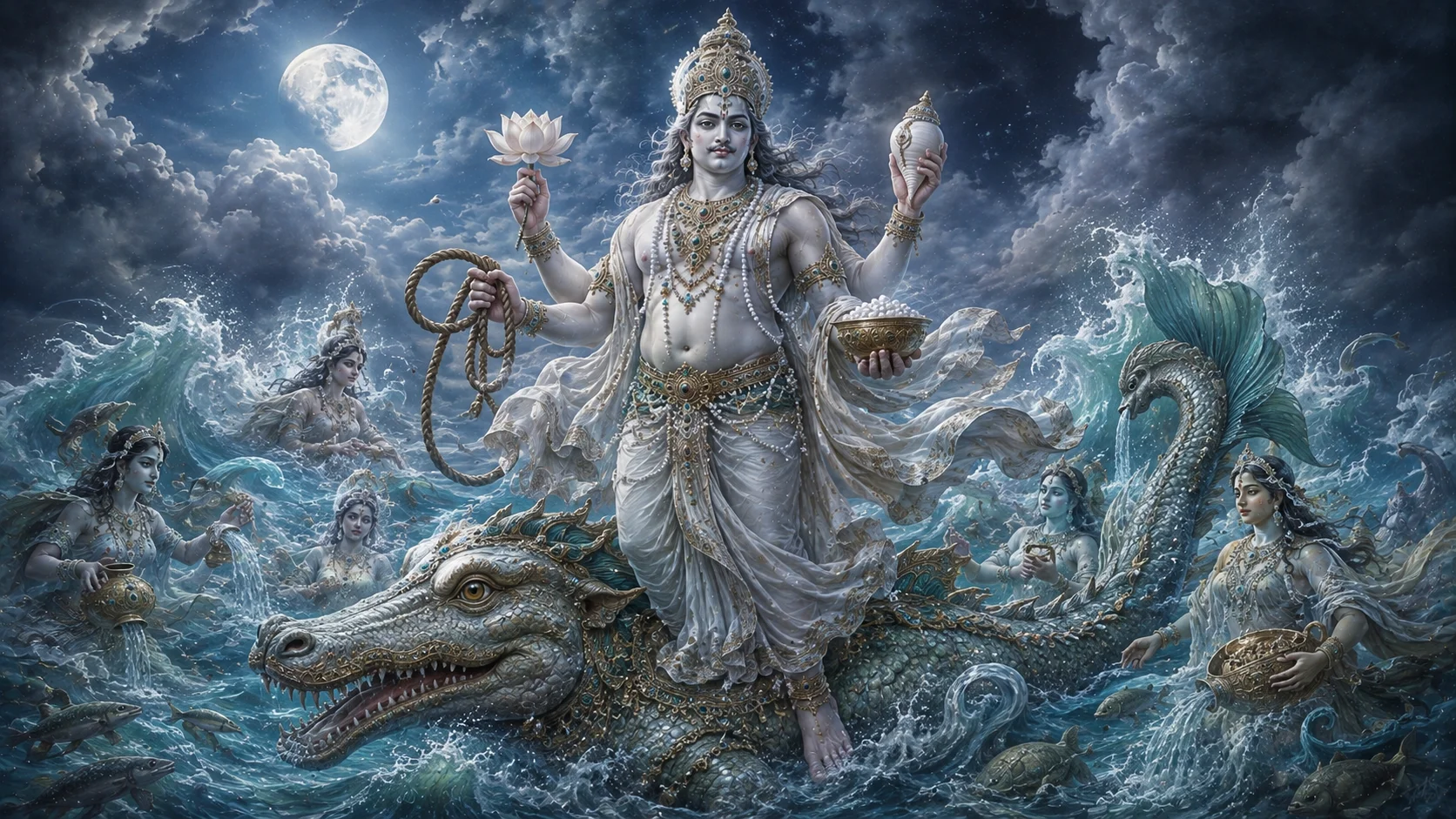
Vasuki, king of the Nagas, earns his place in myth not by size or splendor alone but by service. When gods and demons together sought the nectar of immortality, they needed a rope strong enough to turn Mount Mandara as a churning-stick in the Ocean of Milk, and Vasuki was that rope — his own body wound around the mountain and hauled by both sides in the Samudra Manthan. It is a striking image of a king's body made instrument: the serpent lord's coils becoming the mechanism by which the universe's treasures, and its poison, were drawn up from the deep. Vasuki's association with Shiva, who wears him and other serpents as ornaments about his neck and arms, marks him further as a being whose danger has been tamed into adornment — Shiva's mastery over the primal and the venomous displayed openly on his own body.
Takshaka and the Death of a King
Takshaka, a Naga king of the Mahabharata, carries a darker thread through the epic. It is Takshaka's bite that kills King Parikshit, grandson of Arjuna — a death by snakebite that is not accident but design in the story's telling. Parikshit's son Janamejaya answers his father's death with the Sarpa Satra, a snake sacrifice meant to burn the entire Naga race out of existence, summoning them by name into the sacrificial fire one after another. The rite very nearly succeeds; it is halted only through the intervention of Astika, whose plea stops the sacrifice before it can finish what it began. Takshaka survives — the very serpent whose venom started the catastrophe outlives the attempt to annihilate his kind because of it.
The Forest That Burned Around Them
Nagas suffer again in the Khandava forest fire, when Krishna and Arjuna aid the fire-god Agni in consuming the forest whole. Many Nagas die in those flames. Takshaka survives this conflagration too, absent from the forest when it burns, and his son Ashvasena escapes the fire as well — a narrow, almost incidental survival amid a slaughter that the epic does not dwell on tenderly. Between the Sarpa Satra and the Khandava fire, the Mahabharata gives the Nagas two brushes with near-extinction, and Takshaka's line threading through both as the one that endures.
Ulupi, the Bride from Beneath the World
Not every meeting between Naga and human ends in fire or venom. Ulupi, a Naga princess, becomes one of Arjuna's wives — a marriage the epic records without apology, one thread among the several that bind the Naga realm to the world of men above it. Such unions mark the Nagas as a people who can be kin by marriage as easily as they can be victims of sacrifice or partners in cosmic labor; the same race that Janamejaya tried to erase also gave a princess to one of the Pandavas' own beds. It is a reminder that Patala is not only a threat sealed away below the earth but a court that exchanges daughters and sons with the world above it.
The Kingdom Beneath the Waters
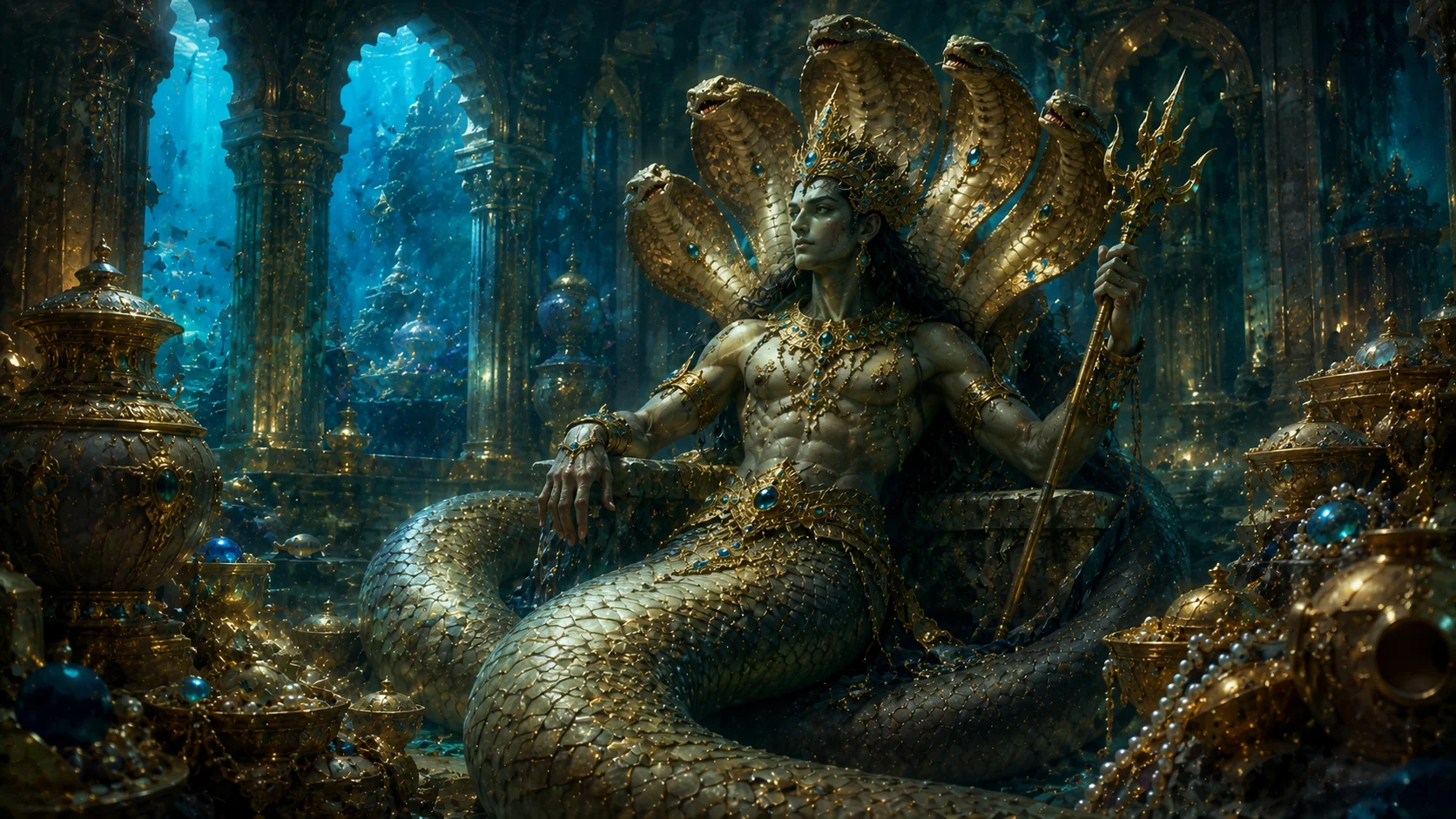
Patala is the Nagas' home ground — a netherworld realm beneath the earth, filled with treasures, jewels, and palaces of a splendor the surface world can only imagine. It is not a place of punishment but of sovereignty: the Nagas rule there as kings rule anywhere, with courts and riches and a society entire, simply built underground and under water rather than in the open air. Every story of a Naga rising to the surface — to marry, to be summoned to sacrifice, to be pulled from the sea by the churning-rope — is a story of that kingdom's border being crossed, briefly, before the serpent-folk return to their own jeweled dark.
Wells, Rivers, and the Rains They Command
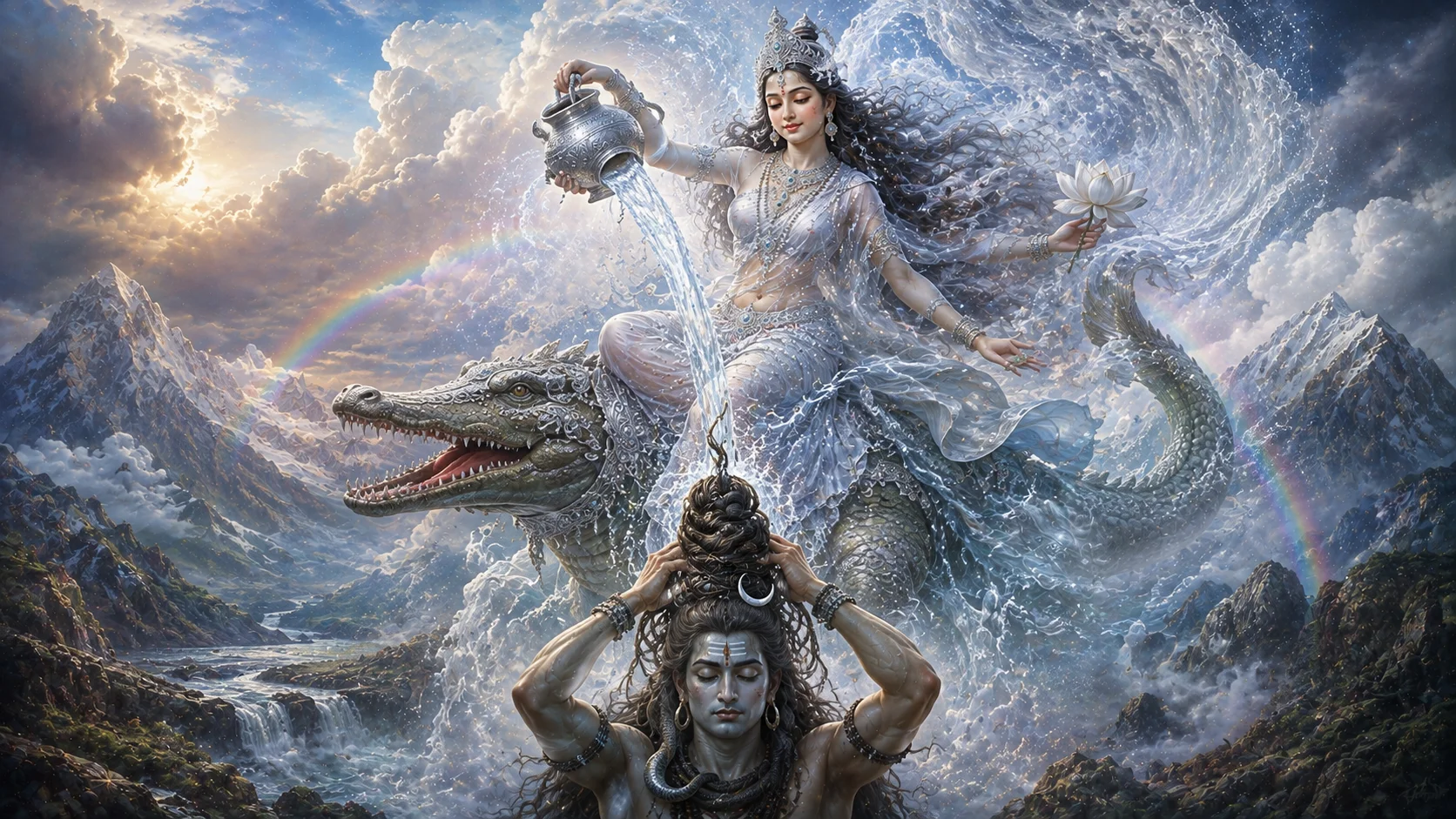
Above the mythic register of kings and epics, the Nagas are worked into the daily religious life of India through their bond with water. Rivers, lakes, wells, and the ocean itself all fall under their guardianship, and Hindu folk religion propitiates them for rainfall, for fertility, and for protection — needs as old and as practical as any village has. Nag Panchami, the festival most associated with this worship, is when snakes and Naga deities receive their due honor, a yearly reckoning between human communities and the serpent-powers understood to control whether the water comes when it is needed.
The Shrines of the South
This folk devotion is not spread evenly across the subcontinent but concentrates with particular intensity in certain regions, especially in parts of South India such as Karnataka, where nagakals — carved naga stones — mark shrines dedicated to these serpent guardians. The custom is regionally variable rather than a single uniform pan-Hindu practice, which is itself telling: the Nagas are venerated not as a distant abstraction handed down from the epics alone but as living local protectors, worshipped with an intensity that shifts from one landscape to the next depending on how closely a community's fortunes are tied to its water.
Two Bodies, One Nature
Physically the Nagas are described as either fully serpentine — great cobras, coiled and hooded — or as beings with a human upper body set upon a serpent's lower half, and they are capable of shifting to a fully human form when they choose. This is not shapeshifting as disguise so much as a natural range: the same being that appears as a many-hooded cobra guarding a well may walk among humans indistinguishable from any other person, and then return to the water as a serpent once more. It is this fluidity between forms that lets a Naga princess marry a Pandava hero, that lets Vasuki wind bodily around a mountain, that lets Shesha be at once an animal shape and a foundation beneath the universe.
Beyond the Hindu World
The Naga did not stay confined to the tradition that first shaped them. Buddhist and Jain mythology absorbed the concept with equal seriousness — the Naga king Mucalinda, in Buddhist legend, shelters the Lord Buddha, extending the serpent's old role as guardian into an entirely different religious frame. From there the image spread further still, into the art and architecture of Southeast Asia, where Naga motifs recur across Cambodia, Thailand, and beyond. This is reception distinct from the core Hindu material — a separate current running outward from the same source, carrying the serpent-guardian's shape into temples and tellings far from where Kashyapa's children were first born of Kadru.
What Endures Beneath
Across epic and shrine alike, the Nagas hold a consistent place: neither wholly divine nor wholly beast, neither simply friend nor simply foe of the gods and heroes above them. They churn oceans and kill kings, marry princes and burn in forests set alight by those same princes' allies, guard village wells and hold up the resting god of the universe on their hoods. What remains constant is the water and the depth — Patala below the earth, the river below the village, the coil beneath Vishnu's ocean of milk — and the sense that whatever power moves through those depths answers, ultimately, to the serpent-born.
Sources & traditions
- EncyclopediaWikipedia — Nāga
- TraditionHindu texts, oral tradition and village tellings (South Asia)
Myths change from area to area and from time to time. This chronicle follows the most widely told versions; tellings in other villages, regions and eras may differ.