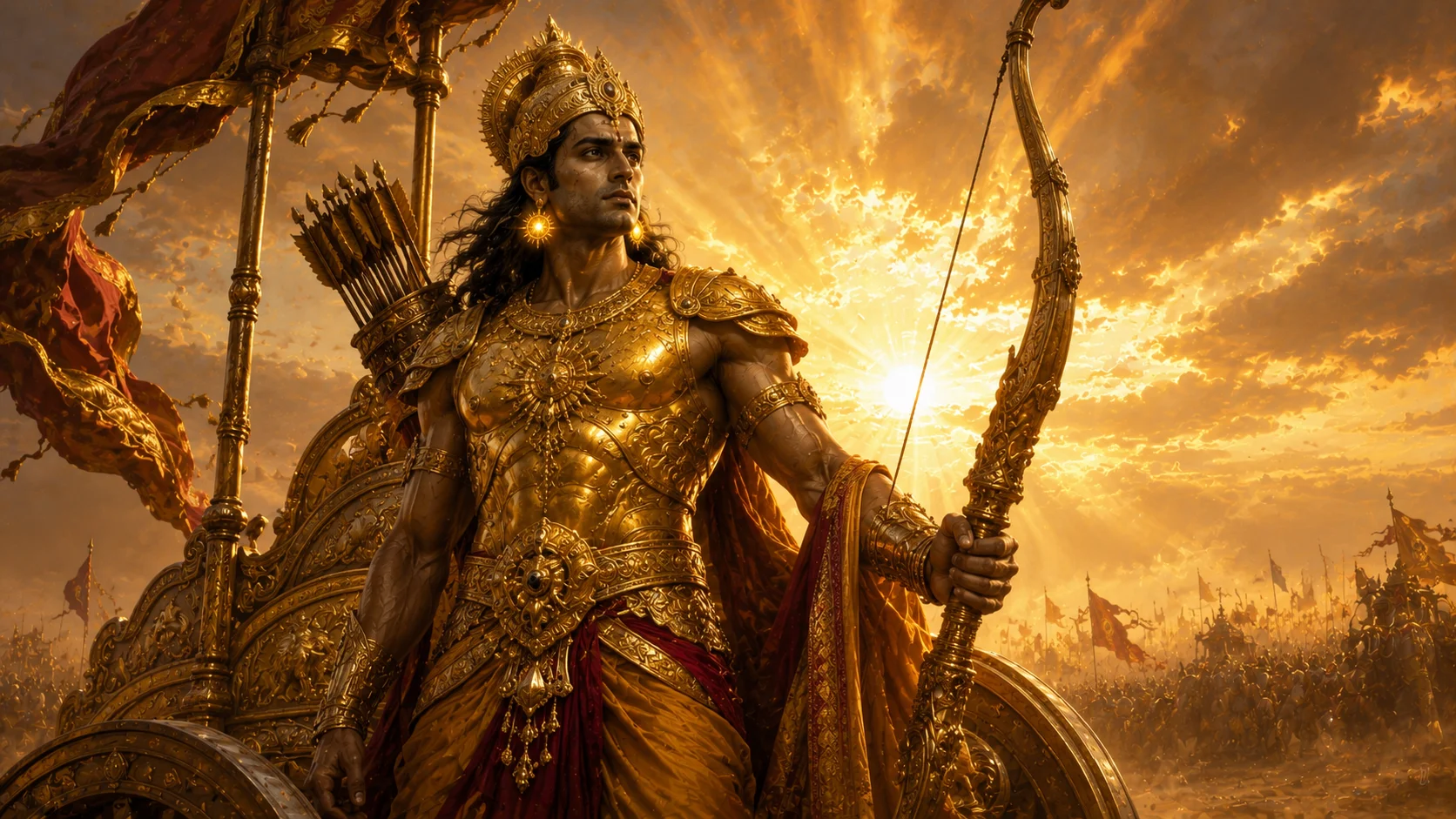
Karna — Karṇa — is the tragic hero of the Mahabharata: the secret eldest brother of the Pandavas, born of the sun-god Surya and abandoned at birth, who grew up scorned for low birth and became the loyal champion of the Pandavas' enemy Duryodhana. Generous beyond measure, peerless in arms, and dogged by curses and ill-fortune at every turn, Karna is perhaps the most beloved character in the epic precisely because he is its greatest victim — a noble soul condemned by the circumstances of his birth.
A Mantra Spoken Before Its Time
Long before her marriage into the royal house, the princess Kunti had been given a mantra by the sage Durvasa, a boon-invocation with the power to summon any god and receive a child by him. In the heedlessness of youth she tested it, calling upon Surya himself. The sun-god could not refuse the invocation once made, and Kunti found herself the mother of a son she had never intended to bear — a son born already wearing golden armour, kavacha, and earrings, kundala, grown into his very flesh, gifts of his divine father that made him nearly impossible to kill.
Set Adrift Upon the River
Unwed and terrified of the shame such a birth would bring, Kunti could not keep the child. She set the infant afloat on the river in a woven basket and let the current carry him away from her. He was found downstream by a charioteer, Adhiratha, and his wife Radha, who raised him as their own. From them he took the names that would follow him his whole life — Radheya, son of Radha, and Sutaputra, the charioteer's son — names spoken with tenderness by those who loved him and as insults by those who did not, for a suta stood far below a kshatriya in the reckoning of birth that governed the epic's world.
Barred at the Threshold of Kings
Karna grew into a warrior of extraordinary gift, but gift alone could not open doors closed by lineage. When the assembled princes gathered to test their skill, and later when he sought to compete for the hand of Draupadi at her swayamvara, he was turned away — Draupadi's brother and the assembly's guardians of custom declared a charioteer's son unfit to contend among kings, no matter how true his aim. The humiliation cut deep and lasted. It was Duryodhana who broke the impasse, crowning Karna King of Anga on the spot so that no rule of birth could exclude him from the contests of princes. That single act of recognition, offered when every other hand was closed to him, became the foundation of the fiercest loyalty in the entire epic.
A Debt Repaid in Full
From that coronation onward, Karna belonged to Duryodhana in a way that outlasted every later revelation and every offer the world could set against it. He fought at his friend's side and shared his fortunes and his enmities, becoming the Kaurava cause's staunchest pillar precisely because Duryodhana had given him something no one else offered — standing, without condition. That the friendship placed him against his own unknown brothers, again and again, never loosened his grip on it, even after he came to know the truth of his birth.
The Deception That Bought Him Skill
Karna sought instruction from the warrior-sage Parashurama, who taught only brahmins and had renounced the warrior class entirely. Karna concealed his true birth and presented himself as a brahmin, and under that false name he mastered weapons few men ever touched. The deception could not last. When Parashurama at last discovered who his pupil truly was, he did not merely dismiss him — he cursed him: that at the moment of his direst need, facing his greatest foe, Karna would forget the mantra needed to wield his most powerful weapon. The curse lay dormant for years, waiting for the one battle where its cruelty would matter most.
The Second Curse, the Sunken Wheel
A separate misfortune sealed his fate twice over. In an accident, Karna killed a brahmin's cow, and the grieving brahmin laid upon him a second curse: that when he stood at his most vulnerable, his chariot wheel would sink into the earth and refuse to move. Two curses, earned in two entirely unrelated moments of his youth, would arrive together on a single afternoon at Kurukshetra, each fulfilling itself at exactly the instant the other did.
The Beggar Who Was a God
Karna's generosity was not a passing virtue but a vow he never broke — he was called Daanveer, hero of giving, because no supplicant who came to him in need was ever refused. Indra, Arjuna's divine father, understood this and used it. Disguised as a brahmin beggar, he approached Karna and asked for the one thing that made him nearly unkillable: his natural armour and earrings. True to his renowned generosity, Karna cut the fused kavacha and kundala from his own body rather than turn away a request. In exchange, Indra granted him the Shakti, an infallible spear that could be used only once. For this act Karna earned the epithet Vikartana, "the one who cut himself," and a reputation for charity that has outlived every king in the story.
A Mother's Late Confession
On the eve of the war, Kunti came to Karna at last and told him the truth she had hidden for a lifetime: that he was her firstborn, the eldest of the Pandavas, born before Yudhishthira and Bhima and Arjuna and the twins. She asked him to leave Duryodhana and take his rightful place among his brothers. Karna refused — the man who had crowned him when the world would not was not a debt he would abandon now, whatever blood said otherwise. But he made her one promise in return: he would not kill any of her sons except Arjuna. Whichever of them died in the duel to come, she would still have five sons living when the war ended.
Third in Command of a Falling Cause
As the war ground on and the Kaurava army lost its generals one by one — first Bhishma, then Drona — Karna rose to command it as its third generalissimo. He met the Pandava champions in the war's fiercest duels, clashing with the mighty Bhima and others, holding the field for Duryodhana's side even as its fortunes visibly turned, until the day arrived when only Arjuna stood before him.
The Wheel, the Forgotten Word, the Arrow
In that final duel, both curses came due at once. Karna's chariot wheel sank into the churned earth of the battlefield exactly as the brahmin had foretold, and in the same desperate moment the mantra for his greatest weapon slipped from his memory exactly as Parashurama had sworn it would. He stepped down from his chariot, struggling to free the wheel from the ground. Krishna, seeing the one opening that would ever come, urged Arjuna to loose his arrow without waiting for Karna to stand ready again. Arjuna did. Karna fell there, beside his stuck wheel, and the ethics of that killing — a warrior struck down while disarmed and vulnerable — have been argued and mourned for as long as the story has been told.
What the Pandavas Learned Too Late
Only after the battle did Kunti tell her surviving sons the truth she had carried since before any of them were born: that the enemy general they had spent the war fighting, and whom Arjuna had just killed, was their own eldest brother. The grief struck hardest at Yudhishthira, the eldest of the sons who had known each other as brothers, who now understood that he had urged an army against his own blood without ever knowing it, and that the family's own silence — Kunti's decades-old secret — had made the tragedy possible from the very beginning.
The Shape of a Life Judged by Birth
Karna's story is remembered less for its battles than for the injustice that framed them — a man of divine parentage and unmatched skill, denied every honor his gifts should have earned him, who found loyalty in the one place the world had not yet turned its back on him, and who kept that loyalty even after learning it had cost him everything else. He gave away his own invulnerability rather than break a vow to a stranger, fought under the weight of curses he could not undo, and died still bound by a promise made to the mother who had once set him adrift on a river and never told him who he was until it was almost too late to matter.
Sources & traditions
- EncyclopediaWikipedia — Karna
- TraditionHindu texts, oral tradition and village tellings (South Asia)
Myths change from area to area and from time to time. This chronicle follows the most widely told versions; tellings in other villages, regions and eras may differ.