Arjuna — Arjuna, "the bright one" — is the supreme archer-hero of the Mahabharata, the third of the five Pandava brothers, and the warrior to whom Krishna sang the Bhagavad Gita on the field of Kurukshetra. Son of the god Indra, friend and disciple of God himself, he is the very ideal of the Hindu hero: peerless in arms, noble in spirit, yet plunged into the deepest moral crisis of the entire tradition.
Son of Indra, Pupil of Drona
Arjuna was born to Kunti by the boon-mantra that summoned Indra, king of the gods, to father him — making him a demigod of war and giving him the patronymic Indraputra, "son of Indra." It is Arjuna's descent from Indra specifically that the tradition credits for his singular gift with the bow: prowess in archery, in this telling, runs in the blood as much as it is trained into the hand.
Under the guru Drona he trained alongside the Kaurava princes, his own cousins and future enemies, in the same forest school and under the same discipline. Of all Drona's students, prince and commoner alike, Arjuna became the greatest archer of his generation — the favourite pupil whose dedication won him his guru's special favour and, formally, the title of Drona's most accomplished student, a rank the epic treats as settled and uncontested among everyone who trained beside him.
He won Draupadi at her swayamvara, her bride-choice assembly, by stringing an impossibly stiff bow that other suitors could not even lift, and striking a revolving fish-target's reflection, or by other tellings its eye, with a single arrow shot without looking directly at the target itself. It was a contest built to be unwinnable by ordinary skill, and Arjuna's success there, before an assembly of kings, marked him publicly as the finest archer of his age — a feat that, by the epic's resolution, made him Draupadi's joint husband along with his four brothers.
The Names He Earned
Few heroes of the tradition carry as many epithets, and each records a deed rather than a flattery. He is Dhananjaya, "winner of wealth," from tribute won in conquest; Partha, son of Pritha, another name for Kunti; Kiritin, "the crowned one," for a diadem given him by Indra; Savyasachin, "the ambidextrous archer," for his ability to draw the bow with either hand; and Gudakesha, "conqueror of sleep," for a mastery of will that let him overcome drowsiness itself. Together the names sketch a figure defined less by lineage than by discipline — a warrior who earned his own titles one at a time.
Fire from Shiva's Hand
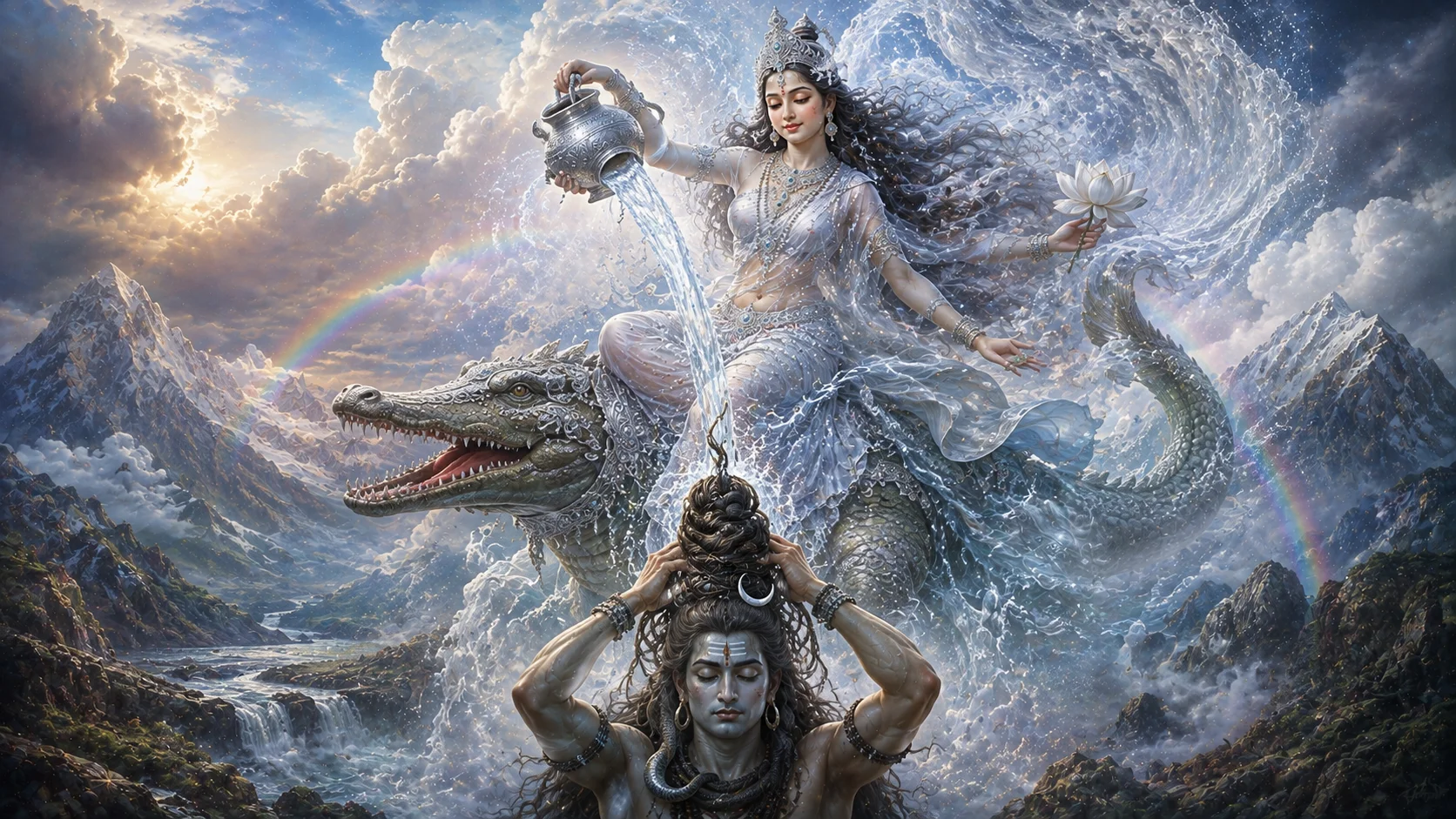
Arjuna's armoury of divine weapons, or astras, was won through austerity rather than inheritance. Seeking power for the war he could already see coming, he undertook fierce penance alone in the mountains until Shiva himself appeared, disguised as a hunter of the Kirata people, to test the sincerity of that penance. Hunter and prince came to blows, weapon against weapon, until Shiva — satisfied by the ferocity and discipline Arjuna showed even against an opponent he did not recognise as divine — revealed his true form and granted Arjuna the terrible Pashupatastra, a weapon the tradition holds capable of annihilating all of creation, not merely an army.
Later, during a sojourn in Amaravati, Indra's own heaven, Arjuna gathered further celestial arms directly from the gods who dwelt there, taught their use by the very beings who wielded them. He returned to the mortal world armed as no other warrior of his age, carrying weapons no human hand had held before him and few would hold again — an arsenal assembled specifically, and only, for the war he already knew he would eventually have to fight.
The Bow Slips from His Hand
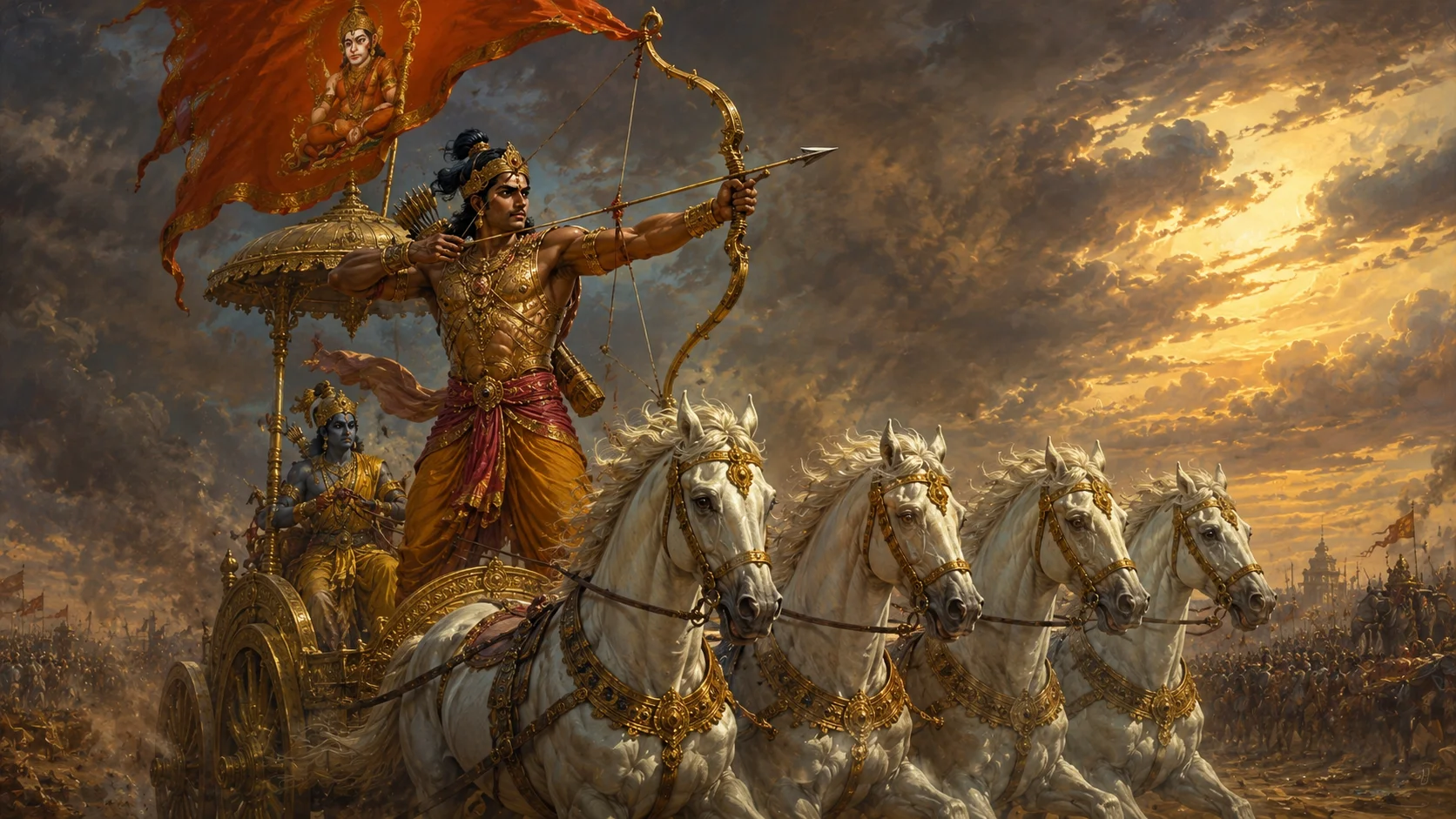
Arjuna's defining moment is not a feat of arms but a collapse of will. As the two armies face each other at Kurukshetra, he looks across the field and sees his kinsmen, teachers, and friends arrayed to be killed — and his bow slips from his grip. He would rather die than slaughter his own family for a kingdom, whatever wrong they had done him. It is to this despairing hero, not to a confident one, that his charioteer Krishna delivers the Bhagavad Gita, the song of God: a discourse on duty, or dharma, on the deathless nature of the soul that survives the body's death, and on selfless devotion as a path through action rather than away from it — spoken to steady a man who has, in that instant, lost the will to be a warrior at all.
Krishna serves as his charioteer throughout the war that follows, a role he takes on specifically for Arjuna rather than as combatant himself, and the counsel given on that first morning underwrites everything Arjuna does afterward. Steadied by it, he takes up Gandiva and fights — not because the doubt was answered away, the tradition suggests, but because he was given a way to carry it and act regardless.
A Kingdom Won in Disguise
During the Pandavas' year of concealment, the Agyatavasa imposed as a condition of their exile, Arjuna lived at the court of King Virata not as a warrior but as Brihannala, a eunuch teacher of dance and music to the palace women. The disguise traced back to a curse laid on him by the celestial nymph Urvashi, whose advances he had once declined — a striking interval in which the era's supreme archer set down bow and manhood alike and passed an entire year unrecognised among singers and dancers, before the year's end let him take up arms again.
Wives Beyond the Swayamvara
Draupadi was not Arjuna's only wife. He married Subhadra, sister of Krishna, and with her fathered Abhimanyu, the son who would become the great tragedy of his later life. In the course of his travels he also wed Ulupi, a princess of the serpent-people, the Nagas, and Chitrangada, a princess of the kingdom of Manipur — unions that, across the epic's geography, tied the Pandava house to peoples both human and otherworldly.
The Vow Before Sunset
The war's cruellest hour for Arjuna was not his own wounding but his son's death. Abhimanyu, still young, was trapped alone inside the Chakravyuha, a spiral military formation he knew how to enter but not to escape, and was killed there while reinforcements were held back by the warrior Jayadratha. Arjuna's grief turned to a vow sworn before the army: he would kill Jayadratha before the following sunset, or walk into fire himself. With Krishna's aid — an engineered darkening of the sky that drew Jayadratha out from cover in the belief the day had ended — Arjuna fulfilled the oath in the day's last light.
Brother Against Brother
Near the war's end Arjuna faced Karna in the conflict's climactic single combat, neither man aware, in the heat of that duel, that they shared a mother and were, in truth, brothers. The two greatest archers of the age met chariot to chariot, and Arjuna killed him — a victory the epic frames as triumph and tragedy in the same breath, won against a rival whose full kinship to the victor would only be understood afterward.
Nara and Narayana
What sets Arjuna apart from every other hero of the epic is the intimacy of his bond with the divine. He is friend, brother-in-law through Subhadra, and — throughout the eighteen days of war — the man for whom Krishna consented to serve as charioteer rather than combatant. Their companionship, sakha-bhava, sits at the centre of the epic's devotional current: Arjuna as the listener to whom the Gita is addressed, and so every reader of that scripture stands, in a sense, beside him in the chariot, receiving the same counsel meant for one doubting man on one battlefield.
The Last Road to the Mountain
In the epic's closing journey, the Mahaprasthanika Parva, the Pandavas and Draupadi walk together toward the Himalayas, renouncing the kingdom they had won. One by one they fall along the path, and Arjuna is the third to go down. His elder brother Yudhishthira, walking on ahead and unmoved by each fall, attributes Arjuna's collapse to an old boast — a claim, made in life, that he alone could defeat all his enemies in a single day — pride weighed now against the discipline that had carried him through every earlier trial.
The Doubt Every Reader Inherits
Brave, doubting, devoted, and beloved of the divine, Arjuna endures in the tradition less as a distant demigod than as a recognisable figure caught between duty and grief. He is remembered for his unmatched bow, for the weapons won through austerity and combat, for a war fought at terrible personal cost — and above all for the single dawn on which he set down his weapon rather than fight, and had to be persuaded to take it up again. That hesitation, and the answer given to it, is the part of his story the tradition returns to most.
Sources & traditions
- EncyclopediaWikipedia — Arjuna
- TraditionHindu texts, oral tradition and village tellings (South Asia)
Myths change from area to area and from time to time. This chronicle follows the most widely told versions; tellings in other villages, regions and eras may differ.