Shesha is the cosmic serpent of Hindu myth — the great thousand-headed king of the Nagas (serpents) named “the endless” (Ananta), upon whose vast coils the god Vishnu reclines in cosmic sleep between the ages, and who supports the entire universe upon his hoods. The endless serpent, Shesha is the cosmic snake of infinity who upholds the universe and bears the reclining Vishnu.
The Endless Serpent
Shesha (Sanskrit Śeṣa, “the remainder” — that which remains when all else is dissolved; also called Ananta, “the endless, the infinite”) is the great cosmic serpent and the king of the Nagas (the divine serpents). He is a colossal, primordial serpent of immense, infinite length, with a thousand (or countless) hoods/heads, dwelling in the cosmic ocean and the depths. His name and nature express infinity and endurance: he is “the endless” (Ananta), the infinite serpent, and “the remainder” (Shesha), that which remains when the universe is dissolved at the end of an age, persisting through the dissolution into the next cycle of creation. He is one of the great primordial beings of the cosmos.
The Couch of Vishnu
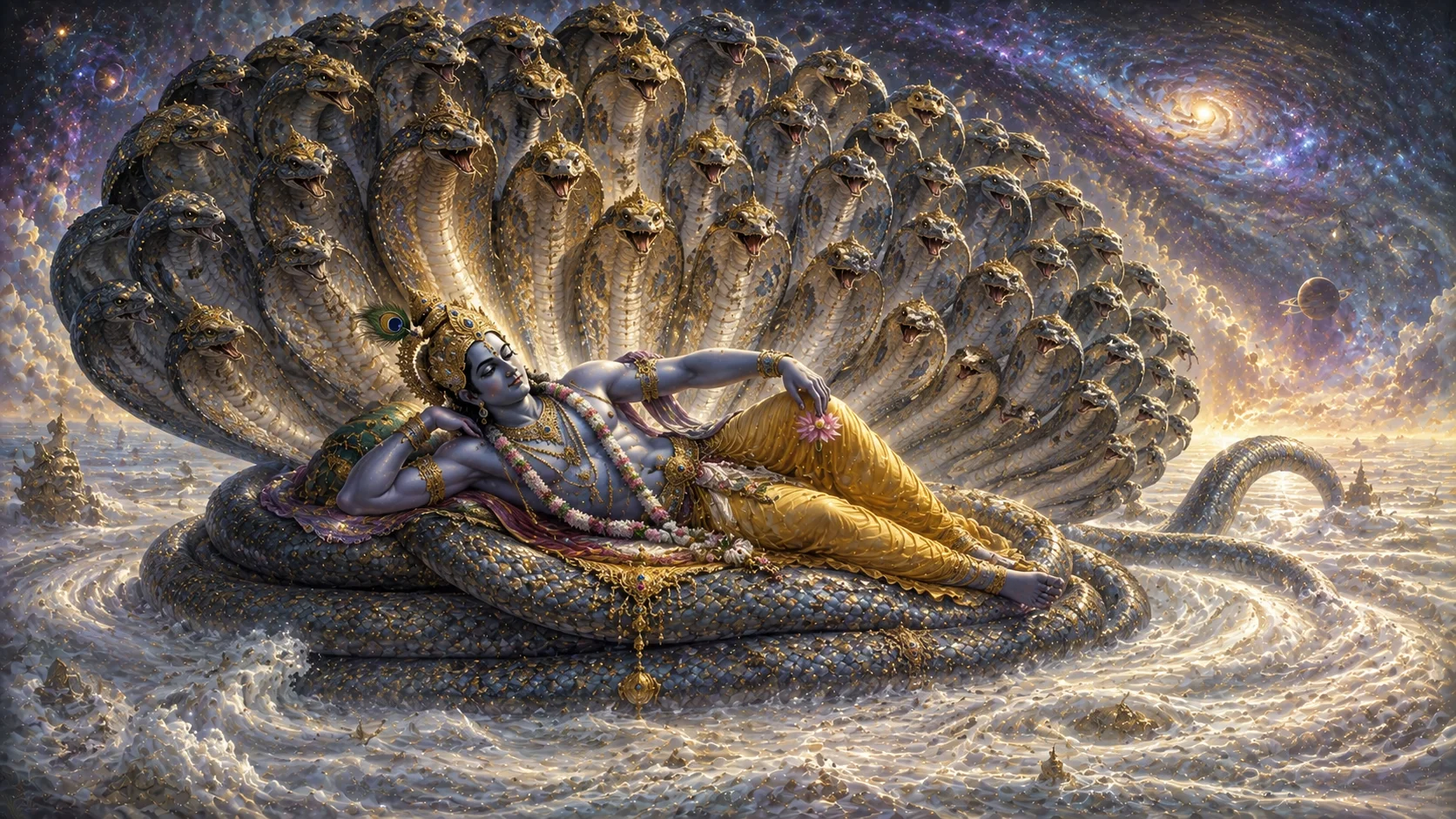
Shesha's most famous and iconic role is as the cosmic couch of Vishnu. Between the ages of the universe — in the period of cosmic dissolution and rest before the next creation — the great god Vishnu reclines in yogic cosmic sleep upon the vast, coiled body of Shesha, who floats upon the cosmic ocean of milk, his many hoods spread above Vishnu like a great canopy. This image — Vishnu reclining serenely upon the endless serpent Shesha on the cosmic ocean, with the lotus growing from his navel from which Brahma is born — is one of the most beloved and profound images of Hindu cosmology, the preserver-god at rest upon the infinite serpent between the cycles of creation. Shesha is thus the resting-place and support of the supreme god in the cosmic interval.
The Supporter of the Universe
Shesha is the great supporter and upholder of the universe. He bears the entire universe (and the earth) upon his hoods, supporting all the worlds upon his vast coiled body and his many heads — the infinite serpent who holds up creation. It is said that when Shesha shifts or shakes his hoods, the earth quakes; and at the end of an age, the fire of dissolution issues from his mouths to destroy the universe. He is the foundation and support of the cosmos, the endless serpent upon whom all the worlds rest. He is also said to have incarnated on earth in the forms of Lakshmana (the devoted brother of Rama) and Balarama (the brother of Krishna), descending with Vishnu's avatars as their companion.
The Infinite Serpent of the Cosmos
Shesha endures as the cosmic serpent of Hindu myth — the great thousand-headed “endless” serpent, king of the Nagas, the couch of the reclining Vishnu, the supporter of the universe upon his hoods. He embodies infinity, endurance, the support and foundation of the cosmos, and the cosmic rest of the preserver-god; and he stands as the endless serpent — the infinite cosmic snake who bears the universe upon his hoods, who is the couch of Vishnu in cosmic sleep, and who remains, the “remainder,” through the dissolution and renewal of all the ages.
The thousand-headed "endless" cosmic serpent who bears the universe upon his hoods and is the couch of the reclining Vishnu — the infinite snake who remains through the dissolution and renewal of every age.
Before He Was a Bed for God, He Was Somebody's Son
The serpent who holds up the world begins his story inside a family argument. In the Mahābhārata's opening book, Shesha is the eldest of the thousand sons born to the sage Kashyapa and his wife Kadru — the mother of every serpent that has ever coiled in a temple courtyard or under a stone. Kadru's co-wife, Vinata, bore only two sons, one of them Garuda, the eagle who would become the snakes' hereditary enemy. The two women wagered on the colour of the tail of Uchchaiḥśravas, the white horse thrown up by the churning of the ocean: Vinata said the tail was white, Kadru said it was black, and the loser would become the winner's slave.
Kadru cheated. She ordered her sons to cling to the horse's tail in their thousands so that it would appear black from a distance. Some obeyed; some refused, and their mother cursed them to burn one day in the snake-sacrifice of King Janamejaya — a curse the epic then spends whole chapters working out. Vinata lost, and served. It is a squalid, human, wholly recognisable episode, and it matters because of what the eldest brother did next.
The Serpent Who Walked Away
Shesha did not join the deception and could not bear to watch it. Sickened by his brothers' cruelty toward Vinata and by the malice running through his own house, he simply left. He went to Gandhamādana, to Badarī, to Gokarṇa and Puṣkara and the foot of the Himalaya, and there he undertook austerities so severe that he wore his own body down to skin and sinew — living on air, standing motionless, silent, for ages.
It is Brahma who eventually interrupts him, alarmed at what the serpent is doing to himself, and asks what he wants. Shesha does not ask for power, or heads, or an eternity of glory. He asks only that his mind should remain fixed in virtue and self-control, and that he never again have to live among his brothers. Brahma grants it — and then makes a request of his own. The earth, he says, is unsteady; she reels with her mountains and forests and seas. Go beneath her, and hold her still.
So the serpent passed through a fissure to the underside of the world and took the whole trembling weight of it on his hoods, and Brahma sent Garuda — the enemy of every other snake alive — to be his friend and helper. This is the detail the iconography never shows and the one that gives the figure his moral weight. Shesha does not carry the cosmos because he is strong. He carries it because he was the one member of his family who refused to lie, and a job of infinite patience was given to the only creature who had proved he had any.
Shesha Is Not Vasuki
Popular retelling constantly blurs the two great serpents, so it is worth separating them cleanly. Vasuki is Shesha's younger brother and the naga who served as the churning-rope in the samudra manthana, wound around Mount Mandara while the gods hauled at his tail and the demons at his head, until smoke and flame poured from his mouths — a story of endurance under active torment. Vasuki is also the snake commonly named as the one coiled at Shiva's throat. Shesha's endurance is of a different order entirely: not one agonising afternoon of being dragged back and forth, but a stillness maintained through the entire life of a universe. Vasuki is used. Shesha simply is, at the bottom of everything — the Bhāgavata Purāṇa places him thirty thousand yojanas below Pātāla, the lowest of the netherworlds, under the name Sankarṣaṇa: fair-limbed, clad in blue, wearing a single earring and the Vaijayantī garland, with the kings of the serpents bowing before him in the jewelled cities of the deep.
How to Read an Anantashayana Panel
The reclining Vishnu image — Anantaśayāna, “sleeping on the endless one” — is one of the most tightly organised compositions in Indian art, and once you know its grammar you can read any example in a few seconds. The serpent's coils run horizontally as a raft; his hoods fan up behind the god's head, usually five or seven of them standing in for a thousand. Vishnu lies on his side, one arm folded beneath his head, the pose deliberately unbothered. From his navel rises the lotus with four-faced Brahma seated in it, so the panel shows you creation happening in the present tense while the creator's support is asleep. At the god's feet sits Lakshmi, pressing them.
The relief on the Gupta-period Daśāvatāra temple at Deogarh, in the Lalitpur district of Uttar Pradesh, is the classic early statement of the type, carved when the formula was still fresh. It also carries a lower register that later panels often drop: a row of small charging figures, usually identified as the demons Madhu and Kaitabha being turned back by Vishnu's weapons in personified human form — his discus and mace standing there as men while their owner sleeps. At Srirangam in Tamil Nadu, the deity Ranganatha reclines on Adishesha inside what is generally called the largest functioning temple complex in the world, and the god's sleep is the organising fact of the whole town around him. And at Padmanabhaswamy in Thiruvananthapuram, the reclining figure is so long that no single doorway can contain him: worshippers see him through three separate doors — the face and chest, then the navel-lotus with Brahma, then the feet. The city's own name is a dedication to the snake. Thiru-Ananta-puram is “the holy city of Ananta”, and several million people give the serpent his due every time they say their address.
The Hood Over the Head: A Gesture Older Than Any One Religion
The visual idea of a great serpent spreading its hoods as a canopy over a seated or sleeping holy figure is not confined to Vaishnava art, and the shared vocabulary tells you something about how South Asian religions actually developed — in conversation, not in sealed rooms.
- Mucalinda and the Lord Buddha. In the Buddhist tradition, a storm breaks over the newly awakened Lord Buddha and the naga king Mucalinda rises from his pool, wraps his coils around the seated figure seven times and holds his hood above him until the weather clears. The image is beloved across Southeast Asia, and Khmer sculptors — especially under Jayavarman VII — made it one of the defining forms of Cambodian art.
- Dharanendra and Parshvanatha. In Jain tradition, the twenty-third Tīrthaṅkara Pārśvanātha is recognised instantly by the serpent hoods above him — the naga Dharanendra and his consort Padmavati sheltering him from a storm raised by a hostile ascetic. Worshippers still tell him from the other hooded Tīrthaṅkara, Supārśvanātha, by counting hoods.
Three religions, one gesture. Protective serpents are not unique to South Asia — the coiled snake guards thresholds and healing shrines across the ancient world — but the specific image of the snake as a roof, holding its hood over someone else's stillness, is worked out here more thoroughly and more tenderly than anywhere else, and all three traditions reached for it independently of doctrine.
The Sage With the Coiled Lower Body
Shesha is believed to descend into human life more often than the two heroic births usually named. The most consequential of these, for anyone who has ever set foot in a yoga class, is Patanjali, to whom tradition attributes the Yoga Sūtras. Traditional accounts hold him to be Adishesha come down to earth, and the sculptural convention follows the belief exactly: Patanjali is shown with a human torso, palms joined or holding conch and discus, and a lower body that becomes a coiled serpent, with hoods fanned behind his head. The invocation verse chanted before practice in many lineages salutes him as the one who cleared the impurities of mind, of speech and of the body — and then, in its second half, addresses him plainly as the white, thousand-headed one.
Sri Vaishnava tradition likewise regards the great eleventh-century theologian Rāmānuja as an incarnation of Adishesha, the fourth in a line that runs Ananta, Lakshmana, Balarama, Rāmānuja. There is a logic to this that is easy to miss. If the serpent's defining act is to be the steady support beneath something greater than himself, then a commentator — someone whose entire life's work is to lie underneath a scripture and hold it up — is exactly the right shape for him.
“The Remainder” Is a Technical Term
Everyone knows the cosmological sense of the name: Śeṣa is what is left over when a universe dissolves. Far less known is that in Vishishtadvaita theology the same word is a piece of technical vocabulary with a much more intimate meaning. Śeṣa there means the accessory — the one who exists entirely for the sake of another; its pair, śeṣin, is the principal, the one for whose sake the accessory exists. The soul is śeṣa; God is śeṣin.
Read that way, the serpent under Vishnu is not scenery. He is a diagram of the relationship the tradition wants every worshipper to occupy — belonging to something, holding it up, finding your definition in what rests on you rather than in yourself. It is a startlingly unmodern idea, and it is the reason the image of a sleeping god on a serpent raft is treated as devotional instruction and not merely as decoration.
Two Human Lives, and a White Snake Leaving by the Mouth
When Vishnu takes a birth, the serpent tends to come with him, and in both famous cases he arrives as a brother whose whole personality is support.
As Lakshmana he follows Rama into fourteen years of forest exile without being asked twice, builds the huts, keeps the watches, does the arguing Rama is too dignified to do, and at the end of the Rāmāyaṇa walks into the Sarayu and lays down his body before his brother does. A much-loved later tradition — not in Valmiki, but told everywhere — explains his inexhaustible vigilance by saying his wife Urmila took his sleep upon herself for the whole exile, so that she slept fourteen years and he slept none. It is folk theology at its sharpest: the sleepless one is the serpent who exists so that someone else can rest.
As Balarama, elder brother of Krishna, he is a different creature altogether — pale-skinned, hot-tempered, fond of drink, armed with a plough and a pestle rather than a bow, and strong enough to drag the river Yamuna out of her course with the plough's blade when she will not come to him. His death is the moment the disguise drops. At Prabhasa, with the Yadava clan destroyed around him, Balarama sits down by the sea and withdraws into himself, and a great white serpent comes out of his mouth and goes down into the ocean, where the sea itself and the naga kings rise to receive him. It is one of the quietest exits in the epic and one of the most complete: the support puts down the body, and goes home.
Where People Still Meet Him
Naga veneration is not a survival or a curiosity — it is ordinary, current religion practised by very large numbers of people, and Shesha stands at the head of it as king of the serpent-folk.
On Naga Panchami, in the bright fortnight of Shravana, milk and flowers are offered at anthills and at the carved nāgakal — upright stone slabs showing entwined serpents, installed under peepal and neem trees at the edge of villages and temple tanks across South India, many of them set up by couples who vowed to raise one if they were given a child, and who came back to keep the promise. In Nepal the same festival brings printed images of the nagas up above the doorways of houses in the Kathmandu Valley, where local tradition holds that the valley itself was a serpent lake before it was drained. On Ananta Chaturdashi, in the bright fortnight of Bhadrapada, worshippers of Vishnu-as-Ananta tie on a thread of fourteen knots, usually explained as one for each of the fourteen worlds the endless one is holding up while they go about their day. And in Kashmir, high on the pilgrim road to Amarnath, there is a glacial lake called Sheshnag, which people will tell you the serpent dug himself and lives in still.
Approach any of it with respect. These are not the relics of a dead cosmology; they are Tuesday.
Why We Keep the Endless Snake
Every mythology eventually runs into the same unanswerable question — what is underneath? Put the world on elephants and you must ask what the elephants stand on. The Hindu answer is unusually honest about the problem: underneath is a thing with no end, whose name means what is left over, and there the regress stops, not because the question has been answered but because infinity has been given a body and a face and asked to lie down.
What makes Shesha strange and durable is that the infinite, here, is not an abstraction or a void. It is a person who once got fed up with his relatives. It is a creature that can get tired, that shifts its hoods and cracks the ground under our cities, and that spends the entire duration of the universe holding still so that a sleeping god is not disturbed. We have built the whole cosmos on the back of a patient older brother. Of all the things a civilisation might choose to place at the bottom of reality, that is a remarkably decent one.
Sources & traditions
- EncyclopediaWikipedia — Shesha
- TraditionHindu texts, oral tradition and village tellings (South Asia)
Myths change from area to area and from time to time. This chronicle follows the most widely told versions; tellings in other villages, regions and eras may differ.