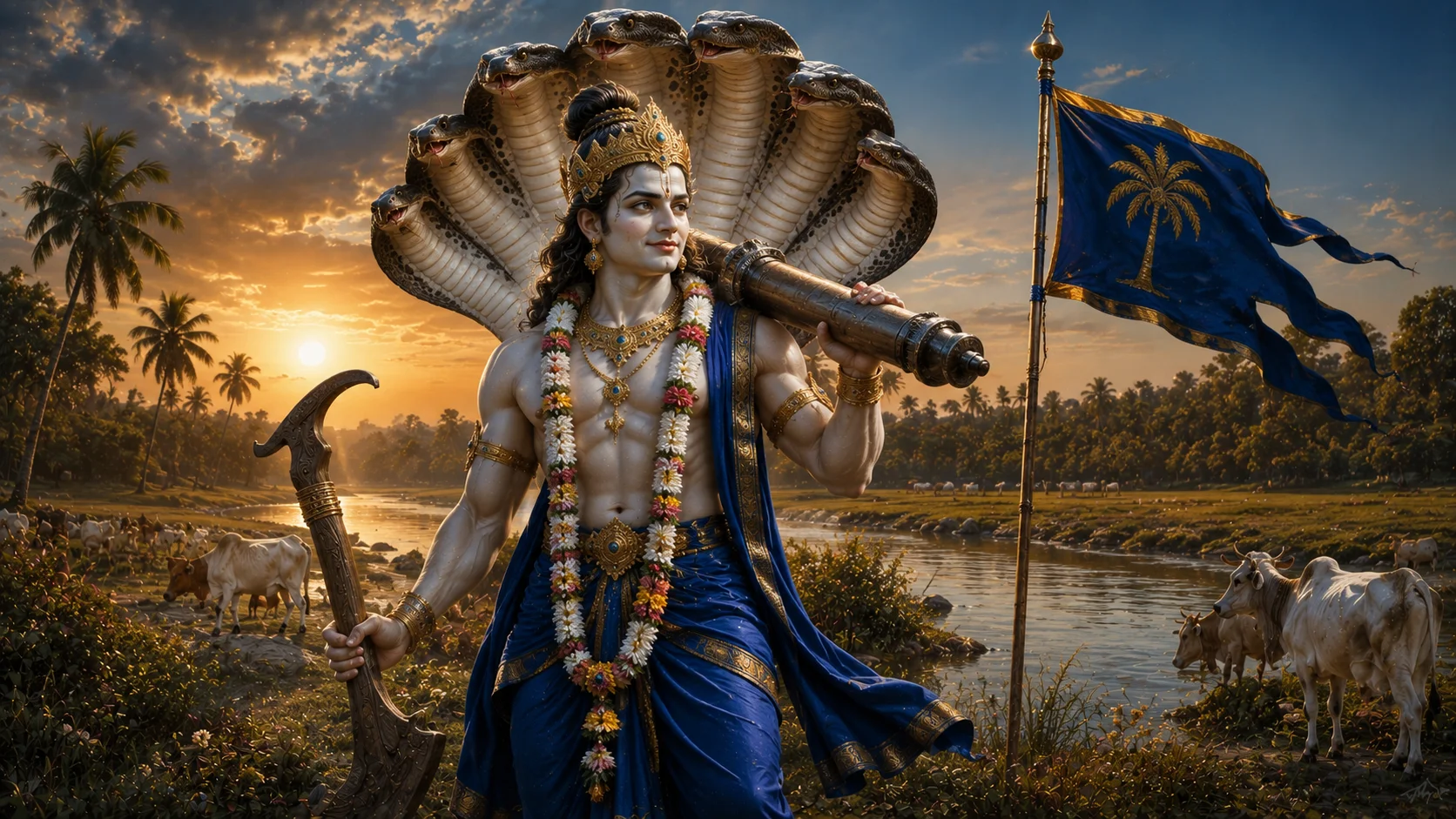
Balarama, also known as Baladeva, Halayudha ("plough-wielder"), and Sankarshana, is honored in a significant strand of Vaishnava tradition — particularly in Sri Vaishnavism and much of South Indian temple practice — as the eighth avatar of Vishnu, with Krishna as the ninth, in place of the Buddha-avatar found in other regional lists. He is Krishna's elder half-brother, a farmer-warrior of immense strength who wields a plough and a mace rather than more conventional weapons, and whose steady, sometimes short-tempered loyalty runs alongside his brother's story from their shared childhood in Vrindavan to the final destruction of their own clan at Dwaraka.
A Birth Transferred Between Wombs
According to the Bhagavata Purana and the Harivamsa, Balarama's origin is itself an act of divine intervention within the larger Krishna narrative. He was conceived, like Krishna, as a child of Devaki and Vasudeva, imprisoned by the tyrant Kamsa who intended to kill every child born to them in fulfillment of a prophecy against his own life. To protect this child before Krishna's own birth, the goddess Yogamaya, at Vishnu's direction, transferred the embryo from Devaki's womb to that of Rohini, another of Vasudeva's wives who was living safely in the cowherd settlement of Gokul at the time, out of Kamsa's reach. Balarama was thus born to Rohini rather than Devaki, and this transference is reflected in one of his names, Sankarshana, drawn from a root meaning "to draw out" or "to drag across," referring directly to the manner of his conception's transfer between mothers. In theological terms shared with Krishna's own story, Balarama is closely identified with Shesha (or Ananta), the great serpent upon whom Vishnu reclines in the cosmic ocean, understood in this tradition as descending to earth alongside Krishna as his eternal companion and support.
Childhood and Youth Alongside Krishna
Raised together with Krishna in Gokul and Vrindavan by their foster parents Nanda and Yashoda, Balarama appears throughout the Bhagavata Purana's account of their shared childhood as an inseparable companion in Krishna's early exploits: joining him in confronting demons sent by Kamsa, including the slaying of the demon Dhenuka in a palm forest and participation in other episodes of protecting the cowherd community, and later accompanying Krishna to Mathura, where the two brothers together killed Kamsa and restored Ugrasena to the throne. Where Krishna's persona in these stories is frequently marked by cunning, playfulness, and subtlety, Balarama is consistently drawn as more direct, physically dominant, and quicker to open anger — a temperamental contrast the tradition maintains consistently across their shared narratives even as it affirms the deep bond of loyalty between the two brothers.
The Plough, the Mace, and Feats of Strength
Balarama's signature weapons, the plough (hala) and the pestle or mace (musala), from which his epithet Halayudha derives, mark him visually as a deity of agricultural and earthy strength rather than courtly refinement, an association reinforced by several Puranic episodes emphasizing his connection to farming, the land, and unpretentious physical labor. Among his notable feats of strength, the Puranas describe his marriage to Revati, daughter of King Raivata (Kakudmi): finding his intended bride to have grown, through a quirk of celestial time-dilation during her father's visit to Brahma's realm, far taller than any suitable human husband, Balarama is said to have used the tip of his plough to shorten her to a stature matching his own before their marriage, an episode frequently cited as characteristic of his blunt, forceful approach to problems his more subtle brother might have solved through persuasion instead.
Role in the Mahabharata and Refusal to Fight
In the Mahabharata, Balarama occupies an unusual position: trained, like his cousin-in-law rivals on both sides, in the martial arts of mace-fighting by the same teachers who instructed Bhima and Duryodhana, he found himself with close personal ties and prior teaching bonds to figures on both the Pandava and Kaurava sides of the Kurukshetra war. Rather than take up arms for either faction, Balarama chose neutrality, departing on a pilgrimage along the sacred sites of the Sarasvati river for the duration of the war itself, and returning only afterward, expressing open displeasure at the manner of Duryodhana's eventual death at Bhima's hands during their climactic mace duel, which he considered to have violated the code of fair combat between mace-fighters.
Death at Prabhasa and the End of Dwaraka
Balarama's earthly life ends, as does Krishna's, amid the self-destruction of the Yadava clan in a drunken brawl at Prabhasa that the Puranas describe as the fulfillment of a curse brought on the clan's own reckless and dissolute later conduct. According to the Bhagavata Purana, Balarama, grieving the carnage, withdrew into meditation on the seashore and departed his mortal body in the form of a great white serpent returning to the cosmic ocean — a death consistent with his identification as an incarnation of Shesha, the serpent upon whom Vishnu rests, rejoining that form rather than dying in any ordinary sense.
The Buddha-or-Balarama Question
The variation between Buddha and Balarama as the ninth or eighth avatar respectively is one of the clearest cases of genuine, long-standing sectarian disagreement within the Dashavatara tradition, not a matter of one version simply being a later corruption of the other. Some Puranic lists, including certain passages of the Bhagavata Purana, include the Buddha as an avatar whose purpose, stated with notable ambivalence, was to delude or mislead the enemies of the gods by teaching a doctrine that would draw them away from Vedic sacrificial ritual — a framing that Buddhist tradition itself does not recognize or accept, and which many modern Hindu commentators regard as reflecting an uneasy, competitive religious relationship between early Vaishnavism and Buddhism rather than genuine doctrinal alignment. Sri Vaishnavism and much of the South Indian temple tradition, by contrast, never accepted this Buddha-avatar identification at all, maintaining instead the older list, attested for instance in the Sangam-era Tamil anthology Paripatal and in later Sri Vaishnava doctrinal summaries such as the Yatindramatadipika, in which Balarama holds the eighth position and Krishna the ninth. This tension is preserved honestly here as an unresolved point of living theological difference between traditions, not flattened into a single claimed consensus.
Balarama as Patron of Agriculture and Prohibition
Beyond his role in the Krishna narrative, Balarama carries an independent association within the tradition as a patron of farming and settled agricultural life, an identity rooted directly in his plough weapon and his frequent depiction, distinct from Krishna's typically slender, youthful cowherd form, as broad-shouldered, fair-complexioned, and physically robust in a manner meant to evoke the strength of tilled land and its yield. Several regional traditions also credit him with instituting the prohibition of intoxicants within the holy city of Dwaraka, an interesting detail given that his own eventual death is set amid a clan-wide bout of exactly such intoxicated violence at Prabhasa after that prohibition had evidently lapsed — a narrative irony that some devotional commentary has noted explicitly as underscoring the fragility of even divinely instituted moral discipline once a community abandons it.
Worship and Living Tradition
Balarama is worshipped both independently and, more commonly, alongside Krishna at major Krishna temples, with a particularly prominent place in the Jagannath temple tradition of Puri, Odisha, where he is worshipped as Balabhadra alongside Jagannath (Krishna) and their sister Subhadra in one of the most widely attended temple complexes in India, especially during the annual Rath Yatra chariot festival, in which his own chariot, Taladhwaja, processes alongside those of his brother and sister through the streets of Puri before immense crowds of pilgrims. He also receives dedicated worship in Dwarka and Vrindavan-associated shrines, and Balarama Jayanti (also called Balarama Purnima or Halashashti in some regional observances) is honored by devotees in the lunar month of Bhadrapada. In the traditions that count him as the eighth avatar, Balarama's inclusion preserves an emphasis distinct from the Buddha-avatar lists: rather than looking outward to explain a rival religious movement's origins, it keeps the entire eighth-and-ninth-avatar sequence within the immediate, intimately linked story of the two brothers of Vrindavan and Dwaraka, honoring the elder brother's steadfast, if less celebrated, share in a story popular memory tends to credit to Krishna alone.
Sources & traditions
- EncyclopediaWikipedia — Balarama
- TraditionHindu texts, oral tradition and village tellings (South Asia)
Myths change from area to area and from time to time. This chronicle follows the most widely told versions; tellings in other villages, regions and eras may differ.