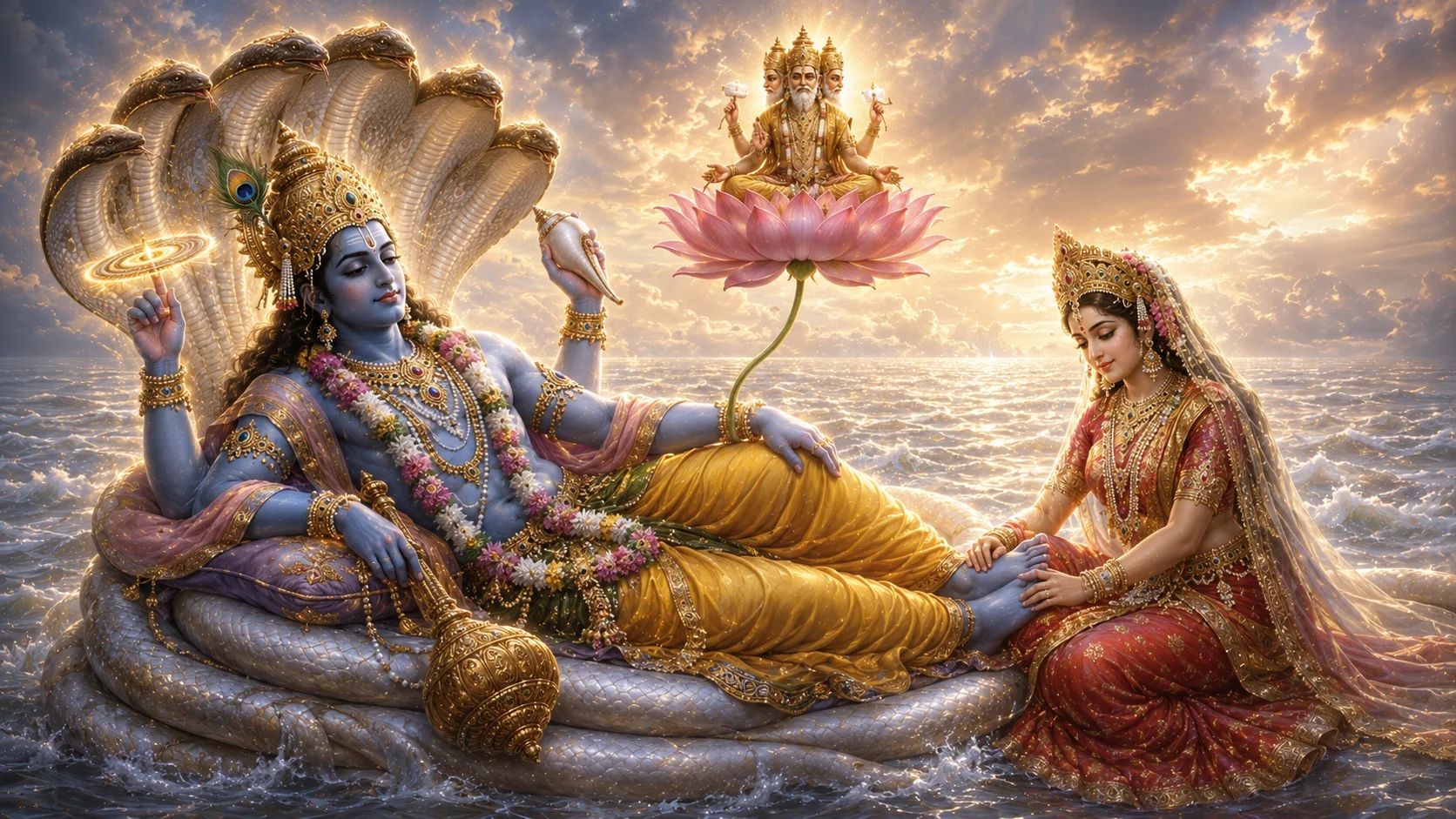
Vishnu is the preserver of the Hindu Trimurti, the deity charged with sustaining cosmic order (dharma) between the acts of Brahma's creation and Shiva's dissolution. For the hundreds of millions of Hindus who follow Vaishnavism, Vishnu is not merely one office within a triad but the supreme, all-encompassing reality from which Brahma and Shiva themselves derive. He is worshipped both in his own transcendent form, reclining upon the cosmic serpent Shesha in the ocean of milk, and through his earthly descents, the avatars, of whom Rama and Krishna are the most beloved.
The Preserver's Office
Where Brahma creates and Shiva destroys and transforms, Vishnu's defining function is protection and maintenance — he is the god who keeps the universe running according to dharma and who intervenes whenever that order is gravely threatened. His abode is Vaikuntha, described across Puranic literature as a realm beyond suffering, old age, and death, where he reclines eternally with his consort Lakshmi at his side, attended by liberated souls who have achieved moksha. In his cosmic form he rests on the thousand-hooded serpent Shesha (also called Ananta, "the endless"), which floats upon the boundless ocean of milk (Kshira Sagara) — an image of poised stability at the center of an otherwise unstable cosmos. His mount is the great eagle-man Garuda, his discus weapon is the Sudarshana Chakra, and his conch shell, Panchajanya, sounds to announce the start of righteous battle and the presence of the divine.
The Dashavatara: Ten Descents
Central to Vaishnava theology is the doctrine of avatara — that whenever adharma (unrighteousness) threatens to overwhelm the world, Vishnu descends in a form suited to the crisis at hand. The canonical list of ten principal avatars, the Dashavatara, drawn primarily from the Bhagavata Purana and other Puranic sources, begins with Matsya, the fish who saved Manu and the seed of all life from a primordial flood; Kurma, the tortoise who supported Mount Mandara on his back during the churning of the cosmic ocean; Varaha, the boar who raised the earth goddess Bhudevi from the cosmic waters on his tusks after a demon dragged her to the depths; and Narasimha, the man-lion who tore apart the tyrant Hiranyakashipu at twilight, on a threshold, and on his lap — circumventing a boon that made the demon unkillable by man or beast, by day or night, indoors or outdoors. Vamana, the dwarf, humbled the otherwise virtuous demon-king Bali by asking for only as much land as he could cover in three steps, then grew to cosmic size and spanned heaven and earth in two strides, leaving the underworld to Bali in the third out of respect for his devotion. Parashurama, the axe-wielding sage, curbed the excesses of a corrupted warrior class; Rama, hero of the Ramayana, exemplifies righteous kingship and marital devotion, and remains one of the most widely revered avatars, especially in North India; and Krishna, central figure of the Mahabharata and the Bhagavad Gita, is for many Vaishnavas not merely an avatar but the fullest, most complete manifestation of Vishnu himself. Buddha is included in several Puranic lists as a later avatar, in an attempt by Vaishnava tradition to absorb Buddhism's founder within a Hindu cosmology, while Kalki, the avatar yet to come, is prophesied to appear at the end of the current degraded age (Kali Yuga) riding a white horse to end corruption and inaugurate a new cycle of time.
Vishnu and Lakshmi
Vishnu's eternal consort is Lakshmi, goddess of prosperity and fortune, and their relationship is portrayed in Vaishnava theology as a paradigm of the union between the transcendent divine and its active, world-sustaining energy (shakti). Wherever Vishnu descends as an avatar, tradition holds that Lakshmi accompanies him in a corresponding form: as Sita alongside Rama, as Rukmini and Radha in connection with Krishna, ensuring that the preserving and prospering aspects of the divine are never separated even across incarnations.
Key Myths
Beyond the avatars, Vishnu figures centrally in the Samudra Manthan, the churning of the ocean of milk, in which he presides over the cooperative-and-competitive effort of gods and demons to extract the nectar of immortality, at one point taking the form of the tortoise Kurma to support the churning mountain, and later manifesting as the enchantress Mohini to ensure the amrita reached the gods rather than the demons. He is also central to the story of the demon Bhasmasura, who received from Shiva a boon that could turn anyone to ash at a touch and then attempted to test it on Shiva himself, only for Vishnu, again as Mohini, to trick the demon into placing his own hand on his head.
Iconography
Vishnu is typically depicted with blue or dark skin, four arms holding the conch (Panchajanya), the discus (Sudarshana Chakra), a mace (Kaumodaki), and a lotus, dressed in yellow silk (Pitambara), and marked with the auspicious Sri Vatsa curl of hair on his chest and the Kaustubha jewel. His forehead often bears the U-shaped tilaka distinctive to Vaishnava worship.
Worship Today
Vishnu and his avatars command some of the largest devotional followings and grandest temple traditions in Hinduism: the temple of Venkateswara (a form of Vishnu) at Tirupati is among the most visited religious sites in the world; Jagannath at Puri, Krishna at Guruvayur and Dwarka, and Rama at Ayodhya each draw immense annual pilgrimage. Festivals central to Vishnu worship include Janmashtami, celebrating Krishna's birth; Rama Navami, celebrating Rama's birth; and Vaikuntha Ekadashi, believed to open the doors of Vishnu's heavenly abode to devotees. Diwali itself, while most closely associated with Lakshmi, is also tied in North Indian tradition to Rama's return to Ayodhya after defeating Ravana, binding Vishnu worship to one of Hinduism's largest shared festivals.
Vishnu Sahasranama and Names of Praise
Among the most widely recited devotional texts in all of Hinduism is the Vishnu Sahasranama, "the thousand names of Vishnu," found within the Anushasana Parva of the Mahabharata, where Bhishma, on his deathbed of arrows, recites the names to Yudhishthira as a summary of the highest wisdom available to a dying man. The text catalogs a thousand epithets describing Vishnu's cosmic, ethical, and metaphysical attributes — names meaning "the one without beginning," "the refuge of all," "the imperishable," and "the ocean of compassion" among them — and its recitation remains a central devotional practice across Vaishnava households to this day, chanted at festivals, in daily worship, and at moments of illness or crisis in the belief that the names themselves carry protective and purifying power.
Vishnu in the Bhagavad Gita
Vishnu's avatar Krishna delivers the Bhagavad Gita, arguably the single most influential text in the Vishnu-centered devotional and philosophical tradition, on the battlefield of Kurukshetra at the opening of the Mahabharata's great war. There, in response to the warrior Arjuna's anguish at having to fight kinsmen and teachers arrayed on the opposing side, Krishna expounds a synthesis of duty (dharma), disciplined action without attachment to its fruits (karma yoga), devotion (bhakti yoga), and knowledge (jnana yoga), and in the Gita's eleventh chapter briefly reveals his cosmic form (Vishvarupa) — a vision of Vishnu containing the entire universe, all beings, and all of time within his body, so overwhelming that Arjuna begs him to resume his familiar, gentler form. This episode is often cited as the clearest scriptural statement of Vishnu's identity as the ultimate ground of all existence rather than merely one deity among many, and it underlies the theology by which Vaishnavas regard Krishna not as a partial avatar but as the fullest possible manifestation of the divine.
Regional and Sectarian Variation
Vaishnavism itself contains substantial internal variety: the Sri Vaishnava tradition of South India, associated with the philosopher-saint Ramanuja, emphasizes surrender (prapatti) to Vishnu-Narayana and his consort Lakshmi (venerated jointly as Sri and often addressed together in temple ritual); the Gaudiya Vaishnava tradition founded by Chaitanya Mahaprabhu in Bengal centers devotion overwhelmingly on Krishna and Radha, treating Krishna as the source from which even Vishnu's other forms emanate; and the Pushtimarg tradition founded by Vallabhacharya centers on Krishna as a child and beloved, particularly in his form as Shrinathji. Across these varied schools, the underlying conviction remains constant: that the preserving, protecting, avatar-taking Vishnu of the Trimurti is, for those who follow him, not one god among equals but the single, all-sustaining reality underlying the entire cosmos, including the very Brahma and Shiva with whom he is grouped in the popular trinity.
Sources & traditions
- EncyclopediaWikipedia — Vishnu
- TraditionHindu texts, oral tradition and village tellings (South Asia)
Myths change from area to area and from time to time. This chronicle follows the most widely told versions; tellings in other villages, regions and eras may differ.